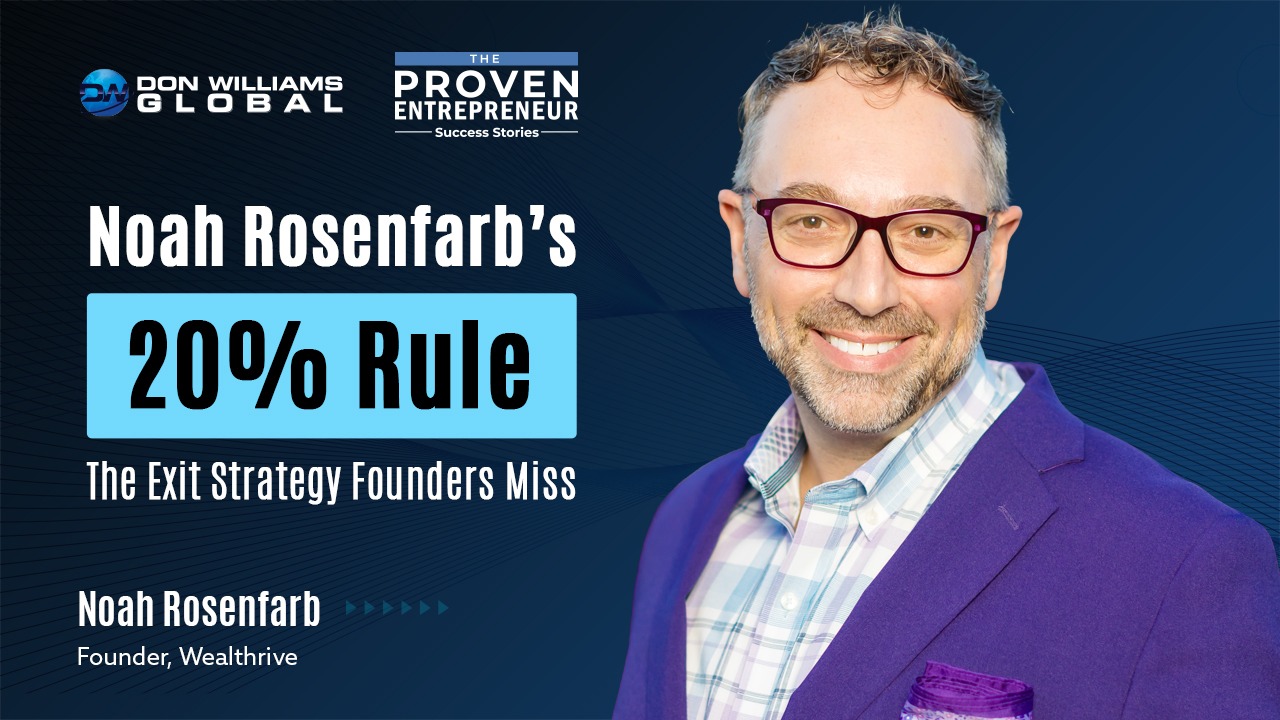
Many founders build impressive revenue but silently fear they are not building real wealth. Noah Rosenfarb’s story offers a clear look at why that happens and what to do next.
Every entrepreneur reaches a point where revenue alone stops feeling like progress. In this conversation, Noah Rosenfarb explains why so many high earning founders are left surprised at tax time and why traditional accounting advice often fails to protect them. He shares how WealthThrive began after years of watching seven and eight figure earners operate without any real tax plan and lose money they could have kept with simple, consistent planning.
One of Noah’s most practical insights is his 20 percent rule. If you want a certain income after selling your business, build at least 20 percent of that income before your exit. This helps founders understand investing long before they leave their company and prevents the emotional crash many feel after depending on a single liquidity event. Studies of business owners show that most feel unprepared for life after selling, which makes Noah’s advice even more valuable.
Noah also explains how freedom grows when a founder builds a team capable of leading without constant oversight. He spent a year traveling with his wife and daughter while his company continued to operate smoothly, a result of trust and clear roles rather than constant supervision. His experience reflects a common pattern. Many entrepreneurs stay overwhelmed not because their work is too large but because they never allow others to take ownership.
Toward the end of the conversation, Noah shares how one unexpected purchase changed his relationship with money. Buying a large boat forced him to examine the tension between saving well and allowing himself to enjoy what he built. It taught him to thank his younger self for disciplined decisions and give his present self permission to live a fuller life. His perspective on legacy and storytelling rounds out the discussion, reminding listeners that wealth is both financial and personal.
For information on how to work with Don visit us at https://donwilliamsglobal.com
You can also reach out to Don Williams at https://provenentrepreneurshow.com
Watch the episode here
How Noah Rosenfarb Helps Founders Build Wealth That Lasts
Hey, Don Williams here with today’s episode of The Proven Entrepreneur Show. What a great guest. And he kind of bent over backwards to attend today’s even though he lives in South Florida for a while, he’s living in Europe. And so I think he’s coming in from Paris today. So Noah Rosenfarb, welcome to the show.
Thanks for having me. Looking forward to getting the conversation in with you.
thrilled that you joined us today. And so before we get in, before we get into it, tell us the name of your company, who you serve, why you do that. Tell us all that good stuff and be generous to yourself.
Gladly. The company is Wealth Thrive. So it’s the combination of Wealth, W-E-A-L-T-H and Thrive. But we just put them together, only one TH, W-E-A-L-T-H-R-I-V-E, wealththrive.com. And what we do is we help very successful entrepreneurs develop their tax strategy. What we found is that so many of my peers…
have no tax strategy. They just go to their accountant and their accountant tells them how much they owe and they get shocked and they ask what they could do and the accountant says, you know, not really anything and on their way they go. so happy to share the origin story of how I got into that business. But that’s what we’ve been doing now for the last couple of years.
Yeah, so I know a little bit about the origins, but please share it with the audience if you don’t mind.
So there came a time in my life where I was what most people would call retired. I had sold an operating business back in 2014. It was a family office for divorced women. And I was living in South Florida and just spending my time investing my money in other businesses and real estate. And I started sharing with my EO peers. You know, we were both part of that entrepreneurs organization.
I just started sharing with the tax strategies that I had been using as a third generation CPA that was familiar with the power of tax strategy. And kind of one thing led to another. And all of a sudden I started speaking about how entrepreneurs should develop their tax strategies. And I was doing it just as pure goodwill. And people started asking me for help. And I was, you know, I’m not looking for a job. And finally in 2020 during COVID.
I kind of realized I’ve got all this time on my hands. I’m not doing all the things that I generally love to do. Let me invest in building a team of accountants, entrepreneurs, financial planners, and lawyers. And let me train them in the tax strategies that I’ve been using for my family and let me build a business. And so that’s what I did. And now it’s five years later and it’s been really, really incredibly rewarding.
Well, I love that and the marketer and sales guru in me, what I key on is this. had people coming up asking me to, can you help me? Can you help me? Can you help me? And if you’re an entrepreneur and you sell product A, but people keep asking you about product B, okay, take the clue. Switch to product B. There’s real market demand for that. And where many people kind of
feel uncomfortable or like they struggle with selling. And certainly in product A that may happen, but in product B that’s not happening. so, listen to the knock on the door and walk through the door. So.
If people keep knocking on your door asking for the same thing, it is usually a sign that your real business opportunity is sitting right in front of you. Share on XIt was the first time in my professional career where people really resonated with what it was that was my depth of expertise. And what kind of came about was that I’m now selling medicine instead of vitamins. Kind of in my prior careers, I was always trying to give people what I thought they needed, but they didn’t want it. And now I’ve got something that everybody wants.
Interestingly, we serve a very small segment because we’re dealing with seven-figure and eight-figure income earners, but they definitely want it and they need it.
Yeah, absolutely. And so the lesson there is this, it’s easier to sell what people want to buy than it is to sell what you want them to buy. Okay. And that’s pretty elementary, but there’s wisdom there. you no, talk, you don’t just talk about wealth. mean, you live it, you study it, you teach it. What’s the moment you realized that the traditional, I’ll just say entrepreneur’s view of wealth.
No doubt about it.
just wasn’t enough. And that lifestyle design has to be part of the equation.
there’s a lot of stories I could share. would say the earliest story was when I was working in my dad’s accounting firm and I was working, my expertise was as a expert witness in divorce court. So I would testify about how much money people made and how much their businesses were worth. And I helped settle over a thousand divorces. And in that role, had, you know, I build my time. And so it was my fifth wedding anniversary and my wife and I wanted to go on a two week vacation and my
the partner that I worked for who wasn’t my father, said, why don’t you go for a week and then come back for a couple of weeks and then you could go do the second week. And I realized then that, you know, I needed to be in business for myself. I needed to create the life that I wanted. And I started playing a game where I’d buy a lottery ticket and I’d think about all the things that would change if I won. Who would I spend more time with and who would I spend less time with and what are the things I’d start doing?
and what are the things I’d stop doing. And every time I play that game, I’d figure out that there were things I could do if I was willing to be more thoughtful on my planning and more courageous in my actions. And so that’s kind of helped me build a life that I call rich beyond money.
Love that thoughtful in my planning, courageous in my actions. That’s some gold there. So many entrepreneurs chase revenue and guys like me help them build that top line. But I think many entrepreneurs forget about turning that revenue into wealth. know, they generate a lot of dollars, but they’re not.
They’re not really generating wealth. What’s a big mindset mistake that you think high-earning founders make when it comes to keeping and enjoying their money?
On the keeping and enjoying, I’d say there’s almost two different answers because keeping it and enjoying it are sometimes at odds with one another. I find that some of that is personality driven. So there are people that are good at making money and then there are people that are good at accumulating money and not always are they the same type.
A lot of times people who are good at making money just find they just find ways to spend it. And, you know, that never seems to be enough. And then on the flip side, you have entrepreneurs that maybe they’re just slow and steady, but they’ve always been good savers. I would put myself in that category. I never earned a significant income. I just was very good at saving my money and compounding my savings. And I think the mistake most entrepreneurs make is not understanding their financial plan.
Most entrepreneurs think they’ll sell their business one day and everything will fall into place. It rarely works that way unless they understand their financial plan long before the exit. Share on XSo a lot of the entrepreneurs that I meet, their plan is one day I’ll sell my business and then I’ll retire. And that plan unfortunately doesn’t always create an outcome that leads to more happiness in their life. So the tip that I have is before you think about listing your company for sale, find ways to generate 20 % of the monthly income that you want before you sell. And so typically that’s gonna be by testing
the types of investments you’re going to want to make after you sell your business. That might be investing in other privately held companies and startups. It might be investing in real estate. It might be investing in the stock market. It might be investing in bonds, you know, and being a kind of no risk investor. But how every, you know, if you want 40 grand a month of income in retirement, well, how are you going to get eight grand a month now? And what that will allow you to do is build the muscle.
of becoming an investor that’s focused on generating income.
Love that build, that muscle. So, you you’ve built and exited companies, advised families and recently separated families and live globally. If a founder said, Hey, I want to reduce stress and increase my freedom in the next 12 months, where’s a good place you’d tell them to start.
Freedom always comes back to your team. If the business only works when you’re sitting in the chair, you don’t have freedom yet. Share on Xtheir team. It always has to do with your team. Who’s surrounding you and are they supporting you in your goals and objectives, not just inside the company, but outside the company. know, Don, you mentioned at the front end that I’m zooming in from Paris. I’m spending a year traveling with my wife and daughter. And this wouldn’t be possible if I didn’t have a team around me that
was supportive of that goal. They recognized that, you know, I don’t need this business exists because I’m here to serve people. But if the business doesn’t also serve me, I’m not going to be in it. And so they all kind of understand what their role is in ensuring that they can serve our clients, that they can be the ones that carry the laboring ore and that I’m here to support them, to help them grow, to…
you know, bring in new ideas and fresh ideas and kind of be at my highest and best use. And I think too often what I find is that entrepreneurs don’t have the right visionary integrator pairing, the rocket fuel that you know, Wickman talked about. And so many of the entrepreneurs are stuck in kind of Michael Gerber’s E-Myth where they’re so good at doing the work that they customers expect that they never get out of their own way.
to let other people rise up and take some of the burden off their plate.
I love that. And I can tell you my own journey, I don’t know, it 10 years ago. was the first time I took an extended trip and it was the two week trip. Okay. And I’ve done eight week trips. I’ve done the year trip yet. At the year trip, I’m not coming back. I don’t think, but at the two week trip and the interesting thing I learned was this. Did my team run things perfectly? No.
Did, when I was in the captain’s chair, did I run things perfectly? No. And so I do know this, if you want other people to lead, you have to actually get your rear out of the seat and let somebody sit down and try the controls. And so many entrepreneurs just hyperventilate over that thought. But remember, will they do it perfectly? Probably not. Are you doing it perfectly?
I’m just guessing, probably not. And so it’ll just be a little different imperfect.
What’s a time when your philosophy on money, and you’ve been a CPA, and I think your father was a CPA, and I think your grandfather was a CPA.
and my grandfather, and my father-in-law as well. It’s all around me. Yeah, a Jewish accountant, imagine that.
Okay. Shocking. Never heard of it. Never heard of it. What’s a time when your philosophy on money completely evolved and what triggered it?
I bought a boat and that really shifted my relationship with money. And it really helped train me to be a better spender. I’ve always been a really good saver. And one of the goals I’ve had since I was a kid is I always wanted to own a boat. My wife has no interest in boating. And so I, you know, acquired this, you know, large boat.
and three bedrooms and two bathrooms and full-time captain and the bills were just coming in left and right. And it was so uncomfortable for me. I guess I had a taste of that when I built a home, my wife and I built our home from a clean sheet of paper. And that process also had some similar stress around money because you get bills out of nowhere, but the boat was more unnecessary. It was too.
totally purely for my pleasure and enjoyment. And I had never really incurred an expense that was really just for me, and one that was so significant. And so what it led me to do was change my perspective on so many other things like the we live in South Florida, the Miami Heat, we’re in the, you know, NBA playoffs.
I would never buy an NBA playoff ticket. Well, now all of a sudden I look at one of these invoices that I get out of left field for the boat. Yeah, so all four of us went to every round of the playoffs. And it really helped me loosen up. And it also encouraged me to develop a new mantra when I started, you know, feeling some anxiety about enjoying the success that I’ve had. And I would say, you know, Noah, this is the time to thank your younger self.
for being frugal and making all those good smart financial decisions. And now you don’t have to be so frugal anymore.
Man, thank you.
Yeah. Thank your younger self. That’s gold there. So when you think about legacy and not just money, but impact, what does that look like for Noah?
It’s really about sharing my experience. So I’ve become a writer, you know, never really thought as a kid that I’d write five books or I produced like a quarterly newsletter just about my life and what’s going on in my life. And part of the reason I started that when I turned 40 was really because my wife’s like a family historian. She takes over 4,000 images a year and puts them into carefully crafted albums for each of our kids. They each get every year.
on their birthday, an amazing album filled with basically the story that took place for that calendar year. And there was no narrative to go with it of what was enabling us to create these amazing experiences and memories. And so I wanted to capture that so that the kids could kind of go back to what was dad doing at the time that was kind of feeding this capability. And so sharing that experience, not just for the benefit of my kids,
and for the benefit of, you know, whomever is interested and the feedback that I’ve gotten, which has been incredibly positive, but also going out and being a speaker and sharing some of the experiences I’ve had and developing the framework to become rich beyond money, really sitting down and assessing what are the things that I’ve learned over time that I could share with others that may help them become rich beyond money to get the life that ultimately they want to live.
Thank you very much. Okay, last question. Finish this sentence. True wealth begins for the entrepreneur when they finally…
have financial independence, they have their ideal life, so they spend time the way they want, and they still have meaning and purpose in their life.
True wealth begins when you have financial independence, you live the life you actually want, and you still have meaning and purpose. Share on XNo, it’s been my pleasure. I think I reserve the right to recall the witness at a later date for a deeper discussion. What is the simplest way for a listener to reach out to your company?
with pleasure.
If you’re interested in reducing your taxes go to talkabouttax.com and you could fill out a form there get on a call with my team We’ll gladly introduce you to some resources that we have that would be available at no cost and then of course when you get on a call with our team will Describe to you how we might be helpful to your individual situation if you want to you know Follow me on social media kind of all the normal places that you’d expect to find someone
so you can look me up and connect with me there as well.
No, it’s been my sincere pleasure to host you today. Thank you so much for coming on the show.
Thanks for having me, Don.
That’s today’s episode of The Proven Entrepreneur Show. We’ll see you next time. Thanks.