Most leaders spend years refining strategy, yet the companies that truly succeed often win because of something far less obvious: culture.
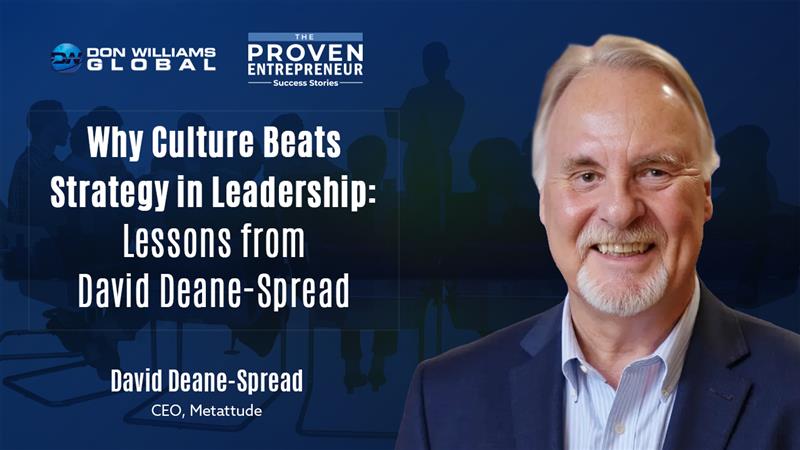
In a recent episode of The Proven Entrepreneur Show, host Don Williams speaks with David Deane-Spread, leadership coach and founder of MediTude, about the real drivers behind successful organizations. Drawing on nearly three decades of experience coaching CEOs, executives, and senior leaders, David explains why companies that build strong workplace culture often outperform those that rely only on strategy. When employees feel respected, heard, and supported, they deliver better service and stronger results for customers.
The conversation also explores how modern business leadership requires openness, listening, and collaboration. David highlights the importance of psychological safety in teams, where employees can respectfully challenge leaders and contribute ideas. He also shares a practical leadership approach built around observing, listening, asking questions, and speaking less. These simple habits help leaders build stronger teams, encourage accountability, and create high-performing organizations.
For information on how to work with Don visit us at https://donwilliamsglobal.com
You can also reach out to Don Williams at https://provenentrepreneurshow.com
Watch the episode here
Why Culture Beats Strategy in Leadership: Lessons from David Deane-Spread
Hey, Don Williams here with today’s episode of The Proven Entrepreneur Show. I have a long distance super guest to share with you today. have David Deanspred from MediTude all the way from Perth, Western Australia. David, welcome to the show.
Thank you, Donna. It’s a real pleasure to be here.
Yeah. So, we’re thrilled to have you and we could tell by your accent that you were not from West Texas and, a little further West than that. So David, tell us what, you do. Your company is Metatude. Tell us what your company does, who you do that with, why you do it. You know, tell us your, your business story.
Hahaha.
Sure, the business story is that for the last coming up 27 years, I’ve been coaching and helping senior leaders, CEOs, board members, and senior executives to transform their business from being struggling or starting or sailing the business or wanting to sell the business to becoming the employer and provider of choice in their space.
And I can’t think of a better objective for any business to want to have anything other than that goal, those goals. To be the best employer and then leverage that to be the best provider. It underpins the value of the business.
I love that.
Yeah. think, you know, culture beats strategy, pardon me, every time. and so the, being the best employer doesn’t necessarily mean paying the most, doesn’t necessarily mean being the nicest. It means being the most open and honest and opportunities and, you know, treating people the way you’d want to be treated.
Being the best employer isn’t about paying the most — it’s about being open, honest, and treating people the way you’d want to be treated. Share on XYeah.
And most people are looking for fair above all else. You know, there’s a saying, what’s that old saying? Good help is hard to find. And I think that’s very true. But in my 30 some years as an employer, I would also tell you that good companies to work for are hard to find too. And so, you you want to be that good company.
Yeah.
because it makes it really easy to get good help. Yeah.
and to keep it and to it to attract and keep the talent. And I actually
think that I think that you said that culture beats strategy. I actually think culture is strategy. Not the whole of it, but it’s a big part of it.
Culture beats strategy, but I believe culture is strategy — not all of it, but a big part of it. Share on X⁓ think, I,
yeah, I, totally, I totally agree. know, Herb Kelleher, who was the founder and CEO of Southwest Airlines, he was kind of the first guy to say the customer isn’t always right. And in reality, we know the customer isn’t always right. Now they are always paying the bills and we should always treat them with that importance, but face it, they’re not always right.
Herb said, I will take care of my people and my people in turn will take care of my customers. And so, you know, they were a fun, fun place to work. know, HR wasn’t called HR. It was the people department. You know, Herb was a little crazy. He would ride his motorcycle in the airport terminal and, you know, but they were, they had fun at work and hey, that’s a
Exactly. And the experience… Go ahead.
big piece of a great culture is having fun while you’re doing it.
Absolutely, absolutely. And look, you know, there’s no doubt about it, that the way the leadership treats their employees is the way the employee treats the customer.
How leadership treats employees is exactly how employees will treat the customer. Share on XI buy that. So let’s talk about mindset a little bit. Tell me about a moment in your life when either mindset failed you or failed a client. And what did you change that altered that afterward?
Look, the one that I’m using a lot now at the moment is the equality and the equal importance of leadership versus followership. They are both equally important. If you ask a follower what they want from a leader, and you listen to what they say, and then you ask a leader what you want from a follower,
tell me more.
then you discover there’s a lot of similarity if they’re mature, if they’re developed. And the reality is we want a follower to have the psychological safety and the confidence to be able to respectfully and effectively challenge a leader. Leader’s not always right. Leader doesn’t know everything. And the leader has a particular point of view and it’s quite different.
sometimes to the follower who’s on the front line, who mostly is the party making the money. They’re the one delivering the service and the leaders are back a bit looking at other things as well. And so they need to work together. They’re two sides of the same coin, equally important. And once the followers know that the leader gets that and appreciates that and is then more listening,
and is more inclusive. The accountability always remains with the leader, but the responsibility and the authority lies with the empowered follower, team member. And I come from a military and a special forces and intelligence and a law enforcement background. And we had our teams and as I led those teams, I knew and I expected my people to challenge me.
Leadership and followership are equally important — leaders aren’t always right, and followers must feel safe to challenge them. Share on XI love that.
if what I was doing wasn’t up to standard or wasn’t taking us down the path that we’d agreed on. And if they didn’t challenge me, then I’d question them and say, why aren’t you challenging me? What am I doing that’s stopping you from challenging me? Or what do you need to be more comfortable challenging me?
Yeah.
I think the military provides some of the finest leadership training available in the world. And one thing I learned from a group of fighter pilots that I was working with was this, you know, they prep and they plan, you know, the mission there, and then they go do the mission.
And then they debrief on the mission. What do we do right? What do we do wrong? What, you made a decision here. Why bop to bop to bop to bop. And they spent about as much time in the debrief part as they did in the prep and the execution part put together. And, and that’s how they were able to continue to.
Absolutely.
⁓ perform at a very, very high level. And another group, which was multi-branch spec ops people here in the States. And we were doing close quarter, what are they called? CQB, know, clearing simulated guns, simulated ammunition. was interesting that the kind of the concept of what I’ll call
fluid leadership. So you might be the team lead. Okay, you might be the team leader, but at a certain point in the mission, maybe the leadership role rolls to another team member. And, you know, either you’re injured or, or there’s just something that requires this person to step up. And it was interesting.
Correct.
Well, that person’s
got better vision or might be closer to the action and they’ve got a better view of what’s going on and they can call it.
Yeah. Or they had the special skill, you know, above and beyond. And so it was interesting to me and to watch these pros. I mean, I got to play along and that was fascinating, but to watch these pros do it, you know, they kind of passed the mantle of leadership, really without speaking.
Yep. Yep.
You know, they just, they just knew what they were doing. so unbelievable example of teamwork and, and leadership. I have real strong thoughts on, you know, I think a lot of people are in positions of leadership, but maybe you’re not leading. And to me, there’s a distinction between someone who has a leader and someone who’s in a position of leadership. They may not be the same thing. And a leader.
Yeah, was automatic.
Yep.
has to have at least one follower, least if they stop and turn around, there has to be at least one person that of their own will is following them. And by definition, a leader has to be going somewhere. You can’t be stagnant and be a leader. If you’re not going somewhere, you can’t lead.
A leader must have at least one follower, and by definition a leader must be going somewhere — you can’t be stagnant and still lead. Share on XThey have to lead. have to lead. Now, leadership is
a verb.
It is a verb. love that.
You know,
it’s definitely that. And the other side of that is the, in commerce, they do not spend enough time training.
No, no.
because you have to train
to do that. mean, when we went, before we ever executed an operation, we rehearsed. We’d even build a model of the premises and we’d do the timing, we’d do the practice, we’d get it right, we’d use a stopwatch if necessary. Because we had an infill and an ex-fill, we had time deadlines, and we had to also realize that we weren’t really in control. We’re not in control.
Yeah. Just like in business,
we’re not really in control. Yeah.
We’re not really in
control, you know, it’s a myth. But the only thing we can control is ourself, our own thoughts, our own feelings, our own words and our own actions. And the outcome is not dependent entirely upon that because there are other inputs. And we’re to be alert to that and flexible enough to adapt.
The only things we truly control are our own thoughts, feelings, words, and actions — outcomes are influenced by many other inputs. Share on XAnd I think that once a leader realizes that what they’re thinking are just thoughts, then they may or may not be accurate. Somebody else’s thought may be… We all kind of have the default position that, hey, I’m right and everybody else is wrong, but the reality is we don’t…
At speed.
Yeah.
have the corner on human knowledge and, and probably statistically we’re wrong far more than we’re right. And so you’ve got to be open-minded to, to hear other opinions, other viewpoints from other people. know when I was an early leader, I kept trying to hire people that looked, walked, act and talked like me. And one, that was hard. And two, it wasn’t a great team. It didn’t build a great team.
Today, I’m constantly looking for people who have skills, ideas, perspectives that are different from everybody else on the team. Okay. Because that’s how we’re actually the strongest. And then I’m a big believer in, what I would call transformational leadership, where I really think a business leader only has a couple of jobs. One cast and communicate the mission.
Yeah.
the, whatever the vision is for the company and, and say it so much that people laugh at you. Okay. And when they laugh, just keep telling them, okay, this is the vision. This is the mission. This is the vision, this is the mission. And, and then job two is probably just go get the best people on the planet to help make that reality. And then job three is give them what they need to help them get the job done. Um, because if.
Yeah.
If we have to do everything ourselves, you know, our output is pretty small. But if other people… Go ahead.
That’s correct, absolutely.
We have to be inclusive. We have to listen and then we have to, in fact, I use the an expression called OLAAT, O-L-A-R-T, observe, listen, ask, rarely tell.
Observe, listen, ask, and rarely tell — that’s how leaders become inclusive and effective. Share on XI love that. I love that. A lot of the work I do and…
And if we can come up from the…
Go ahead.
lot of the work I do in selling is, you know, question sell.
People don’t like to be told. ⁓ Questions sell. People want to give you their opinion. And when you provide an environment where they’re encouraged to do that, they will, and they will come up with some phenomenal ideas. Yeah. Yeah. So tell me this.
Curiosity and Discovery.
Yeah absolutely without a shadow of it out. Give them a chance.
Like what’s the most common leadership fail you see from incoming clients?
the inability to have a necessary and confronting conversation.
The most common leadership failure is the inability to have a necessary, confronting conversation. Share on XHmm.
It is the big one. And you know, it’s commonly called a difficult conversation. And I’ve actually reframed that as a necessary conversation. And there are many classes of those. It’s about dealing with unacceptable behavior and unacceptable performance, mainly. How do we do that and keep trust and respect on the one hand, and on the other hand, necessary conversations to discover what’s really going on.
I love that. think communication is a foundational skills leadership and anybody can have the happy conversations, but great leaders can. What Zig Ziglar used to say, can you step on their toes without ruining their shoeshine? And you know, to give people some room to accept feedback and the simple way to do that,
Yeah.
that I share with my clients is this, is if you’re open to feedback, they’ll be open to feedback.
Absolutely. We model the way.
Yeah.
Yeah, you have to lead. You have to lead. If you’re open, they’ll be open. And it’s kind of amazing what a team, what a high functioning team can accomplish as opposed to a bunch of people that are pulling in different directions.
You have to be the example.
Yeah, yeah, absolutely.
100 % alignment.
So
alignment. David, if somebody wanted to reach out to you for leadership improvement, leadership training, what would be the easiest way for them to get ahold of you?
Go to my website, metattude.com. Everything’s there. Yeah.
Spell that for us, sure we get it right.
mic echo tango, alpha tango tango uniform delta echo.
Okay. Metattude.com. Yeah. Love that. David, it’s been a real pleasure to have you on the show today. Thank you so much.
Metitude. Yep.
It’s a real pleasure being here. Thank you very much, Don.
You bet. And that’s today’s episode of The Proven Entrepreneur Show with David from Perth, Western Australia. See you next time. Bye.