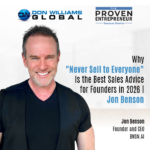
Overview: This blog covers the story of Jon Benson, founder of bnsn.ai and the man credited with inventing the video sales letter back in 2006. It walks through his personal health crisis, his approach to ethical persuasion, and the value driven marketing philosophy that helped him and his clients generate hundreds of millions of dollars in sales. It is built for entrepreneurs, founders, copywriters, marketers, and small business owners who want to understand how honest, values based selling outperforms hype driven marketing, based on his conversation with Don Williams on The Proven Entrepreneur Show.
He was 280 pounds, battling fourteen different illnesses, and just thirty eight years old when his heart nearly gave out for good. Nobody in that hospital room could have predicted that this same man would go on to become one of the most influential names in copywriting and persuasion marketing. Jon Benson, founder of bnsn.ai, turned that painful chapter of his life into the foundation of a career built on honesty, connection, and value driven marketing.
On The Proven Entrepreneur Show, host Don Williams sat down with Jon to unpack what it really takes to influence people at scale without crossing into manipulation. Jon explained the difference between coercion and genuine persuasion, and why brutal honesty in sales copy often outperforms polished hype. He shared how small business owners can attract more ideal buyers simply by refusing to sell to everyone, a strategy he has used to help clients scale into the hundreds of millions.
Their conversation also touched on failure, fear, and comfort zones, three themes every entrepreneur, founder, and business leader wrestles with at some point. Jon revealed why he intentionally makes his own life uncomfortable, from brutal workouts to launching a new business every major birthday, and how that mindset shaped his approach to copywriting, sales psychology, and long term business growth.
For information on how to work with Don visit us at https://donwilliamsglobal.com
You can also reach out to Don Williams at https://provenentrepreneurshow.com
Watch the episode here
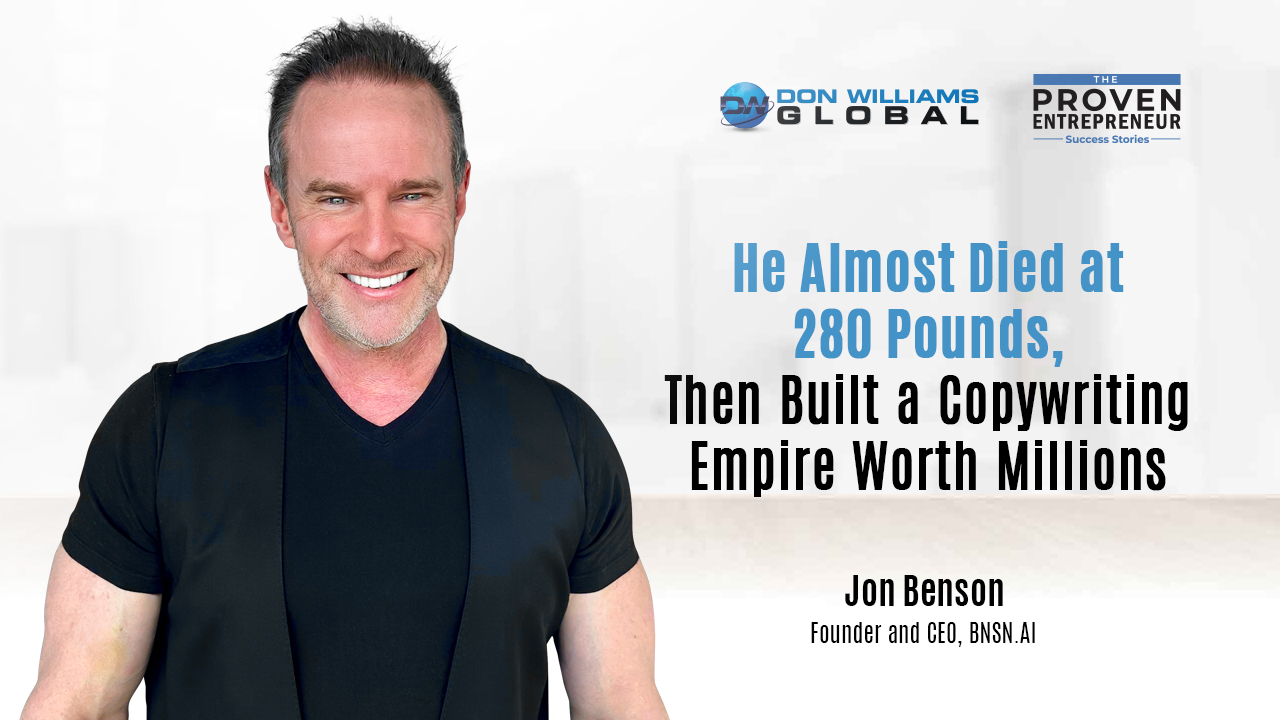
He Almost Died at 280 Pounds, Then Built a Copywriting Empire Worth Millions | Jon Benson
Hey, today’s guest is literally one of the most influential minds in modern persuasion. He’s the man behind billions with a B in sales through video sales letters and behavioral driven marketing. Jon Benson. John, I’ve been looking forward to this conversation. Welcome to the show.
Thank you, Don. It’s great to be here. Looking forward to it myself.
We’re thrilled to have you. before we put you in the hot seat and ask you 52
Thank
questions in 41 minutes, no, I’m kidding. Before we do all that, tell us, name your company, what you do, who you serve.
Sure, so my main company right now is Benson, my last name, but it’s just without the vowels, so it’s bnsn.ai. And we are an internet marketing company specific to copywriting and sales language. And I was the one of first people to do that in the AI space starting back in 2010 with teaching machine learning how to decipher.
Copywriting which is a very specific form of language is a lot harder than than just writing is for example and then and then it started going all the way through 2018 2019 start working with large language models before anyone knew what it all and was and So we’ve been really at this for a long time and that’s our main focus is to help good people sell good things with really awesome words
I love that, good people, good things with good words. I like it.
Mm-hmm. Lots of good. Lots of good.
Okay, so tell me this,
Yeah.
we strip away the funnels to copy the frameworks.
Mm-hmm.
Who does a person have to become internally to consistently influence people at scale?
Well, that’s a great question. The internal part of a marketer, the reason we appeal more to business owners than we do, think, to even copywriters, even though I’m known as a copywriter, I think we have copyrighted customers, but a lot of small business owners, because they really get the resonant messages that we’re trying to convey, which is, how do I put my heart and soul into what I’m saying while still being persuasive?
How do I put my heart and soul into what I’m saying while still being persuasive? Share on XSo that’s the switch that has to happen on the inside of a small business owner. They have to start speaking to not themselves, which is what the natural knee-jerk reaction is to do, is to assume that, everyone knows as much about the company as I do, and they’re in love with the product as we are, they got, no, they don’t have a clue. Most people have no clue. They know they have a problem. And if you speak to someone like, have a solution to this problem, and I understand the pain that you’re going through,
And you’re speaking on that type of a wavelength, but using value-driven marketing, meaning that your values are echoed through the words of your copy, but they don’t take over the copy. And you see this a lot, if I can just digress just for a second, you see
Sure.
this a lot in people that are really driven by things like let’s say the spirituality space. So my former partner was very much into the spirituality space. And when she wrote everything was in this specific language and these catchphrases that
that people in the space would know, but she was only talking to people who were already sold. She wasn’t talking to people that were curious or sort of almost sold. And that’s who we wanna help our customers talk to. Let’s talk to the people who are curious about it, but they don’t know all the ins and outs, but they want to read something or hear something like in a video sales letter or in a video on YouTube or whatever, podcast maybe that resonates with them. And they go, that person is someone
I’d like to hang out with. That person gets me. That person sounds like they’ve lived a similar life or they’re wanting to help similar people and that’s the big switch that happened. When that happens in somebody’s mind, they can scale an offer to an unbelievable degree. We’ve helped people scale to hundreds of millions of dollars. So that’s one of the big secrets. And I think I will add one more thing on top of that, that people should do that in an ethical way. People have taken this teaching that I’ve done for 15 years on
How do I integrate these values and how did I become the number one guy in the VSO space? I created VSOs in 2006, but how did I become number one in the health and fitness space? And a lot of it is because I had those values just crept in. I wasn’t intentionally doing it. It’s just that I grew up and I was an athlete and then I became obese and sick and I…
I had a heart attack at 38 and almost died was care flatted out. was like 280 pounds and it was like, I was a wreck. had 14 diseases. So I’m not making that number up. So 14 different illnesses, just my body just falling apart. And so I really resonated with the target audience. And I just wrote from that, that degree of passion and hurt and injury and, and longing to be whole and connected and, and
find the love of my life and all the things that I equated with this, because if you have no health and energy, you have no desire to go find the love of your life. At least I didn’t. And so I wrote from that perspective and it really resonated with people. And later I’d started teaching people how to do that with copy.
Yeah, I love that. And we’re kind of brothers from other mothers, which I didn’t know. you know, my second book, Romance and Your Customers, all about delivering experiences where customers absolutely love your business, where they throw their money at your business. And one of the basic tenets of that is my perspective as the company and the seller is almost totally irrelevant. It’s
My perspective as the company and the seller is almost totally irrelevant. It’s all about how do they see it, how do they hear it, how do they experience it. Share on XYou’re
all about how do they see it? How do they hear it? How do they experience it?
And
when you can see things from the other person’s point of view, that’s the beginning of real influence, which isn’t making people do something, but I think it is making it easy for people to want to do what you want them to do. Because they’re gonna do what they wanna do. They’re not gonna do what I want them to do necessarily, but they are gonna do what they wanna do.
Yeah, the difference in this really resonates with me. The differences between coercion and compelling someone to do something are, is, is there’s miles of gap between those two words. And a lot of people hear copywriting and persuasion and NLP, the things that I teach. And they immediately think of coercion. They think of trying to twist somebody’s arm into buying something or manipulate them through stories and
The difference between coercion and compelling someone to do something, there’s miles of gap between those two words. Share on XWe’re very good at telling stories. We’re very good at yanking on all the emotional change, both positive and negative. But we’re doing this in a way to, at least I’m doing it in a way to really move someone from a point of confusion and noise in their mind and just simply fear of not knowing what to do next or uncertainty and moving them to the point of like, no, I’ve got to take action on this. This is absolutely critical to my being. This is who I am. In other words,
This aligns with my core values. So I don’t want to sell a weight loss product to somebody that’s an anorexic or somebody that’s already naturally great metabolism and they don’t need any of this stuff. know, like the adage says, my wife is from Siberia. So it’s like selling ice to Siberians. not, it’s probably not, while you have the skill to do that and we joke around a lot about it, that’s not what we want to do. In fact, we want to alienate those people. We want to actually say, hey, if you’re this person,
Nothing personal, but this is just not for you. And you immediately earn like brownie points in the mind of the opposite person. So I will say this constantly in marketing. will say, look, if you’re looking for this or this or this, and sometimes it’s not the obvious things like, hey, if you want a push button system that magically makes money fall out of the sky, this isn’t for you. I’ll get very granular. I’ll say, if you’re someone that’s looking to work like eight hours a week,
and you’re looking for the eight to 10 hour a week lifestyle, you’re not willing to roll up your sleeves and do a seriously good hard days work with this, this probably isn’t for you. It just isn’t. that scares people when you hear that because they think, my, well, no one’s gonna wanna actually work hard. And I’m not going all the way to the old P90X stuff where it’s like, okay, 90 minutes and you’re gonna, it’s gonna kick your butt and all this stuff.
But if that’s the case, the reason why the P90X, if I’m dating myself here a little bit, but this was the biggest fitness program in the 90s and they didn’t sell at all until they actually started telling the truth. And all they did, they didn’t know they were doing this, is I talked to the owners of the company, I met them at a Tony Robbins thing and I said, guys, all you did was this core alignment that we talk about. You’re just aligning your values, Tony Horton’s values, your company’s product with the people that are like, no, I want to work out that we’ll just…
I want to work out that’s going to challenge me. I don’t want the easy way out of it. And that’s what happened. And they became one of the first, I think, $100 million companies, if not more than that. yeah, talking, you’re speaking my language there. That’s compelling incursion.
Yeah. I’m telling you, I think we’re brothers.
know, John spoke several times about, you know, telling the truth. I’ll just share this with the audience. If you want to sell a lot of whatever you sell, just be brutally honest. Because it shocks people because they’re not really used to people being brutally honest. And so they’re attracted to that. so…
If it’s not good for them, just tell them, this is not good for you. And if it’s great
Yeah.
for them, tell them, this is great for you. Just be brutally honest. So, yeah.
I may share another adage here, Don, if I can,
because I usually don’t like to interrupt people, this one’s too similar to what we talk about. The line that people say to me when they meet me, if I’m speaking somewhere, they said, there’s two things that I remember that you said that I will never forget. One of them is there’s that their adage is this is not your fault. You know, we hear this all the time in sales editors. So I changed that to it’s not all your fault, but now it’s your responsibility.
It’s not all your fault, but now it’s your responsibility. Share on XNow that you know this, it’s your responsibility. And that was the truth. It wasn’t all their fault. You’re born with certain genetics. I was born with terrible genetics for heart conditions and stuff. people are born and they’re raised in environments that aren’t the most conducive. I was raised in a great home, but it’s like I just got lazy with my dad. So I earned it, my own laziness and my own like addiction to food, but also really bad genes. I wasn’t born with it, I couldn’t help the genes. But was my responsibility once I knew about it.
The second was much more akin to what we’re talking about here. I just think that if somebody is going to be honest, they need to be brave enough to tell the truth. You don’t need to lie and copy. And this is the second thing that people would say, is I would say, you don’t need to lie, but you do need to be brave enough to tell the truth. Because it takes a degree of bravery to do exactly what you just said, Don, to say like,
You don’t need to lie, but you do need to be brave enough to tell the truth. Share on Xthis is just not gonna work if you’re this person or you shouldn’t buy this if you’re that person. And we’re being really blunt here in saying, we’re obviously taking the idea of values to like the nth degree, but there’s a way to do that without even saying any of those things. There’s a way to do that to lace your values with the same words and phrases that other people who share those values resonate with as well. We’ve done the research on this. There’s quite a bit of data on it and we incorporate those words and values
simply saying the same, so people love it because it’s their values, so we’re not making something up. And when somebody else reads it, it’s like, wow, it’s like this was written to me. This is like a, sometimes when you get an email, it’s like it was written to one person. That’s what you wanna make somebody feel. And of course it resonates really, really well and it attracts more people to your offer that are more immediate buyers and certainly more curious buyers.
Yeah,
I agree. Great stuff. Let me ask you, was there, I mean, you’ve been in the game a long time, been to the mountain, been on the top of the mountain a long time. Was there a personal pain or an insecurity that you had to master?
that directly became a great advantage for you in persuasion.
yeah. Yeah for sure the Groping only child and to much older parents. My dad was 56 when I was born so Great family greatest generation parents. So my father fought in World War two So it’s like it’s like most people’s grandparents that are my age, right? So
Thank you for his service.
yeah, yeah, he I wish I could I think them every day until he passed but he
You know, these are, they say greatest generation. I got front row seats to this and pretty amazing, but intense amount of introspection. I just tend to be an introspective kind of guy. So that led to a lot of isolation and I had to overcome whatever I was dealing with from a business point of view and from a, that what became a fitness career point of view, was so much had to, I had to overcome just this absolute disdain for isolation, for loneliness.
for not being able to feel connected to other people. So I went out and just studied everything I could on how to connect with others and a lot of the values, the value-driven conversations and what’s led into value-driven marketing came out of that study of really having to overcome that type of innate, just total discomfort and almost just a.
phobia of it like it’s like wow I just can’t stand being alone no brothers and sisters and just as I made I made friends very reluctantly and I was like the kind of the weird kid in school because I was an athlete but I was also like into cerebral stuff so people didn’t quite know where to put you and a musician all three so you’re like what what this guy who who the hell is this guy what does he do right and so there was always that like confusion that people had to go and go through to get to get to know the person underneath and
And so that was, once I realized how to do that with myself, I realized how to do it better with my clients and how to write their stories from a position of just being really raw and authentic and, just vulnerable and vulnerable is like, can be a manipulative tactic used in, some, like I hear it in pop culture a lot, but I’m talking about actual vulnerability, actually saying, well, similar things to what I’m saying now, but saying it inside of a sales letter.
is, you know, my problem, my biggest letter was my second of all weird things. Well, no, I probably had a couple others that were bigger, but one of the biggest ones is still running today. And so that’s 20 years old. And it started off with, hey, my name is John and I’m not a naturally lean guy. That was the first words out of my mouth. And people don’t even know I wrote it, even though it’s my voice. It’s different things, not my friend’s. So I wrote it for my friend’s product.
And I said, I can write this. I know all about this. This is a truth about abs. And I know exactly what this guy feels like. And I just told a story about how I felt in junior high school where I had these little pudgy rolls and I was skinny and fat at the same time. And this kid had these abs and it’s like, know, I was like, what on earth is he doing? And, know, it was like this feeling of like when you’re that age, I’m like, I never quite lost that longing for that.
that feeling of being more like having a sense of control. And then where I got with the where I’m going, the body stuff is kind of obvious. But then I started going a little deeper. It’s like, but they went way beyond the body. went into like, how can I like use how can I get more feeling like I have more control over my life or my finances or for my relationships? I longed for not being a controlling person.
but having a sense that I would have a way to manage the situation. And I didn’t have a way to manage the Bonnie or manage this and everything else was falling out of place. And so once I figured out a way to manage something I thought was unmanageable, these other things started falling into place as well. So I just told a story and I told it hopefully more eloquently than told telling it here, but that story really resonated with people and it ended up being a huge letter. And so those kinds of things, mean,
Again, the more raw you can be, the more honest you can be. It just makes for, it makes for great copy, but it also more importantly, I think makes for great relationships with your customers.
The more raw you can be, the more honest you can be, it makes for great copy, but more importantly, it makes for great relationships with your customers. Share on XI agree, and with your spouse, and with your kids, and with your friends. And
Yeah, totally. Definitely, definitely spouse.
if it’s good for your business, it’s probably good at home. And if it’s
Yep.
good at home, it’s probably good in your business, because we’re all just people. So
yeah, yeah. Totally. Totally.
was there a moment, like a single moment, maybe a campaign, a failure, but a time when you…
saw human behavior so clearly that it kind of changed everything forever.
Hmm. I don’t think there was a moment as much as there was a series of moments when I was in my twenties. And when I saw, I started a business, I listened to, I was a huge Tony Robbins fan, am. and just got very fortunate to work with Dean Graziosi who’s Tony’s
partner and got it into that inner circle. But this wasn’t in my 20s. In my 20s, I was just a guy that went to a Tony Robbins seminar and literally started a business the next day, knowing nothing about the business I’m starting and just quit my job cold turkey. I was like, just to prove it to myself, I could do something. didn’t even know what this, I didn’t even know how to do what I started. I started a business as a graphic designer. I didn’t even know what a graphic designer did. I just thought it sounded cool. So I can’t draw.
So I’m like, okay, so why on earth would you do this? go, well, I can organize things. And that ended up being a 14 year business. But during that experience of being around people, found that, okay, I’m willing to take these radical chances. I don’t have a, I have the fear, but I’m just like, okay, I’m just gonna go through it because what’s the worst that could happen? mean, no one’s gonna come and take your life. No one’s gonna do anything like that, right?
At least more likely that’s not gonna happen. So what’s worst that can happen is you can fail and what I learned through Being around tons of people is that fear of failure? Which for whatever reason did not get downloaded into my brain probably again growing up as an athlete and doing a lot of athletic stuff and like just Getting hurt all the time. It’s like maybe that was it racing motocross and flying my bike 30 feet in the air
I was like, okay, if something happens, something happens. I was afraid I was, would have those moments of fear, but I’m going to do it anyway. And I, I don’t know. got that from my dad. And so I saw so few people had that not recklessness because I wasn’t reckless, but I just didn’t have a fear of failing. And I realized that the more I fail and the faster I failed, the faster I was able to figure out how to succeed. So failure became something that wasn’t anything to be feared at all. In fact, it was something to be.
The more I fail and the faster I fail, the faster I’m able to figure out how to succeed. Share on Xalmost cherished in the sense that you could take an experience and say, wow, that didn’t work. And like the Edison story, you know, I figured out 10,000 ways how not to build a light bulb. That’s sort of the approach that I took. And it wasn’t always, it wasn’t always easy because I went through years of failing and years of failing in the design business and years of failing in the software business. And like, and it’s been very difficult at times, but that just basically persistence.
Of you’re going to do this regardless. There’s not the failure. The failure is not an option. It’s a war of attrition. I saw that so few people had it and worse than that, not trying to rag on other people. I’m saying worse than that. That started alienating me in relationships because that started like, the women I would date and, and, and when I get close to they had this, this, that fear thing going on. And so many of relationships in my life fell apart because of just, there was a fear that was going on.
and it was way underneath, way more than the business sphere. And I realized there’s a whole lot of reasons for that. There are way deeper than what we can go into now, but I just realized that I wanna live like a fearless life, not a reckless life. And so few people really just want to even do that. And so that became like a real differentiating point between me and a lot of my friends and of course my now wife, she feels the same way, but.
That’s hard. And that was a, I don’t know that answered the question thoroughly enough, but that was a big differentiator for me. That was like, I can use this as a superpower. I can say, I’m going to go try this, go try this, go try this. And then I found out where the, the, the bad part of it is, is because you’ll try, you’ll try 10 things versus just one thing and stick to it. it’s like, it took me a while to learn how to stick to one thing.
And let
me say this about the failings is I think people have a fair failure. I think that’s human, but truthfully failing is not the opposite of success. It’s actually required for success. You must
Failing is not the opposite of success. It’s actually required for success. You must fail to be able to win. Share on XMm-hmm. Mm-hmm.
fail to be able to win. And I can tell you this, this is not, I don’t have empirical data, but 40 years working with Fortune My Better Companies.
founders, 200 podcast episodes with proven entrepreneurs. And I can anecdotally share that people who have the biggest failings, where they hurt the most, they lose a lot of money, they have a severe reversal, they also have the biggest wins. And it’s almost
The peaks are almost equal to the valleys. And so little valleys, little winds, big valleys, big winds. And I can’t prove that. I’m not a sociologist, but I can just tell you. I think that’s the truth. So there you go. Okay. We’re into the fourth turn. I can see the checkered flag out there. We’re coming into the home stretch. When you look at your mind now,
And I think to do what you do, have to be fairly self-aware, introspective. You started out introspective. I don’t think that’s probably gone away. You’ve just added to it. Are there any patterns that you catch yourself falling into that you have to consciously override?
yeah. Yeah. Big time. I would say the most, one of the most destructive patterns is becoming too comfortable. it’s, I’ve been fortunate that it just so happens to be that the hobbies and passions that I have, they push you into a state of discomfort.
I’m competitive physique athlete, for example. That is the most discomforting you can be is to stand on a stage at 5 % body fat when you’re depleted and, know, just did this in September. It’s like, and obviously it’s an extremely vulnerable state to be in, needless to say, you’re standing there in your underwear basically and you’re looking like an idiot. But the…
the discipline it takes to get there is some of the most intense that people can go through. Especially if you’re not doing things that would, shall we say, help expedite the process, that are not necessarily good for you. So I can’t do that for health reasons and don’t want to do that, but the point is that keeps me completely uncomfortable to where you’re going to bed hungry, you’re doing two hours at times of
of cardio walking, you know, 20,000 steps a day, whatever case may be. And in feeling, there’s never a sense of where you just feel like there’s like an hour or two in the day where you feel comfortable and then at night you chill with your woman or your husband or your wife or whomever you’re married to. But even in that, my brain wants to go find ways to make that comfortable.
So how can I make the dieting part of this more, and I figured out how to do this. How can I make the training part more comfortable? I figured out how to do it. And so I just, literally this week I said, I’ve made this too comfortable. I have to literally go get uncomfortable and I have a treadmill sitting here against the wall that is nowhere near as fun as the treadmill downstairs in the gym and that’s the one I’m gonna start using. Or you can cut out this food that you’ve enjoyed for the last six months because you said you could and you did make it work, but it’s.
It feels too easy now. so I always have to find ways to make myself get out of that comfort zone. It’s so easy to get into it, especially in our modern lives. And we’ve been really fortunate and stuff. But yeah, that’s it. Stay in a position of being, I like to be, I actually like to be somewhat uncomfortable. I fought martial arts. So when you get hit in the face a lot, that is uncomfortable.
I always have to find ways to make myself get out of that comfort zone. It’s so easy to get into it, especially in our modern lives. Share on XThat’s not comfortable.
That’s not comfortable. Yeah. Getting choked. You’re not comfortable. you know, I, I, know, all the things I was doing in my life, I did things that were really uncomfortable. And, um, but, but it’s so easy to sit in this chair and to do this for 12 hours a day and to just to physically get too comfortable. So you get up and move and all that stuff, but intellectually, oh my gosh. Yeah. It’s so easy to fall into those patterns. So what can you do? And so I’ve made it a point to start new businesses at every major birthday.
to say I’m gonna do something kinda crazy. I turned 50, so I’m gonna start this company. It’s like push yourself. That’s it, man, push yourself. Never to the point of saying I’m uncomfortable all time. I love to enjoy my wife and I’s favorite places, Rome. We’ll go to Rome and we’ll stay as long as we can and we’ll just have a great time. But while I’m in Rome, I am making sure I will going out of my way to, I’m gonna walk.
I’m gonna walk as far as I can, I walk for four, five, six hours a day sometimes just to burn off the carbonara and wine that we’re drinking. So I don’t, my body doesn’t adjust or my mind doesn’t adjust to being like, okay, completely in this zone of being too comfortable. So that’s my sermon on comfort. that didn’t come across too preachy, but that for me is like, that’s huge. And I do not always succeed.
Yeah, I can fall into the comfort travel really quick.
Yeah. So the audience knows my thoughts on comfort zone physics. We like our comfort zones because, you know, it’s comfortable. And so why wouldn’t we like it? But, but as we exit our comfort zone, our comfort zone expands and
Mm-hmm.
we exit again and expands and so on. And so at this point in life, I think you’re racing out of your comfort zone every day and expanding it as far as you can. And, I think that’s a good way to live life. So I, I commend you on that.
So
John, if somebody wanted to reach out to you or your company, what’s the best way to do that?
Well, I’ve got a couple of things. First of all, I want to offer if, if, your listeners are interested, if you go to a free buyer profile.com that’s free. The first word tells you everything. We will walk you through how we think of integrating values into marketing. And it’s basically, takes you about 10 or 15 minutes to go through the process, but it will give you this really, really detailed report of the words and phrases that you should consider using and not using.
in your marketing and sales copy that will help you attract more ideal buyers. People that will resonate with you, they’ll read it, they’ll go, wow, there’s something about that that just clicks for me. And that’s one of the greatest gifts we can give people. that’s free just for, that’s what we want to give people. So check that out. And that’s a great place to reach me. I’m very reachable. bensin.ai, B-N-S-N.ai is the software company. And we have…
Tons that we do, I do live coaching every Friday with our groups, because it’s just something I’m passionate about. I believe in the human element, majorly in the human element. So rather, we own an AI company and we’re doing all this human stuff because it’s like to make it actually sound good and actually work, we need the human element to it. So pretty easy to reach that way. And also YouTube is johnbitza.com, forward slash YouTube for tons of hundreds of persuasion videos and copywriting videos if you want them.
So freebuyerprofile.com, is that right?
Yeah,
we call them buyer profiles. So they’re actually technically they’re called buyer alignment profiles are basically aligning your values with the buyers that you want to attract and Really if you take one thing away from a marketing position that I’m saying here is that you should never sell to everyone This is one of the biggest things that we they want I talk to my customers and I go, okay Who’s your avatar and they go?
You should never sell to everyone. Share on XWell, anyone that’s not, when they say anyone, it’s just the wrong answer, right? So we want to get really specific and we want your buyer, we want your avatar to have a name. We want to know this person as if you were talking to your neighbor. So you’re obviously gonna alienate some people and to do that, the best way to do it is to attract the ones that you really want to attract and that’s what we hope.
Love that. John, thank you so much for coming on the show today. It’s been a treat.
My pleasure, Don. Thanks for having me.
Hey folks, that’s today’s episode of the Proven Entrepreneur Show. We’ll see you next time. Thanks, bye.