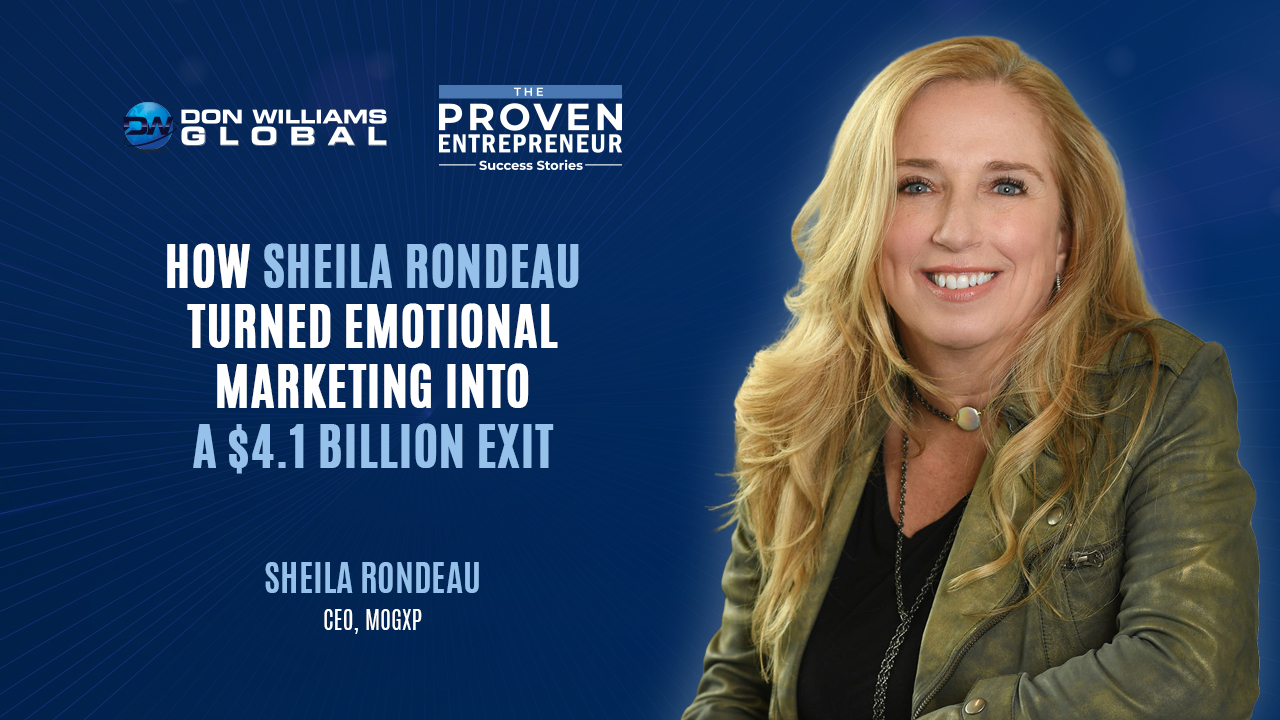
Overview: In this breakdown of the Proven Entrepreneur Show interview with Don Williams, experiential marketing expert and MOGXP founder Sheila Rondeau explains how emotional connection, customer experience, and brand loyalty outperform traditional advertising. From helping build Vitamin Water into a $4.1 billion acquisition target for Coca-Cola to rebuilding her agency after COVID wiped out her client base, Rondeau shares real strategies for customer engagement, experiential marketing, leadership culture, and small business resilience that any entrepreneur, marketer, or fractional CMO can apply today.
What if the most profitable marketing decision you ever make has nothing to do with advertising at all? Sheila Rondeau, founder and CEO of MOGXP, built a career proving that experiential marketing and genuine customer engagement create more brand loyalty than any television or email campaign ever could. Her clearest proof point is Vitamin Water, a brand she helped grow through grassroots events and flavor-driven consumer engagement until customers were demanding it in convenience stores, eventually pushing Coca-Cola to acquire the company for $4.1 billion just to control shelf space. It’s a case study in what experiential marketing and pull-based demand generation can do when brands stop pushing products and start creating real emotional connection with consumers.
Can customer loyalty really be built in a single thirty-minute conversation? For one pharmacy client serving adult seniors, Rondeau’s team proved it could, sitting down one-on-one to review prescriptions and answer questions that usually got rushed through, turning routine visits into lasting brand loyalty and repeat business. She contrasts this with younger demographics, who respond better to fast, frequent touchpoints instead of long in-person sessions, a distinction that matters for anyone building a customer experience strategy or demographic-specific marketing plan. The lesson applies far beyond healthcare marketing: the right amount of customer attention depends entirely on who you’re serving, not a one-size-fits-all playbook.
What separates a resilient entrepreneur from one who burns out? For Rondeau, it’s the willingness to fire a profitable client when the culture turns toxic, and the discipline to rebuild from zero using relationships instead of guesswork. After a costly divorce and then losing most of her business overnight when COVID shut down experiential marketing entirely, she leaned on five trusted contacts to rebuild her agency around fractional CMO consulting and digital lead generation. Her approach to leadership, client boundaries, and business resilience offers a practical framework for entrepreneurs, small business owners, and marketing consultants navigating their own moments of crisis or reinvention.
For information on how to work with Don visit us at https://donwilliamsglobal.com
You can also reach out to Don Williams at https://provenentrepreneurshow.com
Watch the episode here
Sheila Rondeau: The Entrepreneurial Journey Behind a Billion-Dollar Brand
Welcome to today’s episode of the Proven Entrepreneur Show. Today’s guest is somebody special, somebody who understands something most companies miss. And that’s this: people may forget your marketing, but they’ll never forget how you made them feel. Joining us today is Sheila Rondau. Rondau, excuse me, founder and CEO of Mog, M-O-G-XP.
Which is an experiential marketing and customer experience powerhouse, helping brands create deeper emotional connections, stronger loyalty, and unforgettable moments in a world that frankly today is drowning in noise. So she’s built a reputation for helping organizations move beyond transactions into transformation, where brands stop acting like companies and start behaving more human.
This conversation is going to challenge the way you think about leadership, customer experience, marketing, culture, and what truly creates lasting impact. Please welcome Sheila Rondo. Welcome to the show.
Thanks, Dawn.
Yeah, thanks for being here. This is a real treat for me. Before we get into questions, tell us about your company and who you serve and what you do and outcomes that you deliver.
Okay, so my company’s multifaceted. my core business has always been experiential marketing, and that is face to face marketing for really that larger brand where they want to do the surprise and delight and create consumer engagement. They want to change buying habits. But I took all those key learnings, and we had a time called COVID where
The experiential world just stopped. People stopped engaging. And so I took those key learnings and built out the consulting side of it, fractional CMO, where I work with small to medium-sized businesses, taking those things that I learned to help them grow their business, because those businesses are the ones who really need it. And then most recently, how do you in how do you take all of those key learnings?
build up a pipeline and how do you keep that pipeline warm and turn them into real leads? And so I have created a new digital side of it that allows us to to serve companies that in the past haven’t been able to afford an agency and and not by doing it cheaply, by doing it smart and doing it in ways where we can replicate processes
But create your voice.
So important to have your voice in that sea of noise. So, okay, I’m gonna ask you a couple of questions. And I know you, and I I know you’re an expert, and so that’s why I’m thrilled to have you here today. So I’m gonna try and get as much value for the audience as I can out of your brain today. So, question one: what’s something most companies or companies spend millions of dollars on in marketing?
That you think consumers emotionally just stopped caring about years ago, but companies are still investing for?
You know, companies do a ton of email marketing. And for for many of them, it still works or they wouldn’t do it. But a lot of the the things that they do as regular course of business don’t change buying habits. They spend a ton of money on email marketing. They do a ton on radio, they do a ton on TV. But when it comes down to it,
And you take those dollars and you can do an experiential marketing campaign where you meet consumers at what matters most to them and create an experience, you change buying habits and you create a loyal customer base where TV advertising just doesn’t.
Email, radio, and TV marketing rarely change buying habits, but an experiential marketing campaign that meets consumers where it matters most to them builds a genuinely loyal customer base. - Sheila Rondeau Share on XYeah, I b I buy that. So thank you. Now you build experiences for huge brands and so not just running ads but but the experience. Is there a moment where you can share where where it was obvious that the human connection it just outperforms the algorithms?
Yeah, I there are a couple of those like moments that you look back in your career and say, we we got it, we got it. So I worked with a a pharmacy that focused on adult seniors and
Being able to sit down one-on-one with seniors and go through their prescriptions and answer their questions, where so often they feel like they get rushed through the process and created that engagement. And it you have to understand that when you’re talking about different types of brands, the older the demographic, the more time you need to spend with them.
But the least frequently you need to spend it with them. Because if you become their friend, you are forever their friend and they remember that. A younger demographic wants to find you, discover you for themselves or be referred to you. And they want to have conversations that are very quick hits very often. And so being able to find those correct
Positionings. So again, the seniors spending a half an hour with them, going through their prescriptions and making them feel connected. Those people, it changed their buying habits because they became loyal customers of a particular brand with a card that showed a loyalty membership and and it changed their buying habits. In reverse, we sat down with with
a younger demographic. We made it ultra focused, where we went to the things that mattered to them. We sponsored the types of events that they wanted to and we gave them a product that they really enjoyed. And we met them where they were at grassroots. They loved it. It changed buying habits and it grew a brand out of nothing.
The older your demographic, the more time you need to invest with them, but the less often. Earn that trust once and you become their friend for life. - Sheila Rondeau Share on XLove that. Thank you. So do you think there’s a misconception or maybe even a self-delusion entrepreneurs tell themselves about customer experience?
Yes. So most customers don’t care who you are or what you do. They don’t care about your story. They care about how you fit in their life. When you think back, one of one of the programs I did many, many years ago, but it still holds true. I helped build vitamin water. And when we did that, what we did was we built customer loyalty.
Most customers don't care who you are, what you do, or your story. They only care about how you fit into their life. - Sheila Rondeau Share on XBy creating flavors and having engagements that were just quirky and fun. But we reached out to where the consumers were and created so much demand and such a connection with the consumers that the consumers went to convenience stores and asked the convenience stores to carry the product because they wanted to buy it. So much so that it was taking up shelf space from Coca-Cola.
That Coca-Cola bought vitamin water for $4.1 billion because
Wow.
they didn’t they wanted to control how much shelf space vitamin water got versus their other brands because it w we were competing with them at a level that that literally had them shaking their head.
We built so much consumer demand for Vitamin Water that customers asked convenience stores to stock it, and Coca-Cola ended up paying $4.1 billion just to control that shelf space. - Sheila Rondeau Share on XThat that’s amazing. And of course, you know, that’s kind of rounding error to Coca-Cola. But but still, it it’s a big number for for vitamin water. So love that.
Yes. And all of a sudden,
they used that model for other brands because we literally were getting the demand at the convenience stores and it was a pull model instead of a push model. Most people go to the brands, go into distribution, go into retail, and then get pushed to consumers. And this consumers were demanding it through retail models.
Real brand demand isn't pushed onto consumers through distribution, it's pulled by consumers who go looking for you themselves. - Sheila Rondeau Share on XYeah, love that. And and that’s kind of a that is a totally it’s an inverted campaign actually. and so pretty pretty s pretty amazing. I know that on for my sales clients, you know, what we share with them is this is that people are always gonna act in their best interest and they don’t really care about your best interest, they care about
themselves and and rightly so. I’m not being negative. And so the the trick is to present your product service or experience in a way that the customer can see the benefit to owning that product service or experience because they’re always going to do what’s in their best interest. And when you when you do it like that, you step out of this kind of adversarial, you know.
People always act in their own best interest, so your job is to show them the benefit of what you offer, not to fight them into buying it. - Don Williams Share on XFighting seems to be the metaphor for selling, you know, warrior this and and when you present it to where it’s in the prospect’s best interest, you really can’t keep them from buying the it would just happen automatically and it’s fun and it’s easy and and you know, everybody wins. Okay. got a long and storied and illustrious career.
Had some really big hits. I didn’t I did not say that. And and everybody,
The old experience.
everybody who knows the show knows that Don’s hair is gray. And so, you know, that’s just the way it is. So let me ask you this: Have you ever walked away from a client or a campaign or an opportunity?
Because it violated values. Might have been really profitable. Might’ve been big money even. But have you ever walked away from a client campaign or opportunity because it just didn’t fit?
Yes, yes, there is nothing more empowering for a small agency or boutique agency to fire a client. It does wonders for the organization, but I’ve also done it at big agencies. but either time that I’ve been in that scenario, it is good for the organization, it is good for the team, and it refocuses on them on the things that matter.
There is nothing more empowering for an agency, big or small, than firing a client who won't let you serve them the way you're meant to. - Sheila Rondeau Share on XAnd that is truly serving clients that we are meant to serve. It also re-reinvigorates them in a way where it reminds them that it is not about all the messaging and so on. It’s how you make people feel. And when people walk away and they have that strong connection with a brand, it is about the consumer and not about the egos.
Yeah, love that. I it one thing I share with with my clients is this. When you have that, and and they’re generally rare, you know, that you have to fire a client, but you know, it does happen. the attitude I I like my client to have is, hey, your client that you just fired are perfect. They’re perfect clients. They’re just not they’re just not your perfect client. They’re they’re somebody else’s perfect client.
For someone else. But
it also reminds everyone in the agency that when we are talking to our clients about who their customers are, it’s why we have to find the right messaging, why we find the right niche. And we don’t say that all all clients are good clients to all customers, that we don’t fit all customers because then we fit for nothing.
yeah, I I agree with that. If you s if you don’t stand for something, you stand for nothing, you know.
Some things.
It’s just the way it is. And I I think it was Herb Callaher who was kind of the first big CEO to say, hey, the customer isn’t always right. But they are always the customer. They are always paying the freight. And so let’s and let’s keep it real. But Herb’s attitude was, I don’t worry about customer service. I take care of my people. And by taking care of my people
I know they will take care of my customers and and they were, you know, kinda successful at that at Southwest Airlines. Just a little bit.
Take care of your people, and they will take care of your customers. That's the real secret behind great customer service. - Don Williams Share on XAnd and
the culture comes from the leadership. And so if the leadership supports the people, then the people take care of the customers. And I feel that way. If I have a client who is beating up on my team, first of all, I I look for constructive criticism because we can always get better. What I won’t do is allow my people to be to be pressured to do things that they know are wrong.
Or to be in an environment that’s hostile.
Yeah,
Heaven forbid, but if you lost everything tomorrow, had to rebuild from zero, what would you do in the first thirty days?
In the first 30 days is I go through and I rebuild my contacts and I do what I’ve done every time there’s been a struggle. You find five people who are true advocates, and you ask for their assistance in identifying someone who would benefit from my services. So we talked about COVID. I had gone through a very nasty divorce that had cost.
millions. I then lost millions of dollars in business overnight when COVID hit. So I basically went through that scenario and I reached out to the people who knew me the best and said, who could I best service at a time when I can’t do what I normally do?
When you have to rebuild from zero, find five people who truly believe in you and ask who they know that you could serve right now. - Sheila Rondeau Share on XI love that. And and people, there
Mm-hmm.
there’s a there’s a principle in there. It’s okay, and it’s actually a sign of strength to ask for help. And when when it’s like that, your top five contacts, they’ll rally and help you. And none of us got where we are on our own. Nobody. There was there were people who helped along the way. Okay.
I can see the checkered flag, we’re almost to the finish line. Last question Twenty years from now, when people talk about Sheila in rooms you’re not in, what do you hope they say?
That I was fair, that I was kind, and I led.
Twenty years from now, I just want people to say I was fair, I was kind, and I led. - Sheila Rondeau Share on XFair, kind and led. Wise words, people. Fair, kind and led. Sheila, thank you so much for being on the show today. It’s been my pleasure.
Thank you. Always a pleasure to spend time
That’s
with you, Don.
my pleasure. That’s today’s episode of the Proven Entrepreneur Show. We’ll see you next time. Thanks. Bye.