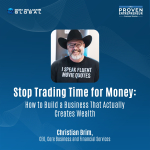
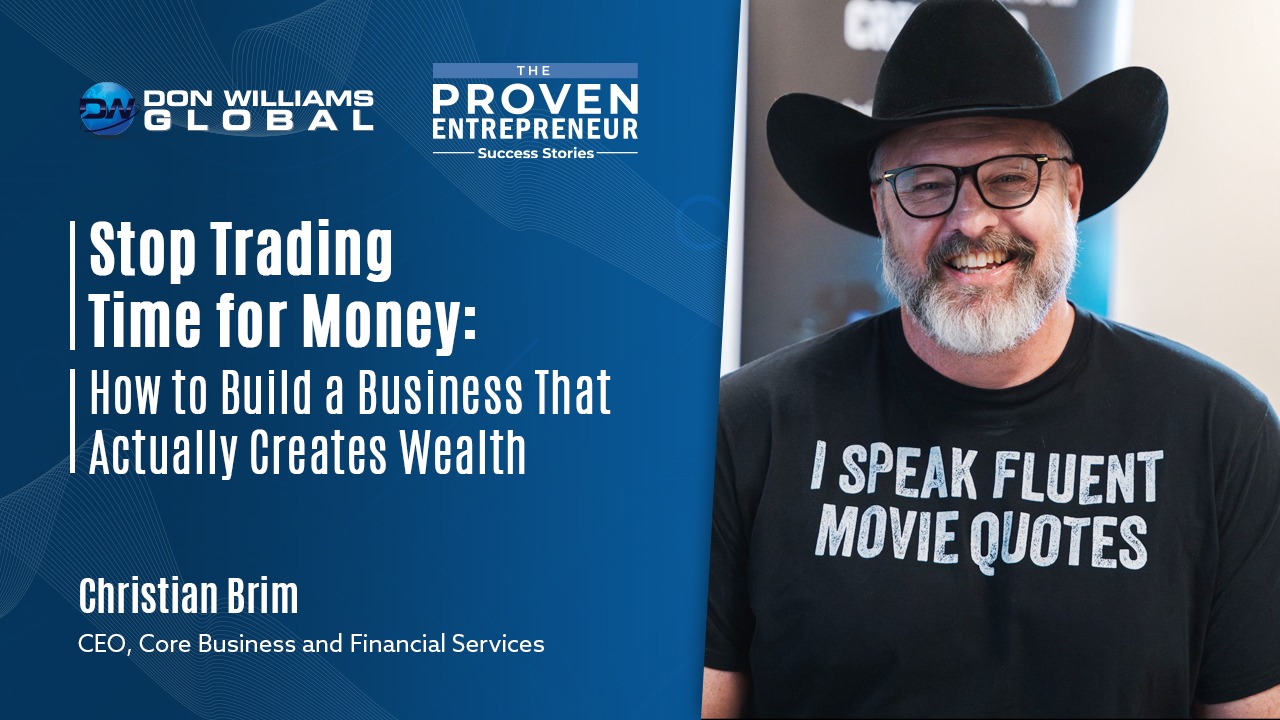
Many founders believe that working harder is the only way to increase their income, but this mindset often leads to burnout rather than a better bank account. Christian Brim joined host Don Williams on The Proven Entrepreneur Show to explain why true success comes from leveraging others rather than doing everything yourself. After nearly bankrupting his company by chasing growth without a profit plan, Christian realized that a business must be intentional about making money to survive.
The journey from a “youthfully ignorant” twenty-seven-year-old to a seasoned leader of a million-dollar company taught Christian that numbers tell a story. He emphasizes that accounting is more like a language than math, providing the clarity needed to get unstuck and scale with confidence. By implementing the Entrepreneurial Operating System, he turned his struggle into a structured organization that thrives independently of his daily efforts.
Aspiring entrepreneurs should focus on building wealth instead of just chasing top-line revenue that never hits their personal pockets. Christian advises that you must understand your balance sheet and income statement to ensure your future vision aligns with financial reality. Whether you are a creative agency owner or a small business leader, the goal is to stop being the bottleneck and start building an asset that lasts.
For information on how to work with Don visit us at https://donwilliamsglobal.com
You can also reach out to Don Williams at https://provenentrepreneurshow.com
Watch the episode here
Stop Trading Time for Money: How to Build a Business That Actually Creates Wealth
Hey, Don Williams here with today’s episode of The Proven Entrepreneur Show. I’ve got a good friend ⁓ and expert with us today, Christian Brim, all the way from Oklahoma City, Oklahoma. Christian, welcome to the show.
Norte Tejas is what we call it. Thank you, Don, for having me on the show.
Hey,
the way that the metroplex, Dallas-Fort Worth Metroplex is growing, at one point, we’re going to be connected all the way from probably the North Dallas side first, all the way to Oklahoma City. I mean, it’s just…
Mm.
Ardmore
for sure. I don’t know if we get to Oklahoma City, no, mean, a hundred years from now, absolutely.
Yeah, it’s just gonna happen. So ⁓ Christian, I know you have a couple companies. Tell us what you do, who you do it with, why you do it, ⁓ all that good stuff.
Yes.
All right. So, ⁓ my EO qualifying company, ⁓ is, is core group. do, ⁓ financial things for creative entrepreneurs. So videographers, creative agencies, that kind of stuff. And so financial things, we bring the clarity and peace of mind to them that, ⁓ is, is lacking in most creative businesses.
that looks like bookkeeping, accounting, taxes, payroll, that kind of stuff. ⁓ I also work as a consultant with entrepreneurs to help them get unstuck. So the ones that have had success and reached ⁓ a level of success but just can’t seem to get past that. So I work with ⁓ them as a consultant slash coach ⁓ in that capacity as well.
Okay, love that. And just to clarify for everybody, so an EO qualifying business, EO is Entrepreneurs Organization, which is a global organization to support entrepreneurs about 18 or 19,000 people around the world. And qualifying business means that you do at least a million dollars in top line revenue. so, ⁓ Christian and I actually met ⁓ through EO, I don’t know, quite a while ago, five, six, seven, eight years ago.
long. Yeah.
something like
that, and when I was also a member there. So, okay, first question, Christian, every entrepreneur, most entrepreneurs can look back at a moment where the light bulb clicked on. What was the moment for you when you realized that you could build an actual business, not just a job?
Mmm
⁓ So I was the right age of 27. I had had two jobs, one in public accounting, one in banking. And ⁓ I was very frustrated ⁓ as I assume most entrepreneurs working for others ⁓ happen to be. ⁓ And there came a point where working with the bank, ⁓ I just realized that like what I wanted and what
they wanted was not right. And so I started looking for other jobs. really wasn’t looking to start a business, but ⁓ I found this advertisement in the Journal of Accountancy for an accounting franchise and just reached out to him and had the conversation. six months later I was in California doing the franchise training. ⁓
I had two young children. My wife worked very part-time. I went in debt to purchase the franchise and to start the business. And I can’t really replicate that state of mind, like what the hell was I thinking? ⁓ But I can say, you know, whether it was the franchise that kind of drove this home, but very, very early on, I realized that I wanted
something that worked independently of me. Not that I wouldn’t work in the business and for a long time I did, but the ultimate goal was to create something that existed beyond me.
Very early on, I realized that I wanted something that worked independently of me… the ultimate goal was to create something that existed beyond me. Share on XYeah. Love that. Love that. And so I’m guessing maybe there was an awkward or tense conversation at home when left your job and your wife who worked very part-time in your words. And you said, Hey, I’m going to go to California. I’m going to invest in this franchise and we don’t have the money. So I’m going to borrow it to do that.
Well, in my defense, her dad wouldn’t lend me the money. So I didn’t have a choice. Right. So now I, I, I, distinctly remember that going down to the Lord’s table at church to pray and she was walking with me and she just had tears streaming down her, her, I mean, like she was terrified and I, and I get it. I mean, like for some reason I didn’t feel any fear or, or I felt fear, but like I felt confident that I could do it.
And, you know, over the years, I’ve tried to replicate that type of motivation where you have zero options, but to succeed. And it’s, it’s really kind of impossible to do once you’ve had a certain amount of success. ⁓ I’ve actually become much more risk averse as, as I’ve had more to lose. ⁓ And my decisions affect a lot more than me. You know, it affects, affects the employees. So, but at that point.
⁓ You know, it was yeah, I can do this. did I didn’t know any better It kind of reminds me of the article I read about the PayPal ⁓ Founders and they were having all of these problems. This is a couple of years ago They were having all these problems with bank fraud and when they started out they were just tech guys, right? they didn’t really know banking and ⁓ They they admitted that had they known when they started it
what was all involved with bank fraud and having to deal with it, they said we would never have started. And so there’s something about being youthfully ignorant that helps.
There’s something about being youthfully ignorant that helps — sometimes not knowing the limitations is your greatest advantage. Share on XI totally agree. I think sometimes you have to be the bumblebee. He doesn’t know he can’t fly, so he does. And ⁓ I think back to my very first company, I had a whopping $6,000 was my total capital. And I convinced a landlord to do a new finish out on 1,380 square feet in Wichita Falls, Texas. Not sure what he was thinking.
Um, and it all worked out. mean, we were there about 10 years, but, um, but, uh, I literally, uh, couldn’t spell balance sheet and P and L. I had no idea what that meant. And all I really knew was how to sell a lot. And, um, and if you, truthfully, if you only have one skill, that’s a good one to have is that you can win a lot of business offense. Well, um, you know, kind of like Oakland, we’re both.
I think you’re a Oklahoma alum and I’m a huge Oklahoma fan. And during the glory days with Barry Switzer, always was like, let’s hang half a hundred. If we score 50, you know, we win 99 % of the time. there’s something to that. Okay. So you work with owners on decision-making and financial clarity.
F-100.
But, yup. ⁓
Mm-hmm.
Mm-hmm.
What’s one myth that you think entrepreneurs cling to that keeps them kind of stuck?
specifically around money, I find a lot of, ⁓ beliefs that become problematic as entrepreneurs. so, you you, you, you show up as an entrepreneur with whatever beliefs around money that you have, ⁓ from, from your childhood experience and young adult experience. but some of them are not.
⁓ Factually, correct. They’re just beliefs, right? And and I think the one that I I see ⁓ People struggle with a lot is the belief You have to work hard to make money or or if you work hard you make money ⁓ And the reality is is that is true sometimes but I know a lot of people that work hard that don’t make money and The problem with that belief
is it sets you up for not being as successful as you could be. And it shows up in a lot of ways. It shows up ⁓ in your, ⁓ how you structure the business. like, you you feel like you’ve got to be doing more, working more to make money. But it’s kind of like, I tell people like, okay, well, if you get really good at what you do and therefore you can do it quicker, should you get paid less or should you get paid more? Right? Right. So, so
Entrepreneurs arrive with their own beliefs about money, but many of those beliefs aren’t facts — they’re just stories we’ve carried for years. Share on XYou present that to them and they’re like, well, no, that’s not true. And like, okay, so you see how this is limiting you. ⁓ it shows up in pricing all the time, because again, a lot of people just look to their costs or effort or time that they’ve got into something. And they say, well, that didn’t take me very much time. So I don’t, I, I won’t, I won’t charge that much. There’s that fear factor. ⁓ but I think it all stems from the, the, the self-limiting belief that you have to work hard.
to make money and I would say the ultimate goal of an entrepreneur is not to figure out how you can make more money, it’s how can you make more money off of the efforts of others. Which sounds kind of mercenary, but I mean that’s what the entrepreneur model is.
Yeah, no doubt about it. early on knew that ⁓ no matter how good I was, I can make more money if I can leverage more people. ⁓ There’s just no doubt about that. So I know you’ve seen business owners succeed. You’ve seen business owners struggle. What do you think separates the ones
Mm-hmm.
who scale with confidence from the ones who are perpetually overwhelmed.
⁓ Well, I don’t know if this exactly answers your question, but it is my experience. And then you can interpret it how you want. ⁓ I think a lot of entrepreneurs have ⁓ this characteristic of being very persistent. ⁓ Others might say it’s stubbornness, depending upon what side of the fence you’re on. But this ability to overcome
negative things or how reality is to create the vision that they see. And ⁓ that characteristic is very important to achieve success. But at some point it becomes a ⁓ limiter, right? Because there are some things as entrepreneur
Persistence is critical, but eventually it becomes a limiter. Sometimes the bravest entrepreneurial move is admitting you are no longer the right person in the seat. Share on Xas your company grows and scales that you need to not do and let others do one because you’re the the the bottleneck but also two is like you’re not you’re not competent to do it like you think you know but you really don’t and for me that was marketing and finally letting go of that rope I use the analogy I was hanging on to the rope not so that my hands were burned it was burned down to the flesh like I could see the bones right and and I wouldn’t let go
of that. But, you know, once I understood that, you know, I was not the right person in the seat, I was just there by default, ⁓ and actively tried to find someone better for the job, ⁓ you know, I guess that’s confidence. ⁓ And so I don’t know if I’ve answered your question, but I can redirect and answer a different way if you want.
No,
no, I appreciate that. Okay, so thinking back to your own experience, you’ve been an entrepreneur how long now?
28 years.
28 years. What’s a moment when business just punched you in the gut and had you get back up and keep going?
You
Well, I had a ⁓ unhealthy desire to grow. I think for lot of entrepreneurs, that’s kind of like the default mode ⁓ is grow ⁓ without really any ⁓ end game in mind, no like goal you’re trying to achieve. ⁓ And I did that to the point where
I almost bankrupted the company and it was a ⁓ function of, ⁓ tell these lies to yourself, you’re investing in the company, right? And that’s your excuse for not making profit. Mike McCallewitz talks about this in his book, Profit First, great book if you haven’t read it, just to hear Mike’s story, because it really resonates with, if you’re an entrepreneur reading Mike’s story, I’m like, yeah, that’s me.
and making excuses for not doing the things that I knew needed to be done. but I, you know, I actually walked away from the business and left it in the hands of my brother for a couple of years because I was so burnt out and, like,
I didn’t know the solution, but I knew one thing: what we were doing wasn’t working. Something had to be different — the business had to change. Share on XI remember telling my brother, I went and started a software company and I said, I don’t know if this software company is going to work, but I can tell you, I’m not coming back and running this damn business. and two years later I was back, ⁓ because it had, it run into financial difficulty. And I said to myself, you know, I don’t, I don’t know what is, is, I don’t know what it needs to be, but it’s gotta be different than what it is. Right.
I don’t know what the solution is, but what we’re doing is not working. And so it was that point that I, ⁓ we implemented, ⁓ EOS, entrepreneur, entrepreneur operating system brought in an outside facilitator. And that really, was, it was a slow turn. It was one over years, honestly. ⁓ but that, I go back to eight years ago when we implemented EOS as the turning point.
⁓ of going back the other direction.
Love that. Thank you. Okay. So last question. We’re hearing this call, 28 year and a 35 year entrepreneur. Lots of gray hair. And hey, I’m happy for every one of them. At this point, every day with hair is a good hair day. ⁓ Yeah, exactly. So hypothetically, I bring a brand new entrepreneur to the call.
Lots of gray hair.
Mm-hmm.
Better to turn gray than to turn loose.
Hmm.
And their question is this, how do I use my business to build wealth, not just revenue? What’s a simple plan you’d share with that brand new entrepreneur?
Hmm.
Well, I think it starts with your intent. It is, and this is a lot about what Mike McCallowitz talks about and what I talk about in my derivative of private first for creatives is you have to be intentional about making money, right? Making money is not an afterthought. It’s not something that happens sometimes. It should be something that happens all the time.
If you’re not making a profit, then something’s not right. And the answer is not to continue to grow because that’s a lot of entrepreneurs solution. Well, if I just get more customers, more clients, sell more X, Y, and Z, that’ll fix the problems. But no, it doesn’t. It compounds the problems. And so you have to be intentional, figure out how to make money.
You have to be intentional about making money. Profit is not an afterthought — it should happen all the time, not just sometimes. Share on Xin the business and then you can figure out how to scale it. But until you are making money, don’t have it’s like, why are you replicating something that’s not working? ⁓ So to me, it’s intent. I think ⁓ there are great tools. Profit first is one of them that helps you with that. But I also think that entrepreneurs, for the most part, are number averse. ⁓
I like to, my statement is that accounting and finances is much more akin to language than it is to math in that ⁓ accounting numbers tell the story of the business and every business has a story. And I really like to sit down with entrepreneurs who are stuck and they have this vision.
Right? One of the, one of the things that entrepreneurs do really, really well, and it makes them entrepreneurs is they can suspend reality. Right? That’s, part of how they get through those difficult times is they see the future, but sitting down with a business owner and saying, okay, well, what, what do you, what is your plan? What, how do you see the business? Where do you see the business? And then looking at the numbers and seeing what story they tell.
And starting where those two don’t match up, right? Like, okay, you say this, but the numbers are telling me this. And I think that all entrepreneurs need to have a ⁓ basic level of understanding of numbers so that they can understand the story that their business is telling them. You don’t have to have level of expertise that your financial professional does, your CPA.
That’s not what I’m saying, but you said when you started, you didn’t know what a balance sheet and income statement is. As an entrepreneur, there are zero excuses for not understanding those things. Zero.
Zero. Yep, absolutely. Okay, so Christian, if somebody wanted to reach out to you either on the consulting side or on the core group financial side, what’s the easiest way to reach out to you and your companies?
Mm-hmm.
Christianbrim.com, ⁓ beautiful website, just relaunched it. It’s beautiful, beautiful, best ever. ⁓ And Core is coregroupus.com.
Awesome. Christian, it’s been my pleasure to have you on the show today. Thank you so much.
Thank you, Don, for having me.
That’s today’s episode of The Proven Entrepreneur Show. We’ll see you next time. Thanks, bye.