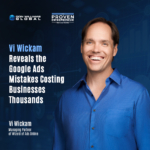
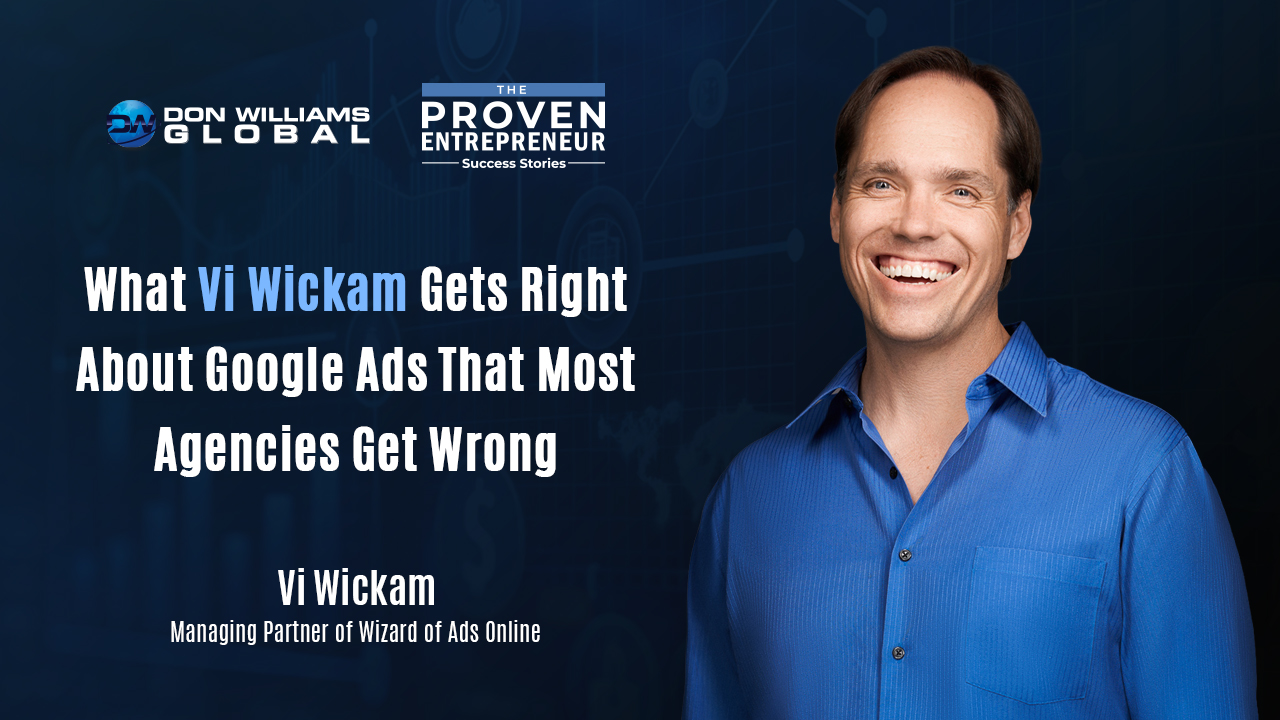
What if the biggest problem with your marketing isn’t your budget, but the advice you’re following? Many business owners assume that spending more on Google Ads will automatically lead to more customers, yet the reality is often far more complicated. In this episode of The Proven Entrepreneur Show, Vi Wickam shares why understanding incentives, trust, and lead quality matters far more than simply increasing ad spend.
One of the most valuable insights from the conversation is that not all leads are created equal. Vi explains the importance of separating brand keywords from non-brand keywords and why businesses should focus on profitable opportunities instead of chasing every possible click. He also highlights how agency compensation models can sometimes create misaligned incentives that prioritize spending more rather than earning more.
The discussion also explores the growing role of AI in marketing and why human expertise remains essential. While AI can accelerate content creation and streamline tasks, it still depends on strategic thinking, experience, and sound judgment. For entrepreneurs looking to grow their business, the episode delivers a simple but powerful reminder: trust, transparency, and strong brand positioning continue to outperform shortcuts and marketing hype.
For information on how to work with Don visit us at https://donwilliamsglobal.com
You can also reach out to Don Williams at https://provenentrepreneurshow.com
Watch the episode here
What Vi Wickam Gets Right About Google Ads That Most Agencies Get Wrong
Hey, Don Williams, welcome back to The Proven Entrepreneur Show, where we pull back the curtain on the real stories behind real revenue. Today’s guests represent something pretty rare in the marketing world. Legacy level persuasion blended with modern digital execution. Now you’ve probably heard of the Wizard of Ads, Roy H. Williams.
He’s the man who turned advertising into art, built brands through story and founded Wizards, Wizard Academy, though there are many wizards, Wizard Academy in Austin, Texas. And that’s a place where entrepreneurs go to think bigger. Today we’re talking to the leader, the wizard partner who brings that wizard, wizardry. It’s it’s a brand new mouth. I’m just trying it out folks. When he brings that wizardry online, by Wickham.
is the driving force behind wizards, wizard of ads online, helping businesses, business owners translate timeless persuasion principles into scalable, scalable, scalable emphasis, scalable digital systems that actually, here’s the magic people convert. So this conversation is about story versus strategy, art versus algorithm.
traffic versus trust and how entrepreneurs can quit shouting and start enchanting. Vi, welcome to the show.
Thank you, Don. It’s great to be on your show. I really appreciate you having me here today.
We’re thrilled to have you and we’re going to ask you the tough questions so that we walk away with real value for our businesses. And I appreciate you being here and being open-minded and open-hearted to today’s conversation.
Nothing better than a hard question. Yes. I do digital marketing for businesses all across North America and do web development, Google Ads management, Google business profiles, all of the things that tie together.
There we go. Okay. So you are based in Loveland, Colorado. Okay. And you serve entrepreneurs. Tell us a little bit about your business.
to make a successful brand online. We bring message alignment to online and offline media. And we really focus on creating a transparent system where business owners understand what we’re doing and why we’re doing it and generate real results for them instead of trying to snow them in a bunch of jargon.
Transparency in marketing means helping business owners understand what you're doing, why you're doing it, and how it drives real results. Share on XLove that. And transparency, that was kind of the magic word there. In digital marketing, it’s not an industry known for a lot of transparency. And I’m being maybe even generous when I say it like that. But that is a real benefit to the business. okay. Let’s say you and Roy.
True fact. For sure. you
Walk into the average Facebook ad account today. Would you call it advertising or would it be more interruption?
Well, first of all, I don’t do Facebook ads because I really don’t like Facebook and social media. I find it painful and it just sucks me in and I end up spending all this time. And there are other people who are able to to just do it as an advertising platform and do it much better within the Wizard of Ads partnership. There are other partners who do social, but
Okay.
your question I can still answer. I just wanted to lay that caveat first that like, well, first of all, like, if we’re looking at social, what we want to do is communicate connection and build, you know, it really is a brand building exercise and a storytelling exercise. And that’s.
I appreciate that and I can reword it and say Google.
You know, like people treat social like a selling exercise and every, every time you post, they think of it as an opportunity to sell.
And at most 10 to 20 % of your posts should be selling and 80 to 90 % of your posts should be building community and telling stories and showcasing your staff and making yourself approachable so that when people choose you, or so that when people choose the service you offer or the product you’re selling, you’re the one that they know, like and trust. Because at Wizard of Ads, what we do is we build brands that people know
like and trust. When it comes to Google Ads, it’s a whole different game because Google Ads is focused on being the person who’s there when somebody’s looking for you. in social, you’re trying to show up in their life and become a part of their experience.
Only 10 to 20 percent of your content should sell. The rest should build community, tell stories, and earn trust. Share on XIn Google Ads, there’s kind of two pieces of it. And this is one of the transparency elements that we do, which is we always separate brand searches from non-brand searches. when somebody, and this is one of the things that is a secret tactic that many digital marketers do to make themselves look better is if you blend non-brand and brand keywords,
you look like you’re doing really great things for them and really it’s the brand that’s doing the heavy lifting. So I can say, hey, look, you your non-brand Google ads are giving you a three or a four or a five X ROI, but your brand is giving you a 50 X ROI. And it’s not uncommon for us to have 25 to 100 X ROI on this brand keywords because one, they’re a great match. They’re looking for you.
we’re showing them exactly what they’re looking for. Two, they’ve already chosen you. So, you know, that’s your opportunity to lose, not your opportunity to win. So you should be getting a 25 to 50 % click through rate on those opportunities. And you should be getting a 50 plus percent close rate on those opportunities because they already know, like, and trust you.
Love that.
Yeah, agreed. So let me ask you, do you think the industry, the platforms and the marketing agencies, do you think…
they’re training entrepreneurs to optimize for clicks instead of connection.
Well, Google’s incentive is to get you to spend more. And I say this, spending a half million dollars a month in Google Ads, and getting calls or emails from Google Ads reps trying to get us to spend more on a daily basis. Google’s incentive is to get you to spend more and not to get you to convert more of that spend into revenue.
Google's incentive is to get you to spend more. Your incentive is to convert that spend into revenue. Share on XYou know, they really like they don’t want you to do so poorly that you stop spending money with them. But they really don’t care whether or not you’re getting a 2x return or a 10x return. They really care. you should add more broad keywords and stop blocking so many of these these keywords because you know, we want you to show up all the time. Don’t you want to show up all the time? You know.
your competitors are showing up all the time. You’re missing all this opportunity. And I’m like, yes, please. I would like to miss all that bad opportunity that’s going to cost me $500 or $1,000 a lead. And I want to take the leads that are going to cost me $100 a lead. It’s not that hard. I mean, it’s hard. But if you play the way Google wants you to play, you’ll just blow all your money on Google Ads. And that’s not what I want from you.
because I’m not incentivized to get you to spend more and many agencies take a commission on your spend. This is another thing that Wizard of Ads does differently than most digital agencies.
So most digital agencies take anywhere from 10 to 25 % of your Google Ads spend and they pocket it. Some of them tell you that they’re doing this. Some of them just do it and they don’t even tell you. So if a Google Ads manager says that you pay me and I pay Google, run away. Because if you’re paying them, you don’t have accountability for what you’re actually spending.
And there are legitimate good Google Ads managers that charge a 10 % 15 % commission. I feel like that in, well, I know that that misaligns our incentives. My incentive is to grow your business as a Wizard of Ads partner. My incentive is to create top line growth for you as cheaply as possible.
Misaligned incentives turn marketing budgets into agency commissions instead of top-line growth. Share on XTo do that, you I have to turn away a lot of those expensive opportunities to focus on the things that are going to be profitable for you. Whereas a lot of agencies just, you know, like they’ve got a 10,000 or 20,000 or $50,000 a month budget. They just want to spend it all because if they spend it all, they get their whole commission.
Yeah, yeah. this has turned out to be a better interview than even I thought. So a couple of magic points I want to emphasize. One, Google’s goal is not necessarily your goal.
Ha
No, it’s rarely your goal. And I will say that when you’re spending a lot of money, Google does give you access to people who actually are more experienced, more knowledgeable, more likely to give you guidance that’s useful and actionable. But their tier one
Yeah.
know, ads reps are saying, you know, just add more broad keywords and stop blocking so many things. You’re, you know, which is the opposite of what you actually want. You want the phrase matches and the exact matches and you want to block anything that is not a good fit for what you’re looking for in leads.
Pure gold there, folks. Pure gold. Listen to that. The other thing is if your contact at your marketing company says, you pay us and then we pay Google, understand that is obviously not transparent.
That is so not transparent. And you have no way to know what they’re actually paying Google. And there’s a good chance that they’re just pocketing 25 % of that money.
There you go. Okay. Good stuff. Bye. Thank you. Let me ask you this. What do you think is the most, let’s talk about small business owners. Okay. So two million and under. What do you think is the most dangerous marketing lie those owners believe?
I would say that everything can be measured. And when it comes to online measurement, we do a really, really good job of it. But it’s really hard. And it takes a lot of time to set it up and to manage those integrations. And things change. And things break. And even when you’re measuring everything as well as you can, you’re lucky if you’re 65 % to 70 % accurate.
The dangerous marketing lie is that everything can be measured perfectly. Even strong tracking is often only 65 to 70 percent accurate. Share on XSo we’re talking about on the Google Ads side, we’re measuring the impressions, we’re measuring the clicks, we’re measuring the conversions, and we’re measuring form fills and clicks to phone calls and booking widgets. And all of those pieces we’re measuring as well as they can be measured. And then that’s going over to their CRM. And so we’re pulling in data from their CRM.
And we’re saying, we’re matching these things together to say, well, this is how many of those leads, the phone calls got marked as qualified leads and this is how many of them got marked as bookings and this is how many of them were sold. And then we’re passing that data back to Google as conversions. And so that Google knows what those leads bookings and sales were. And.
If we’re doing everything right, we’re getting 65 to 70 % accuracy on that. And people think, oh, they’re measuring everything, it’s all perfect. No, it’s a messy, messy situation and it’s very difficult. And if you think they’re 100 % accurate, you’re fooling yourself.
to know.
Yeah, I love that. And I would just recommend to the audience, so if you’re trying to do it yourself, can kind of have your foot in a bucket, unless it is your area of expertise, because even the experts are 65 % to 70 % accurate. And so if you’re not expert, and you can just look in the mirror and you’ll know if you are or not, OK? But if you’re not.
for sure, for sure.
Yeah. Yeah, yeah, yeah.
Have you been doing
this for 10 years or more? 20? 30?
Yeah, if you’re not an expert,
you’re probably wrong. And let me say this about lead generation. So my history goes back 40 years in direct mail and outbound call center lead generation. And so the client always wants the very biggest quantity of the very best leads. Typically, those don’t go together.
Yeah. Mm hmm. Yeah.
Sure.
Typically those are opposite of each other. As quality rises, quantity falls, and as quantity rises, quality falls. But when you put someone in like a platform, you need to understand that really their motivation is to provide you the minimally, the largest quantity of minimally viable leads. And I don’t know that anybody’s ever going to tell you that. think…
As lead quality rises, quantity usually falls. The best growth teams know the difference between volume and value. Share on XNo, almost never, yeah. Right.
Google’s never gonna tell you that, man, it’s never gonna tell you that.
No, absolutely
they’re not because Google doesn’t care.
No, no.
But
I care because my incentive is to help you grow your business. If I’m working with you, like the only way I get a raise is if your top line revenue grows in that first year I’m working with you and each year after it. that is aligned incentives is a critical element of am I incentivized to get you to spend more or to get you to make more?
Aligned incentives come down to one question: am I rewarded when you spend more, or when your business makes more? Share on XYeah.
There you go. Okay. Listen to that folks. Okay. Be properly aligned where you got the same goal.
I got another big lie, which is that Google is a money-making machine, and you can just keep putting more money into Google, and you’ll keep getting leads at the same cost per lead. It also doesn’t work like that, because as you and I both know, there is a limited amount of opportunity in a market. so whatever that limit is on the keywords or the campaign that we’re targeting,
Tell me.
Like the limit is the limit. And once you hit 50, usually 65 % or so of the opportunity, you start paying way more. So say you’re paying $100 a lead when you’re at 40 or 50%. That might be two or $300 a lead when you hit 65%. And it might be $600 a lead when you hit 75%.
And the truth is, most of the time that last 35%, 40 % is just not worth buying.
Yeah. Yeah. I love that. And the other thing I think people, people in my own practice is we have to explore, you know, sometimes the, and I’ll just pull numbers out of the air. Sometimes the hundred dollar lead is more beneficial than the $20 lead. Yeah. You have to track it all. You know, if the, if the, if the average dollars per lead, forget dollars per sale, I’m paying for the lead. If the dollars.
Now.
Sometimes, for sure. Track it all the way through. Yeah.
per lead on the $10 lead are only 20 and the dollars per lead on the $100 lead are 1000. You know, I need as many of those as I can get and I’ll fill in with the others. Yeah.
Yeah. Yeah, and that’s a good segue into the importance of building a brand.
Because the truth is, is branded leads are lower cost of acquisition and higher return on investment. You know, once you’ve built that brand, but you’ve got to invest to build the brand. And that is lock, stock and barrel for, for Wizard of ads. That’s what we do is we help businesses build brands and you get higher quality relational customers.
when they’re looking for you and they know, like and trust you.
Branded leads create lower acquisition costs and higher returns because customers already know, like, and trust you. Share on XYeah. Yeah. And I would even not argue, but I would even add that no, like contrast is really important.
no interest or mandatory. People do buy at times from people where they don’t really have an affinity, they don’t have a warm feeling, don’t, maybe there’s a personality conflict, like, I don’t really like the guy, but I believe the guy.
Sure, absolutely. Sure, yeah, I
trust him. Yeah, trust is mandatory. And if you betray the trust of your customers, there’s no coming back from that.
Trust is mandatory. If you betray the trust of your customers, there's no coming back from that. Share on XYeah, and trust is certainly the foundational.
No, I’ve shared with my customers all the time. Trust is a bridge built gradually, okay, from both sides, destroyed in an instant. And so treat those relationships like the goal that they actually are. Okay, so let’s go to AI. Nobody’s talking about, nobody’s talking about AI. Let’s talk about AI. So let me ask you this. We live in a world where AI can generate ads and
Yes, for sure. All right. Nobody, nobody’s talking about AI. ⁓ man.
seconds, nanoseconds. But persuasion isn’t just typing, you know, it’s psychology. Do you think AI today can replace an expert copywriter, or is it just a tool in the wizard’s hand?
No. True.
Well, it’s absolutely a tool. And there are lots of people trying to replace humans with AI. And in my experience, I’ve been playing with AI since it’s been a thing.
It is a tool that can do a lot of the grunt work, but it always requires human input and knowledge and expertise on the front end and on the back end. you really, at best you’re getting 108010 where you get that 80 % in the middle, that grinding done by the machine.
But if you’re not, if you don’t have the expertise to ask the right questions, to know what questions you need to be thinking about, you’re just gonna create a bunch of garbage, which is what most people are doing with AI right now. know, a lot of just flotsam.
AI can handle the middle work, but expertise is still needed on the front end and the back end. Share on XA lot of gobbledygook.
Yeah. Yeah. And so I’ll just share this. So published nine books, working on book number 10 and 11. We’ve done about 200 of these episodes. I speak, you know, we post on five platforms five times a week. So I, if I have a problem with content, it’s that I have too much. And, but my team, you know, we fed all of that into,
Sure.
a specific AI engine. And so with all of that investment, AI Don’s pretty good. He’s not quite as, I don’t think he’s as good as Don, but he’s pretty good and he’s certainly a lot faster. And so he’ll give me that.
Sure.
Sure. Yeah, Hey, AIV
is also pretty good, but I still have to edit AIV every stinking time, even if I give him a really good prompt.
Yeah. Yeah. Yeah. Yeah. I agree.
Okay. So what do you say to a founder who says, my product is service or experience is great. It should just sell itself.
Well, good luck with that.
Good luck with that. Okay.
Enough said. That’s good enough right there. Okay. Here’s my closing question. If an entrepreneur listening right now feels stuck, they’re working harder than ever. They’re not breaking through. What’s the mindset shift they need to make?
Hahaha
Thank ⁓
That’s a good question. I think that it’ll depend on the person. mean, sometimes it’s taking a step back and asking the question, am I doing the things that are actually gonna move the needle? Or am I just working in my business, spinning my wheels, doing things that feel productive, but they’re not actually making a difference? And I think that that is a very common thing people do when they get stuck.
they do the things that they know how to do and the things that got you into this problem are not going to get you out of it.
When entrepreneurs get stuck, they often keep doing what feels productive instead of doing what actually moves the needle. Share on XI love that. so I think, and of course I’m, um, have an affinity towards coaching and consulting, but many times if you’ll get someone else with fresh eyes, not in your business, somebody from outside your business in, in a couple of minutes, they can identify the log jam and set you you free. And, and that’s a good thing. So.
Mm-hmm. Yeah.
Sure.
Absolutely.
So Vi, how would a listener reach out to you, to Wizard of Ads online? What’s the easiest way to make contact?
Well, my website’s really hard. It’s wizardofadsonline.com. And you can also look at viwicom.com and that will get you there too. But, you know, like I’ve got a bunch of tools on the website for making sure you don’t get taken by a digital weasel and that you’ve got control of your online assets.
Brutal.
which is another one of those things that small entrepreneurs and even medium sized entrepreneurs fall into where they fully trust somebody and they don’t verify and they don’t have control of their own digital destiny. So there are tools for that on Wizard of Ads Online as well.
Business owners should trust, verify, and keep control of their own digital destiny. Share on XSo I would encourage everyone, you need to be sure you own your domain, your profiles. Yeah, you need to own it all. And unfortunately there have at times been service providers who typically under the guise of, this is easier this way, but it’s just bad structure and bad bad structure will come back and bite you.
your website, all the Google properties.
It is. And I’ve seen people held
ransom for those assets, which, you know, that is not where anybody wants to be.
No, no. But I thank you so much for being on the show today. It’s been a real treat. I’m grateful.
Thank you, Don. It’s been a pleasure getting to know you and a pleasure sharing this space with you.
Thank you. Hey folks, that’s today’s episode of The Proven Entrepreneur Show. We’ll see you next time. Thanks. Bye.
Bye.