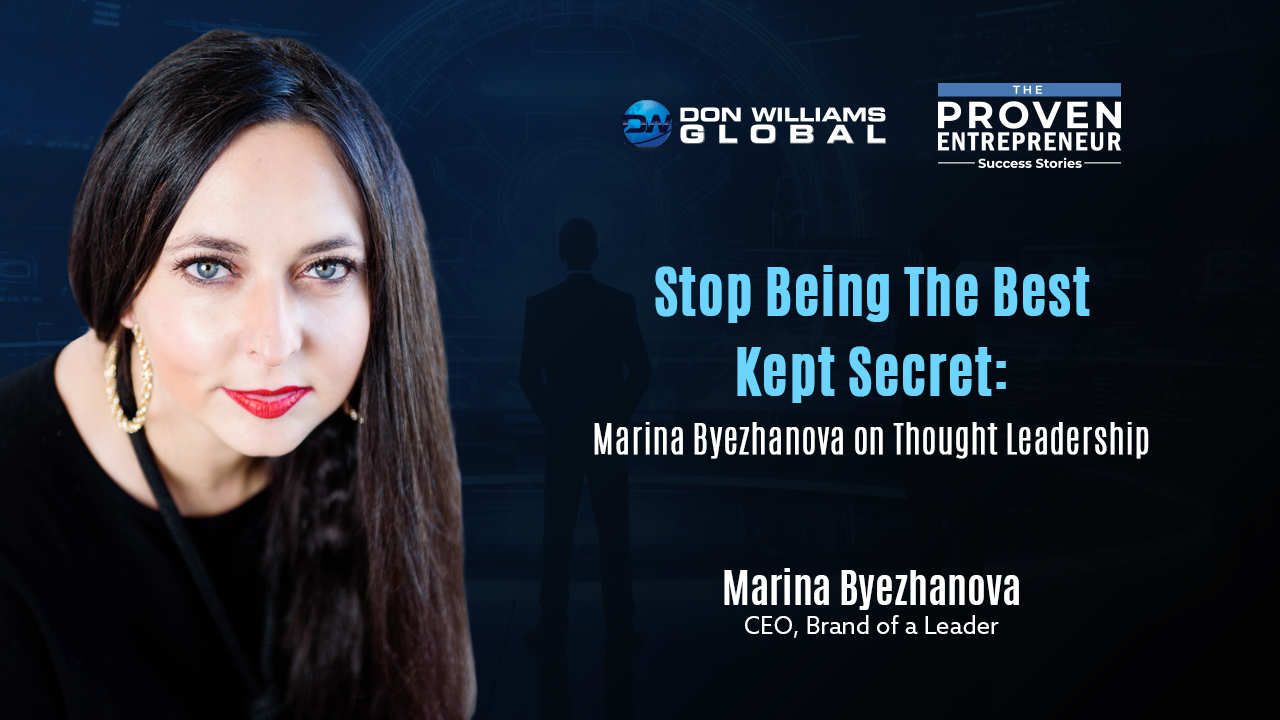
You’re not losing deals because you’re bad—you’re losing them because you’re invisible.
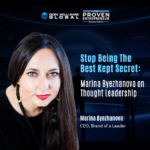
In this powerful episode of The Proven Entrepreneur Show, host Don Williams sits down with Marina Byezhanova, co-founder of Brand of a Leader and a speaker with Deloitte Academy, to expose a critical blind spot in modern business: your personal brand is either working for you—or costing you money. The conversation starts with a simple but uncomfortable question: what shows up when someone Googles your name? In today’s world where decisions are driven by Google search and AI tools, being invisible is no longer neutral—it’s a liability that directly impacts your credibility and opportunities.
Marina breaks down how the absence of strong thought leadership and online visibility quietly drains your business of potential clients, partnerships, and even top-tier hires. She highlights why many experienced entrepreneurs—especially senior executives—are being overshadowed by less experienced but more visible individuals. The reality? It’s not about who is better—it’s about who is seen. The episode dives deep into LinkedIn strategy, authenticity in content creation, and the importance of showing up consistently, even if your content isn’t perfect.
One of the most inspiring parts of the conversation is Marina’s personal journey—losing a seven-figure recruitment business during COVID and rebuilding an entirely new company purely through her personal brand and reputation. This story proves that a strong personal brand is not tied to one business—it’s a portable asset that can help you recover, grow, and scale faster. The discussion also touches on handling criticism, overcoming fear of visibility, and why being too “humble” might be holding you back from real growth.
Before you watch—Google your name. Are you showing up as an authority or disappearing completely?
If this episode shifts your perspective, share your biggest takeaway in the comments—or drop your LinkedIn profile and start building a brand that actually works for you.
For information on how to work with Don visit us at https://donwilliamsglobal.com
You can also reach out to Don Williams at https://provenentrepreneurshow.com
Watch the episode here
Nobody Knows You? This Is Why You’re Losing Clients (Fix It Now)
So, listener, let me ask you a question. If we were to Google your name today, what would Google tell us about you? Today we’re going to talk about personal branding and I have one of the top experts in the entire world that’s going to share with us today. But understand this, your brand is working whether you think it is or not. The question is, is it working for you?
If being invisible online is not part of your leadership strategy, then your personal brand is already costing you opportunities. Share on Xis it working against you? Today, from Montreal, Canada, I have Marina Byezhanova. Her company is Brand of a Leader. Marina, welcome to the show.
Thank you so much for having me, Dawn. I love that you opened with the question of what shows up when someone Googles you. You know, when I deliver, I’m on Deloitte’s faculty of speakers and I deliver master classes to their corporate clients who are C-level executives on building, we don’t call it personal brand, we call it leadership brand.
And every time I ask that question, I see this mischievous look on almost all of the faces and they kind of like start giggling and they’re excited. And I said, I know why you’re smiling because you were thinking nothing shows up when you Google me. I am safe. Nothing shows up. And then I asked them, but is being invisible part of your leadership strategy? And they were furious. So I love that you opened with that question.
Your competitor may not be better than you. They may simply be more visible than you. Share on XYeah, I love that. so Deloitte, have you ever visited Deloitte University?
No, so I’m part of the program which is their Deloitte Academy, so not quite the same, but a different program of their own.
Okay.
The only reason I ask, it’s about a quarter mile from where I’m sitting today, the worldwide training facility for Deloitte. And I think they have an 800 room private hotel for their employees only to train. And I think they’re duplicating it. So now they’re going to have 1600 rooms only for Deloitte people on one of the prettiest pieces of property in Texas.
no.
Wow, it’s incredible.
So, okay, let’s hop right in. I’m going to ask you, you’re going to feel like you’re tied to a chair and there’s a bare bulb and we have this to make you talk. No, it’s not going to be that bad. But here’s question one. If I Google an entrepreneur right now and what shows up doesn’t clearly position them as the authority or an authority in their space, what is that costing them?
like financially.
Well, hugely and adding to the conversation, Don, not only when you Google an entrepreneur or the entrepreneur’s company through their thought leadership, but also when you ask an LLM who is, right, not the authority, but who should I be contacting in the space ABC, right? Which is more and more what we’re doing. The conversation has become a lot more complex and LLM search is rooted in thought leadership. So even when we’re looking for companies for service providers, organizations via an LLM,
is rooted in thought leadership. It’s not like traditional SEO was more rooted in, know, links, et cetera. You could still really market your organization without the entrepreneur’s thought leadership. Now that cost of not having thought leadership visibility has become even bigger. So what it’s costing is it’s costing clients, it’s costing investment opportunities, it’s costing partnerships, and often overlooked, but now increasingly important, it’s costing potentially top hires.
The cost of not having thought leadership visibility today is bigger than ever because AI search is rooted in thought leadership. Share on XI can’t tell you how many people within my own organizations, and we have just the most incredible team I’m so grateful for, have said, I came to work at Brando a leader because of you. I Googled you. I saw your core values. I saw what you stand for. I saw that alignment. I wanted to work for someone like you. So of course, it’s costing on the business side, the usual things that we know about prospective clients who will find your competitor who has positioned himself as a thought leader and authority in the field and will go and hire their services.
It’s also costing us luck talent.
Thought leadership is no longer optional if you want clients, partnerships, investors, and top talent. Share on Xpretty expensive. Yeah. Okay. All right. So I know you work with execs and high level founders. Are most successful entrepreneurs actually under leveraged when it comes to their personal brand? Are they succeeding kind of in spite of their efforts on personal brand?
Most are not making an effort and missing out to their more junior colleagues. You know, and it’s interesting. we hear, I hear so many of our clients who are C-level executives, or as you said, you know, successful founders. We work specifically with Gen Xers. So they’re, you know, mid forties and older. And they increasingly say, you know, it’s not fair, You know, it’s just not fair. I go to an industry event and I sit there at a conference and I’m looking at a panel. Who are these people?
They haven’t achieved anything. They haven’t built a business as successful as mine. Why are they invited to speak and not me? And I say, because nobody knows about you. They’re making a bit more noise and they’re more strategic with their visibility. And, know, if the tree falls in the forest, but nobody’s there, did it really fall? And so most entrepreneurs and
If the tree falls in the forest but nobody’s there, did it really fall? The same applies to entrepreneurs hiding their expertise. Share on XI would argue, and I’m often asked, well, why do you work with GenXers specifically? Well, GenXers have more to say, you know, with all respect to our, you know, more junior colleagues, GenXers have a lot more battle scars, a lot more successes, but also a lot more failures, things to talk about that are of value. And often they don’t know how to put themselves out there. They feel that it’s too self-promotional, whereas, you know, the younger generations are so comfortable self-promoted, so comfortable putting themselves out
there. So my answer is definitely under-leveraged.
Yeah. Yeah. You know, in my primary business, help people, I just help people increase their top line. And, so many people, and it doesn’t matter if they’re a million a year or 10 million a year or 20 million a year, they’re, they don’t want to come across as salesy. They don’t want to put themselves out there. If they do put themselves out there, they want it to be like Steven Spielberg, Hollywood perfect. And.
Nice.
And I’m like, you know, it’s social media and actually a little blemish maybe actually helps, you know, because it’s real and not, you know, if it looks too Hollywood and you know, it’s probably too Hollywood, but it’s…
especially
now in the era of AI. You know what’s really funny, Dawn? I used to, and this is on the topic of overly polished social media content, you know, I used to post something on LinkedIn and then later on notice, for example, I made a typo and it would mortify me. Mortify me. my God, I had to post it in there for four hours. There was a typo. What are people going to think of me? Now I’m so happy when it happens. I’m like, well, at least they’re going to know I wrote it and it wasn’t AI, right? So the
era of overpolish is becoming even less and less so because humaneness competes with everything that we see that is AI generated.
Humanity is becoming more valuable because people are exhausted by overly polished AI-generated content. Share on XYeah, I love that. have a tech client, they a big business and a caption and a video. We did a four hour video session. They’ll end up with about hundred reels to use over the next couple of years out of that because we did it intelligently and we went about it. But the first one that showed that there’s a couple typos and spelling and punctuation errors, and we let AI do the captions and
You know, it just kind of rubs him the wrong way. And I’m like, look, you know, getting your posts out there is more important than being perfect. Okay. People don’t care. Turn the captions on on your television. They’re not spelled right. Okay. And English is kind of a weird language anyway. You know, is it, is it two, two or two?
Getting your message out there matters more than trying to look perfect. Share on XYou know, and, um, you know, one day somebody with some senses, we’re going to outlaw everything to do with the King’s English. We’re going to go to phonetic English and we’ll just, we’ll just spell things the way they sound. you know, kids will be able to have a master’s in English comp in the third grade, you know, cause it’ll be easy. Okay. Next question. I’m on a rant there. So I think most entrepreneurs default.
I’m going to be humble, I’m going to be quiet, I’m going to be reserved. There’s a few like me that are noisy, okay? But I don’t think there’s a lot of us that are noisy. But that’s a pretty direct question. Don’t you think that false sense of humility or too much humility actually suppresses their progress and growth?
only if it’s inauthentic. So there are some people that are painfully, you know, humble, and they cannot get out a piece of content that uses the I pronoun, everything has to be we, everything has to be us, right? Even if they’re talking about an individual achievement, but it is so authentic. It’s not, for some it’s performative and people can feel when it’s performative and people can feel when it’s authentic because…
The offline persona has to match the online persona, right? So if people know that you are the sweetheart kind of soul, you’re so inclusive, you’re so community driven, of course they’re going to see your content and so we will we, or if vice versa, they see you online, they meet you in person. They’re like, yes, of course. I feel like I already know you. When it’s performative and people want to sound humble or sound anything that they’re not, it catches up with them because the worst thing that can happen is when people meet you in real life and that’s not the person that they expected to
to meet or people know you in real life and they’re like, what’s the show you’re putting on, right? It’s the worst thing that you can do. So faux anything, I would say is extremely detrimental.
The offline persona has to match the online persona or your brand eventually collapses. Share on XHowever, most people, so as you said, you are more self-promotional as am I, so I understand you, but there are a few of us and most people feel very uncomfortable putting themselves out there and feel very much, know, most of our clients at Brandable Leader,
would rather not be putting themselves out there. They see it, come to us, thus they’re our clients, we help them build visibility, but they see it as a necessary evil rather than something that’s exciting and they love it and it helps them put their thought leadership further over time when they start understanding that it’s not an exercise in vanity that is actually bringing value, that they get to impact and inspire people, that it helps the organization, it helps attract talent.
Then they warm up to it, all of a they care about analytics and how their posts are performing. But it’s definitely an uphill battle because it’s that identity and comfort zone and a bit of an imposter syndrome putting yourself out there, maybe being really humble and feeling is the self-promotional and then giving it time to be able to see impact to shift it.
Yeah, I love that. And I love what you said about, you know, it really only works if the online you, the online persona is in fact you. And so if you’re two people, that will almost always bite you in the rear, no matter the context. I’ve written nine books, written and published nine books at this point, and I’m working on 10 and 11, which I don’t recommend working on two at one time, but I am.
But in my second book, Romancing Your Customer, I was delivering a keynote and then we were doing Q &A at the end and we were talking about that book and it’s about delivering exceptional experiences to where people absolutely love you. Okay. And it’s not hard. You just have to kind of want to and trust me, your competition’s not doing it. So you can own your industry. You can own your niche.
If you want to own your niche, deliver experiences your competition refuses to deliver. Share on Xbut this one person in the audience stood up and said, I’ve read the book and the book reads just like he talks. And that’s like the finest compliment I’ve ever had as an author is that it’s just a different way to deliver my message, but it’s still me. And I think that always, that authenticity always pays off.
And kudos for that, Dawn, because that’s rare, because also for most people, it’s very hard to own their authenticity, right? Because a lot of people also misunderstand the concept of authenticity. They think, being authentic, I want to make sure that I’m authentic online. And they mean like nice and likable. But if you are authentically not nice or likable, there’s nothing that we can do online, right? And so often we tell people, well, listen, Donald Trump is one of the most authentic people.
Yeah.
I’ve seen and that’s why he has a following, but he’s not, you know, traditionally nicer likeable. He’s extremely polarizing, right? And the people say, no, no, no, I don’t want to be like that. I said, well, you don’t want to be like that if you’re not like that. If you’re like that, you should be like that because creating a different type of a persona online that your mother, Teresa, where in reality, you know, you are a polarizing human being is a mistake. It catches up with you as you said. At the same time, it’s very hard to own who you are and expose yourself to others at scale.
Because if you truly do that, yes, you will have a lot of fans and people standing up in the audience and saying, wow, you know, this is exactly how you sound in the book. You are so authentic, but you will also have people who will not love you and people who will say you are full of this or you are not, or you whatever, right? They will not love you because you’re showcasing your authentic self. Not everyone’s going to be a fan. And that’s hard. It’s hard for our businesses, right? When someone criticizes our business online, right? It’s about a review, but it’s about us.
It’s really hard and that’s one of the biggest reasons why people have a hard time A. putting themselves out there and then B. putting out their real and authentic self.
I think those are wise words. I can remember my first hater, my first online hater, and I was crushed. I was just devastated that I think I’m pretty likable. My mom likes me. I thought everybody would. This person does not and said some really what I felt were unkind things. And it just kind of rocked my world for a while.
But the flip side of that is this, until you have some, I don’t think you’re doing enough. You’re not out there enough because everybody’s not going to like you. Everybody’s not going to like me. And some people are going to be pretty active in their dislike. And that’s OK. What’s that old saying? All publicity is good publicity. I’m not sure I agree with that.
If nobody dislikes your content, you probably are not visible enough yet. Share on XIt does depend on the situation because I’ve had
some situations where I doubted it for a moment, but you’re right, you know, because when we, it’s, yes, it’s about scale. The more you put yourself out there, the more you expose yourself potentially to people not liking you. But it’s also, if you’re playing too safe and too neutral, you don’t give a chance to yourself to have raving fans and for people to really love you. Right? And we know that for organizations too, for organizations doesn’t take a position. It doesn’t stand for anything. It’s kind of cookie cutter vanilla. It’s not going to go far.
It’s not gonna have raving fans. Same for an individual. So yes, there’s going to be people that will dislike you, but then there will be people who will love you, and then that will balance out. And also the good news I always tell clients is, no matter how much of a polarizing persona you are, vast majority of people are supportive and nice, vast majority. There will always be people, and depending again on what you’re saying and what you’re putting out there,
There will be more emotional people in keyboard warriors and even on LinkedIn with their names and their company names and their job titles, but they’re in the minority. More often than not, people are great and support them.
If you play too safe and too neutral, you never give people a reason to truly love your brand. Share on XYeah, I love that. Okay, so let me ask you this. You’ve had brand of a leader for how long?
five years almost.
Five years. Okay, so here’s a tough one.
You lose your company tomorrow, but you keep your personal brand because you can’t really get rid of it. You know, once you have it, you can’t get rid of it. How fast could you rebuild?
Well, listen, it happened to me five years ago. So five years ago, had a different business. Well, now it’s more than five, six years ago. I had a different business. It was a seven-figure business in the recruitment and headhunting space. Very different, although we doubled into different kinds of branding, employer branding, know, a bit more like through company culture side of things.
⁓
But very successful business, thriving business, and it died during COVID. So it a very painful death. I mean, it died in COVID partially because of COVID and big part because of a very challenging partnership and mismanaged things for which also take very humble and vulnerable accountability. But it died. And a year later, I had brandable leader with clients.
And it was purely on the back of my personal brand, purely because there was, it was just myself and my co-founder. The only source of new client acquisition was me and my name. And all of a sudden I was doing something completely different, which also is important to say because people think equate personal branding would be known in their industry. But then you’re a spokesperson for your industry or your company. It’s not a personal brand. Personal brand is portable, right?
Personal brand is portable. You can lose a company and still rebuild because people trust you. Share on XAnd so because I had already a reputation, people trusted me. And what I always stood for in my personal brand was radical authenticity. And I always talked about stand out, speak out and be radical authentic. When I was working in recruitment, I just applied it to recruitment. And then I said, well, now I’m applying the same thing, but building your visibility as a thought leader, standing out as a leader, speaking up as a leader, being radical authentic as a leader. So to people, didn’t feel like too radical of a change.
She was doing this and now she’s doing that. My overarching, what I stood for, still held. And so listen, that was six years ago, lost the business. Five years ago, launched this business. I have 15 team members. We’ve worked with clients in 12 countries and we’re growing, we’re successful, we’re doing really well. So how long does it take to rebuild? Well, at some scale because in the first year…
had clients, was able to pay bills and I didn’t go bankrupt after losing a business. So you can rebuild pretty fast. So I don’t have to have the hypothetical scenario. I hope I never have to live through it again, but it did actually happen.
Yeah, thank you for sharing. OK, I’m going to ask you three or four questions, just looking for a one word answer. OK.
Okay.
for serious founders, LinkedIn or Instagram.
Podcast guesting. words.
you’re a rule breaker. Yeah, I like that in a person. Personal brand before product brand.
I’m
Yes.
Yes. Yeah. So it’s, mean, it’s one of the things I teach my clients is this, and most of what we do is B2B and B2G. And they’re like, well, you know, our company doesn’t have the relationship with that company. I’m like, hey, companies don’t have relationships with companies. People in companies have relationships with people in companies, but we’re all buying and selling to people. Okay. I don’t care if you’re dealing with the federal government or whoever it is.
Companies don’t build relationships with companies. People build relationships with people. Share on XThe image is cheaper.
Ghost riding, smart leverage or dangerous short
Smart leverage.
Okay, good.
Should every CEO, should every founder, should every entrepreneur write a book?
Hey, I’m going to ask a follow up on that. Why not?
Why not? You know what? I think that the book has to be in the person. I think the person needs to feel that, I don’t know, maybe I romanticize books, you know, I’m a reader, and to me it feels like one of those things that we don’t need a lot of noise for the sake of noise of you must and you should. Do I think that there’s necessarily a story in everyone that’s enough for a book? I’m not sure about that.
So I think that is it a great tool? If you have a story in you, it’s phenomenal. It gives you credibility. It gives you another audience. It exposes you to people who are more readers than not. And the more books in you, the better. That’s great. But can I say everyone must know? I also can say that for building a personal brand, there’s any singular platform that’s a must. Even something like LinkedIn, it’s kind of an obvious, but is it a must?
It’s not a must. Listen, Seth Godin is a prolific marketer. He built a huge brand in marketing, barely being on social media. You know, like an RSS feed. He does all of the non-best practices, you know, for most of his career. And he built a huge personal brand. So no platform is a must, but if you’re able to, you know, every platform builds you incredible visibility and leverage.
Love that. Marina, if somebody wanted to reach out to you or brand of a leader, what’s the easiest, best way to do that?
One is our website, our beautiful website, brandofaleader.com. And then on a personal level, my unpronounceable last name in this combination with his first name is the only one on LinkedIn. So if you copy and paste it into LinkedIn, Marina Bezhanova, I’m the only one there, top of feed and let’s connect.
Awesome. Hey, folks. I’m going to keep the right to recall this witness. This lady’s a genius on personal branding. We just kind of scratched the surface, but it’s all the time we have. Marina, thank you so much for being on the show.
I’ll be back anytime. Thank you for having me.
Thank you. Hey folks, that’s today’s episode of The Proven Entrepreneur Show. We’ll see you next time. Thanks, bye.