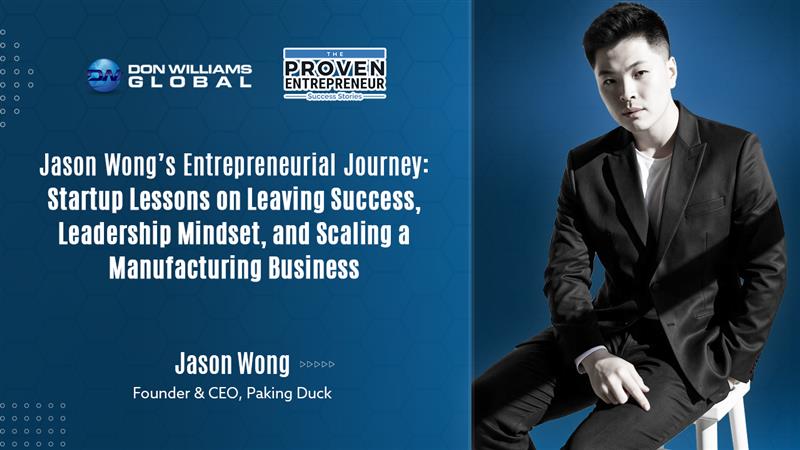
Jason Wong’s entrepreneurial journey is a powerful example of how real business success stories are often built by questioning what already works. After years of running profitable consumer brands, Jason made the difficult decision of leaving a successful business to start over—an experience that reshaped his entrepreneur mindset and approach to growth. His founder journey story highlights how startup lessons are rarely learned from theory, but from lived experience. By shifting from brand owner to manufacturer, Jason entered the manufacturing business with a fresh perspective, focusing on solving long-standing problems that most founders simply accepted as “industry norms.” This kind of business decision making reflects how entrepreneurs think differently when they see opportunity where others see risk.
A key theme in Jason’s story is leadership mindset, especially when it comes to hiring mistakes in business and scaling a business responsibly. Early missteps taught him that the true cost of a bad hire isn’t salary—it’s lost momentum and misaligned culture. Over time, this led to a strong belief in hiring A players in a startup, prioritizing ownership, commitment, and cultural fit over impressive resumes. These startup lessons extend beyond hiring into how founders build teams, delegate responsibility, and create environments where people can perform at their best. Jason’s experience reinforces that sustainable growth comes from clarity, not constant hustle.
What makes this entrepreneur podcast episode resonate is its honest take on redefining success. Jason challenges the idea that success is purely financial, emphasizing work-life balance for entrepreneurs and the importance of building a business that supports personal fulfillment. His story speaks directly to founders, CEOs, and leadership teams navigating growth while trying to protect what matters outside work. As an entrepreneur mindset podcast episode, it offers more than inspiration—it provides grounded insight into scaling a business with intention, leading with clarity, and making decisions that align success with long-term purpose.
For information on how to work with Don visit us at https://donwilliamsglobal.com
You can also reach out to Don Williams at https://provenentrepreneurshow.com
Watch the episode here
Jason Wong’s Entrepreneurial Journey: Startup Lessons on Leaving Success, Leadership Mindset, and Scaling a Manufacturing Business
Hey, Don Williams here with today’s episode of The Proven Entrepreneur Show. What a treat. have Jason Wong from Packing Duck in the house. Jason, welcome to the show.
Thank you for having me, I’m excited.
Yeah, I’m thrilled to have you. So before we get into questions, tell us a little bit about who you are, what you do, who you serve, why you do it, all that kind of stuff.
man, my name is Jason. I’m from Hong Kong and I came to America when I was eight years old. And currently I run a manufacturing business, a custom packaging manufacturing business. And I service a ton of brands that some might, know, some you might not know. We work with brands like Questbars, Vita Coco, you know, more household names. And then we also work with a lot of consumer brands and beauty supplements, apparel. We do a lot of categories here.
That’s amazing. So you wouldn’t know this, but I spent 26 days in mainland China right before COVID. And so like the fourth quarter of that year, you know, flew into Hong, spent a couple of days in Hong Kong, but 26 days on the mainland. Man. Hey, if you’re listening to the podcast and you haven’t been to China, go to China. It is absolutely unbelievably amazing.
my gosh.
I thought 26 days I would see the whole country. It’s huge. You can spend 26 months and not see everything in China, but absolutely amazing experience. Okay. So first question.
Not enough.
Mm-hmm.
What’s a decision in your career that you made that looked completely wrong at the time you made it, but it ended up changing the trajectory of your business for the good?
It’s an amazing question really and I think at that moment when I gave up everything people thought I was crazy to leave a successful business and and starting this manufacturing business I have so the manufacturing business I have right now was started around two years ago and up to that point I have been operating and developing my own products my own brands I was running a very successful beauty company I was I had a nail company a hair company
eyelash company, skincare company. I had a lot of these brands I was operating and one day I said, I’m going to do something new. I felt like my time is here. I felt like I’ve done everything I wanted to do on a brand side. I’m going to switch over to the manufacturing side. And people thought I was crazy. They’re like, why would you leave something that you’ve built for so many years to do something that I honestly don’t think you have any business to be in.
Even if something is working, that doesn’t mean it’s where you’re meant to stay. Sometimes your best move is walking away from what already works. Share on XAnd I was like, listen, I honestly don’t have any business being on the other side, but I knew this was my calling. felt like my talent and my skills is better used here. So I dropped everything and I started a manufacturing business. it is, I think this year we did more in revenue than the last 10 years of my career combined. And we’re only second year in. so, looking back, I think that was the most pivotal moment for me was to follow what I believe was the right move.
Yeah, and speaking about following what you believe, your best work is what you’re passionate about. so even if you’re very successful in something that you don’t really care about, there’s something better for you out there in what you do care about. okay, what’s the most expensive mistake you’ve made?
Absolutely.
And how would you help other entrepreneurs avoid that?
Great question again. I think the most expensive mistake is in our business is hiring, hiring the wrong person. really, really takes a beating out of you because for every hire you go into it with the hopes that this will be the superstar of the team. I look at hiring kind of like building a sports team, the roster, who are our star players, who are starting five.
And every single hire, think about it in that perspective. No one is hired just to be an add on. Everyone’s there to play a very pivotal role. And
I, there was definitely some lessons in the earliest stages of my career, not in this company, but I’ve had some hires that, interview extremely well. They knew how to talk, but when it comes down to the last moment where you really need them to make a shot, they don’t pull it through. And, know, I think it could be fault of my own. saw too much of what I believe in them and didn’t really look at the red flags are in front. and so I would say that was the most expensive because it’s not just
hiring the wrong person and paying them a salary but like what are the loss and opportunities that we missed because of the wrong person being placed in the wrong position and you know same thing happened in this company too we thankfully only had one of that instance happen but a lot of them came back to after I reflect on it on how I hired so now my hiring process is completely different I look at not just what’s on the resume but is there a cultural fit is this person willing to give it their
The most expensive mistake in business isn’t paying the wrong salary. It’s the opportunities you lose when the wrong person is in the wrong position Share on Xall or is this just a side job for them? Do they actually have passion for what they do or are they just doing this job because that’s what they’ve been doing for last five, 10 years? And, you know, nowadays we have not had a single issue. Every single hire we’ve had has been extremely high A players.
You know, and it’s the who. Every time you think it’s the what, the why, the where, man, success comes down to the who. Do you have the right players on the team? I have a good friend I learned this from. He said, you know, for a CEO, for the leader of the company, you really only have a couple of jobs. One, you cast and communicate the mission of the company.
over and over and over and over over and over again. And when they laugh at you because you’ve told them so many times, you keep telling them, okay, it becomes your mantra. And then you hire the best people on the planet to go make the mission a reality. And he said, that’s basically it. Okay, get the best people. And I shared that with a
physician who runs a big physician group one time and he said, well, how would I know if I’m overpaying them? And I said, I learned this from another friend. If they’re truly an A player, you really can’t overpay them. They’re going to demand that they deliver an ROI on your investment into them. So thank you for sharing that. Very wise, Jason. Yeah. So what did you believe about success early on?
I agree.
that maybe you don’t believe now.
Hmm. I think when I was a lot younger success was what I see other people do was displayed
materially or you know a revenue number out there and as I got older and deeper into my career I realized that none of that really matters success to me I think there’s there’s two parts to it personal success and and career success I think personal success is do I work a job that I truly love around people that I enjoy working with and
When I was younger, was maybe I need to hit $10 million. Maybe I need to hit 50. But nowadays, I don’t look at that as the only indicator of success. Obviously, you still need to make money to have success and grow the company. But I wake up every single day enjoying the work that I do. I am passionate about what I do. And I go home happy that I did a great job at it. That to me is great success.
Making money matters, but it’s not the only indicator of success. If you’re miserable, no number on a balance sheet will fix that. Share on XOn a personal level, I believe that success is having quality time with the people that you love. Once again, very similar concept. And you’re not compromising other parts of your business or your life because of your business. I think earlier on, I believe that I had to sacrifice everything in order to have success. I think everyone’s definition of success is a little bit different. If you were to talk to a billionaire like Elon Musk, he might say, yeah, I’m willing to give
up everything in my life in order to have a trillion dollar company and that’s fine by him but that’s not for me. me success is am I building something with people that I love? Am I able to make enough money to create a life that I want to live in? And do I have time to truly enjoy the fruits of my labor? And if I’m able to hit all these three points to me that’s the pinnacle of success.
I totally agree. You cannot, your balance sheet alone, no matter how it looks, will not determine your, if you’re miserable, what difference will it make? It won’t make any difference. And so, you know, there is a balance and what I share with my clients is this, is like, first off, we have to figure out what you want. And many entrepreneurs kind of shy away from that because it’s a commitment to say,
I want this because maybe I want something else. Maybe I want that. Like I get it, but we can’t, we can’t begin working on your model for success until we know what it is that you want. Okay. And then with intention, brick by brick, we can make that happen. So, okay.
Mm-hmm.
Absolutely.
Let’s talk about mindset.
Do you have a routine? Do you have a habit? Do you intentionally work on your mindset? And if you do, what is it?
I’m delusional.
I’m absolutely delusional about what is possible and how I’ll get there. And I think it’s the same mindset that took me from, you know, working a restaurant job. And I grew up living in a garage, you know, like we didn’t really have a place to live. I lived wherever I could and I worked really odd jobs as a kid. I started working when I was eight. When I was five years old, I was working in restaurants in the back helping. These are family restaurants. It’s not like I applied again.
Whoa.
W2 it’s like family restaurants from early stage I had this mindset that I have to I have to work hard and I need to think outside of box and how to do more and so It is the same mindset took me out of that environment. So from eight years old to 16 years old I was working I would say six days a week in restaurants and every single job you can think of a waiter a host is a a cook, you know guys in the back prepping stuff
Yeah.
And throughout that time, I was so delusional that I knew I was gonna get out of it. And I save a lot of money and I moved to Los Angeles by myself when I was 18 years old. And I rented a small room in someone’s house and I was like, you know what, this is going to be temporary. I’m going to start my company out of this tiny room.
And a few months later, I was doing my hundred thousand dollar days selling stuff online. I was, it was an e-commerce for a little while. And it was just because I was delusional. If I just believe that the path that I was set on as a kid is a path out beyond forever, I would not be anywhere near where I am right now. But I was just delusional. I knew that I had to do it. I knew that I could do it. And it was whatever means possible. So
Okay,
I love how you frame it as being delusional. We all have thoughts and by default we think, well, they’re accurate and right and true and people who disagree are wrong. But we actually know that thoughts are just thoughts. you can believe that
delusional thought, just as easy as you can believe that you’re going to fail. And what your mind fixates on is what you get most of the time.
Right. I agree. And
I think the part that
part of being delusional is I was, I was very set on making things work. And I, and I always try to swing for the fences there in every single part of my life, every single part of my career. There’s always one moment where you can see me if we were to look back at it, where I was like, I’m going to make a really, really big bet that this has got to happen. And if it does, there’s a great chance that we’ll 10 X from here. And if it doesn’t, it’s okay, we’ll try again. And, and part of being able to take
take the swing to the fences is I was just very delusional where I could be. You know, even if I didn’t have money, I’ll tell you a really good story here. The first time I made a really big success in e-commerce was back in 2016 in December. And I launched a coloring book called the meme Bible. And the meme Bible was essentially a coloring book. It’s very silly if I describe it, but it’s a coloring book of the year’s most popular internet trends and memes.
if you will. And it sounds like a silly idea then, it’s still a silly idea now, but it resonated with a large amount of people on the internet that were consuming these culture and they want to buy it. But the kicker is the only thing I had was a picture of the book. I went and learned Photoshop and I Photoshopped pictures of what the coloring book could look like. And I had a picture of it. I made a website for $20 and
Started making advertisements online. I was syndicating it to blog posts to affiliate networks and the first day I did $4,000 second day at $7,000 by the end of the week. I did a quarter million dollars and Here’s the kicker. Here’s where I was delusional. I didn’t have a single coloring book on hand at all It was only day eight after I made all that money. I was like, okay now I have the money I’m gonna go buy and like actually make this thing a reality
No sane person will ever do that. No one in their right mind would do that. But I was just crazy.
Yeah, maybe a little bit, but like, you know, every entrepreneur, you know, spent 35 years working with entrepreneurs and I don’t know any entrepreneur with worth their salt that didn’t go sell something that they didn’t actually hadn’t built yet. And, um, and, and I’ve talked with non-entrepreneurs that are like, that’s just crazy. And you’re like, is it really? I mean, if it won’t sell, why build it?
Yeah.
Mm-hmm.
And
if it does sell, you’ll have budget to work with to put it together. I’m like, it’s not as crazy as it maybe sounds.
What?
I think a lot of people try to perfect before they launch a product they spend seven eight months trying to refine every single process.
before they launch their product or open their store. And I think, yeah, like I’m not saying my way is the right way, but in my perspective, launching fast and understanding feedback and reiterating it is how I like to operate. And I like to think of best case and worst case scenario, right? Like in the scenario that I just presented to you, the worst case scenario is I sell nothing.
A lot of people wait months trying to perfect something. I prefer to launch fast, learn from feedback, and adjust along the way Share on XThe best case scenario is I sell everything. And I’m willing to accept the worst case scenario in hopes of achieving the best case scenario. I knew that, and I knew what it takes to make that product. knew I could launch it on time. It’s a, it’s a book. It’s a coloring book for God’s sake, right? Like it’s not, it’s not a rocket science. I’m not promising people I’m selling them a rocket. So I knew that if I just generate enough money and understand the demand, I can just easily buy inventory and get the book done in a few days.
So it’s it’s calculated a version of being delusional. Like I didn’t go in thinking that I’m going to ship something that can never be done. I knew how it could be done. I just needed the capital to do it.
Yeah, yeah. you know, what you say, I’ve known this like all my life, know, hope for the best plan for the worst. You’ll get something in between almost every time. But once you understand the bookends and you’re at peace with how those can work, it’s liberating. can boldly go forward, you know, with courage that normal people don’t have.
And so, okay, last question.
If you had to rebuild everything today, if everything was gone, no audience, no capital, what would you do in the first 90 days?
Mm-hmm.
First 90 day will be…
Um, understanding, I’ll do a lot more research on the market and understand what are some areas that is ripe for fixing. So in every single business I’ve built besides the coloring book one, that one’s kind of for fun. Um, even in the manufacturing, even in beauty, there was always a white space on the market that I identify that I can be in. And so for manufacturing, what I was trying to solve for was there was really no reliable suppliers for packaging in the space I was in, because when I was running my own brand,
we had to deal with our fair share of manufacturers overseas, whether that is in China and Korea and Japan, even here in the United States, there was really no one that I felt like was doing it the right way. Everyone’s doing it the same way for the last 20, 30 years. And so when I came into this space, I brought in a fresh perspective on how to deal with clients, how to do designs, how to manufacture using the latest technology, leveraging AI in this process. When you think about manufacturing, you’re thinking about a giant warehouse of a
a few machines and a bunch of people just making things step one, step two, step three. That’s been the way that’s been done for many, many years. So I come in here and I bring a brand new perspective because I identified that problem. So if I were to do it all over again, assuming that I’m not working on the same industry, I’ll go out there and I’ll talk to people.
Talking to people is the number one way for you to understand what’s broken. If you talk to enough people, you’re gonna find a common denominator across whatever you’re trying to look for, that there is something missing. And same idea I took for my cosmetic company. There’s a bajillion beauty companies out there. Everyone’s selling the same thing, but what is the one thing that they’re missing? And how I found that was I went through people’s reviews.
So I was making eyelashes, for example, you know, the fake lashes that people wear when they go out. I went through other brands, Amazon reviews, I went through their website reviews, and I didn’t look at their five star reviews. looked at their one star and their two star reviews. combed through every single review to identify what are the common things that everyone’s complaining about. Then I made my own brand solving for those specific problems. And I knew that there’s already an audience looking for a product like this because everyone’s complaining about it. You don’t write a review for some
Mm.
mean,
unless you’re truly, truly caring about it, right? And so that’s a very long answer to give you, but I will start.
That’s great.
You dropped this gold nugget. want to be sure everybody heard that. So Jason did his own market. I mean, he did about a quarter million dollars. If you hire Buxton or somebody to do that market research for you, that would be expensive. It’s $250,000. He did his own market research and he found areas where people had pain.
Mm-hmm. Mm-hmm.
The easiest people to sell are people that are in pain because they want the pain to stop. The easiest people to sell are not the people who just want it to get better. Okay. They’re not nearly as motivated as somebody who’s in pain. ⁓ that’s man, that’s, that’s a nugget. Pay attention to that folks. And the other thing I would say is this, the answer to almost all of your problems as an entrepreneur is go out and talk to people, whether you’re trying to figure out what to sell.
Yeah.
Yeah.
trying to figure out how to sell it, trying to sell more of it, okay? Trying to hire more people that are A players to help you do it. It won’t do you any good to sit in your office and not talk with people. Get out there and talk with people, tell them what you want, ask them if they can help. You’ll be shocked at the numbers of people that will just show up to help you hit your goals.
Thousand percent, I agree with you.
Jason, what’s a good way for somebody to reach out to you if they hear this and say, man, I want to know about packaging or I just want to know more about Jason’s theories of entrepreneurship? What’s the easiest way to get you?
Yeah, thanks for plugging. My website is packing duck. That’s P a K I N G and duck d u c k dot com. And my email is Jason at packing duck dot com.
So simple. Jason, thank you so much for being on the show. It’s been a true pleasure. Thank you very much. That’s today’s episode of The Proven Entrepreneur Show. We’ll see you next time. Thanks. Bye.
Thanks a lot. Appreciate it.
and sweet.