They didn’t meet in a boardroom, didn’t raise flashy venture capital, and didn’t follow a playbook — they built a $10B business the slow, uncomfortable, unglamorous way most people never talk about.
Long before Cardiff became a serious name in small business lending, this story started with two kids sharing rolled tacos, splitting a Coke, and stretching five dollars as far as it could go. Dean Lyulkin arrived in America as a child with nothing, after his family fled a collapsing system. William Stern was already there. What bonded them wasn’t ambition or money, but time. Years of growing up together, opening a joint bank account as teenagers, staying close through school, college, and life pulling them in different directions. When they finally came back together to build a company, the foundation wasn’t strategy. It was trust.
That trust was tested early and often. The 2008 financial crisis didn’t just slow things down — it froze the entire system. Banks pulled away from small businesses. Credit disappeared. Survival meant making decisions with incomplete information and living with the consequences. Later, COVID delivered another gut punch, shutting down commerce and forcing them to confront a simple truth most founders learn too late: cash is not optional. Through it all, the partnership worked because they didn’t try to be the same person. One went deep. One stayed broad. Delegation wasn’t weakness — it was survival.
What’s striking isn’t just the scale they reached, but how their definition of success evolved. Early on, it looked like growth and momentum. Now, it looks like freedom. Working with people they trust. Choosing what deserves their time. Protecting peace as fiercely as revenue. This isn’t a story about shortcuts or hacks. It’s about staying in the game long enough to let compounding do its work — in business, in leadership, and in friendship.
For information on how to work with Don visit us at https://donwilliamsglobal.com
You can also reach out to Don Williams at https://provenentrepreneurshow.com
Watch the episode here
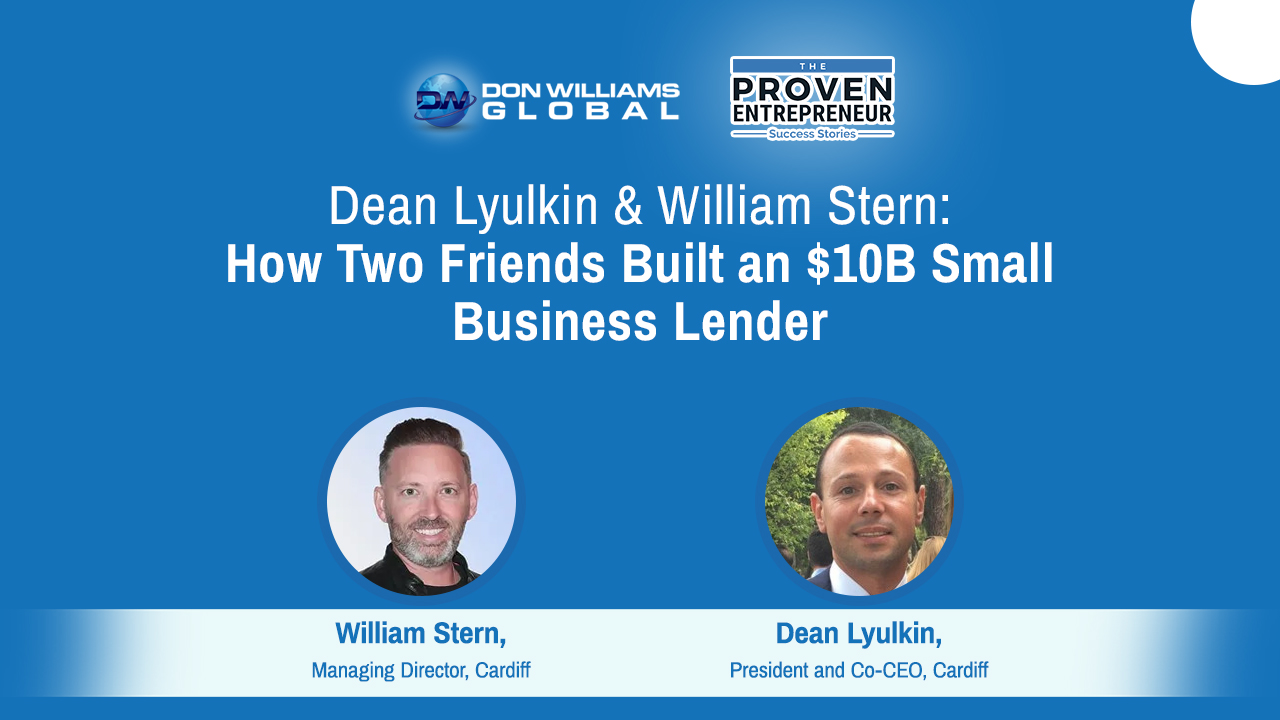
Dean Lyulkin & William Stern: How Two Friends Built an $10B Small Business Lender
Hey, Don Williams here with today’s episode of The Proven Entrepreneur Show. Got a real treat for you today. 140, 150 episodes of the show. The first time we’ve had partners on the show at the same time. Welcome to the show, Dean Lyulkin and William Stern with Cardiff. How are you guys? Oh man, thrilled to have you.
you
Thanks for having us.
You are both, and Cardiff is based in San Diego, California. Yes. Okay. And so tell us, what does Cardiff do? Who do you do it with? I mean, I know, but let’s tell the audience. What do you do? Who do you do it with? Why do you do it? How do you do it? What’s your story?
you
Dean, don’t you take that one? I’ll take the next one.
Wow.
He just threw you under the bus there, team.
Hopefully, hopefully there’s an easier
question subsequently.
So Cardiff’s a unique business. We are a privately held lender to the very small businesses that serve America, serve Main Street. And we’ve been at it for over 20 years and we’ve provided about $10 billion of financing to America’s small businesses. And we like to brag a little bit, but we are America’s favorite small business lender.
think we received that award, what, two years in a row? So something to be proud of. We’re not young men anymore, but we’ve built this business for the last 20 years together, which is extremely unique. And we’ve stayed away from being public or being owned by private equity. So it makes Cardiff a pretty unique animal in this space.
I agree. when you say, you did say 10 billion with a B, yes. Yeah, yeah. Amazing. Congratulations. That’s rare air in any industry. So, okay, we’ll serve this to William and it’s tougher question because he deferred to you. So, you know, every great partnership can look back and find a spark.
with a B.
Yeah.
Thank God.
So what first drew the two of you together and when did you realize that it was more than just a good idea, but you shared a mission worth building?
Yeah, that’s not an easier question, but nonetheless. So I’m going to just sort of go back in time a little bit. So Dean and I became friends really in like late 1989, maybe early 1990 when he first came to America from Ukraine. So I’m going to tell his story, but quickly, right. They left, you know, communist Russia before communism fell and took nothing with them and settled in San Diego after going to
Hahaha.
You know, after being through camps in Europe and trying to, you know, make their way to America, and lucky enough, ⁓ they landed in San Diego, we became friends in Hebrew school. So like Sunday school. And, you know, at the time, I just thought he was cool, right? I was, I don’t know, nine years old, maybe he was 10 years old. And I just thought he was smart and he was funny. And he, he shared the sort of the same
you
You know, the same interests that I did, right? You’re young kids, right? You’re bonding over nonsense. And so we just kept that relationship going. We opened up our first joint bank account at Wells Fargo. I think when he was 13 and maybe I was 12, his grandmother, who was like 80 years old at the time, walked us like a mile each way to Wells Fargo. during the summers, we would take out $5 a day. We would share five rolled tacos, right? We’re based in San Diego.
We’d share five rolled tacos. We’d share one Coca-Cola. And with the money left over, we’d go to our 7-Eleven and play video games. And that was pretty much our summers until, until Dean got a car and, and then we had amazing freedom. We stayed friends through high school. We stayed friends through college. We both went to UCSD in San Diego. Afterwards, Dean went to Fisher Investments in the Bay area and worked.
Early exposure to limited resources teaches discipline that later protects leaders from careless growth. Share on Xhand in hand with Ken Fisher, who’s on the Forbes top 100 richest people in America. He became an equity partner in Fisher Investments at a very young age. Meanwhile, I was down in Southern California starting Cardiff. And to kind of close the loop on this circle, I begged him for three years incessantly to leave his job at Fisher and to come start something down in San Diego. His wife had moved
She was, she’s an attorney and she moved to San Francisco to start a life with him. They bought a house together in San Francisco and they were just getting married. And I’ll never forget the moment that he said, yes, I flew up to San Francisco to help him pack to basically leave his wife for another man, his first wife, which is, which is me. And so, yeah, well, it’s legal now it’s legal now, but, but that’s the story. He helped
from San Francisco.
He helped build Cardiff, I shouldn’t say build, he helped me scale Cardiff. I sort of had the idea, right, I wanted to democratize, I wanted to democratize lending. I wanted to do something that no one else had done. And I was sort of early, right, the technology wasn’t there yet. But I was hopeful. And sort of with the advent of the smartphone really in 2008, a la, you know, Apple.
We were able to quickly build and scale leveraging technology, a blend of both human and digital sort of underwriting. And here we are today. I think we’re closing in on at the end of this year, it’ll be over $11 billion deployed to Main Street. So a lot of money for two elementary school buddies on a budget.
Yeah, love that. Okay. So I don’t know if this is an easy question or a tough question. I’ll let you guys arm wrestle as to who gets what. So clearly, know, Cardiff is something pretty special that you’ve built and scaled together. Most partnerships, you know, there’s kind of a yin and a yang effect. mean, you, have different skill sets. So here’s a tough one. How do you handle it?
when your strengths or opinions are different or collide.
I’ll tell you a little bit about why this thing works.
So we’re different people with different skill sets, different ideas, different visions. But we’re also similar in a lot of ways in our ambition and our upbringing in terms of who we are. So kind of the core of who we are. And what makes this specific thing work is that one of us
really wants to specialize and dig deep on one particular subject matter. And really lets everything else kind of go and be run by other folks. And the other one likes to be very broad, but is extremely lazy. And so this, this approach to business
Ha ha ha.
Amazingly enough, right, because we’re intelligent enough. This specialization and hands off attitude towards a lot of things inside the business combined with a very broadness that combined with some really strategic laziness, as I like to say. What that allows us to do surprisingly is not fail, but to build because that combination allows us to build other people and leaders within the organization.
So you would think laziness is a destructive force inside of a business, but really what we mean by laziness is delegation. And so when you are lazy, you want other people to do things for you. And while that might be negative when we talk to our kids and their approach to school, inside of a company, laziness is actually a powerful multiple.
Because what laziness allows you to do is to not be a small business owner that wants everything done exactly the way they want it done. But to say, hey, Bob, Jill, you do it the 70 to 80 % of the way. That’s the best way you know how to do it. And of course, we were there to help along the way, but we’re not there to micromanage things. And so, you know, for better or worse, that’s that’s been
Small businesses are the backbone of Main Street, yet they are often the first to lose access to capital when conditions tighten. Share on XYeah.
Those have been powerful forces that helped shape the business and allowed us to build other people into leaders.
Thank
I love that. Thank you for sharing. So many times I think the best business leaders really just do one or two things. One, they cast and communicate the vision to the troops over and over and over and over and over again to where everybody is crystal clear on the mission. And then just go get the best people on the planet to help make the mission happen and give them the tools to do it. And many times that’s the best way to go.
Yeah.
And I loved your comment on laziness. can remember when my youngest son was, I don’t know, 10. I’m going to meet your teacher night and the teacher says, what do you do for a living? And he says, well, you can tell he doesn’t work. I mean, look how he’s dressed. And I’m wearing a t-shirt and shorts and I’m like, Hey, just because I make it look easy doesn’t mean I’m not doing something. And so he sees it a little different today, but that was, that was funny then.
You
That’s right. Yeah.
Yeah.
And it’s interesting, you know, like over the years, if you look at the metamorphosis of us as people, there’s a lot of change that’s happened over the last 20 years. And we’ve had to get really uncomfortable with sort of evolving from what we thought we were early on. You know, probably if you, if you asked us 20 years ago, like, you know,
Thank you.
who are you from a professional standpoint, you would say, well, Dean, you’re analytical and William, you’re a salesperson. And I think first we worked hard on getting Will to be comfortable not being a salesperson. He hated that because that’s what he identified with. And he became like an elite marketing genius over the last 20 years and not a salesperson.
That’s right. Yeah.
And for me, I was able to sort of metamorphosize, if that’s even a word, but sort of evolve from being this kind of analytical person, likes to research things, likes to think through things into being comfortable being more of a salesperson, right? And even helping a little bit on the marketing side of things.
I think that’s another sort of, know, together with laziness and specialization, delegation, all of these things have contributed to building this really cool business.
Well, and I think the fact that you embraced growth, which, know, real growth is uncomfortable because you’re going places you’ve not been. And if you’re not going places you haven’t been, you know, you’re probably not actually growing, you know, as a person. So did you ever have a make or break moment? So things are tough, cashflow, clients, conflict, where you thought, ⁓ are we doing this?
No.
No,
no, we can end it now. We’re good. Yeah. No, were plenty. There were plenty of times, right? We call them existential crises, right? And by the way, Dean, you were asking a question, metamorphosis, is that a word? Franz Kafka would argue. Yeah, right. That is a word. So how to scoot is that one. But for all the, for all the, for all the people that still know how to read books. So
had a couple of those.
Thank God.
Yeah, we had our existential crises. So, know, Cardiff was started in 2004. I was 24 years old. Dean came aboard three years later and he had perfect timing, just perfect timing. Because what came less than a year later, maybe a year and a few months later, actually, it was six months. Interesting. Well, what came was the financial crisis of 08, which
six months.
Ha ha ha.
you know, which not tangentially had an effect on our business, but it was a financial implosion, meaning that it touched everything that was associated with the monetary system. wasn’t just, you know, real estate and those, you know, the network of other sort of industries adjacent to it, right? Like escrow and title and, you know, those types of sort of verticals.
No, it touched commercial finance too. It tightened the gears of finance to such an extent that the wheels of the economy grinded to a halt. Just imagine this huge locomotive, is the wheels of commerce just grinding to a halt, almost perfectly timed with Dean’s arrival at Cardiff, his wife’s in San Francisco going, what on earth did we do?
I mean, they’re planning a wedding actively. So, you know, more than I want to focus on the turbulence of that relationship and sort of what was the root cause, right? No, it’s fine. No, I’m sure she doesn’t hold it against me whatsoever. But no, you know, the 08 financial crisis was huge, right? Like I was saying, the sort of gears of commerce grinded to a halt.
We’re still married, it’s fine.
Ha
Dean’s fault,
he broke it.
No, absolutely. was, but yeah, he touched something he shouldn’t have. That’s what we tell our kids. But no, you know, banks had to come to Jesus moment. The federal government, right, with the Dodd-Frank Act, forced banks to like take a hard look in the mirror and say, hey, we need to recapitalize. We need to keep more cash on hand. And to do so, the the person that we will
You know, it’s like, it’s like duck duck goose or whatever. It’s like the one person they’re not going to tap on the shoulder are small business owners, right? Everybody. It’s like Oprah Winfrey. Everybody gets a car. Well, banks are like, well, everybody can get a loan. You can get a car loan. Why? Because there’s an asset. You can get a home loan now. Why? Because there’s an asset. But the one person that never got chosen was small business and never that relationship never ameliorated.
to use another big word that Dean tried to use earlier. I just piggybacking off of that. But it never ameliorated, right? It never got better. That relationship between the large banks, the five large banks in the US, not to mention the consortium of 10,000 sort of small and regional banks in the US. They never wanted to sort of reengage with small business owners. So we took advantage of that. And then going back to the question of existential crises,
We had another one, which was COVID. If the government says as a business, you’re not, I mean, especially in California, right? Big population centers flying that, you know, woke, you know, sort of blue flag, right? They shut down commerce, right? They wouldn’t allow restaurants to operate. They wouldn’t allow, they wouldn’t allow you to eat outside or inside. You can’t go to movie theater. Good God. I mean, they’re filling in, you know, skateboard parks and
Cash is not a growth strategy; it is a survival requirement when uncertainty removes all other options. Share on XHmm.
with sand from the beach. I mean, it just made no sense. So you could just imagine if small businesses can’t not even proliferate. We’re not talking even expand, but if they’re not even allowed to operate, well, how do they pay back their debt to us? Now is it come to Jesus moment for us, for all the small business owners that are listening, keep dry powder on hand. Cash is the one, is the one non-negotiable that will save you nearly from any crisis.
Mm.
Yeah, I agree. All challenges are better with a big bucket of cash, no matter what they are. Okay. So, last question, even though I can already tell, I want to recall both witnesses to a future episode, and I’m pretty sure I want Dean’s wife to join us to where I can get the lowdown. But last question, fast forward five or 10 years from now.
That’s right.
What does success look like for the two of you?
I think, know, for me, the best, it’s funny we watch so many podcasts, you know, these days, right, we don’t watch television anymore. So you’re exposed to so many people’s definitions of success. And I think the most recent and best one I heard was just the ability to do the things you want to do with the people you want to do them with whenever you want to do them. ⁓
Success is being able to do what you want, with the people you want, when you want. That doesn’t mean not working. It means choosing. Share on XI think that’s a great definition.
Yeah, yeah.
And you know, we’re almost
there at this point. So I think more is better. So, you know, five to 10 years from now should just be doing the things that you want to do, which by the way, doesn’t mean not working. It’s just working with the people you want to work with and working on the things that you want to be working on and enjoying life in the way that you want to enjoy it on your own terms. I think that’s, know, that’s the American dream. That’s freedom.
Love that.
Yeah,
yeah, I’ll add to that because I think, you know, Dean and I have been very blessed, very lucky, right? We built a business between two best friends. And then later on down the line, we recruited two other best friends to come work with us and share in the success. It’s a unique story. And in fact, you know, I’m writing a book right now that says they lied to you work with friends.
Cash is not a growth strategy; it is a survival requirement when uncertainty removes all other options. Share on XAnd it’s just been the most rewarding experience when you talk about success. You know, everybody has their own definition. Generally, the gravity of it, right, the center of the universe or whatnot is money. Some people are ashamed to admit that. But as you said earlier, Don, right, most problems in life, right, are better tackled with a big bag of cash. That’s, know,
It’s the truth, right? That’s just kind of how the world works. It’s just, you know, it’s not even about, it’s not about hoarding or the accumulation of wealth, but rather it’s a tool, right? It’s a tool to get the best medical care, right? It’s just a tool. And so hopefully people will become, you know, more aware that these tools do solve real world problems and there’s no reason to be shy about it.
the truth.
But going back to the idea of success, separate from the money aspect, you know,
Recently, there was a Buddhist monk on Chris Williamson’s podcast, I think, and they asked the same thing. said, Chris Williamson said, well, you do you want success? Do you want happiness? And the Buddhist monk replied, I don’t seek out happiness, right? Because I’m going to paraphrase here, but the flip side of happiness is despair and sadness. So I don’t seek happiness. I seek being content.
I don’t seek happiness. I seek peace. And once you find it, you should fight like hell not to lose it. Share on XHmm.
I seek peace. And I think peace is the best way to describe, I think, what I’m after. It’s been a tumultuous journey starting Cardiff, right, and then improving and iterating on the recipe, right, with the advent of technology, the smartphone and APIs, going from direct mail marketing a million pieces a month to then realizing that
The war is actually being fought on this, right? The smartphone. And so having to like, just imagine being trapped in a casino in Las Vegas and sort of the winds of change are pushing you and pulling you in different directions to, know, slot machines, to table games and back and forth. And you’re not sure where to lay your bets. And if you lay the wrong bet, you don’t just destroy your own livelihood.
Yeah.
your wife, your children, their futures and employees and their families. And it’s been 21 coming on 22 years next April, 22 years of intense double downs and splits and asking for more markers, right? Like, can I get another marker? And I think, you know, as we pivot to the next era, I seek peace, right?
I, you know, as you gain wealth, you stand to lose more than gain more. And that’s the sort of 2020 in hindsight sort of can only be earned and not given sort of lesson of life, which is find peace. And when you have it, fight like hell, right? Fight like hell to not lose it.
Hmm.
Thank you. Appreciate that. So, hey listeners, if you’re looking for business financing of about 10 different methods, you can go to cardiff.com. And, and it’s pretty easy peasy to find out if you can get some help. And so if somebody wanted to reach out to either of you gentlemen, what’d be the best way to do that? Through the website, LinkedIn.
done. Yeah, if you’re looking to, you know, if you’re looking for financing, it’s www.cardiff.co.
Oh .CO, sorry.
⁓ Yeah, no, that’s okay. And our whole thing is approved in minutes funding same day. But if you’re looking to reach out to me personally, it’s, you know, joinwilliam.com.
Okay, awesome. All right, guys, thank you so much. I do reserve the right to recall the witnesses. We’ll talk and see if we can get Dean’s wife to join us. I’m sure she knows part of the story I want to know. I’m really grateful. Thanks.
You
Thanks Don, appreciate you. Bye bye.
Nice to meet you, Don. Thank you.
That’s today’s episode of the Proven Entrepreneur Show. See you next time. Thanks.