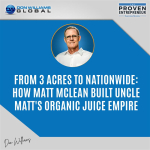
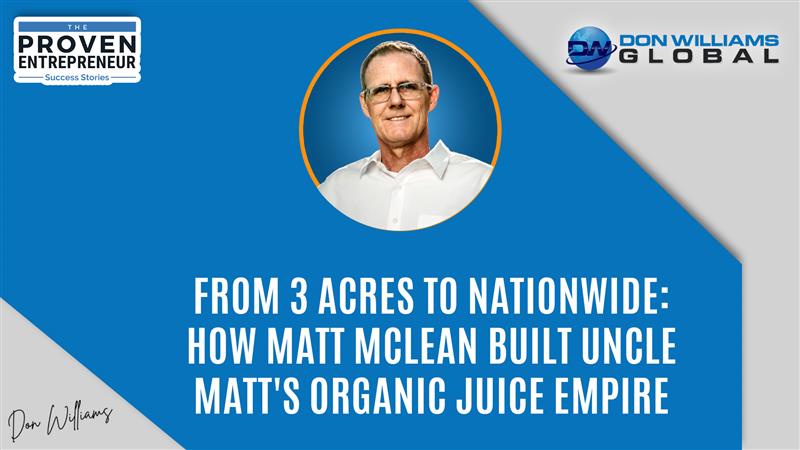
Join Don Williams as he sits down with Matt McLean, the visionary founder of Uncle Matt’s Organic, in this inspiring episode of The Proven Entrepreneur Show. Dive into a captivating narrative of entrepreneurship that begins with a family legacy in citrus farming and transforms into a nationwide organic juice brand.
Discover how Matt turned a simple request from a German client into a game-changing business opportunity, pioneering organic juice in the United States before the USDA organic seal even existed. Learn about the challenges he faced, including the devastating citrus greening disease that threatened to destroy his entire business, and how resilience, prayer, and strategic pivoting became his ultimate survival tools.
Key Highlights:
- The journey from a three-acre family grove to a nationwide organic juice brand
- Scaling strategies that took Uncle Matt’s from local markets to major retailers like Publix, Kroger, and Whole Foods
- Overcoming the citrus greening crisis by developing global supply relationships
- A remarkable business comeback story, including buying back the company during the pandemic and more than doubling its size
Matt shares candid insights about entrepreneurship, including the importance of persistent yet respectful relationship-building, the value of family support, and staying true to your passion. Whether you’re an aspiring entrepreneur, a food industry enthusiast, or simply love an inspiring business story, this episode offers valuable lessons in innovation, adaptability, and perseverance.
Don’t miss this extraordinary tale of turning agricultural roots into a thriving organic juice empire!
For information on how to work with Don visit us at https://donwilliamsglobal.com
You can also reach out to Don Williams at https://provenentrepreneurshow.com
Don’t forget to subscribe to The Proven Entrepreneur Show for more success stories, actionable strategies, and the best of entrepreneurial wisdom!
Watch the episode here
From 3 Acres to Nationwide: How Matt McLean Built Uncle Matt’s Organic Juice Empire
Hey, Don Williams here with today’s episode of The Proven Entrepreneur Show. The show where proven entrepreneurs share their story to help you learn and improve in your own entrepreneurial journey. Our guest today, I am so excited, is Matt McLean of Uncle Matt’s Organic. Matt, welcome to the show.
Okay.
Hey Don, thank you very much for having me today. I appreciate the opportunity.
It’s my distinct honor, so happy to have you. I think you’re one of the pioneers in organic foods. I have a little sister who, she was buying organic, we’re coming up to Thanksgiving, this will air probably a little after Thanksgiving. She was buying organic turkeys 35 years ago when they were hard to find. Yeah, and now pretty common.
Wow, okay.
We’ve learned the wisdom of eating clean food that doesn’t have a long list of ingredients. Eating food that is the ingredient. Yeah, yeah, that’s it. Yeah. So.
Right.
Right, there you go. There you go. Well, she was way ahead of her time 35 years ago.
Yes, she was. her older brother, I’m embarrassed to say, of poo-pooed her on her choices. And as is often the case in my life, the women are generally right. And if I disagree, I’m just not. So Matt, tell us a little bit about the business you’re in now. How long you’ve been in business?
What do you sell? Who do you sell it to? How do you sell it? Tell us about Matt’s Organic.
Yeah, thank you. So we were founded in June of 1999. This year we’re celebrating 25 years in business. Kind of hard to believe about that. Big accomplishment. Yep. So we’re kind of one of those organic pioneers have been, we were actually organic before the USA organic seal came out in 2002. So we were farming organic for a while, but we have become America’s
We were organic before the USA organic seal came out in 2002. Share on XCongratulations.
The number one selling organic orange juice brand and grapefruit juice nationwide. From a little tiny beginning here in Claremont, Florida, which is just west of Orlando, used to be surrounded by citrus. Now we’re more surrounded by homes. But we started with three acres in my dad’s backyard. We turned it organic. From there, we have grown to over 15,000 doors nationwide. You can find this public Sgroger, Whole Foods, Sprouts.
Walmart, a lot of different doors. You can find us from Hawaii to Alaska to Maine, even down in Puerto Rico. So we’ve come a long way from business, but we still feel like that little challenger brand. We compete every day against Tropicana and Simply, Coke and Pepsi, the two biggest beverage brands in the world. So while we’ve come a long way, we still have a long ways to go.
as we get more penetration with households and in the market.
Well, but love that David and Goliath aspect because, you know, your competitors are like mammoth, huge, ginormous, like big, big, big. Yeah.
Yeah, pretty much unlimited resources that you’re going up against, but it does give you the David Goliath every day, which is fun for that analogy because we do feel that way. And we’re more nimble than Goliath and we hope to beat them in different places and spaces.
was getting ready say, and David did prevail.
He did. So we have that. That’s definitely the heart of David.
Yeah, David did prevail. Okay. I’m going to take you all the way back to little Matt McLean. Okay. So like you’re five years old, no more, no more than 15. You’re in your family home. And what we want to know is, was there an adult who set an entrepreneurial example at your kitchen table?
Got it.
Yeah, I mean, my father, he had his own business. He had his own Grove caretaking business and he owned his own Citrus Groves. And so he was a citrus consultant. He also went out, they had a harvesting company and a caretaking company. So he was the entrepreneur. He was his own boss for a long time. It wasn’t always that way, but he was the entrepreneur in the family.
Awesome. you overheard some of those conversations at the kitchen table about payroll and employees and customers and operations and marketing and all that stuff. You grew up with that.
Absolutely. And then also was plugged into being one of those employees. And I joked for the longest time at Uncle Matt’s, I was the employee he never paid, you know, and then he’ll joke, well, that was room and board was free, buddy.
Yeah, yeah, awesome. So tell me, was your first job working for your father or did you actually work someplace else where you turned in your effort and received a check?
Yeah. So I mean, in junior high and high school, I started when I remember eight years old helping however I can out in the groves with dad and his consulting clients and business. And it was great. While it was hard work, it definitely taught you how to persevere and the credits you get for a hard, hard day’s work. And then later, as I became, you know, 10th, 11th, 12th grade, I then ran a little crew for him. And so I also
learned leadership skills, how to lead other young men, how to be responsible, and all the things that go along with being your own small boss and leading team members. So those were key things for me growing up. I was taught by my dad with just entrepreneurship skills. And then I went off to college. It was…
Yeah, I was ready to get out of the hot Florida sun and try to do more on the business side. And so I got a degree in business administration with a specialty in finance and a minor in economics. And then from there, I was ready to get out of agriculture. didn’t take any ag classes at all. And it was no ill will towards my upbringing. I just felt a calling to do something better than drive the tractor out in the grove.
Yeah. So funny you say drive the tractor. My first, my grandfather was a wheat farmer in Kansas and my first paying job was driving a John Deere tractor at wheat harvest. And I think I was 11. I don’t think they probably let 11 year olds do that today, but it was a different world back then. and so they didn’t think anything of it, you know, sit your butt on that tractor and drive it until you get done with the field.
Haha.
Yeah, correct.
I mowed a lot of groves with a case, a little case tractor and a five foot bush hog behind me. And I did two passes per metal. I mowed hundreds and hundreds of acres on that little joker with a five foot bush hog mower.
Yeah, there you go. so, you know, I look back at that. I didn’t look fondly on it at the time, but I look back at it fondly now. I learned some really good lessons. I learned what hard work really was. That and digging fence post holes by hand for our fence. I learned what hard work was. I learned that while I love to be outside, I did not want to be in agriculture. And it
yeah
It pulled you back. did not pull me back. So that’s awesome. Okay. So what, so after your childhood at home, you went off to university or college. Where did you go?
Yes, I went right up the road. The land grant university in Florida is the University of Florida. My granddad, my dad, my mom, my brother, my brother-in-law, they were all Gators. And so University of Florida was kind of the path that I went to. I grew up a Gator. Go Gators, if you’re a Gator listening. And like I said, at that point, I decided I was going to get a degree.
in business actually started off like everybody was either pre law or pre med, you know, boy, I was even what makes the most money. my gosh, that’s what I’m going to be. And it didn’t take long to realize I may not be cut out for pre med or pre law. It was biology or chemistry. I just realized like that’s not going to be my specialty. So God had a different plan that pushed me out of being a doctor or lawyer. And it really was business. I just I loved business growing up.
And when I started studying business, it really resonated with me. And from there, the rest is kind of history when I got out of college to stay in business and start my own business.
Yeah, awesome. So when you graduated as a Gator, was your, did you take a job or did you immediately put that business degree to work as an entrepreneur?
Yeah, so I had some, I graduated and I had a couple opportunities. I actually didn’t think I would get back into agriculture and kind of the family business. I still had that goal of charting my own course and I had some opportunities in sales. Went and applied for one business job that sold business forms and stuff. And it was a territory sales manager. Another was computer software. And I got offered
one of the jobs and kind of went back and forth. Boy, do I want to do that and move to Jacksonville. And at the same time, and some just didn’t feel right. Like it didn’t really, there was no necessarily passion about it. didn’t like, okay, yeah, I could sell that. And at the same time I had an opportunity with my father. He introduced me to one of his growers who was a client of his who was German. And this gentleman said, hey, I’m really looking for somebody to help me. I want to import Florida.
orange juice and grapefruit juice, I have friends in Germany that own bottling plants. And if somebody can help me go around Florida and find great tasting juice and help me buy it, we’ll ship it to Europe and I can sell it to my friends there in Germany. And I think there’s a whole lot more opportunity besides just the handful of bottlers that he knew. And I said, well, geez, let’s see. Okay. So start my own little business, go around the juice plants and I get to travel to Europe.
I’m in. Okay, sure. So that off I went, I started a little import export business and went around to the 35 different juice plants in Florida. And we found, you know, conventional orange juice and grapefruit juice. And we shipped it over to Holland to the port of Vlissingen. And from there, he imported it and took it to the different viling companies in Germany.
and later in Europe and then later we did this in the Middle East. And so that’s where I cut my teeth on juice quality, really knowing what makes great taste in orange juice by variety, Bricks, acid ratio, oil content, all of those things make up a good quality juice. And so I really learned from the French and the Germans over in Dubai, different taste profiles.
and what really was, you what was a sweet juice, what was an acidic juice, the timing of the varieties, all of those things. And it also happened where my aha moment came. Like most entrepreneurs, they have that one, you know, what is it that really gets you there? And I was, I was doing fine. had a juice brokerage business. I was making good money. I was self-employed. I got to travel abroad. Life was good for me right out of the gate.
Until I found, I got introduced to one German customer and he asked me about biologic. He said, I need to find basically organic, grapefruit juice. And I had no idea what that was. I said, sure, Mr. Noy, I w you’re a great customer. If you want it, I’ll go find it. And that set me down my whole uncle Matt’s organic journey. cause I came back and besides figuring out, you know, where I could find organic grapefruit juice that I would then would get processed.
put in a drum and send to him, I needed to figure out what was this market, what is even organic? And there was no organic Tropicana or simply in the marketplace at that time. And this was probably 1996, 97. So for me, thought, hey, trends usually come from the food industry. A lot of them will come across the pond from Europe into the US. And if this started to really take hold in Europe, this could be something in the US.
But I knew nothing about CPG, consumer product goods. I knew nothing about, you know, how do I get a Tropicana or simply equivalent product onto the market shelf? I knew quality juice. And then at the same time, I didn’t know, can I supply it long-term? How could I scale this business? And luckily for me, my granddad was still alive and they’re the agronomists. My dad, my brother, my granddad, they were the real agronomists in the family. They were the growers. I went to school for business and
was on the other side of the growing. And so I went to my dad and granddad at that time and really asked them about organic farming and is this viable? Is this something that we could scale? What is the long-term potential in Florida? And my granddad, he was offended and chuckled and said, you know, I’m old enough to remember, you know, buddy, we did this before pesticides were invented after World War II.
And we planted cover crops, we put down compost, we did all kinds of different things and nobody called it organic, but it was organic farming. And it was really at that point in his life, this was at the end of my grandfather’s life, he just said, you know, this is really how we should go back to farming. A lot of those methods were not ever disproven. They were just displaced by new technologies that came out, know, ammonium nitrate and urea, some of those other synthetic fertilizers.
that people fell in love with and then the university started recommending him because they got a lot of money and funding to do research on it. And so he got excited, which then excited me and gave me a passion. You know, it made sense from my standpoint that, hey, okay, I don’t need to spray a lot of pesticides to do organic. It’s not allowed, number one. And those things, if you just look at the label, they have skull and crossbones on them. And it just was very common sense for me simplistically going,
Well, if I can do it without the skull and crossbone, that would be a better way for the environment. That would be better if I was to consume it. I would have less chance of having any of that on the product. And so off I went, young and dumb, at a very young age of 27, figured out after a couple of years, how do I come up with a CPG brand? What do I call it? And how do I do this? And I launched Uncle Matt’s in June of 99.
thrilling story, a couple of accidental twists and turns, but you were open-minded enough to say, yes, if that’s what you want to buy, I’m going to find it. And I’m a big believer that all progress starts with a yes. Catastrophe is sometimes avoided with a no, but progress requires a yes.
E113 | From 3 Acres to Nationwide: How Matt McLean Built Uncle Matt’s Organic Juice Empire Share on XYes.
Mm-hmm. Yep.
Yeah. Right.
And we’re all in the business of serving clients. And so the client wants this and I’m going to help find it. And interesting, my grandfather, who I said was a wheat farmer, you know, they used ammonium nitrate, you know, huge. And today in that area, he has since passed, but today in that area of Kansas, many of the farmers only spot fertilize.
Yep.
Literally used GPS and the tractor and, and, and Mark spots where they will fertilize and almost all have gone to no till where, you know, back in the day, I was disking the field an hour after the combine had cut the crop. mean, literally the day of harvest, we’re flipping the ground back over and, now they just, they don’t flip it over at all.
Yep. regenerative, yeah, regenerative practice, no till.
Mm-hmm.
Mm. Yeah.
Yeah.
And those little stalks act like straws for the rain, you know, to where the rain goes subterranean instead of sitting on top. Partially anyway. So great. Okay, so that’s kind of how you got started. Okay, but today Uncle Matt’s is a pretty big company, yes?
Yeah.
Right.
Yes, we are. Yep, good size. I mean, we’re no longer the small little, you know, entrepreneurship company. We’re the next step. We’re now doing our own manufacturing. So we have our own bottling facility. I think we have, I don’t know, total 75, almost 80 employees, which is good size and producing a lot of product to feed a lot of people nationwide.
Yeah.
Yeah, love that. So, we kind of got the launch. Tell us a couple of steps in how you scaled to selling organic juice coast to coast and kind of top to bottom Alaska to Puerto Rico.
Yeah. So in beginning, it was a lot of hustle, a lot of heart and hustle, trying to find the right connections that really could help me prioritize which accounts that I should even go into. Because organic is not for every account and especially wasn’t in the beginning because it was higher priced. People didn’t know what organic was. So had to be pretty particular. We started with
you know, local high end grocery store chain called Goodings and a local chain of health food stores called Chamberlains. And between those two, had, you know, that and some other natural food stores made enough business for me to get into business and get going. And then from there it was hiring another, a good broker rep who acted as my sales team, cause I was a one man band. And so they would take our product and go sample it to a lot of different stores up and down the East coast.
And then I would add another distributor here or there that would call on those new chains and accounts. so I just organically built the business store by store, state by state until you get some big accounts. so like Publix, they called me after two years of knocking on that door. They called me on 9-11. The first tower had just fallen and
I was a little bit in shock and I had called on Publix for two years and the last time I went in, I went in on the sales pitch with three generations of McLeans. It was myself, my dad, my granddad. And we sat in front of that buyer, Raul Garcia, super nice guy. All the harassing I did to him, probably should have put me in jail.
because I was always calling him and, you know, I’d love to sell you something. And he was so professional and polite and just a great, humble guy that he just said, hey, you to be patient. When the review period comes, don’t worry. I’m going to let you know and you’ll get a chance. OK, great. So I went in there with three generations, sat in front of him. And, you know, obviously, we finally got our chance. And so when the review was finished, he called me. It just so happened to be.
That was the day he was calling everybody to tell them if they got in the set. And he said, hey, Matt, this is Raul Garcia. And I remember I answered the phone. I only had one employee. And unfortunately, she was from New York City. And she had some friends that potentially were in one of the towers. And so she was very distraught. And I said, hey, you need to go home. I’m really sorry. pray for favor up there and that nobody in your family close to you was hurt.
I literally answered the phone like, Uncle Matt, how can I help you? Raul Garcia. hey, Raul. He said, on a really bad day, Matt, I’m going to give you some really good news. We’re bringing you in. And she’s like, I’m not sure how to feel here. It is a really bad day, and this is really good news because I knew it was the next level for my company. At that time, Publix had about 1,000 stores, maybe like 900. And that was just a big day.
completely tripled my distribution and store account, took me to the next level of scale and capabilities and just legitimate in the eyes of consumers, household penetration. And so that was the next plateau. And then after that, I remember I got the call from Kroger in like 2005 and then like 2009 was Whole Foods Nationwide. And they just kept building momentum and building momentum. And before you know it, you’re nationwide.
And you’re in, you know, a lot of stores and a lot of doors. And so, that was my big aha one moment there with Publix and breaking through to the next level of becoming a real brand and a real presence.
Well, I love that. And a couple of principles that you shared one, you know, when you have the grocery rep, he’s going out, he or she, they’re going out and asking people to buy. And one of the things I’d tell everybody is if you’re not selling as much as you want to sell, ask more people to buy every day, every day, ask more people to buy. And then with Raul Garcia, sounds to me like you had become quite acquainted before that fateful day.
Correct.
Yeah. Yeah.
Yeah, to where he knew you and knew your voice when you answered the phone. Persistence! Stay at it!
Yeah, he did. I was very persistent. was all heart and hustle, but respectfully persistent, right? If you’re not respectful, that’s not going to work. You’re going to annoy the people in the buyer and they’re going to say no thank you to you.
Absolutely. Okay. So think back over your career and what I want to look for here is a, is a hard moment. So something happens. and when it happened, it’s like, that hurt. Now in retrospect, you know, looking backwards, maybe it was a positive, but, sometimes at the moment they don’t.
Mm-hmm.
Sure.
feel very positive, they feel really negative and ouch. Do you have a hard lesson, a hard moment you can share?
yeah.
yeah, mean, and every entrepreneur, let’s see, what time is it today? Give it a little bit more time. There’ll be another hard moment. It’s just business, right? You ride the waves, highs and lows. The biggest thing for us was when citrus greening disease showed up in Florida in a big way. And that is, it doesn’t affect humans. It’s this bacterial infection just infects the tree.
Yeah.
and it clogs up the main artery of the tree and it’s spread by a little, little psyllid, which is an insect. It bites the leaf and it transmits this disease into the tree. And so the tree then eventually dies, becomes nonproductive. The fruit never gets ripe, hence the term greening, it stays green. So from our standpoint, we were hunkle mats.
Started in June of 1999, 2002, we formed another company for fresh fruit and we began growing a lot of our, we would grow all of our own citrus. So we started our own supply base. We converted over 35 different growers, over 1500 acres. My dad and brother, the agronomist were taking care of all of it. We had our own separate company for caretaking of, you know, our own tractors and mowers and
everything that was needed to take care of the Grove organically. had our own, you know, IP for our farm plan of what really was the right cover crop to grow and what kind of compost and sprays and all that. And we had institutional money lined up to help expand and buy more Groves. 600 acres we owned of the 1500. We had private equity money to help grow our brand. So we had it all lined up to be this perfect long-term juice and fresh fruit.
stalwart and then the little bug shows up and our groves start dying and our production starts going down and growers no longer can make money when they don’t have fruit to produce. And then on the flip side of that, our product doesn’t taste as good. So now I have two problems. have our growers that are, their trees are sick and dying. I have our product that doesn’t taste as good and consumers are complaining.
And I have a big come to Jesus meeting with myself of, this could literally be it. Like, you know, Elizabeth, this is the big one, as Fred Sanford would say, this could be it for my company. have a, we had a lot of debt that would come of that. But we had to pivot and we had to pivot pretty fast. And luckily, our reputation and our integrity.
We were able to find other suppliers in Texas and Mexico that had asked for a long time, know, hey, we know your competitors with us, but if you ever need additional product, we have it. And so we had to start pivoting quickly to bring in from these other locations. And I was the proudest fourth generation Florida citrus grower that you’ve ever met. And it was, you know, on our label all Florida forever. And you’ll never, you’ll see me, you know, wave another flag.
And I had to quickly pivot and realize that this could be the death blow for our company if we don’t change. And so that’s what we did. We developed really a lot more friendships in Texas and California, East coast of Mexico. And now globally, we have other relationships developing in other countries to help with high quality supply. And so that was the biggest is as that then unraveled in Florida.
Today we have three growers left, 75 acres in Florida, and it’s all for research and development to try and find a cure for graining. So a completely different model than what we had up until 2015. So up until 2015, everything that went into Uncle Matt’s, I had a hand on and we grew it and we had control of it and we had to pivot. And the whole industry in Florida has to pivot even.
Florida’s Natural, the largest co-op, is now product of other locations because they suffered the same fate as we did. So that was the biggest moment of almost death and destruction and defeat. But a lot of prayer, you know, the little slogan is, pray and do not lose hope. And that’s what I live by, and I’m a living proof of it. I’m always hopeful. So there you go.
Pray and do not lose hope. I'm always hopeful. Share on XWell, I love that. Thank you for sharing. It reminds me of something Zig used to say, be firm on principle and flexible on method. you know, sometimes that pivot, you just have to see things a little differently, but on your other eyeglasses and put on those rose colored glasses and see if you can find a rose somewhere. Sounds like you did that. So awesome.
There you go. Yep.
Mm-hmm.
Yeah. Yeah. We did. Yep.
Okay. What about a warp speed moment? Things are going pretty good. And then all of a sudden, my gosh, we’ve, we’ve unbelievably grown the company. you have a moment like that.
Yeah, you know, we got to a point where we we sold the company. So we got to 2017 and as a family decided we were going to get our minority partner out the private equity group. It was time for them to exit. And when we started looking at the opportunities, really nobody wanted to just replace a minority investor. They wanted to buy the company. And so we kind of weighed the options of, hmm, OK, take on a lot of debt.
Or is it a good time to exit and we just come through the citrus green debacle and boy, that was a scary time. So we decided to exit. My wife and I stayed on with Dean Foods. They were the largest dairy company in the US, a dairy conglomerate. $8 billion with a B. What do they have? 70,000 employees, 60 or 70 plus plants, 6,000 trucks every day. DSD milk is ubiquitous. It’s everywhere.
And I stayed on my wife and I to help continue to run the company, be a good steward of the brand. And in November of 2019, they filed bankruptcy. I would have never ever guessed that company that large, that big, that strong, they had too much debt and dairy was dying. Plant-based milks were rising. They were just on the, they couldn’t close their plants fast enough. Capacity was gone and they went bankrupt. And so I’m sitting there at the beginning of the pandemic going, Ooh.
maybe I should buy this back. And then at the same time, like, do I, that’s kind of a crazy idea because the country is like in turmoil, the globe’s in turmoil. Maybe, maybe that’s not the right thing to do. But we decided, you know, a lot of good prayer on it. And, you know, no, I really still love uncle Matt’s. It’s my passion and I got a chance to buy back. So let’s go buy a pack. And so that’s what we did. And then from there, since, you know,
June of 2020, here we are 2024 and we’ve way more than doubled the business. We’ve had some real hyper growth. You know, the pandemic pivoted a lot of people back to just health and wellness. What am I putting in my body? Vitamin C was really big, C, D and zinc were huge, you know, kind of the natural supplementation to fight COVID and stay healthy.
We introduced a new product right as soon as I bought it back, we quickly pivoted and brought out a product called Ultiman Immune. We took orange juice. We added elderberry, which is known to fight colds and flus. And then we boosted it to 300 % vitamin C with acerola, the high antioxidant fruit, and boosted the D and the zinc. And so we kind of had our own little covenator in a bottle and it tastes fantastic. And so that had rapid growth.
Today, it’s still one of our top selling items, even though the pandemic is long gone because it’s just a good, tasting beverage with health and wellness. So that would be my interesting rocket ship time. There were many other times where, you know, like when Publix came on or Kroger or Whole Foods where you got that great jolt of a thousand to two thousand new doors, but, know, the pandemic story and buying it back and then, you know, having to rehire your team and.
all of the unknowns around the pandemic, but then it really rewarded our risk because we’ve done a great job with the new team.
What a great case study in entrepreneurship. I’m presuming you told here you bought somewhere south of that.
Bought at bankruptcy. Yeah, bought out of bankruptcy price for basically the cost of the assets, the juice that was on an inventory. More than doubled, or a good bit more than double the company. So we’re in a good spot. And now we’re self manufacturing. So as of a year ago, we copacked for the whole life of me. We had copackers around the, you know, up and down the East coast in the Midwest that we would send our juice to.
and then doubled the company.
and our formulas and they would bottle for us and then we would sell it. So, you now we’re at the position where we have brought it all internal. We’re in control of all of our own quality. We have our own facility where we bottle with new state of the art equipment, which allows us to be much more nimble and creative and innovative and has led us even into the path of doing organic, cold chain, fresh brewed tea, which is fun. And so we’re
throwing our hat in a couple different rings to just to see why we have that competitive advantage of being in Texas in the middle of the country and doing our own thing. Are there some other things that our brand could, other places and spaces that we could play in?
think you just like being David. Okay. I think you just like it. Yeah. I’m going to T. There’s only a couple little guys in T. Yeah. So love that.
You made me write. Yeah. Maybe I just like to be challenged, right? think you probably, you may have hit on something there.
It could be, and you know, in a way, I mean, the thought that’s running through my head is Matt’s the Steve Jobs of citrus, you know?
I don’t know about that. That’s a really, he’s a whole lot more successful than I am for sure.
No!
Well, forget the zeros maybe, but you know, sold most Apple had to buy it back, you know, and so, so I
True, yep, yep. It’s a fun comparison, yes. I totally get the business. Correct, yes.
There’s a parallel. I’m just saying there’s a parallel. Okay. Probably toughest question I’m going to ask. No, no, the toughest question. I’m going put you in a time machine. I’m send you all the way back to 20 year old Matt, who’s probably a sophomore at the University of Florida. You get about 60 seconds to share something you know now you didn’t know then, but would have been positive for you to know then.
Yep.
Mm-hmm.
Mm-hmm. Yep.
Okay. That you’ve learned on your entrepreneurial and your proven entrepreneurial path. Okay. So they’re set up, can send you back 20 year old Matt, you get about 60 seconds. You’re in the time machine. Matt, meet Matt. What do you got?
Yeah.
So let’s see, probably, no, undoubtedly would say, marry your wife sooner. Don’t take three years to date and marry the woman of your dreams that is your complete perfect match and business partner in life. Couldn’t have done it any better. Should have done it sooner.
I love that. You may or may not know this. I wrote a book five or six years ago titled, Romancing Your Customer. And it parallels the customer journey to the romantic journey. And all the time I have people saying, would you write it the other way? Now come out with the sequel to Romancing Your Spouse, Life Partner, whatever, and turn it around. Because I think many times non-entrepreneurs
Mm-hmm.
Yeah.
view entrepreneurs and say, well, they’re, they’re all about the money. They’re all about business. And I’m not saying that there’s not a piece of that, but truthfully, we’re all people first and family members second, and we’re business owners third. And, and that’s almost universal. And I’m fortunate to have clients all over the globe and it doesn’t make any difference if it’s in Riyadh, Saudi Arabia, or Lahore, Pakistan.
Mm-hmm.
Yeah. Yep.
Well, no.
That’s still the deal. We’re people first, family members second, and then we’re business owners third. So Matt, how can we as the proven entrepreneur tribe, how can we reach you? How can we support you? Is there anything we can do for you?
Yep. Agreed.
Yeah, absolutely. Well, so if what you heard today compels you, which I hope it would do, you can go to Matt or you can go to Uncle Matt’s dot com, W W Uncle Matt’s dot com. Click on our product locator page and enter your zip code and you will find a retailer near you that has our products. Go to that store and buy it and let me know how you how you like it. And hopefully if you do tell a friend, that’s the best way to help us is.
Abide and tell a friend about it.
Awesome. don’t you also have a, you have the retail distribution model, but I think you have a subscription model also, yes?
We do. So if you go there and you don’t find a store locally that carries what you want, you can order us online and it’ll go directly to you as well. It’s going to be more expensive because it’s perishable overnight. So we always say if you can find it local, get it there. But yes, we also have a subscription model. We can ship to anywhere in the U.S. to get it to you. And some of those items like our little two ounce shots or our juice boxes aren’t near as prolific.
out there in the marketplace as our 52 ounce orange shoes. we have a lot of different items and I would encourage you to go on, shop around, take a look. We’ll have some Black Friday sales coming up and then holiday sales as well.
love that. And that’s a couple of great examples of romancing your customer. One, Matt’s romancing his retail distribution points. Hey, if you can find it there, go buy it there. Okay. And then romancing the end user. Hey, if you can’t buy it there, we can deliver it overnight. It’s perishable. It’s very, very high quality product. Costs a little more, but you know, people will pay for quality. And so love those examples. Matt.
Yep. Yep. Yep. Yep.
Such a pleasure for me to have you on the show today. I’m grateful.
Thank you, Don. Yeah, likewise, I always enjoy meeting people that have the same kind of passion that I do. And I can tell you have that for helping entrepreneurs. And the small business is the engine of America. And so keep helping that small engine grow.
I agree of America and literally the world. When our economy is strong, other economies are strong. And when we catch a cold, and sometimes people don’t realize this, but when we catch a cold economically, other countries sometimes catch pneumonia. And right or wrong, it’s just the way it is. So I’m so grateful.
Correct. Correct.
Mm-hmm.
Yeah, absolutely.
Correct.
And so folks, that’s today’s episode of The Proven Entrepreneur Show. Go to unclemats.com, find a store, drink some good organic citrus juice. If you can’t find it, just go to the website and order it.
Correct. Don, thank you very much. I appreciate the opportunity.
Okay.
Thank you and we’ll see you guys next time on the next episode of The Proven Entrepreneur Show.