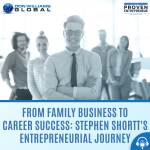
In this insightful episode of The Proven Entrepreneur Show, host Don Williams welcomes you all. Dive into an inspiring entrepreneurial journey with Stephen Shortt, a Dublin-based business leader who’s redefining career guidance and family business dynamics. In this captivating episode of The Proven Entrepreneur Show, Stephen shares his unique path from growing up in a family of trailblazing entrepreneurs to building his own successful businesses focused on helping people find fulfilling careers.
Discover how Stephen transformed family business challenges into a mission of making workplaces happier, using psychometric assessments to match people with their ideal career paths. From selling comic books in school to running international businesses, Stephen’s story is a testament to the power of self-awareness, honest communication, and breaking traditional career boundaries.
Key highlights include:
- The rare experience of having two entrepreneurial parents
- Navigating family business succession with grace and strategy
- The importance of understanding yourself before charting your career path
- Overcoming conflict-avoidance to create more meaningful professional relationships
Whether you’re an entrepreneur, a business leader, or someone seeking greater career satisfaction, this episode offers invaluable insights into personal growth, business strategy, and the art of finding your true professional calling.
Tune in and get ready to be inspired by Stephen Shortt’s remarkable entrepreneurial wisdom!
For information on how to work with Don visit us at https://donwilliamsglobal.com
You can also reach out to Don Williams at https://provenentrepreneurshow.com/
Don’t forget to subscribe to The Proven Entrepreneur Show for more success stories, actionable strategies, and the best of entrepreneurial wisdom!
Watch the episode here
From Family Business to Career Success: Stephen Shortt’s Entrepreneurial Journey
Hey, it’s Don Williams with The Proven Entrepreneur Show. I have one of my dear friends from way over the pond today. Stephen and I have graced multiple stages. He as prime attraction and me as support. And he needs a lot of support. Please welcome to the show, Stephen Short.
Don, thank you so much for having me. But I think the biggest thing when we were doing the double act was the two of us looking at each other going, surely in each double act is supposed to be the straight guy and the guy who can’t take anything seriously. And the two of us looking at each other going, who’s who?
Yeah, well, I totally agree. And it was obvious from the both ends, the beginning and the end of the end that there’s not a straight man between the two of us. so it was a barrel of fun. And I look back on that with fond memories. Now, Steven, from your accent, we know that you are not from East Texas.
Mm-hmm.
Tell us where you live, tell us what your business is, tell us what you do in your business, tell us who you do that with.
Wow, there’s a lot going on there. So yes, not from East Texas. I’m from Dublin in Ireland, which is the center of the known universe. Now, I know, I mean, I’m not from East Texas. The first time that you and I, think, met each other properly. I was telling you that I just spent time with some people from Dallas and you were telling me that Dallas was a suburb of Fort Worth. So that was my introduction.
to what East Texas is like. So that was fun time. I’m in Dublin, Ireland. I have grown up in two family businesses, bought both of them, sold one just before COVID. Now what we focus on is career guidance and selection using personality profiles and psychometric assessments to help companies to find the right people to hiring the right candidates. And I and all of the different businesses that we’re involved in,
Yeah, yeah.
are on a mission to make the world a better place with happy people in fulfilling rewarding careers.
I love that the world can use more happy and people fulfilled by what they do and life is way too short to do something that leaves you less than fulfilled.
Mm-hmm.
So for just on that point, so the statistics show that there’s about 60 % of your waking time. So we sleep, everybody sleeps during the night normally, but 60 % of your waking time is thought is either at work or thinking about work. And for entrepreneurs, that’s even higher because we never switch off. So if you’re not enjoying your time, you’re spending the majority of your time not happy. And to me,
That’s a terrible place to be. So what we want to do is to help people to get themselves on the right track.
think it’s a tragedy. Life is way too short to be unhappy. you know, Zig used to say, you can have everything you want in life if you just help enough other people get what they want in life. The principle being that it’s hard to be happy if you chase your happiness, but it’s pretty easy if you help other people get theirs. so, yeah, so love that. you know, you probably know this, you know, my mission is to help others who help others.
You can have everything you want in life if you just help enough other people get what they want in life. Share on XMm-hmm.
Well, I like that. Anyhow.
Mm-hmm.
And I love helping, people who help others, it’s just a much bigger ripple. And that makes me happy. So I’m going to take you all the way back to little Stephen. So age five to 15. That’s pretty big age range. But in your home, the house that you were raised in, was there an adult who set an entrepreneurial example for you?
Okay.
Did you have an entrepreneur in the house?
So had two. my father was born youngest son of six, a police officer and a stay at home mom. And my mother was the eldest of three girls on a farm in the North of Ireland. So she was destined to be a nun, but that didn’t like the, the eldest child was always sent off to the nunnery. She didn’t do that. She became a teacher.
My father wanted to do different things, but ended up being a teacher as well. They met. Then my father has quite the, adventurous streak in him. So in the sixties and seventies, he was in Saudi Arabia in the middle East, from Ireland, from a little back town in, in, in Ireland. So like lots of breaking of ceilings and all the rest of it and doing things that are completely off the beaten track, went and became a psychologist and occupational psychologist. Then my
mother and he went out to Saudi Arabia in the seventies. He worked for a couple of engineering companies in HR and selection using psychometrics and personality profiling. That’s how we’ve developed all of these things. My sister and I were both born in Saudi Arabia. We drove home when I was about five. So about the age that you were talking about. And we had the from five.
to 10, I’d say we just had the one business, which is the current business that we have. Well, I’m pivoting that business, but it was the psychometrics, the career guidance and the selection, things like that. Then when I was about 11, 12, we set up an English language school in ESL school in Dublin. And that’s where I focused most of my time from 15 onwards until we sold it until I sold it in 2019, the end of 2019, just before COVID. But growing up,
I think I have gotten an immense amount from both of my parents. have the traits of my father, traits of my mother, whether you want to call them positive, negative or whatever, have sometimes they’re, they’re counterbalanced. And I think that I’ve gotten an immense amount of mentorship, teachings, learnings and everything else from, from both of my folks who were both real trail, trailblazing international entrepreneurs.
Love that. And I’ll share this with you. I think we’ve done 130 episodes of the Proven Entrepreneur Show. The vast majority of entrepreneurs that we’ve interviewed did not have an entrepreneurial example in their home. And you may be the only one that had two so far.
Congratulations.
So that’s how useless I am that I needed two people pushing me to be an entrepreneur to try and make up for the lack of anything that I had in me. Okay, fantastic. Thanks Don, thanks.
Well…
Well, no, I think it probably provided you a double shot of balance because, know, entrepreneurship, as you know, you know, there, it’s a little bit like that Clint Eastwood movie, the good, the bad, and the ugly, you know, it’s not all good. It’s not all bad. And there is generally some ugly somewhere, but we’re all learning anyway. Yeah. Life is an experiment and entrepreneurship is just a grand experiment. So.
Mm.
Yeah, it’s usually in the finances, but okay.
So what’s really interesting for me when I look at my folks, my father, as I said, like traveling out to the in college and doing it, gone out to the Middle East. we almost moved to America instead of coming home from the Middle East in the early 80s because there like there was so many opportunities and everything else. But we ended up coming back home to Dublin instead. But my mother is much more cautious, much more risk averse, much more
kind of down to earth. I had that really interesting balance of, of, I’m not going to say push pull because they were, they’re completely in unison and they’re really like, work incredibly well together. They sweet. So I nearly left the family business. I, there was a time when I was really struggling to, to get alignment and thought that, we’re arguing over everything, what we should be doing, the products, the services, the itinerary, everything that we were doing.
And I sat down one day at home and I said out loud for the first time, I need to leave the family business or my parents will never see their grandkids because we won’t be able to be in the same room as you did it. Cause we were really killing each other in arguments. And as soon as I said that every fiber in my body viscerally reacted and I said, okay, that’s definitely not what I wanted. And that’s when I started to figure out this thing of successful succession and how I figured out this framework. Now we all live in the same house. we, we,
My wife and I sold our, our home. moved, we renovated my family home. So my parents live downstairs. We live upstairs. The house is all interconnected with two entrances. have their own living room, kitchen, bedroom, the whole lot. So the dog is up and down and the kids are up and down. Like my daughters are up and down. but they’re completely independent, but we still have like Christmas dinner in our house at the same kitchen table that I sat down in my old house and said, I need to leave the family business. So we’re now 15 years later.
not only still working happily together, but now all living together as well.
Wow, I love that. And maybe there’s a business there on teaching families how to get along in a business. Because it can be a challenge for sure, just the husband-wife thing, where they work in the same company. And it’s interesting how ops that’s tracked to where you get somebody who is a risk taker and somebody who is
Well, that’s what I do.
Hmm.
So how did I hear that explained? Go, go, go. And whoa, whoa, whoa. And so to put them at the same kitchen table, that can make some interesting conversations for sure.
I like that. I like that.
Well, is so, I mean, I work with a lot of family businesses on succession planning. I don’t do the tax or the legal side of things because that’s different from place to place, but I do the interpersonal side of things. And if for me it is, it’s really powerful when you know that the kitchen table and the boardroom table are the same piece of furniture. And then how do you navigate all of that when you’ve got parents who’ve built the business in a lot of cases and the younger generation that
want to do things and then how does that risk, does the risk profile changes as we get older and everything else. So there’s a huge amount of self-reflection and help that people need when they’re navigating that because it can be, I’ve seen it go horribly, horribly wrong, which is heartbreaking.
absolutely. You know, in the big scheme of things, family business. And sometimes that gets sideways. So let me ask you as a young man, as a child in your parents’ home, did you ever have a job, like a job, a J-O-B outside of the family business?
loads of stuff. when I was in. I don’t actually know. It’s probably less than middle school when I was about eight or nine years old. So because we had the family business, we used to make catalogs of the books and assessments that we used to sell. So we had a massive industrial strength photocopier and printer. So I used to draw cartoons and comic books and I would photocopy them on the.
printer in the office and I would sell them in school. So I would probably say I would draw the comics and I would sell them in school for about five cents, five cents or something like that. Those days have probably cost about seventy five cents per photocopy. So but I didn’t have to pay for it at the time. And my grasp on unit economics has gotten a little bit better since then. But so I’ve always been kind of doing stuff like that.
when I like I was the one who was organizing all of the the winter social and the Valentine’s ball and all this kind of stuff in school. And I used to because in Ireland, it’s 18 is the legal drinking age as opposed to 21. So we were 16, 17 when we were at that age of going out and partying. So I I had this really weird thing on my printer where sometimes the dates of birth that the years would get jumbled up a little bit and it would
make people appear to be a little bit older than they were back in the day. so I used to sell tickets and IDs. so I’ve done, events. worked for Heineken for running their events in university for a year. I was, I had a couple of different sidelines and different training programs, different bits and pieces. I did work like gainfully employed by somebody else.
Huh.
think it might have been like two weekends and then just didn’t do well with the sense of authority and having to do something on somebody else’s decision. But I’ve done a couple of things like I tend, I tried my hand at a couple of things and tried to have a bit of fun.
You
Yeah, I love that. I have a friend whose great grandfather started a construction company, big construction company here in the US. And they’re probably in their fourth.
I won’t say generation because there were brothers that had a big age range and so senior passed it to his younger brother. But very interesting to watch them because they’ve gone through several generations now, different leaders. But one of the requirements was that when you graduate college or university, you have to go to work in the field.
Mm-hmm.
for somebody else. And I think it’s five years.
So there are a lot of family businesses that have this you either come in as low as you possibly can, which is what I did. I started as low as I possibly could. Not by choice. It was my parents choice at the time. thought, know marketing. I can be the marketing director. It’s like, no, you can’t clean the door.
Ha ha ha!
But there are a lot of family businesses that do that the five years. you want to commit, if you want to join the family business, you have to go prove yourself somewhere else. And then you can get a job at the same level as whatever you get yourself to in the other business. And then you come in. So this is what I recommend to family businesses. They get put people in either once they’re outside or they come in as low as possible. Because as a family business member, you are going to get probably more mentorship and more attention than a normal employee does, but you still have to.
earn your rights, you’ve still got to put in that sweat.
Yeah, I love that. So…
Talk to me about a hard lesson as you look back over your career, something that happened that is, ugh, it hurts, I don’t like it. But maybe now, in retrospect, turns out that it was a huge positive, but at the moment it was disheartening to say the least. Do you have a hard moment you can share with us?
So the first thing that came into my mind when you were talking about that is actually not, I still to this day, well, I’ve improved since then about this. So I’ve always been very conflict diverse. I’ve grown up quite conflict diverse. I just want everyone to get along and I like connecting people and like motivating people. And what I found more often than not, because most of the time, like we’re all entrepreneurs, we deal with people. It’s a people to people world. I used to joke that
the English language business would be great if it wasn’t for the students, the teachers, the host family, like it was for all the customers. It’d be a brilliant business. But invariably when I had difficult times, it was because I didn’t deal with the situation, especially a people situation head on quick enough. And it festered or it moved on or it, it morphed into something even worse than it possibly was because it was allowed to sit and fester. So really, and I, have
I still am very conflict diverse, but especially over the last 10 years, I suppose, or maybe less than 10 years. I’ve gotten more comfortable with having those. Somebody reframed them for me, actually. They’re not difficult conversations. They’re honest conversations, because if you’re just talking about from your honesty, and this is look, this is my perception. That is all that it can be. And if even if that conversation, so I’ve done a lot of workshops on the crucial conversations that
very popular in the circles and having that. even if the two stories of the two perspectives, if they don’t align, okay, well then we’re going this way. Maybe it’s time for you to go that way. And that’s completely okay. 10 years ago, that would have completely thrown me for a loop. Now I think I’m more centered, more secure, more confident in what I’m bringing to the table, without being arrogant, I hope.
so I think that’s probably the biggest learning that I’ve had is dealing with stuff head on as soon as possible before it gets worse.
I love that. I’m a firm believer that avoidance is not a strategy. If there’s an issue, it’s best to deal with it now. It will not get better. It will only devolve. It will not evolve. So love that. Okay. Tell me about a warp speed moment. Things are going pretty good in your business or businesses. And then you do one thing or two things. You make a hire and all of a sudden it’s like, Whoa.
Avoidance is not a strategy. If there's an issue, it's best to deal with it now. Share on XWe were doing pretty good, but now we’re really doing good. Do you have a moment like that?
So, well, yeah, the beginning of this year. So when I took over this business, then focusing properly on it when I sold the other business was 2020. And then, as you know, couple of things happened in the world in 2020. So we rebuilt our career guidance program. So we have a career guidance program where anybody can come on and do an assessment and we will tell you what are the top 16 careers for you based on your unique mix of interests and abilities.
March?
When we were building that, we built it with Irish schools in mind and selling to Irish schools, for them to be able to use it with their students and to be able for teachers to be able to, to manage their whole class. schools, I’m guessing it’s the same everywhere, but schools, because they have as well, annual cycles before they add changes to their curriculum and everything else. my goodness, but it is a painful process to go and get anything into a school. And.
When I took over the business in 2020, we had two and a half staff members, two full-time and one part-time staff member. We’re now nine full-time staff members dealing with this, but we’re taking on very specific roles of a direct salesperson or a person who’s exclusively looking after the sales of our selection business or the career guidance business or whatever. And when we started actually carving out
responsibilities and roles and putting systems in place for the salespeople rather than me and my COO trying to do what we were doing and trying to do the other stuff and trying to keep that customer happy. Plus also doing all of the administration stuff. As soon as we created just that space for somebody who has the capacity and the awareness and the readiness and the enthusiasm to build it. I think we, we did.
Before the summer this year, we did 150 % of what we did in the entire year last year, the year before, or something like that. was like, as soon as we stopped being the bottleneck of having to try and fit in everything together, it started to take off and we’re rising and rising, which is brilliant.
The bottleneck is by definition always at the top. Share on XIsn’t it interesting that the bottleneck is by definition always at the top? Yeah, every time. And the other lesson that I seem to continually learn is it’s the who. It’s not the what, it’s the who.
Yep.
Yeah. Yeah. Yeah. The, the, was it Dan Sullivan, the who, not how book, which I thought was really interesting as I was really, great way of looking at it.
Yeah.
and doves tails right in with your business, you know, the who. So, okay, what about, what about a nugget? A piece of wisdom that you hold near and dear to your heart that you’re like, man, when I learned that, that was so good for
Yeah.
Well, I don’t know if it was a, it was a one piece of nugget stuff, but I mean, we do psychometrics, we work with personality profiles, we are developing our own personality profile. We work with a number of publishers around the world. And one thing that I’ve, because I’ve grown up with a psychologist as a father, I’ve always been doing these assessments to see like what kind of careers or what kind of outcome I get. And I think a lot of people in EO, which is how you and I know each other, very interested in this kind of personal development stuff.
But the thing that always strikes me is until we know really ourselves, we’ve no idea how to get to where we want to go. the any map will any map is this is where you want to get to, but you also need to know where you’re starting from. So understanding who you are, what your strengths are, what your values are, what you actually want out of life. That gives you such an immense amount of self-awareness to be able to go, okay.
That’s where I want to go, but I can’t go that way. I’ve got to go this way or I’ve got to go around this way. Or maybe that’s not what I want anymore. That’s what other people told me I wanted. Actually, what I want is over here. So I think having that self awareness and understanding from doing a little bit of work on values, on core purpose, on what makes you happy, all the rest of it gives you an immense amount of internal knowledge to know where you’re going.
I love that. Okay, toughest question I’m going to ask you. I’m going to put you in a time machine. I’m to take you all the way back and you’re going to get to meet 20 year old Stephen. And you’re going to get about 60 seconds to share some sage advice that you know now that you wish you knew then. And so into the time machine you go, my brother, all the way back. Here’s Stephen.
What’s my pin number?
What are you telling?
I’m going to give you a very flippant answer first because that’s how we operate with each other. And I’m going to say, buy all the Bitcoin. Just Bitcoin. Just remember Bitcoin. That’s all you need. Funny enough, when we sold our language school, the 6th of December, 2019 was the day we sold the school, the final day. And that was the day that COVID was officially confirmed by the people in Wuhan. I was accused
Good point, good point.
Yeah, Apple.
by lot of people are going, you knew what was coming. said, if I knew what was coming, I would have bought both gold, Bitcoin, Pfizer stock and PPE. Like, no, I didn’t know what was coming.
If I went back into a time machine, in all honesty, I don’t think I would tell myself anything. and the reason is, and this is, it’s, I have been having this conversation recently because somebody said to me, somebody gave me this quote recently, which is the definition of hell is on your last day on earth, the person you become will meet the person you could have become.
And they were using this as a motivator, like, don’t you always want to be like pushing and pushing and pushing? Where I look at that, I look at that in a slightly different way. My wife has always said that if it wasn’t for her and the girls, I’d probably be out there living the high life, like private jets flying all over the place, doing deals and X, Y, and Z doing this, that and the other, and just living the high life.
If on the last day on earth that I’ve been fortunate enough to have in my view, a very comfortable, very fortunate, very privileged life with a fabulous wife, fabulous kids and have that life. If on my last day I get offered, you know what, you could have been this high flyer and all the rest of it and private jets and yachts and all the rest of it. I hope.
Right now I believe it, but I hope that I would not want to trade that for who I could have been. So who you could have been is not necessarily a better person. So if I make any changes in the past, there’s a possibility I don’t meet my wife, there’s a possibility my kids aren’t poor, all that kind of stuff. I’m not going to tell myself anything. Other than buy Bitcoin, I might tell myself to buy Bitcoin. Just a little bit.
I love-
Well, I so love that. And like I said, I’ve done about 130 of these and that’s, I think, the best answer I’ve heard to that question. And we do know each other through EO and the emphasis there is typically business, family, personal. And though I love EO, doesn’t mean I blindly agree with everything I’ve…
Mm-hmm.
learned there and to me it’s actually personal family business is the priority. Pardon? Me too!
Do want to know a secret, Don? That’s how I do my updates every month. Me, family, friends, business.
Yeah, me too. I’m like, you know, and, and a lot of the mothers and some of the fathers would be, no, it’s the family first. I’m like, I get it. But if you’re empty, you can’t fill other people. And so it has to start with self and then family. then, you know, give somebody in your family a horrible illness and a person’s priorities, you know, get.
Mm-hmm.
straightened out pretty quick. They’re like, that business is not everything.
You, you know, Warren Ruston, right? You’ve, come across Warren in this song. Yeah. I was, I had the privilege of meeting him on a regional leadership academy. I’ve, did the global leadership academy as well, but on the regional leadership academy, he, whatever it is, I don’t know if you’ve been on some of these, so you just know how, when you’re in that space, how you’re ready to receive stuff that you might’ve heard before, but it just hits differently when you’re in that connected space. And I had come.
Sure.
to the retreat. And I had this issue that was burning in my head and I was going right when I’m back, that’s it. I’m going to get rid of that person and they’re gone. They’re dead. Blah, blah, blah, And whatever magic that Warren had woven through that long weekend while we were there, he hit with this line, which is lift where you stand. So I think it’s from an American pastor. think it’s a, it’s a well-known phrase in the States, but it’s lift where you stand instead of.
Lift where you stand instead of waiting until you get to the top of the hill to be able to turn around and help people. Share on Xwaiting until you get to the top of the hill to be able to turn around and help people wherever you’re standing, turn around, see what you can see, you can help lift them up and then move on to the next thing. And it resonated so deeply within me. It’s one of only two phrases that’s on my vision board. Both the other phrase was from GLA as it happened. the real those those phrases have really resonated with me for the years. But it’s this sense of lift where you stand.
I can help other people. can’t help everyone. I can try and help who’s around me. And then I need to move on to the next thing to see where I’m going so then I can help more people.
I love that. I too met, Stephen and I know through, we, no, we don’t know each other. We met through an organization called Entrepreneurs Organization, which is global. I actually think I met you in Dublin the first time.
in Dublin, yeah, you were traveling with your wife and you were speaking to the chapter there.
Yeah, my wife fits right in. She’s a redhead and Ireland somehow seems to be the birthplace of all redheads. At the airport in Dublin, I was like, you’re not going to be that easy to find here. she was really easy to find in China. She was the only redhead in the country. But we do know each other through EO and I attended regional leadership academy and had the opportunity to chair.
Co-chair one and attended Global Leadership Academy and some of the best leadership training available on this planet. I don’t know about on other planets, but certainly some of the best available here. And so enjoyed that. So Stephen, if somebody in the audience wanted to reach out to you and learn more about psychometric testing.
and putting the right people in the right spots and hiring people to where they’re going to be fulfilled in their career life, how would they reach out to you?
So the easiest thing is probably just stevenshort.com. It’s currently under renovation, but I just think I’m gonna go on to that now before this podcast goes live. And even if it’s still under renovation, I’ll make sure there’s a link to my LinkedIn or something like that to get in touch if people want.
Awesome, I love that. And for those of you that are listening and not watching, know that Short is 2Ts. Steven Short with 2Ts.
Yeah. But so it’s S-T-E-P-H-E-N-S-H-O-R-T-T. But actually, because I’m such a bit of a domain junkie, S-T-E-V-E-N-S-H-O-R-T-T, S-T-E-V-E-N-S-H-O-R-T, S-T-E-P-H-E-N-S-H-O-R-T, all the dot coms will still lead to that. it’s one of the joy of having a slightly unusual name that I could get this before anybody else did.
spoken like a domain genius. I, on the other hand, have the other issue, Don Williams. I know six of us, only two of whom I’m related to, and one was a country western music superstar, and I’m never going to knock him off SEO. It’s never going to happen. But such is life.
Okay, well, Stephen, thank you so very much. It’s been my distinct honor and pleasure to have you on the show. I look forward to gracing a stage with you somewhere, and I promise I will still be vying with you for the funny man part. And thank you so very much.
Pleasure, thanks so much for having me Don.
And that’s today’s episode of The Proven Entrepreneur Show.