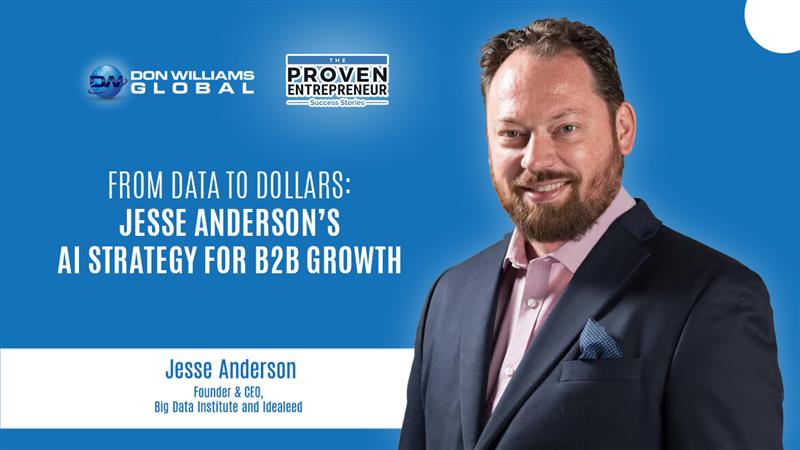
In this episode of “The Proven Entrepreneur Show,” host Don Williams welcomes Jesse Anderson, a data and AI expert from Portugal, who shares insights into his ventures, Big Data Institute and Idealead. Jesse discusses how Big Data Institute leverages his extensive background in data and AI to provide consulting services that help companies optimize their data architecture and team structures. He also introduces Idealead, a company that uses AI to identify the most promising leads for businesses, allowing them to focus on high-potential prospects rather than casting a wide net.
Jesse delves into common pitfalls businesses face when integrating AI, emphasizing the importance of using AI strategically rather than as a mere trend. He highlights the need for creating systems rather than relying on one-off solutions, and the value of data-driven decision-making. The conversation also touches on the fear of AI replacing jobs, with Jesse advocating for AI as a tool to augment human capabilities. The episode concludes with practical advice for entrepreneurs on how to discern genuine AI expertise in a crowded market and the importance of investing in professional guidance to maximize AI’s potential.
For information on how to work with Don visit us at https://donwilliamsglobal.com
You can also reach out to Don Williams at https://provenentrepreneurshow.com
Watch the episode here
AI That Sells: Jesse Anderson on Finding Your Ideal B2B Customer
Hey, Don Williams here with today’s episode of The Proven Entrepreneur Show. Got a great guest, got a genius all the way from Portugal, Jesse Anderson. Welcome to the show.
Welcome. thank you for having me. really do appreciate it. And I’m all the way from Portugal, as you mentioned, but by way of Billings Montana.
Yeah, I was getting ready to say, I think when I first met you, were in Reno, Nevada, and then somehow you ended up in Portugal living across the boulevard from the Atlantic Ocean. And so I’m jealous every time we talk. So love that. So Jesse, you are the founder and CEO of Big Data Institute and also Idealead. Would you tell us about both of those somewhat?
Sure. So I’ll tell you about Big Data Institute first. Big Data Institute is utilizing my background in data and AI. I have a pretty significant background in that. And to do that for consulting. So come in. We work with companies on the architecture of what they should be doing for data and AI, as well as the team layout. So that’s an important part. I’ve written three books on that. Just how do you organize things right? I speak at conferences all over the world on that.
So that’s one part, that’s an important part. And so I had this problem in my consulting business that I realized, hmm, I could use AI for that. And I actually know the tools to use for that. So I created this other company called Idealleed. And Idealleed is using AI to find the exact customers you want based on various characteristics and data and saying, I want them to look like that person and we can do that for you.
Awesome. So, so let me drill down a little bit on ideal lead. So if I understand right, basically what you’re saying is instead of a B2B company, they’re biz dev people going out and downloading a thousand records from zoom info or seamless or Apollo that they can engage with you and rather than give them the wide net of, people have the right title.
and are with the right size companies and the right size industries, you’re able to actually drill down and provide them the most, the 25 or 50 people most likely to actually buy the product, service or experience they sell. Is that right?
That’s right. So what often people are trying to do is they’re trying to go wide. They’re, they’re going after these performance numbers, these, these metrics that are just impossible. So if you have a thousand people, you don’t have anything that’s actionable. have a thousand people on a list that doesn’t do you much good. So what I realized, and especially in my business, I could do a Google search. could do a zoom info search and say, who are all these technology managers? But.
If you have a thousand leads, you don’t have anything actionable Share on Xall those technology managers aren’t the ones I want to be talking to. They need to be a data manager. And so then you could say, you just search on data manager. Well, not every one of those data managers are ones I want to talk to. So if you’re in a B2B niche, which obviously my company is, my consulting company, you can’t just go and do that search because then you spam a bunch of people who are completely uninterested in your project and your product.
And you waste a bunch of their time and yours. But if you get really niche and you’re really niching your business and you’re really focused on just those core customers you want, we can tell you which are those core customers. So more importantly, your time, your salespeople’s time isn’t spent on zoom info and that sort of thing. Their time is better spent and actually talking to customers because it turns out salespeople aren’t great data analysts and they aren’t great at doing searches. Wow. Surprising.
Salespeople aren’t great data analysts—and they shouldn’t have to be Share on XI can see you smiling, but I that’s very surprising. Algorithmically, we can do this significantly better. So everybody does what they’re best at. In fact, salespeople don’t really like to do that searching. What they really prefer to be doing is talking on the phones, talking things that make them money directly rather than let’s go through some lists.
So if you’re in sales, remember this name, Idealleed. And if you are in ownership and you want to make your salespeople happy and save them a bunch of time and put them on the hottest prospects, remember Idealleed. So Jesse, thanks for sharing that. Okay, I’m going to ask you a couple of questions about your journey and digging into your expertise on AI. So what’s the number one mistake?
you see founders make when they quote unquote add AI? And what’s a simple fix that helps them actually drive outcomes?
So one of the most common ones is that people just say, I’m going to add AI for the sake of AI. Everybody’s doing AI. I have to do it in my business somehow, some way. And what they’ll do is they’ll either hamstring it in, they’ll try to shoehorn it in there and say, we’ll just put it this thing. And then we’ll say, boom, we’ve got AI problem solved. When actually,
that there may be better applications. There may be significantly better applications. So what they’ll try to do is there’s this unfortunate facade that the AI companies have given. saying, if you just type in some queries, some prompts, you’ll get the answers. But the unfortunate part is the models, chatGPT, Gemini, those sorts of things, don’t know the follow-on questions to ask you. They don’t know enough about your business to say, don’t do this, do this.
And if you have the right person, the right guide, they can ask those questions. They can talk to your people to say, actually you’re thinking this, but actually you’re better served this way. I’ll give you a bonus one too. And that is the difference between one offs and systems. And this is really key. I talked about this in a webinar recently, and this is when you are creating or doing something with AI, if you do something just every so often.
You just have this task that’s not repetitive. Just do it every so often. That’s called a one-off. Those are completely fine. Just bring up your prompt, put that in. But if you’re doing something consistently and there’s a consistency to that, you should be creating a system out of that. The reason for that is if you have 100 people and you’re saying, hey, everybody go use AI, they’ll do 100 things different.
And that’s not what you want. You want some efficiency. You want people doing the same things. You want process for that. And so when you want to create a process around something with AI, there’s various ways of doing that that are pretty cost efficient. But overall, you will get significantly more efficiency by creating a system and a process that way.
Love that. And so I can remember, you know, for years and years and years, McDonald’s hamburgers here in the U S and really worldwide was like the number one, you know, fast food. They were the king of the fast food industry. I think Chick-fil-A probably has knocked them off, but McDonald’s saw themselves not really in the hamburger business. They saw them in the systems business. And so they were able to scale unbelievably because they,
had maybe the best systems on the planet in and out of that industry. So great counsel there. OK, tell me about a time in your past where a company had tons of data, but they really weren’t getting any value. And how did you help turn that big pile of data into real value?
That’s a lot of experience in a lot of different ways. So what I didn’t mention in my background is that I’ve consulted everything from startups to Fortune 100 companies, Fortune 50. And so the differences between the Fortune 50 and the startups, Oddly enough, they both have similar problems of getting their data and making their data usable. It’s an unfortunate, not a fact.
due to size, it’s just due to how difficult it is to do data correctly, do AI correctly. But I will tell some medium businesses and some small business stories. So one common reason for difficulty with AI is organizationally. In fact, if you look at who within your organization is going to cause you the most difficulty, it’s actually your people. It’s getting your people to adopt.
And AI doesn’t, it isn’t like any other technology. Many times you’ll think of the last time you put some technology and said, Hey, everybody who used this and nobody uses it. AI is no different. It’s you have to get into this process. You have to get in this thinking. So you see a few people on LinkedIn, sometimes that the CEO saying we’re an AI first company. And if you don’t use AI, we’re going to lay you off. For example, I think that’s a bit extreme. What I would encourage people to do.
is to lead by example, lead by showing them what to do. But at its core, what these people are worried about is AI is going to replace me. That if you start using AI, I’m going to lose my job. So I think it’s key for companies, founders, CEOs to explain this as saying, no, we’re so far backlogged. Even if we get 20%, 50 % more productive in this.
We’re still behind our backlog. this is really, that’s one part of that. So organizationally, that’s one of your difficulties with AI with data projects. Just trying to get your organizational transformation as one part. Paying open AI 20 bucks a month, that’s the easy part. Getting it to be done. this is something I talk about at our industry conferences quite a bit is.
Fear of AI replacing jobs is real—but the truth is, we’re still behind on our backlog Share on XJust putting a technology in place. That’s one part. So then you have the second problem of let’s say you get the technology in place. People are saying yes. And now you have this whole other problem of the data. Is your data accessible? Is your data usable? Does Dawn have a bunch of different data than Jesse? Because now if we both put the same information into our respective models, chatgpt,
we’ll get different answers because Don has one piece of information, Jesse has another. So there’s this whole other issue of do we have the right data? Are we sharing data correctly? Do we have a difference in our data between finance and let’s say, biz dev, for example? These are all very common issues. So it comes back to that systems. If we have the right systems in place that we’re pulling from the same data, then we’re able to make decisions.
And this is really what’s key is you will have perhaps different data, different systems, different sources of data. That’s really what you have to change.
Okay. Love that. So you mentioned, you know, that some people are fearful that, AI is going to take my job. And, and just yesterday, think Paycom, which is a huge credit card processor here in the U S they just limited 500 jobs supposedly because of AI efficiency, but isn’t, isn’t the best way to
avoid any problem there, just to adopt and become somebody who has some skills with AI, because most people don’t. And so it’s kind of how you look at it, right? It’s, it’s, am I going to be fearful of it or, or am I going to embrace and learn and, and improve my value, the value that I bring to a company? Isn’t that the right way to go about it?
I think that’s the right way. What I try to tell people is AI is both dumber and smarter than you think. It’s more powerful and less powerful than you think. And the reason I say that is because outside of when I say industry, basically data and AI people, people who really keep up with this, we kind of know what’s happening, but we’re also pushing the boundaries of what’s possible. And then you have the non-industry people, people like yourself, quite honestly, who are…
AI is both dumber and smarter than you think Share on XYou’re kind of six months to a year behind us. And then to your point of, then you have the people who aren’t doing anything. They’re just way far off. They’re off in no man’s land. So what you’d ideallead want to be is you ideallead want to be that person who’s experimenting, who’s actually trying and seeing what is possible. Because, and for some of the stuff we don’t honestly know. We don’t know whether this will work.
whether that will work. There’s one way to find out, but we also have, you have a background in it, you can say, hey, that probably won’t work. You have low odds of that happening. But for the beginners, what I’d say is try it out. One thing as you try to begin that’s worth pointing out is that models, these generative models are always programmed to give you a response. So the issue there is,
It won’t tell you, don’t know, oftentimes. So if you’re pushing some sort of boundary, ask a question you know the answer to, because then you can say, they got that question right. Let me move on to the next question, the next question. There’s a few things that due to the really good marketing of the industry, you don’t know yet, but within the industry, we say, here’s this problem, here’s that problem, here’s that problem. Hallucination, for example.
Hallucination is when a model says, here’s the answer, but that’s actually not the answer. It just kind of pulled something out of the ether. If you know how they work, then you can understand. Pulling out of the ether just means there is statistically something that happened, how they work behind the scenes. And that’s the answer you got, but that was not the answer.
I love that. And I think everybody who has used any of the large language models has seen a hallucination where it’s like, well, I don’t think that’s right. so it certainly pays. I think humans first, AI second. And the best use is kind of a marriage between the two. All human and all AI is probably not the way to go.
Yeah, in fact, that’s something I would point out to do to as any CEOs watching this is AI more correctly, Gen. AI, which is usually what business people say when they business people say AI right now, they mean Gen. AI, generative AI. In industry, don’t we don’t we distinguish that differently. But anyway, as of right now, generative AI isn’t really able to replace a human.
So what I would really advise people to do is to think about how do we augment our existing humans? Is there some task that’s there that is really good for AI that humans hate? Basically what I did with Idealead. AI is really good at this, human hates this, here you go, here’s a list. And so find that equivalent within your business and you’ll get much more adoption of that that way. Augment your humans basically.
Yeah, I love that.
Love that. And I mean, the audience knows, always recommend, if it’s, if it’s beyond your realm of knowledge, it’s outside your skillset, get a pro. Okay. Hire a professional, hire a Jesse. Okay. That can, um, geometrically accelerate your use of AI or generative AI or the other kinds of AI.
It just makes so much sense. A lot of times entrepreneurs, we, we think, well, we’re going to bootstrap it and you know, we’ll figure it all out. But, you know, time is money. And so many times it just makes sense to get a pro, get somebody who can take you right to the answer. Okay. So what’s a wow level customer experience that data makes possible something that like moves the needle almost immediately.
that would help most companies.
Let’s see. Well, what I like to tell people about is we’ve become used to recommendations, but recommendation engines are something relatively recent. If you think back, let’s say, 20 years ago, I talked to people who were very early on in Netflix and Spotify, for example. Spotify was one of the first music suggestion engines, and that was really novel. And I would say…
Recommendation engines aren’t just tech—they’re decision accelerators Share on XHere, as we fast forward, we actually have come to expect that. We expect things behind the scenes to be smart enough to say, Jesse, you’re interested in this or that product. Here’s another product. So what we’re trying to do is you’re trying to make it so that somebody can form a decision faster and say, when we form a decision, make a decision. They were trying to say, am I getting a good price? Is this the right product? And if you really look at how Amazon works, that’s what they’re doing.
Everything that Amazon is trying to do is not to help themselves, the seller. They’re trying to help you come to a decision faster so that you can say, I’m getting a good price and this is the product I want. That’s they give you all the other products there at the bottom. They want you to be able to click through and say, no, that one’s wrong. I want this one. So that’s one thing. Hey, recommendation engines are a great way.
May not be usable for everybody, but if you’re in some sort of e-commerce, that’s what you need. Another great way of data, using data, especially internally in a business, is to make your own decisions. Make a good decision, make a database decision. We joke about it in the industry that the only times that people are brought in, your data scientists or your analysts are brought in, is to the CEO already has a decision.
They just want some support for that decision from the data. it’s very hard to, what’s called speaking truth to power, it’s saying, no, the data doesn’t really support that. And you can make a decision however you want, but the data doesn’t support that. so that’s a key insight for people. Hey, data may not support your decision. You can make a gut hunch.
And entrepreneurs are very good at those gut things. But as you grow in the business and you get more and more data, then you can take those and you can start to say, do people actually want pink instead of purple? You can make data augment the decisions.
Love that speaking truth to power. I love that. And I always think that’s a sound counsel for agencies of any kind. know, sometimes an agency avoids speaking truth because the power might let them go, but it’ll come back and bite you anyway. I mean, you might as well just tell them, tell them what the truth is and let it, let it go. Okay. So today, you know, you cannot,
you cannot walk down the street and not meet 10 people who are AI experts. There’s an awful lot of AI experts in the world. Can you give us a quick BS detector, something that would help an entrepreneur kind of filter through, these are the real players and these are the pretenders.
I would, and I would tell them to take a first step and try to take a first pass and say just how difficult is the problem. So if this is just a, I need to do some light and fluffy sort of thing training for my team, maybe that person’s just flying for that. But that system creation, then we need a person with some chops. And so to your question, how do you validate that?
You get a trusted advisor to help you because more than quite frankly, most people can’t. The issue that’s become prevalent, as you rightly point out, is AI equals prompt or prompt engineering. So you just write some prompts. Well, that isn’t really what you need. You may need something much bigger. You may be better off with this other thing. So the issue there is AI, especially these people,
don’t know where their lane is, basically, as it were. So they don’t know what they don’t know. There’s a lot of unknown unknowns, to use other metaphors. And so you don’t want a person with a lot of unknown unknowns to guide you. So how do you find that person? Look at their resume. If they’re on their LinkedIn profile, they are an AI influencer, and they just became an AI influencer.
If someone just became an AI influencer on LinkedIn, they probably don’t know much Share on XWe’re likely they don’t know anything about it. They know a little bit about this. It’s always worth also paying. They will have different pay scales, quite honestly. They are there to hear, me point you in. How do you use ChatGPT when if you’re talking to other people, they’re talking about other models or other different
types of modeling, other different types of AI, because each one is different, each one is unique. I experienced this just in the industry for Idealleed. There’s a lot of people who have companies and they just know how to do gen AI. And so if you get one millimeter outside of that gen AI space, they know nothing. So it’s a steep drop off to nothing. And this is what you face is…
They don’t know the right things. They don’t know how to use it correctly. You will regret those times.
Yeah, love that. Love that. And I love the pay scale, you know, if sometimes the most, what appears to be the most expensive solution is actually the least expensive solution because it gets you to the finish line the fastest. Okay. And it gets you to a better outcome. And so keep that mind. Okay. Jesse, thrilled to have you on the show today. If somebody wanted to reach out either about how to tackle big data, okay. And make something happen or
The most expensive solution is often the cheapest—because it gets you to the finish line faster Share on Xideal lead, how to get to the most likely leads to buy their product, service or experience. How would they reach out to you or your company?
You can go to the websites bigdatainstitute.io or to idealead.ai. Those are two ones. Probably the easiest way is to email me jesse, J-E-S-S-E, at bigdatainstitute.io. And I’d be happy to have a conversation about how we can help you and hopefully avoid some of these pitfalls that are well known.
that. okay. Reach out to Jesse at jesse at biginstitute.io or you can go to big, big institute. ⁓ big data Institute. I’m so sorry. Big data Institute.io. It’s a new mouth. I’m just trying it out and, or ideallead.ai. If you want a real expert, when you look in the dictionary under AI expert, you see Jesse’s picture. Jesse, thank you so much for coming on the show. I’m grateful.
Big Data Institute.
Now, Big Data Institute.
Thank you for having me, Don. I really appreciate it.
That’s today’s episode of The Proven Entrepreneur Show. We’ll see you next time. Thanks. Bye.