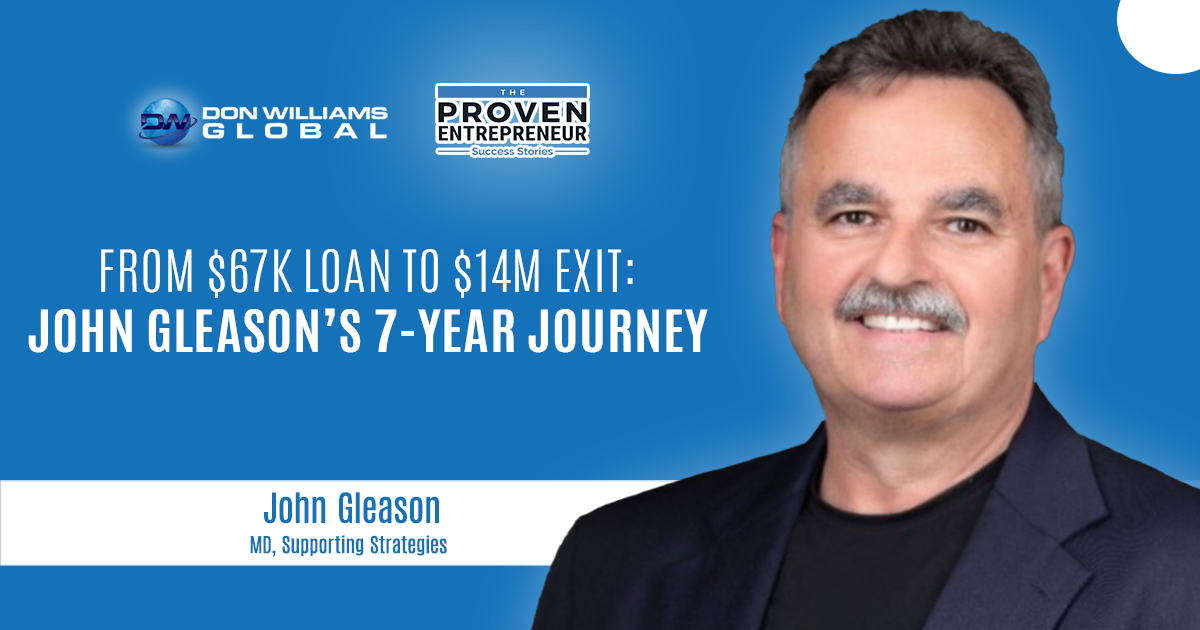
When John Gleason launched his first company outside Boston, he mortgaged his home and poured everything he had into his dream. For seven long years, banks turned him away, payroll was a struggle, and survival was a daily challenge. But John didn’t quit. Eventually, HSBC gave him a shot — and that $1.7 million credit line became the liftoff that changed everything.
In this episode of The Proven Entrepreneur Show, host Don Williams dives deep into John’s journey — from sleepless nights and financial hardship to building a company that hit $14 million in sales and $2.5 million in EBITDA before selling to private equity.
What set John apart? A relentless focus on planning. He literally kept his business plan in a 3-ring binder on his desk every single day — a living guide that shaped decisions, inspired accountability, and made his eventual sale happen in just five days.
Today, John leads Supporting Strategies, helping entrepreneurs professionalize their finances and avoid common money mistakes. His story is a masterclass in persistence, leadership, and the power of written vision — a reminder that success often hides behind years of quiet, consistent work.
For information on how to work with Don visit us at https://donwilliamsglobal.com
You can also reach out to Don Williams at https://provenentrepreneurshow.com
Watch the episode here
$67k Loan to $14m Exit: John Gleason’s Untold Entrepreneur Journey
Hey, Don Williams here with today’s episode of The Proven Entrepreneur Show. The Proven Entrepreneur Show is the show designed to help you as a non-entrepreneur take your first step into entrepreneurship, where if you are an entrepreneur to take your next step to be bigger, better as you go. Today’s guest got a real treat for you today. have John Gleason with Supporting Strategies. Welcome to the show, John.
Good morning, Don. Thank you very much for having me.
My pleasure. Now, and I’ve got a question I’m not going to ask you for about 15 minutes, but I can’t wait to ask this question because out of 150 or 200 episodes and thousands of entrepreneurs, I know one thing about you that I don’t know about, that I don’t know any other entrepreneur ever did. And when you shared it with me, the first time I was like, genius. so stick around, listen to the whole episode. You’re going to want to catch that folks.
Okay. So supporting strategies, is a trusted resource for entrepreneurs, but take us back. What was your hardest near failure moment in Boston where you thought the business might not make it. And then how did you turn that around?
think my hardest near failure moment was about my third attempt to bank the company, to get a credit line for the company. We were growing fast. We were bootstrapped. I had borrowed $67,000 on a ranch house that I own small home just outside of Boston. And that’s how we started the company. So probably five years in, Dawn, I was going to bank after bank and I had a business partner who was saying to me, don’t bother. We’re not bankable. It’s not going to work.
And I believe it was a Bay Bank. I was with the third or fourth time. And it’s, you know, it’s a process, as you know, it was much more laborious at that point in time. is over 25 years ago. And they finally took their time, probably two months and came back to us and said, no, sorry, you know, went through credit. We can’t do it.
And we had a significant payroll scrambling to make payrolls, scrambling to pay vendors, meeting with vendors in person, paying them what they could to keep going and going without paychecks for months at a time, little children at home. So it got pretty dire. And then we finally were able to finance with HSBC Bank.
Hong Kong Savings Bank, which is a very big bank worldwide. And I was very fortunate, I’m still grateful to HSBC to this day. They did a 1.785, strange number, but that was their number, $1.785 million credit line revolver was included with that. And I went out and bought some additional equipment. That was really the liftoff point for us to get to the point where we were able to build a company large enough to…
accomplished $2.5 million in EBITDA on $14 million in sales and eventually sold the company to a large private equity group called Colbert.
So, tell me this, from the time that you started trying to secure financing to the time HSBC came through, that time when you’re cajoling, begging, borrowing, pleading with vendors, when you’re having tough conversations in your house because you’re not bringing paychecks in on a regular basis, how long was that timeframe?
was seven years. It was seven years. I can, the reason I know is I have one of those acrylic awards from the bank where they granted us the credit line and we went from like zero to 60. So I was able to get equipment credit because I could lease equipment and so forth, but I wasn’t able to get a hold of cash. So it was difficult. It was a difficult undertaking and we spent a lot of time pouring over cashflow forecasts.
and cajoling different clients, asking them to put us in front of larger vendors that they had been doing business with for many, many years just because we were this quote, unquote, a startup, even though we were in now at that point, we’re probably eight years into it, nine years into it. But I remember vividly with seven years.
Yeah. Brutal, brutal. The big lesson there folks is don’t quit. Keep going, keep going. There’s a lot of 20 year overnight success stories where they were on the downside most of the time, but when they got to the upside, the upside was so far up, it made up for a lot of that downtime. Okay. Supporting strategy. You’ve helped hundreds of Boston businesses with financial operations.
Don’t quit. Keep going. There are a lot of 20-year overnight success stories. Share on X
What’s the most common, dumbest money mistake you see entrepreneurs make and how can they fix that?
Well, the most common thing I see with small entrepreneurs, small companies, and our largest, our most recent three clients are California, Texas, and Texas. But the smaller, and they’re larger companies, but the smallest entrepreneurs, one thing that I see them do is oftentimes they’re operators, professional operators, they’re great at whatever they do. They’re roofers, they’re landscapers, they’re chiropractors, they’re running preschools, and they have a tendency to…
to go to the bank and check their bank balance online.
And that’s a terrific mistake because you’ve got checks floating, you’ve got payroll, you’ve got 401k match, you’ve got, you really need to professionalize your books. So that’s a mistake that I see with believe it or not even larger, five, six, seven million dollar companies sometimes they live on the online balance or by literally phoning the bank to try to get their balance. But that’s not really the cash they have, right? Done.
So that’s what the small companies with the larger companies, what we see is a lack of planning, know, forecasting for the future and checking seasonality, like not just looking at trailing 12 months, which we call TTM, but comparing, you know, first quarter, second quarter, third quarter, 2026 to previous years. Take a look at that quarter. Look at your percentage of what I like to look at as percentage of expenses against gross revenue.
and see if your payroll is trending up. Is your insurance trending up, whatever it might be, your rent, what have you. And then move the needle on the larger expenses. Don’t so much focus on the tiny, tiny expenses because you’re not gonna see an overall improvement in the health of the company. So I’m talking about from the financial side. So those are the two things that I see. Real small companies, they just don’t have the data. They’re not.
They’re not getting the reports that they need. They don’t understand the KPIs and so forth. larger companies, it’s amazing. Many of them don’t do much forecasting and they’re really living month to month, week to week.
Yeah. Amazing. So, so you talked about this to me, Boston has like this great historical DNA, this great entrepreneurial DNA that’s kind of unique to Boston. and so how do you think, and does that have any effect on, you know, how you’re able to, to expand and have customers all across the country?
Well, it’s interesting that you say that, I’m in an 11 story office building just outside of Boston. And I met with a real estate syndicator this morning, commercial real estate syndicator, who’s from Boston and he doesn’t do any business in New England. And so what we were talking about this morning, eight o’clock in the morning was how small the country is, quote unquote.
So he’s got some deals going on in North Dakota, South Dakota. He’s getting out of a deal in Savannah. He’s getting out of a deal in Norfolk, Virginia. We see young guys, early 40s. dad’s a CPA. Good friend of mine. So I think, yes, think Boston is kind of known as a place where can go to get things done. And, um,
There are a lot of folks who are highly educated in the area that remained here after they’ve gone to college here and that and so forth and that we’ve got a great history. But I’ll tell you, it’s kind of funny that you bring that up is one of my newest clients, I get a call from the CEO and the company was based in Cerritos, California. And I said, geez, what brings you here? You know, the first thing you want to ask always, you how did you find out about me? And he said, well, I’m from Weymouth, Mass, which is a suburb of Boston. But I said, well, this is a Miami number. goes, well, I live in Miami.
And my company is a $60 million company in California. We operate in California, Arizona. And I know you see this done California, Arizona, Texas, to some extent, Florida, but I’m really comfortable dealing with people from the area. And I said, okay. And then his COO was from Massachusetts as well, but that’s not always the case. know, another new client of ours is down in Austin, a medical device company.
And I was talking to him, kidding around, we’re talking about how small the world is now. And I said, you are not from Texas, sir. And he laughed and he said, I’m from Pittsburgh. I said, you’re from the Monongahela River area, right? And he said, it’s funny that you mentioned that. We were called the Monongahela River rats. So the reason I’m bringing this up is not to go on and on, but just to mention that I cannot believe how much in the past 20 years, how much.
the world has shrunk, quote unquote shrunk. We’re actually dealing with clients in Western Europe now. We’re business for their American affiliated companies. So we’re doing GAP and so on. So yeah, it’s fun. We talk about sports and whatnot, but actually we’re about trying to help people. That’s what we really like to do. my personal opinion is that most people are very good people.
And if I can help them in any way to do better to advance their cause and to help them build their business, then I’m all about it. I don’t care where they’re from and who they are. But we do identify, we all identify, right? I know you identify with a certain football team, the Sooners, and that’s fun and so forth. But I know you, Don, you’re like me, I’ll work with anybody from anywhere. And I always give people the benefit of the doubt and I love working with people from all over.
Yeah, no doubt. And I’ve seen that in, you know, over the years of my career, how small the world has gotten. And so today I literally have clients on every continent, but Antarctica. And if I could find somebody on Antarctica, I will cut you a heck of a deal because I want to be able to say I have clients everywhere. And ⁓ I don’t know what service I can provide to scientists in Antarctica, but I’ll think of something.
That’s amazing.
I think that’s awesome.
You know, I’ll think of something. ⁓
think that’s fantastic.
I’m only on two continents right now, but I admire what you’re doing and I would like to head in that direction myself.
Yeah. Well, I appreciate that. You know, because companies in other continents, everybody wants to do business in the U S okay. Tariff, no tariff doesn’t really make any difference. If you’re in another country, you would like to be doing business in the U S because it’s still is the largest economy in the world. And so, you know, any way you look at it, we’re not the biggest population, but we are the biggest economy for sure. So, okay. Here, next question.
absolutely.
Entrepreneurs just starting out, maybe small medium business. Okay. What’s one back office system or process that’s almost universal. You could recommend to almost anybody that would save them years of pain and millions of dollars.
absolutely. My favorite thing, I’m writing a book about it right now. Hopefully we’re going to talk about it just a little bit. And that is to create a business plan. And, the reason is, that once you create a business plan, even if it’s a one page business plan, even if you’re just starting a landscaping and snow removal business or ice removal, or you’re doing a parking lot striping or what have you, you yourself, the entrepreneur, you’re going to bring that into your subconscious.
that you’ve developed that in the back of your mind, even when you’re sleeping at night, you’re taking a nap or what have you, you know you have this business plan, so you have a mission, you’re heading towards completion of this mission. I’m not saying that that business plan is not gonna change, it’s gonna change, it’s gonna change often, especially the first years that you’re in business, so make changes to it, but you’ve always got that mantra, right, that business plan, and you can…
learn from your mistakes, can improve upon it. But if you don’t have a business plan, you can’t guide yourself towards any goal. You have to have a business plan. And I think even myself as a today and supporting strategies of my franchisee.
If you don’t have a business plan, you can’t guide yourself toward any goal. Share on X
We’re all locally owned and operated as a national company. We have to have a business plan and we live and die by it. This is the way we’re going to work. It doesn’t have to be rigid. The business plan can change, but that’s the very biggest thing in my opinion that any entrepreneur starting out should adapt and adopt. Make sure that you have one. It does not have to be a 100 page business plan. It can be very brief. You can expand upon it.
I love that and I am a firm believer, no mission, no accomplishment. You’ll get an awful lot of nothing with the absence of a mission. Now, the first time I met you, you talked about your commercial printing company, the one that you took you seven years to get bankable and that you eventually sold. And you told me that you sold that company from the time that you thought about selling the company, you actually had a deal in literally
days. Is that right?
Yes sir. Yeah, it’s correct. So we founded the company with the idea that we’re going to sell the company eventually.
So any company that you’ve found, you’re either going to leave, you know, the old saw is, you you’re going to leave on the stretcher or you can pass away at your desk, God forbid, or perhaps that’s what you want to do, or perhaps you’re going to sell the company, or perhaps you’re going to pass it on to your legacy, to your children and so forth. But our particular goal at that point in time was we wanted to sell the company. So believe it or not, the business plan expanded that we had, and it probably was an 80-page business plan at one point in time.
Certain parts of the business were the responsibility of other members of the business that work there because another thing that you want to do is an entrepreneur of course is you want to Not only give credit where credit is due, but you want to give people responsibility and you want to let them perform and if you are You know micromanager and you’re over controlling and so forth. You won’t let the business go you’re choking the business You’re actually the logjam that’s preventing the business from growing
So the most important thing you can do besides the business plan is hire the right people and be quick to fire, but slow to hire sometimes. And it takes a long time to really understand what that is for people like myself, but some people pick it up right away. You know, the people that are brighter than I and so forth, but it did take me a while. The other thing is even though you might empathize,
with someone and they might have many issues and so forth, you have to recognize what their limitations are. Even though they’re smarter than you, they can do certain things a lot better than you within the business. Realize what their limitations are because they can be limiting the business as well. So those are some of my opinions on what you can do best.
I love that. So
I can recall that when you told me you had a deal literally within, I don’t remember, three or four or five days, really short timeframe, I was like, now how in the heck? And what you told me going back to this business plan and this mission is you said, you know, we had a printed copy of our business plan literally sitting on my desk every day. I own the company. And I was like, oh my gosh, that’s pure genius.
Yes, sir.
Can’t imagine, you know, anybody else has ever told me something like that. And so…
Really? Well,
that was our differentiator. And yes, we did have a deal within five days. So when we decided that we were actually going to put the company on the market, and we did it without a broker or intermediary, which was not wise in retrospect. But at the time we had, what was going on at the time was some large entities were going around, private equity groups and also public companies. It was a public company based in Dallas actually.
that I met with and, um, there were some family offices that were consolidating the commercial printing business because the commercial printing business was undergoing a lot of change at the time. So we went out, I had a business partner who was sales. I was operations and I was the CFO, uh, the accountant and so forth. We went out to Chicago to a national print show that was, believe it or not, a week long and stayed in the hotel for a week. And, uh, the buyers were right there. All the folks that we were hearing speeches from and talks and so forth. And, um, we.
Basically, know, over cocktails and dinner that night, we were getting offers from day one, from day two, from day three, you know, and by day five, we had a verbal agreement and, you know, we were part of a national entity, I think five months later. We sold the and then I ended up working for that company for about three years. It was fun. It was a whirlwind. It was very quick. But we had a good idea of what we wanted for the business, what we thought the business was worth. was part of our business plan to know where we were.
So I highly recommend it. Highly recommend it. We didn’t know at the time that other companies weren’t doing the same thing until we were acquired and they said, geez, we hadn’t seen this. We hadn’t seen this before. You actually know what your margins are, your ratios, your key performance indicators. And we were following…
author of a book called Open Book Management at the time and the sample business that was in Open Book Management was a chocolate chip cookie manufacturing company believe it not. And we were using a lot of the same premises that were illustrated in that book and forgive me right now I can’t recall the author and they were very good. know Open Book Management just meant that we made people responsible for their parts of the business. If they were running the bindery they were responsible for that. they did HR management, responsible for HR and then we shared with them their performance.
And the KPIs, keep performance indicators that kind of, that’s how we knew what their performance was. And if they wanted to edit the KPIs, we allowed them to edit the KPIs and show us how they would do better and so forth. so we had, we had trucking at the time, we had sales, we had estimating, we had staff accounts, had six staff accounts. So we had about 130 employees at the time in the sales business. So we had a number of different areas where people could demonstrate their expertise.
So the key for us was make sure that people know how they’re doing. Forget about annual reviews. Talk to people quarterly. That was my philosophy. Talk to people all the time. And if they wanted to, my office door was open, if they wanted to come in and make an appointment and talk to me in regards to…
Yeah.
How I was performing, that was fine too. We were open to that. And the other thing we did, lastly, I’ll just end with is we believed in a walk around management. So we had a 130,000 square foot plant, but actually the top floor of the plant was three floors, each 30,000 some odd square feet. The top floor we we sublet because we wanted to control the freight elevators, believe it or not, done. So on floors one and two, I would walk those floors every day, at least twice a day, maybe three times a day. And I would say hi to all the foremen or.
We believed in walk-around management. I walked the plant floors every day. Share on X
lead people and at least in, know, every driver, every person that worked for me, if I could. And they knew they could come up and they could tell us what was going on, how we could approve what we were doing wrong and so forth. They knew it was an opportunity for them, not necessarily just to kibitz, but to kind of share experiences. So I would highly recommend that to anyone who works in a physical plant or.
in the physical business where you’re coming in contact with your team members and that’s to be open with them and communicate with them as often as you can.
Love that. Okay. We got just another couple minutes. So I want to talk, I got a little inside knowledge. I know you’re writing a book, so tell us a little bit about your book and what you’re discussing and put you on the spot. Like when will it be out?
Yes, sir.
Don, I’m really enjoying the process. With Don’s help, I’m writing a book and right now the tentative name for the book is Three Ring Binder. It has to do with our business plan. I cannot believe how personal the book has become. Where I’m at right now, Don, is I’ve gone back to my wife, my sister who worked in the business, my adult son and said to them, can you give me perspective on what you thought about the business?
We had a printed business plan in a three-ring binder on my desk every day. Share on X
And not just my role, but what were your impressions? And I said, listen, I don’t want your answers right now. This is literally two weeks ago, not this past week and the weekend before. I take a couple of weeks, ruminate about it. Email me, call me, whatever. My son lives with me, my wife lives with me, of course. And they’re all thinking about different things. And they’ve been great and supported me in regards to suggesting.
different chapters and so forth and help me with the editing. As a matter of fact, already I’ve thrown out some stuff that don’t think was pertinent to me personally, but what I’m looking to do is to actually help business people to improve their lives and improve their business and so forth. And I’m just gonna try to make my past business experiences relevant to them. terms of, originally my original goal was to complete it in October, but now that I’ve got other…
family members and stakeholders actually involved and they agreed to give me some feedback. I’m going to probably say first quarter of 26. Because it’s more important to me that its quality won’t be real long booked on. But I really appreciate your help with it and I’m very enthusiastic about it. I spend time mostly on the weekends on it.
So I’m looking forward to it. It will be, it will have some funny stories, some pertinent stories, but hope to incorporate some business lessons that I learned the hard way, you know, in real life, in RL as they call it now.
Yeah. Well, I
love that and I love the title. And like I said, out of, you know, 35 years with entrepreneurs all over, um, known a lot of entrepreneurs who had business plans, known a lot of entrepreneurs who didn’t have a business plan and who were, um, kind of working like,
Thank you.
the old oil man or the old horse trader, you know, they’re kind of looking in their pocket every day to see how much money they had looking at the bank and, and trying to, you know, run a business that way, which is pretty challenging, but you are the only one I’ve ever heard that kept that business plan in a three ring binder on your desk every day. And I think that’s magical.
Yes, sir. Yeah.
Well, thank you. It turned out to be a very, very useful tool at the end of the day.
Love that. So John, if somebody’s listening to the episode and they’d like to reach out to you, okay, what’s the easiest way to do that?
The best way to do that is to please email me at j, for my first name, John, Gleason, and it’s spelled just like Jackie Gleason, so it’s G-L-E-A-S-O-N, at supportingstrategies.com. And I will be back to you by the following day, if not the same day, and I’d love to hear from you. Thank you, Don.
Love that.
So Jay Gleason at SupportingStrategies.com. John, it’s been my distinct pleasure to have you on the show today. Thank you so much.
Yes, sir.
No, thank you Don. Always a pleasure and I really feel flattered that you gave me the opportunity. Thank you so much.
I’m grateful. Folks, that’s today’s episode of The Proven Entrepreneur Show. We’ll see you next time. Thanks. Bye.