Growth in business often starts long before a sale is made. In this conversation, Doug C. Brown explains how predictable revenue comes from understanding your ideal client, setting real sales goals, and using a math based approach to every stage of your sales process. Many entrepreneurs chase big numbers without the budget, structure, or team to support them, and Doug points out that the right sales mindset and a clear revenue strategy can prevent most of the frustration that comes from unrealistic planning.
One of the most useful insights from the episode is how much opportunity sits inside existing relationships. Doug explains that dormant clients respond faster than new leads and often create quick wins that build confidence in the sales process. This is where strong follow up, buyer fit, and simple re engagement can lift revenue within weeks. When companies focus on the right buyers, shorten their contact to close time, and practice relationship based selling, their sales process becomes steadier and more cost effective.
Doug also highlights the role of mindset in performance. When pressure rises, people often get stuck in fight or freeze mode, and this blocks progress. He teaches teams to break this cycle through small wins and a shift in thinking that opens space for better decisions. He also shares how his own network helped him rebuild a seven figure business using his phone and long term trust. The message is simple. Growth follows the people who understand their buyers, value their relationships, and approach selling as helping rather than pushing.
For information on how to work with Don visit us at https://donwilliamsglobal.com
You can also reach out to Don Williams at https://provenentrepreneurshow.com
Watch the episode here
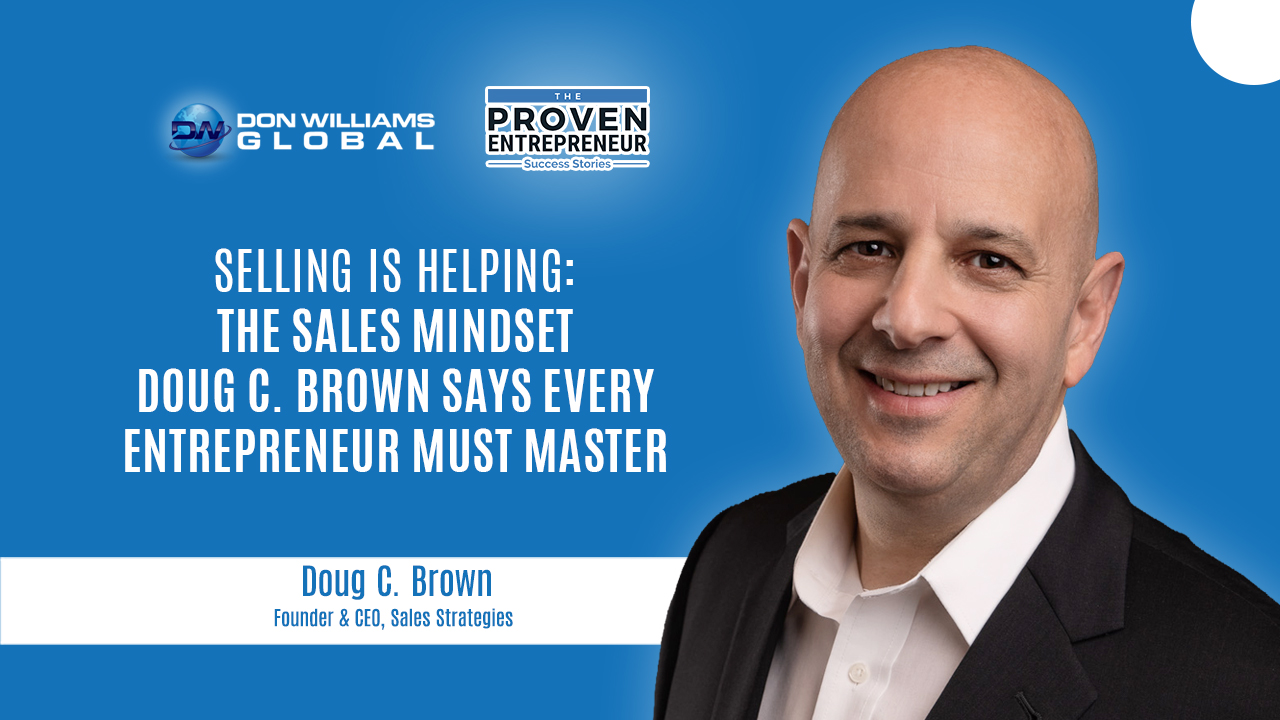
Selling Is Helping: The Sales Mindset Doug C. Brown Says Every Entrepreneur Must Master
Hey, Don Williams here with today’s episode of the proven entrepreneur show. I got a real treat for you today. I got a sales guru and I don’t throw that word around lightly. so Doug C Brown, welcome to the proven entrepreneur.
Hey, Don, thanks for having me here. I’m so grateful to be here.
Man, it’s my pleasure. So Doug, tell us, name your company, what you do, who you do it with or for, and why do you do it?
Sure. The company is called ⁓ CEO Sales Strategies. And I advise companies for the most part, advise entrepreneurs, solo entrepreneurs, as well as major corporations. Been doing it now for 30 plus years. And I help them with predictable revenue and growing their revenues in a
a math based metrics based formula. So, ⁓ why do I do it? well, you know, I, I’ve, know, in my youth, I was always coaching companies and doing these types of things. Always in entrepreneurial ventures. I’ve had, I think we’re on a 37th company, if I remember correctly now. And, you know, the reason I do it is because I wish I had somebody like, and it’s going to sound arrogant, but I wish I had somebody like me tell me what I know now.
when I was involved in that process because I made, you know, the mistakes that a lot of entrepreneurs make and, know, sometimes they were happy mistakes and sometimes they were very unhappy mistakes. but, know, I’ve won more than a loss, so to speak. So that’s, that’s the good thing. So that’s why I do it. And I, you know, especially now I’m at point in my life where, you know, money’s not really the issue. So, you know, as it was in my say,
30s, you know. Now it’s more of a, you know, I can just make people’s lives easier really when it comes down to it, because it’s very predictable what we do and it’s really in the math.
Yeah, I love that. you know, I live in kind of the same neighborhood. I’m in kind of the same space. And I always think that, you know, a coach or consultant who can not only help you go from A to B, okay, who’s number one, they’ve already been, they’ve already taken that trip. And so they know how to, how to help you do it. But also if they can push them a little closer together, that just accelerates everything.
.
Right.
And so love that. Now, you’ve built and trained some of the best sales teams in the entire world. What’s a really common mistake even really smart entrepreneurs make when they try to scale sales?
Ooh, that’s a big question. there’s a lot of, I’ll you the first couple that I definitely know. when they’re trying to scale, they don’t really have an ideal true goal. They have a kind of a goal they throw out there, but it’s not really backed with any solid, like, like what you asked me, why are we doing this? And what’s the purpose of this? You know, it’s like, you know, I’m doing whatever, pick a number, you know, I’m doing 15 million today.
Hmm.
I want to get to 40 million. It’s like what timeframe? Well, I’ll use a real, you one of my clients who I coached, I do a lot of work now with consultants and things like that. You know, his client wanted to go from 400,000 a month to 2.5 million a month in four and a half months. And I’m like,
That’s big.
Why don’t you play the lottery? you know, like it’s like, it’s, it’s a huge amount of growth. So I asked, said, what kind of marketing budget do they have? And they go, well, they just hired a CMO and not really a heavy marketing budget. I’m like, so tell me how this is going to work. Like, let’s run the numbers. And I’m like, let me guess they’ve never have grown a $30 million company before. Right. Because that’s what they’re trying to do. They try to go from 5 million to 30 million and you know, like
four and a half months. so, you know, do you have a $5 million marketing budget? Do you have a sales team that can handle this? Do know, all this stuff that’s going to come along that you know already done is not going to happen that fast. So I educated my, my client to educate their client and let’s take a first step and figure out what is the real goal. And the real goal was to get from 400,000 to 600,000.
which I said was much still pushing it, but it’s a much more tangible goal than to try to go to two and a half million. And that, so that’s one of the biggest mistakes I see people make. And then the second biggest mistake I see them make right after that is, um, they don’t know who their ideal right fit buyer is. So what they end up doing is coming out, throwing a ton of money at this whole process. And then it’s like, well, that didn’t work. That didn’t work. That didn’t work. That our messaging is off. This is off. That’s off, man.
Yeah.
that worked, but we’re not getting where we want to go. And so, you know, and of course, if we’re trying to, I don’t know, pick any analogy you want, hit a target of whatever we want to go to the mountains, but we drive toward the ocean that has no mountains near it. You know, we’ll see the mountains if we keep taking a boat and keep taking the land vehicle and we drive, you know,
to go there eventually will hit a mountain, but it’s a long path. So when we know what the ideal right fit buyer wants, we know how to message them. We know how to find them. We know what they want. They fear their needs, how to have a conversation with them. And things just go a heck of a lot faster compressing that time to contact to close. And I think that’s probably the second biggest mistake. They make others, but those are two biggies.
Yeah, I love that. so one of my first businesses, I was in the call center business. And when you do outbound, no matter how much skill you have, no matter how much technology you have, if you’re calling the wrong people, it won’t work. You’ve got to be calling the right people. And you’ve got to know who that ideal client is and put all your effort onto them.
What do you think is the, is there a common first domino, a common first thing you change that helps a client begin to grow?
Yeah, usually it’s within, right? So a lot of companies are sitting on a lot of things that, or some things that, you know, like most of them have, and by the way, this is something somebody can easily implement. Most of them have neglected their client base, right? Their dormant client base. And so the first thing I’ll look at is, you you look at direct mail,
Most companies have neglected their dormant client base, and re-engaging them brings quick wins they never expected. Share on XHmm.
of recency, frequency, and purchase, right? That’s how they used to determine who got your mailer or not, right? So we go after the dormant clients because there’s already a relationship there. And we just re-engage with them. And they all of a sudden, they’re picking up sales. And you you mentioned the word guru and beginning, I appreciate the compliment. But they think I’m like some guy who descended down from the heavens.
and they’re picking up all these sales that are just sitting there. know, re-engagement of follow-up and component, like they’re not doing follow-up. know, follow-up is an easy way to get a 5 % minimum bump up to maybe 15 or 20%, depending on how, you know, lacking it is in the company. So we start to re-engage on things that get them very quick wins. And there’s a reason for that. Number one, they like it.
Number two, they think I’m good and they keep me there in the company. Right. So there’s a lot of, there’s some strategy that’s, you know, self-serving, but that’s what we look at first. We, you know, don’t, you know, we, we teach something that all the time. That’s like short, short, short, medium, long. And it’s like, let’s work on short strategy stuff that will bring in cash within the first 30 days in the beginning, no more than 60 days. You know,
Sure.
IE referrals, things like that. Like it’s all the stuff that they should be doing that they’re not doing until I show up and I actually force the accountability and the measurements of these processes.
Yeah, I love that. I’m always amazed with clients who are like, you know, what we’re going to do is we’re going to teach you how to convert one more prospect to a sale out of every 10. And they’re like, well, that didn’t sound like very much. you’re like, well, on a good day, you’re converting two out of 10. And so when you convert just one more out of
Thank
10, it’s a 50 % lift. And so, you do got to look at the math and then I wrote a book about seven or eight years ago titled, Romancing Your Customer, which is all about treating your customer with kid gloves and the way you’d want to be treated if you had a really high bar. so, so many companies, even kind of sizable companies,
Yeah, right.
They don’t really put much money or effort into retention or win back. And you’re like, now look, if you were AT &T, about 85 % of your marketing budget would be going to acquisition and then about 10 % to retention. And that includes new sales from those customers. And then 5 % to people that have left, where you just call and say, you left. I’m sorry you left.
I’m sure I did something wrong. I’d like to fix it. Would you please come back? And you’d be amazed at how many people come back just because, you know, you owned up to maybe you did something wrong, maybe you didn’t. So.
Yeah,
a of people think just like you’re talking about, like, you know, I need new clients, new clients, new clients, new clients. We already have new clients. You just aren’t working them to get new regenerated sales out of there. Increase the buying frequency, increase the transactional value, you know, increase new clients through your clients. your marketing costs drops down, right? So absolutely on target what you said.
People think they need new clients, but they already have new clients. They just aren’t working the ones they already have Share on XSo
you’re kind of my brother from another mother. I’ve heard you say this and I’ve been saying this and for all I know there’s 10 other people that say this. But one of the things I’ve always said is, quit selling, start helping. Stop selling, start helping. And you often say selling is really about helping. When did you personally learn that truth?
Yeah.
Honestly, I think probably somewhere around when I was five years old. So I started working for my dad’s business at age three sweeping floors. And I was always hanging around with the adults because I’m three, four years old, right? I mean, what are they going to do with me? They’re not going to put me in a closet. And, you know, so my father used to take me to all of these, ⁓ he owned an industrial machinery, repair and sales company.
So we’d go into these big factories and things like that. I loved it. It was awesome. And we’d sit in the owner’s office or the CEO’s office, and my father and he would be talking. And my dad was always willing to walk away.
Hmm.
You know, if it wasn’t the right fit for him or wasn’t the right fit for the company, he was willing to walk away. So he was in there actually helping and he built a reputation amongst my dad was very smart. He could fix anything, electronic, electrical. I don’t know how he did it. I didn’t have that, that bug, but he was very smart. And what would happen?
is people were seeking him out. Because when you play what I call win, win, win, right? And you’re going to be helping people, their defenses start to come down when they realize you’re willing to not stay there when you’re helping them. Because they’re so used to being sold to, and my dad didn’t do it. And it kind of clicked when I was sitting in, I think, office.
And the guy was pushing back, say, I don’t know if we want to do this or whatever. And my father’s like, that’s okay. know, listen, I’m here to help. If you don’t think the help is going to help you, then I don’t want to help you because if I help you, then you’re not winning. And I’m, know, and I’m just going to get another client. It doesn’t make sense. And come on, Doug, let’s go. The guy’s like, whoa, whoa, whoa, wait a minute. Wait a minute. I didn’t say that. Right. Um, so I’ve always come.
For the most part, I’ve come at it from that perspective. I think people don’t play that way, Don, because they don’t have enough leads. They don’t have enough people to talk to. So they kind of get into that scarcity mode and then it’s like, I got to sell every single thing. And the reality is we’re not supposed to. No one has a hundred percent close rate consistently over a period of time. And if they do,
Hmm.
Yeah, we’re not.
I would make a very logical and strong argument. They’re not talking to enough people.
Yeah, I totally buy that. Using the romance of your customer metaphor, I’m like, if you’re not selling enough, you have one of two, maybe you have both problems, most, either you don’t have a consistent stream of qualified leads. Okay. So the reason you’re not married is you’re only going on a date in January and June. That’s not enough opportunities to meet your soulmate or you’re not converting a high enough percentage of your.
Bye.
consistent stream of qualified leads. And so in the romance of your customer jargon, that’s the person who has five first dates a week, but never a second date. It’s like, we’ve got to teach you to be a little better dater. a long time ago, I did a stint where I worked with Judge Ziegler, who was Zig’s brother. And Judge held the world record in pot and pan sales, not Zig. And he used to have a line,
other end.
And he was a great guy, I loved him. He had a line where he would tell salespeople, I know exactly how many appointments you need to hit your goal. And they’d be like, how could you know? he’s like, because it’s the same number for all of you. You need too many appointments. That’s the correct number. And so I certainly hold that to be true.
I think there’d be far less divorces if people followed your reasoning because, you know, a lot of people, don’t have enough. Well, they don’t even have enough leads. Let’s never mind qualified leads, right? So they’ve got, go on a few dates. They find, well, this person’s kind of nice and they keep gravitating to that, but they’re never looking for the real signs of maybe this isn’t right longterm there. And so they go in and they enter in the.
Yeah.
into the in the process and two people are saying the same thing on each side and they haven’t really experienced enough. And then they get into it and you know, it’s like, wow, I didn’t realize you brush your teeth with gasoline, you know, that type of thing. So you know, the master prospector will always outsell the master closer.
The master prospector will always outsell the master closer. Share on XAbsolutely, yeah.
And so if people embrace that and they realize now the master prospector knows how to do exactly what you were talking about in the book, which is how do you get qualified leads, not just leads, right? and, know, once you understand how to do that, you’ll, you’ll, you as the seller can, we’ll calm down.
and not always having happy years or, you know, whatever it might be. And just trying to close it, closing say, you know, no matter what the movie, Glenn, glare, Glenn, Gary, Glenn Ross, especially in today’s selling environment, it’s not going to work.
Yeah,
you are my brother from another mother. And so I can remember when I first started out as a young salesperson, they were attempting to train us to close. And I was like, wouldn’t it be better if I just did a sales presentation that was so strong that at the end they asked me to buy? And they thought I was weird, but of course I was the number one guy in the country. I was like, it just makes so much more sense.
You
Yeah.
to be sure that it’s going to really work for them and show them how it’s in their best interest. And then they’ll just give me their money. There’s no arm wrestle. There’s no try and make somebody do something. They just want to do it because it’s in their best interest. I just get to kind of ride along.
Yeah, it’s, it’s, it’s really a simple process, right? It’s like, got a problem or an opportunity. They want to capitalize on a goal. If you can help them do that there and you demonstrate the proven value they’re looking for. They’re likely going to ask you, when can you start?
Absolutely. Yeah. You won’t have to close. They’ll just buy. So here’s a tough one.
Let’s say it’s all gone. You have to start today from scratch. And the goal, this is a big goal, but you’re a big producer. The goal is to build a seven figure business in 90 days using only your network and your phone. Give us one strategy you’d use.
Mm-hmm.
Mm-hmm.
Well, you know, it’s interesting you said that because that literally did happen to me. And,
You know, I went through a divorce and the divorce, it was not a happy one. It wasn’t amicable, right? And we, so when we went through the divorce, the assets got it, the plead, got it, got depleted down so much that I was like, we literally now we’re running, I’m running two companies at this point and
Hmm.
we had less than a hundred thousand U S dollars in the bank. Now for some people go, well, you had a hundred grand when you’re running two companies with payroll, that’s not a lot of money. Right. And so we ended up in the first, once the divorce happened, within the first six weeks, we generated $860,000.
So, and then we ended up on that company from pretty much having to let everybody go to rebuilding it. We ended up at 1.27 million that first year. So it wasn’t quite a full year. was more like the divorce happened in March. So by December in nine months, we did over a million dollars. Right. So how did I do it? Well, when you’re
Only got a phone and you’ve only got a network. You go to the network that actually has the resources that you’re looking for. And if you already have a network, you can that trust you. They’re going to open up opportunities for you. And that’s what we did. And we ended up selling. and by the way, it doesn’t have to be like 45 people in your network. It’s could be.
one to five, you know, of the right people. And so one of the clients wanted us to do a campaign for them. And we did and in six weeks, we generated $860,000. Right then and there. And then so, you know, and then a few other relationships, one, got 180,000 that came in on top of that, you know, so you can just start to see it wasn’t like 50 relationships, even though I had 50 in my in my
⁓ bag of networking, if you will. But, you know, we focused in, that’s the other thing too, that I found is if you don’t want to spread yourself too wide too quickly. Once you understand that I can actually make money here, you want to kind of focus on that process and that same company we ended up doing, ⁓ the second year we ended up doing almost 1.5 million, just from that same networking list.
So we were able to take that focus and then take the focus on the other company and work the other networking people that we had within that list on the other company. you know, maybe, but I do want to say one thing on it, Don, is like we had momentum still going through relationships. Now, if I didn’t have the relationships,
different story, but those relationships are a goal. And that’s another place that companies and people don’t work enough. They don’t work the relationships. They, know, some people are just sitting around thinking, man, if I could just help somebody today, but they don’t call upon them or they don’t stay in touch with them. And they don’t, you know, I mean, we’re, we’re right now, we’ve got a SaaS company that we just got our MVP out on, and I’m going to be calling upon relationships to either.
look at funding to grow the company out, this new company, or relationships that can put me in front of buyers who will self-fund the rest of the process for some money for marketing and money for continued development and operational support. So I think it’s just a lot of people don’t go back to their relationships.
And, I reached out to one of my relationships, for example, and I said, Hey, I don’t need a ton of money here. I’m not going to raise millions. I don’t need it on this. You know, we’re talking high hundreds of thousands of dollars. And one guy’s like, well, I probably could chip in 300 grand if you really want, you know? And so it’s like, wow. Right. It’s like, but that comes from building relationships over years of trust. Right.
Absolutely. Yeah. Years of trust. And let me tell
you, if you’re an entrepreneur today and you’re like, well, how do I know if I have those relationships? This is your modern day Rolodex. If they’re in here, they’re at least minimally qualified. And there’s some of them in there that are expertly qualified to help you.
Yeah. And they may not directly be able to help you, but they know other people who might be able to help you. And for those of you, ⁓ don’t know what a Rolodex is, cause I don’t know how old the audience is. A Rolodex literally was a bunch of cards that had contact information on it that you would actually could, in most cases, you could turn a couple of knobs and the cards would rotate around and it was called a Rolodex.
hahahaha
⁓ you know, it’s, ⁓ haven’t heard, we use names like that sometimes. I know like the, you know, my, my, my children are in their twenties and, so some of their friends, they’re like, what’s what you had a court on your phone? Like what? Yeah. Yeah. You love, mean, gosh, you love the 20 foot phone. You can walk around the
Yeah. Yeah. I had a 25th chord on the phone. Yeah. And everybody wanted to answer it. Everybody wanted to answer it when it rang.
So thank you for sharing that. last question. You know, when people aren’t selling as much as they want to, and they begin the journey to improving that, that can be…
that can create a high pressure room internally, because it’s like, we’ve not done this, now we’re going to bring in this expert, and they start feeling the heat. On mindset alone, give me a couple things that separates the champs from the chumps, the people who get it done from the people who don’t.
So I just want to qualify the question. So I answer it correctly. If somebody isn’t selling what they want to, and now are we bringing somebody like yourself or me in to help them? And then what’s the mindset or mind shift that has to happen around there? Is that the question or was it different?
Yes. And that being
either the CEO, the founder, or anybody in the sales channel, what mindset change are they going to have to make?
get the job done.
So
if they’re in this place right now where they’re kind of caught up in the limbic system, you know, the fight, flight, freeze or fawn type thing. ⁓ if they’re in the limbic system, the first thing that we’ve got to be able to do is be able to kind of break the pattern out of that limbic system. Because if we don’t me or you don’t coming in there, we’re going to be perceived no matter what kind of information we bring in.
is going to be perceived potentially as a threat.
And once we’re perceived as a threat, the reasoning part of our brain, the prefrontal cortex, it’s going to actually justify the limbic systems place. Right. And so now it’s kind of like locked in there. And it’s like, if any of you have had a discussion with somebody and you’re like, what in it’s logical on your side, and they’re just like, they’re just like not coming off.
Yeah.
any point to see your point of view, they’re locked up in the limbic system. In fact, when somebody is absolutely sure this is right, this is right, this is right. Even if you know, it’s not in their head, they’re locked up in the limbic system. They shut down the reasoning side of their brain because it takes like one, 200th of a second for the limbic system and like two seconds for the prefrontal cortex to kick in. So it’s never going to win. The only way you can start, you know,
The mind is set at that point, right? So I look at it as mind flowing or mind shifting. That’s the first thing. And the way to get them out of that, it’s the same way to actually get objections resolved, is we’ve got to create some type of pattern interrupt in that process to get them to move from that to a perhaps this is possible to
you know, moving from perhaps it’s possible to this looks possible. You know, I think it could be possible. Now they’re kind of in a neutral state. So that’s the first thing we’ve got to get the shift to happen. Now, if they’re not open to that possibility, then I wouldn’t take the engagement personally. Right. But it, let’s say they, they are open to that possibility. We need to have that discussion up.
And if they’re open to that, the way to get the mind to start moving from, now I’m in neutral to buying confidence on the idea again, is to come in with very quick ideas that start giving that, you know, it’s like, like sugar. They take sugar and you’re like, we need, I feel pretty good. Do I have a moment? Right. You got to kind of get those short-term gains in there. Then they’re open to work on the things that are creating the limbic system law.
Love that.
That would
be my advice for anybody. You’ve got to prove your worth in there. once you start to prove your worth in there, then it reminds me of a couple of ones that I was engaged in recently. I love working with like, I used to only work with major companies, major corporations, because you and I both know the money’s there, right? And that type of thing. Right.
They write big checks.
I’m super gratified to help like solo entrepreneurs now, especially consultants and things like that, because I just had two of them recently and that we working together. And for seven years, one of them was only taking payments. And I said, well, why are you only doing that? He goes, well, that’s the only way it’s done. That’s the way companies will pay. They will only pay. And so I said, you you open to the
Yeah.
possibility because he had already started going through this process with me. goes, yeah, okay. And within three weeks, he closed his first full pay consulting deal in seven years. And he’s like, it was so easy. Right. So all it was was process that he had. Then I had another gentleman, he was doing 640,000 a year. So he was doing pretty good as a consultant, right? I mean, that’s not bad. You know, you get no employees, that’s, you know, or one personal assistant.
Yep.
And he went from 640,000 added $245,000 in six weeks to his numbers. And with him, it was about ideal right fit buyer, but it was the mindset around the ideal right fit buyer. And as soon as I was able to get him a very short win, like we got a very short win within the first week.
you
It was like, my gosh, I got this big meeting with this big ideal right fit buyer. he closed two deals and added a quarter million dollars to the bottom line within six weeks. You know, then he’s like, my gosh, let’s do more of this. Right. So we’ve got to get them a little bit of, cause if we’re, we got to build a little bit of confidence. That’s all. And that’s that. So I hope I’m answering your question like at that point. And then they’re far more open to going into more depth because
Usually we’re locked up in our, our limbic system due to the habitual training we’ve had all the way through our lives to keep ourselves safe. And then we, you know, when we’re kids, they were still acting out that same pattern when we’re adults. And we’re like, this doesn’t work. And it’s like, no, because you’re not 11 anymore. You know, it’s, it’s here, but you’re trying to serve a template of love. And that’s what gets people locked up. so that’s what I know anyways.
Yeah, I love that. this, think I know, you know, many things for most of my life I was sure I knew. And if you disagreed with me, it’s like, I’m right and you’re an idiot. But at this stage of my life, only kind of, this I think I know, and I think I know if you’re going to make a change in your business, if you’re to make a change in your family, you’re to make a change in your life.
Yeah, right.
You gotta make a change in your mind first. And so you gotta shift. I like how you put that.
If you want to make a change in your business or your life, you have to make a change in your mind first. Share on XYeah, well, if we don’t, we’re fighting the natural order of the universe.
We are. And if you have the same thoughts, the same attitudes, the same behaviors, you’ll get what you always got. know, if nothing changes, nothing changes. That’s for sure.
you ⁓
Or and or it changes, but it’s not what you wanted. You can, you can neglect your health for a long period of time. And then eventually. Interesting stats. was looking, cause one of the businesses we own is an insurance company. Right. And today I was looking at why people die and what age brackets.
Yeah. Yeah.
And the majority of people who pass away in their 30s and up to 40, it’s mostly accidents. It’s like 20s and 30s, mostly accidents. 40s, 50s, and 60s, it’s chronic illness.
So when I look at that data, like, Hmm. It’s lifestyle, right? It’s like all the pillars of lifestyle that we should have been living, but we’re so hard charged. don’t eat properly. We don’t sleep properly. We don’t take care of our stress. We don’t take care of this, that, and then it, you know, and we deny it. Like, I know I’m supposed to go to the gym. You know what I mean? Like, buddy, I’m too busy, you know? And then all of a sudden it’s like, darn, my neck is killing me or my back hurts or whatever.
Or I know I’m not supposed to eat these meals so fast, right? But I’m in between meetings, man, and I got to go do that. And then all of a sudden your gallbladder starts going, hello, you know, or, you know, ⁓ something even worse. And so I think it’s one of those things that if we didn’t fight the universe, look, the sky’s going to be here tomorrow and whether a storm cloud blows through it or the, the sunshine is there today.
The sky doesn’t really care. It’s still the sky. It’s just going to be like, okay, tomorrow, you know, um, and we’re trying to hold on so tight to control things that we actually don’t have enough space to let decision-making and other people’s opinions and other people’s thoughts to actually be able to take root to perhaps they know something that we don’t. And until it life throws you a crisis, you know, you show up at the doctor and it’s like,
Yeah.
Hey, you got this. And then that’s enough of a pattern break interrupt for them to go, OK, I’m changing my ways, right? Right.
I’m paying attention now. ⁓
Man, this has been great. You and I, we could riff all day. Okay. Unfortunately, I won’t get anybody to listen to that episode. So, I’d love to have you back in the future and we’ll dig deep into something and teach. so, Doug C. Brown, thank you so much for coming on the show today.
Sure.
Well, Don Williams, thanks for having me here. I really appreciate it. And I am very grateful. So thank you.
me too. That’s today’s episode of The Proven Entrepreneur Show. We’ll see you next time. Thanks. Bye.