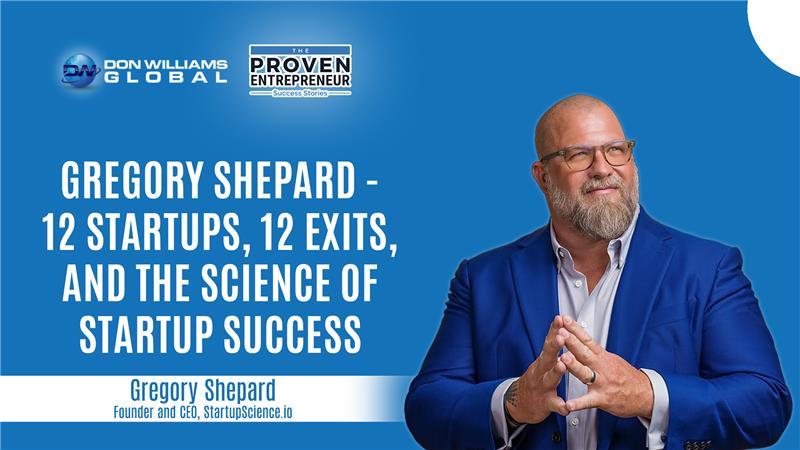
What does it take to build and sell not one, not two, but twelve successful startups? In this episode of The Proven Entrepreneur Show, host Don Williams welcomes a guest whose entrepreneurial journey reads like a blueprint for resilience, strategy, and transformation. Meet Gregory Shepard — Fulbright Scholar, TEDx speaker, author of The Startup Lifecycle, and founder of Startup Science.
From the moment Gregory joins the conversation, it’s clear this isn’t just another startup success story. It’s a masterclass in how to think differently, act deliberately, and survive the chaos of entrepreneurship. Gregory opens up about his early missteps — including a soul-crushing stint in politics — and how a five-year, $500,000 research project into startup failure became the foundation for his groundbreaking platform, Startup Science.
As the episode unfolds, Gregory shares the hard-won wisdom behind his perfect exit record. He introduces the concept of the Ideal Acquirer Profile (IAP), a strategy that flips conventional startup thinking on its head: build your company with the buyer in mind from day one. He dives into the dangers of overvaluation, the myth of investor wisdom, and why most startups fail not because of bad products, but because of poor execution and misaligned expectations.
But this isn’t just theory. Gregory gets real about the sleepless nights, the moments he was days away from missing payroll, and the grit it took to keep going. He speaks candidly about growing up in poverty, being autistic and dyslexic, and how those experiences shaped his resilience and perspective. Along the way, he and Don explore the role of neurodivergence in entrepreneurship, the underestimated power of standardization, and why growth — if done too soon — can be fatal.
This episode is packed with insights for founders, investors, and anyone navigating the unpredictable terrain of building something from nothing. With humor, humility, and a whole lot of heart, Gregory Shepard doesn’t just tell you how he did it — he shows you how you can too.
Watch the episode here
Gregory Shepard — 12 Startups, 12 Exits, and the Science of Startup Success
Hey, it’s Don Williams with today’s episode of The Proven Entrepreneur Show. This is the show where entrepreneurs learn from other entrepreneurs, from stories, from their lives. Man, do I have a great guest today. Fulbright Scholar, TEDx speaker. Okay. Bunch of other stuff, but maybe most importantly, 12 startups and 12 successful exits and like
exits, you know, with a B or near a B, which those are special exits. So Gregory Shepard, welcome to the show.
Thank you. Thanks for having me. I appreciate it.
thrilled to have you. It’s considered our high honor. Okay. And so your current company is a company by the name of Startup Science. Please tell us what Startup Science does and who it does it with and why you do it.
So as an entrepreneur at the end of my last exit, my last two exits went to eBay Enterprise Marketing Solutions. And I left that and wanted to help startups. So I went into politics and became a chairman for congressional candidates trying to move money down to startups. Well, that was the worst decision I ever made in my entire life. was just, so I stopped doing that.
But I did a research project, a five year research project to find why when and founder, why when and how founders fail so I could show the government and try to get them to move money down. Well, they said no again. So then I wrote the book, the startup lifecycle and started the platform startup science and startup science basically takes the fragmented broken ecosystem and pulls it all together into one platform so that founders can access everything they need in one place.
which was one of the things that came up when I was doing the research on why, when, and how founders fail.
I love that. And so don’t find it surprising that entering the political arena was soul sucking and frustrating for an entrepreneur. We typically move at the speed of light and politics and legislative things typically move at the speed of mud, if at all.
my god, you know, it’s
funny about saying that because when I was there, I was like, I said two things. It’s like a snowball rolling uphill in the January snowstorm. And then the other thing I said is it’s like trying to navigate and make things happen like running a marathon through peanut butter. You know, just the most frustrating, awful experience I’ve ever had. It’s terrible.
Yeah.
A hundred years ago, I did a bunch of work for a nonprofit trade association in DC. And, it was eye opening. The two things I learned was this one, you can get access. You want to talk to the chairman of energy and commerce? You can at least get to their office. Maybe you don’t get an audience with them on the first attempt. Okay. But you can get access. And then we had two senators attend,
Mm-hmm.
Mm-hmm.
cocktail party in the Rayburn building. So that’s on Capitol Hill. It’s a building where senators have their DC offices. We held a cocktail reception there. We had two senators and attendants. And I won’t tell you what it cost us, but it was really cheap. And so was like, man, you can not only get access, but it’s not that expensive. And so, ⁓ you know.
Hmm.
Hmm.
No. Yeah, you’d be amazed.
Yeah. ⁓
Yeah,
it was quite something. Eye-opening. Okay. So I’m going to hop right in there. Built and sold 12 businesses, which that’s rare. Okay. A lot of people have started 12 businesses, but they had five or six failures and a couple that did pretty good and a couple that were medium, but built and sold 12 businesses. What’s the one rule, the universal rule you follow every single time.
You have to know it’s a building and exiting a company. There’s one thing you have to know. You have to know where you are and where you’re going. What I mean by that is where you are in the life cycle and then where you’re going means who you’re going to sell the company to. And you have to do that right at the beginning. And so this is contrary to a lot of what, you know, investors tell you, right? So investors are, you don’t worry about that right now, but that’s just not true. And I’ll explain why.
Companies buy companies for one of two reasons. This is what they call quote synergy, right? It’s either make or save money. Most of the time it’s to make money. Now, how do they make money? So think about the performance driver of customer acquisition costs to lifetime value, right? So how much it costs you to get a customer versus how much you make from that customer. All these big companies, they want to grow their lifetime value because they already have the customers and they’ve already paid for them. So.
for every dollar they invest into customer acquisition, if they make $5 because of their lifetime value, that makes sense for them. Now, if they buy a company that can be sold to the thousands and thousands of customers they already have, then that’s just a leg up. So when I think about building businesses and the reason why I’ve been able to sell them all is because I start by thinking about who the acquirer is and who their customers are because
If you can’t sell your business to their customers, they won’t buy your business. So it’s not like you can do that after, you know, 10 years of building a company, right? You have to do that from the beginning. And I learned that lesson the hard way. I had built a company and 50 % of my customers didn’t match their customers. So they were like, we’ll give you half what we were going to offer you. And then we’re to cancel all these customers because we don’t want them. I went back and rebuilt the company. It took me five years and then sold it for full price.
by replacing those customers. So I learned that lesson the hard way and I learned it once. And then from now on, and I tell everybody, I’m like, you have to understand what I call your IAP, your ideal acquirer profile, just like you know your ideal customer profile. Like think about it. Building a business without having an acquirer is like building a product without having a customer in mind.
Building a business without having an acquirer is like building a product without having a customer in mind. Share on XNow listen folks, that’s pure gold. I have done 150 of these interviews. I’ve been a serial entrepreneur for 38 years now. That doesn’t seem possible. I’ve done a dozen startups. I haven’t done a dozen exits. Okay. But the pure gold is when you start the company, know who you’re going to sell it to. That is pure genius. And so thank you for sharing that.
Mm-hmm.
Next question, what’s the biggest lie startup founders believe in?
So typically, when I did the research, so this was a five year research, it was a huge, it cost me half a million dollars. This was a huge research project on understanding founder success and failure. 47.1 % failed in the first 18 months. The research was for five years. So the rest of the failures over the following four years, four and a half years, whatever, those failed for things they did in the first 18 months.
So the first 18 months is really, really, really, really critical, right? What you do then sets the pace for what you’re going to do in the future. I think that a lot of founders based on the research, listen to investors. They listen to mentors. They listen to people. They need to be really careful about who they listen to because the number one reason why founders fails bad advice. And the bad advice came from that group of people, primarily investors. So investors,
You know, they’ll invest in 20 companies hoping one of them makes it. But as a founder, you need yours to make it right. So they’re giving you instructions and feedback on what to do with your business based on their lens of the world from an investor perspective of the world. Right. It’s oftentimes just plain wrong and they can steer you into a hole because they’re trying to turn every single one into a giant company because that’s all they care about. So they’ll push you to that point, but
As a founder, you may not be looking at $100 million or a $500 million exit. You may be interested in a 25 or $50 million exit, which by the way, is the majority of the successful ones fall between 25 and 50. So the biggest lie is this concept that you listen to your investors, you listen to these people, you listen, but you got to hear the parts that are relevant to you based on your experience as a practitioner.
Does that make sense?
I love that.
You bet. Makes perfect sense. So I’m a member of an angel investor network. And when I first joined, the council they gave was this. you know, this is not for somebody who’s going to invest in a deal. This is for somebody who’s going to invest in 10 deals minimum. And you got to expect that two of them are just going to be rotten. They’re going to be horrible. Okay. You’re going to lose everything. And
Mm-hmm.
Hmm.
and you’re going to make a little on some and you’re going to do pretty good on others. But your, your big hope is that you hit one that’s a flyer and, it makes up for everything. And, that’s been pretty sound counsel in that group, even though there’s a ton of due diligence, really bright people. mean, these are not stinkers that are coming across the desk, but, but as we know, it’s hard.
Mm-hmm
startups, you know, the, the attrition, the death rate is significant. And, uh, yeah. And doesn’t really matter, you know, what your product service or experience is. Um, it’s hard. And so, um, if you can make it five years, that puts you in pretty rare air. Um, you’re not in the 90%, you’re in the 10.
Yeah, 90%. Yeah.
Yeah. And, what’s
Yeah, exactly. But what’s crazy is that if you really understand why the ones that are failing are failing, if you actually understand the depth of why they’re failing, you can offset those things. Right? So I have a perfect track record because I understand the depth of failure. So I can see it coming. I can see the decisions before I make the decisions, right? Based on this information.
So, you know, as an example, you know, one of the big failure reasons that they can’t exit in the following five years, because they didn’t build their company to exit at all, right? Like I said, in the very beginning. So you have a huge failure rate at the following five years for that one reason, right? So how many of the investments that you invested into couldn’t get to an exit, but they could have had they planned for it from the beginning, right?
That’s one of the things. The other thing is the idea of overvaluation. So investors, a lot of times will say, okay, raise the valuations because they want higher AUM, higher assets under management, right? Because that shows the fund being bigger, they get more investors and they make two and 20 off the investors, right? 2 % off managed funds and 20 % over the hurdle, over the amount that people invest. So they want to grow their assets under management, right?
So what you have is you have people growing the valuation and pretty soon the valuation gets too high and investors won’t back it anymore and then it folds. And so a lot of times founders don’t realize you raise a million dollars and you ask them in interviews, I interviewed thousands of them, right? And you ask them, when you raise a million dollars, what are you thinking now you have to return to investors in order to keep those investors on board? And they’ll be like, well, I raised a million so I got to give them a million.
maybe a million five and I’m like, no, no, it’s 10 times that. So when you raise a million now in order to keep raising money, you have to show investors that there’s 10 X in it for them in arbitrage, meaning now it’s 10 million, right? And they never realized this. So they get halfway and the one of the big reasons overall is running out of money. Well, running out of money is more of a question than it is an answer, right? Why are you running out of money, right?
Well, one of the big reasons is overvaluation stemmed from the venture capital community wanting to get larger assets under management and growing the valuation, you know, typically 15, 20 % between rounds, even if the business doesn’t justify it.
I love that. As the entrepreneur, you have to see things from the other person’s point of view, and the investor has a specific point of view, and the venture capital company has a specific point of view. It doesn’t mean that you should shun them, but it does mean you should be realistic about their looking at it from their point of view, and they’re going to take care of them first, and you second, or third.
Mm-hmm.
Yeah.
And so to know that, yeah, yeah.
You listen to everybody. You just don’t take the advice from everybody, right? Like
You listen to everybody. You just don’t take advice from everybody. Share on Xyou as a founder are responsible to filter out based on your own experience the advice you should take and try to escape confirmation bias yourself as a founder, you know?
Yeah,
a little discernment will go a long way for sure. For sure. Yeah.
Yeah, negative right because
all the founders including me we’re all optimist right we’re like we’re gonna do this amazing thing data data maybe shelter that a little bit and think a little negative because that’s the that’s how you’re gonna be able to filter out the advice that you get otherwise it’s all painted with the brush of this is gonna be amazing
Yeah.
Oh yeah, it’s going to be great and it’s going to be fast. you know, it’s kind of like every construction project I’ve ever done. I’m over budget over time. You know, no, yeah, no, no matter how much I add to the estimate to, to, you know, make it more true, it’s still doesn’t come in. Right. So, and that’s, and that’s kind of startup land all on its own. You know, things will be harder, things will take longer and that’s just the way it goes. So in your own founder journey.
Twice as long, twice as much.
Yeah.
Mm-hmm.
Do you have a hard moment? It may be one that you’ve never shared publicly.
Yeah. Yeah, many, actually many, many. I can’t tell you that probably 50, 60 times where my team didn’t know, nobody knew except for me that I was a week away from not making payroll. Right? Like you’re, you’re sweating at night. You don’t, and you have no idea what you’re going to do. Right? You seriously have not a clue. You’re like, how am I going to even pull this off? Right?
Ha
Hmm.
That has happened to me several times. those, the sickness you get in your stomach, in your heart drops down to your stomach. You know, your face turns red, you’re sweating in the middle of the night awake, you know, trying to rock yourself at the end of the bed, just like, what am I gonna do? Right? This has happened to me at least 50 times. There is something to be said for having the grit and the…
the self-discipline to keep yourself on the rails, even when things look pretty rough, right? you know, growing up the way I grew up, I grew up poor, right? We didn’t have any money. We homesteaded on our property. You know, I drank out of a milk jug. We went to the bathroom in a bucket. We showered off of trees, a bag hanging from trees. This sort of grit allows you to survive.
Mm.
Right? That’s why if you look at the data, immigrants actually represent 47 % of unicorns. These are people that came into this country, not speaking the language, not, you know, came out of a, uh, evolved in emerging market. I mean, they’re tough, right? They’ve been through it, right? They survive because they have survived. So in, when you look at the data, what you see is that the people that have had the hardest lives are the most successful founders. You know, there are high agency people.
Hmm
Right high agency people. There’s a you could look at a there’s a whole bunch of data on high what’s called high agency people Those are the people that survive. So I think having a hard life and I’m also autistic and dyslexic So having a really difficult life barely graduating from high school, you know, and I went to five different high schools I mean I was a terrible student, you know and But having survived all of that stuff in my life
made it so those moments when I’m sitting at the end of the bed aren’t as bad for somebody who has never experienced that kind of, you know, challenge before, you know, because I’m like sitting there going, well, you know, I mean, I’ve slept in a tent for two years. I think I could, I think I can pull this off and it keeps you keeps your engines running. You know what I mean? Like, you know you see those cars that can run on diesel, they can run on bio diesel, they can run on flex fuel. Like that’s me. Right. And that’s a successful entrepreneur when things get really hard.
Yeah, love that heart. know, hard times make strong people, strong people make good times, good times, make weak people. And the cycle continues. And I think back 20 years ago, so about halfway through my entrepreneurial journey, I went through a divorce and like everything left my house, the house stayed, but every
Mm-hmm.
Everything was inside the house, left the house one day. Yeah. And so as an adult with children, you know, I slept on a pallet on the floor for about a year as my business was not doing well. so I think entrepreneurs have that grit to keep going even if…
Oof, ouch.
Hmm.
Maybe they shouldn’t, but they, I’m just going to keep putting one. ⁓
Sometimes, yeah, sometimes
they need to throw in the towel, but they’ll keep fighting, you know. Yeah.
Yeah, absolutely.
then on, you know, ADHD, which is obviously on the autism spectrum is so common amongst entrepreneurs and
38
% of entrepreneurs are neurodivergent categorized in the nerd. Yeah. It’s a huge, in fact, if you look EY, Microsoft, Apple, even Amazon, they’ve all started to create sales force have all created floors in their buildings dedicated to the neurodivergent because they’re so good at doing this entrepreneurial stuff. Cause they just think different. Like we think different. So that’s an advantage, you know,
⁓ wow.
We do. Oh, we’re just
wired different and I’m not sure we get credit. I’m not sure we deserve credit for it, but we were just wired a little different. And so we see things, you know, differently. Okay. So most startups fail. know that 90 % in five years.
You
Mm-hmm.
Even when they solve a real problem, even when they have a great product, service or experience, why do most of those startups fail?
Mm-hmm.
It has to do with execution. So, you know, if you break down execution, I’m actually writing another book on execution right now, but if you break down execution, so people go, well, execute as that’s a big word, right? Execution has to do with your ability to do organization and time management. Right. So the way that you think about execution is understanding what I call the execution stack. Right. So what is your mission?
What are the objectives for that mission and what are the tasks you have to accomplish? And then what are your measurements? I call it a modem, right? How are you measuring the results of the activities that you’ve done so that you can iterate and make it better the next time, right? So execution early stage, has to do with execution, either doing the wrong things or doing the right things wrong. You can even do the wrong thing, right?
Ha ha!
they sometimes are doing the wrong thing, right? Or sometimes they’re doing the right thing, wrong, right? but first make sure you’re doing the right thing and then really break down what you’re doing into a structure so that you can stay organized and then use priorities for your time management piece. Right. Separate your day into segments. So this allows people to execute. And when I say execution, sometimes the founders are so busy that they, they don’t
think they have time to organize and structure, right? But I get up at four o’clock in the morning, I’m organized and structured by 4.30, I’m working by 4.35 o’clock, right? So I take that 30 minutes every single day to get my act together, right? It’s like Lincoln said, right? If I was gonna chop down a tree, I’d spend 50% of my time sharpening the saw, you know? So I think execution is key and understanding how to break down what execution is.
If I was going to chop down a tree, I’d spend 50% of my time sharpening the saw. Share on Xis a huge reason. The second reason, here’s the second one, big one, okay, is that the traditional thinking about the startup life cycle is that you go from vision ideation to product to go to market to growth, right? Actually, you shouldn’t do that. You should go from go to market to standardization to optimization to growth. Because if you don’t do that, the problems that you have that you aren’t aware of yet, because you haven’t documented
the way that you do things standardized it, they grow and carry with you. It’s like a cancer, right? And it’ll just get bigger and bigger. And when you go into growth, that same little bug that you had will put you out of business when you go into growth because it just becomes a monstrous problem. So I tell people, like, there’s a point after go to market where you’re like, okay, I know I can sell this and everything where you have to I’m going to actually document what this is, how it actually works.
So the process of documenting how it works to write down what it is, what functional area does it, and how do you go about it, right? That’s the key. So if you document how things actually work, then you know how they work. Now you can go back to those things and look at how they’re optimized. Like, how am I optimizing these things specifically, right? So this is where you’re increasing margin.
When you look at companies, there’s three things you need growth, margin, retention. Those are the major revenue drivers, right? Growth comes from sales and marketing. So you have that number on sales and marketing. Retention comes from services and support. So you have that number sitting on services and support and then return. And then margin comes from operations, right? So your CFO, your shared services and product and engineering goes across everything.
So once you organize your functional areas to the valuation drivers, then you start to see when you’re going through standardization, how you can optimize all of these things to increase margin. So this is the key thing. If you skip over those stages, you just bring these problems with you and then you blow them up when you’re growing and you’ll put yourself out of business. So one of the things I’ll tell you is that the average cost of training somebody in the growth phase to become
75 % to 100 % productivity is 33 % of their first year’s wages. So if you’re paying somebody a hundred thousand, let’s say just for easy math, $33,000, you’re hiring five people at a time. Think about the cost, right? Now, if you standardize, you don’t have those people being disrupting your other team. Everybody’s doing things the same way. So you can check your KPIs. They’re lined up.
Yeah.
If you skip over that, you don’t have that there. And now you have these huge costs just by growing and you can put yourself out of business. You can not have those costs by going through standardization and optimization before you spring into growth.
Yeah, love that. So counterintuitive, but growth may actually kill more startups than not doing enough business, um, just because they’re not prepared. Um, and, and, and if you don’t have enough margin, just doubling or tripling sales just means you lose money faster. It doesn’t actually mean you can’t outgrow that on volume. Okay. Um, if you could go back to your 25 year old self.
Yeah, because they say there’s Right because they say there’s the valleys of death not valley
and give yourself one piece of advice, something you know now you didn’t know then.
You only had 60 seconds. So it’s like the very best thing you could tell your 25-year-old self. Gregory, what do you tell Gregory?
I would say that there are five things that I need to have a handful of things. So I would say you have to have optimism, you have to be optimistic about what you’re doing, you have to have discipline, focus, drive, and enthusiasm. If you have those five things, you can fight through the difficulties of entrepreneurship.
I love that. Okay, tell us, where do we find the book? The Startup Lifecycle by Gregory Sheppard.
You can go you can get it on audible or you can get it on amazon or any bookstore. ⁓ it’s all over the place. it’s It’s almost a best seller. So it’s doing really well. ⁓ and it breaks Thank you. Yeah, and it breaks down all the the research I did the research took five years and the book took four years So it’s really dense, but it’s you know, you know people love it’s got five stars on amazon. So
Okay.
Good, congratulations.
It’s amazing. Great job. I’ve written nine. Writing a book is not easy. It’s not for the faint of heart. Entrepreneurs writing books is probably doubly challenging because we have this shiny part of our personality where we want to chase other things all the time. in a book, five years research and four years to write the book, that took a lot of discipline to actually get to the finish line.
Okay, Gregory, how do we reach out to startup science, you, what’s the best way to connect?
My personal website is gregoryshepard.com and on there you can see, you know, I’ve been on four or 500 podcasts. There’s three or 400 articles I’ve written. You know, it’s basically watch, listen, read experience, like all the ways you learn. I’ve got it broken out that way. All the businesses I’ve built and sold, all the companies I’ve invested in, it’s all transparent right there.
Because people don’t believe me to be honest with you. So I put it all I put it all of there so people could see it and then startup science is startup science.io if you’re a founder You want to go to Gregory Shepherd comm click on founders and you can access the platform for free right now It’s free. So if you’re going to do it now’s the time to get in there and there’s two hundred and fifteen thousand investors in there that you can access for free so
Hmm
Just let me tell you this folks, just go do that. This is a really smart guy. Okay. His brain’s wired a certain way that’s helped him achieve what he’s achieved and that free offer. What’s the website again? GregoryShepard.com slash founders.
just click on founders. don’t know if it’s slash founders.
Just, okay, just
click on founders. Okay. Absolutely free. You’re missing out if you don’t go do that. I’m just telling you. Gregory, thank you so much for being on the show. It’s been my pleasure and I appreciate you dropping nuggets of wisdom throughout today’s show.
Thank you and I appreciate your time and your patience and thank you to all the listeners too. Thank you so much.
Thanks folks. That’s today’s episode of the Proven Entrepreneur Show. We’ll see you next time. Bye now.