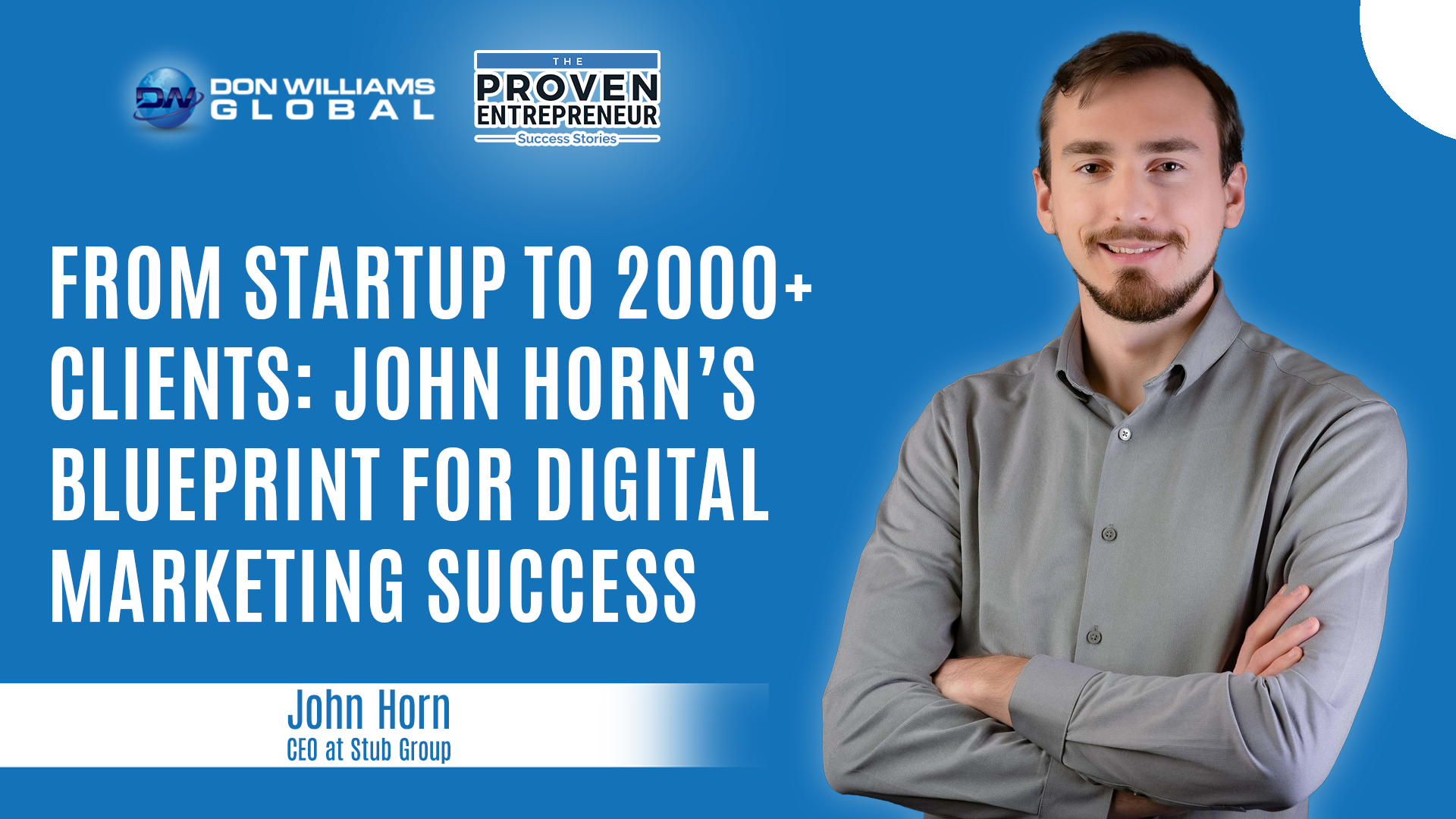
Welcome to another episode of The Proven Entrepreneur Show, where we dive deep into the stories behind today’s most successful business leaders. In this episode, host Don Williams sits down with John Horn, the CEO of Stub Group — a digital marketing agency that has helped over 2,000 businesses grow through smart, ROI-driven advertising.
John’s journey is anything but ordinary. From working in a warehouse at age 10 to becoming the first employee at his brother’s startup, John has played a pivotal role in scaling Stub Group into a powerhouse agency managing hundreds of millions in ad spend. His story is one of grit, strategy, and relentless focus on results.
In this episode, you’ll hear:
- How Stub Group grew from a bootstrapped startup to a 30-person team
- The biggest mistake brands make with paid ads — and how to avoid it
- What it means to land in “Google Ad Jail” and how John’s team helps clients get out
- Why hiring the right people early is critical to long-term success
- How diversification helped Stub Group survive the COVID-19 crash
- A behind-the-scenes look at ad campaigns so effective, they were shut down by platforms
John also shares his thoughts on the future of digital marketing, the importance of tracking ROI, and why best practices from platforms like Google and Meta aren’t always in your best interest.
Whether you’re an entrepreneur, marketer, or business owner looking to scale, this episode is packed with actionable insights and hard-earned wisdom.
Watch the episode here
From Startup to 2000+ Clients: John Horn’s Blueprint for Digital Marketing Success
Hey, Don Williams here with today’s episode of The Proven Entrepreneur Show. I have a real treat today. I have a digital marketing guru expert, ⁓ Phenom and John Horn with Stub Group. Welcome to the show.
Hey Don, thanks so much for having me.
So I’m thrilled to have you on the show. ⁓ Your company has tons of clients, has managed ad campaigns and hundreds of millions of dollars in sales. And ⁓ interesting to me, somehow you seem to have identified a path back if a client gets in, I’ll say Google ad jail.
⁓ You have been able to parole some of those people. so, ⁓ John, tell us what stub groups, core competencies are, who you serve, how long you’ve done it, all that stuff.
Yeah, absolutely. So Stub Group, we’ve been around for over a decade at this point and really focus on the digital marketing side of things. So working with all sorts of different businesses, everything from e-commerce companies to local service businesses, lead generation, SaaS, etcetera, and helping them use the internet to find new customers and ultimately make more money. So the platforms usually talk about things like Google, Meta.
And yeah, ultimately going out, finding where people are at ⁓ and capturing them in the right stage in that customer journey so that we can get them introduced to our clients and again, make more money than our clients are paying to the platforms they have to use to advertise.
Yeah, return
on advertising. That is the magic. That is the magic. So I want to take you all the way back to young John. So you’re in your household that you grew up in between five and 18, and people’s households are different, but you’re in that house. Was there an entrepreneur as an adult who set an example for you?
Yep.
Definitely. So I’d say my family has a history of entrepreneurship. My grandfather owned his own grocery store. My father was an attorney, had his own law practice. And then my brother, my older brother actually started Stub Group and I came on board with him in the early days. And so lots of entrepreneurial examples and things that I was able to learn from and then ⁓ parlay into my own working experience.
Yeah. So love that. know, many times when a child grows up in an entrepreneurial household, you know, the kitchen table is also kind of the boardroom table. And so they just learn a little by osmosis ⁓ by being there. Okay. So out of your childhood home, went to university or backpack across Europe, or immediately went out to the garage and helped your brother and started stuff group.
So I got into the workspace, the workplace on the early side of things. Growing up, even when I was, know, 10, kind of 10 and on, I was able to work part-time with my dad. He worked in a warehouse. I would go and help him work, you know, a day a week, that type of thing more as I got older. And then started working full-time when I was 16, working in kind of customer service and wholesaling and different stuff. And went to college virtually online while I was working. So got a degree while I was working.
Hmm.
And then, yeah, eventually ended up going into the stub group world when my brother and business partner of his started the business and then brought me on really as employee number one. And we’ve grown the business since then.
I love that. So ⁓ brother, partner, you employee number one, how big is the team now? How many clients have you served?
Yeah, we’ve got around 30 people on the team currently. We’ve worked with over 2000 clients and trying to increase that number every day.
Love that, love that. Okay, so, I want to ask you a question. Not often we have a digital marketing guru on the call. So, let me ask you this. What do you think is the biggest mistake brands make with paid ads?
Hmm. I’m not sure about the guru part, but I will give you my best answer to that. Cause they had to see a lot of mistakes. ⁓ number one, I would say is not defining and tracking what success looks like for their paid ads. A lot of businesses will just say, Hey, we need to do X, Y, and Z. And they’ll just start throwing money at the wall and they’ll wake up six months from now and realize they had no mechanism in place to track whether or not that money they’re spending is actually turning like you mentioned earlier into ROI.
and how much ROI and which parts of what they’re doing is working and which parts aren’t because that’s a big part of marketing. Not everything works equally. It’s that 80-20 rule as with most of life. And so you got to track and see which 20 % is driving 80 % of the results. And then let’s spend our time and our money there and not spend it on the other areas that just aren’t working.
I love that. I think that’s a fatal error, not just in digital marketing, but in most things entrepreneurial is if you do not have the end in mind, you don’t know where you’re going. You’re probably already there. You’re lost in the wilderness. So tell me this, the early days of Stubb Group, ⁓ what was that like? So, you know, every dollar matters.
If you do not have the end in mind, you don't know where you're going. You're probably already there. Share on Xclient is really, every client is always important, but like in the beginning, they’re like really, really important. Can you talk about that a little bit?
Very much so. Yeah, very, very brute strapped, very, very gritty. ⁓ those early days, we really, from a pretty early time said, Hey, we’re going to put our money where our mouth is. And, you know, we’re, doing this, this paid advertising stuff. Well, let’s put our own money to see if we can use it to acquire clients ourselves. And so a lot of our early clients that we brought on board were from us running our own campaigns and saying, okay, well, I guess we must know what we’re doing because we’re getting some clients and then, you know, figuring out how to run their campaigns. So.
Yeah, lots of very stressful time as I think is true in the early days of any business, but very much every client counts. We’re going to figure things out. We’re going to go above and beyond, be creative and be very careful about the money that we’re spending and then ultimately grow that into something with some stability.
Love that. I think it’s so important that a company can eat its own cooking. If you really want to understand the customer’s journey, be the customer. ⁓ And that’s really the only real way to see it from their point of view is just have their point of view and infinitely invaluable. So what about an industry secret that you wish every client knew before they hire?
Hmm.
a digital agency? Because I’m guessing that a lot of your clients say, well, I’ve hired several digital agencies and lost a lot of money and it didn’t work. So what’s one thing you wish they knew before they hired that first digital agency?
There’s a lot of places I could go with that, but I think the first thing that comes to mind is, the mentality with which businesses need to approach hiring an agency. So I see a lot of businesses have almost this kind of aggressive mentality towards agencies, which unfortunately I think often is because they’ve had bad agencies they’ve worked with. And so it’s kind of this. On the agency side, you’re almost always on the defensive. It’s like you’re defending everything that you’re doing to that client as opposed to.
where we see things be really successful is this team mentality of, we’re on the same team. We’re trying to make you successful and we need information from the client to be able to be successful. We need to understand what sets them apart, what’s going on in their other marketing, what their clients care about. need clear communication. so I think businesses need to understand, look, when you hire an agency, you’ve…
You’ve got to communicate a lot to them. You’ve got to give them data. You’ve got to give them context because they’re never going to understand your business as well as you do. That’s just not possible, but they’re going to understand things about marketing and about the platforms that they use better than you will as a business owner. And so you got to try and marry those things together and not have that kind of defensive aggressive relationship, but that teamwork striving towards a common goal relationship.
I love that. One of my first businesses, I was in the contact center space. so very similar that almost every client you ever had said, ⁓ I wasted so much money on other call centers. And we were in the outbound space, which is not for the faint of heart. Take some guts to get on there and make 100 phone calls a day and deal with all of that. But
But one thing we learned early on is the more we understand about the client and the more the client understands about us, the better we’ll perform together. And it is a team. And so many of those relationships last years and years and years because the client is so blown away by someone who actually works with them. They just won’t let you go. They’re like, no, no, they stay. These other things might go, but these people.
you
they stay. And so just speaks to handling that customer experience the way you’d want it to be handled. okay. If I put you in a time machine and I took you back to the very first day at Stub Group, what do you know now that you wish you knew then? So I’m gonna put you in the time machine. You get about a minute to say, Hey, John, listen up, man. Okay.
What would you tell yourself on the first day that you know now that you didn’t know then?
direction I’ll go with that is people because people are really our business. We sell the skill sets and time of our team members ultimately. And so I would say.
Be very careful about who you hire and be very quick to say, hey, this is not heading the right direction. We’re not the right fit for each other. And don’t ⁓ don’t cut corners in that hiring process. Because it’s really easy to hire somebody like, I think they’re, you know, they’re almost where I need them to be. Maybe I can invest a bunch of time and energy into them. I’ll get them to where I need to be. But at end the day, there’s a lot of things you can’t change about people. And so you just need to have very high standards.
during the hiring process and then have very good quality assurance in place to make sure that they are the right fit in those first early days of working together. I think that would save a lot of ⁓ challenges over the years if we’d learned that earlier.
Yeah, love that. So we’re all in the people business. I don’t care if you sell sand, you’re selling it to people who are using it for something. Okay. So knowing that we’re all in the people business and then not lowering our standards, that almost always comes back to bite you where you don’t want to be bit later. Okay. When you compromise your principles and then
Third, if you do need to make a change, I’m a big believer in, if we’re going to fail, let’s fail fast and cheap. Let’s not fail slow and expensive. Okay? If it doesn’t work, it doesn’t work. And it’s probably not working for them either. And so let’s let everybody get on to their highest and best ⁓ endeavor, which for whatever reason, it doesn’t even matter, know, is not this particular.
Let’s fail fast and cheap—not slow and expensive. Share on XOkay, so ⁓ what about a hard moment? So something that’s happened in your experience in the business that maybe in retrospect, you’re like, actually pretty positive that that happened. But when it happened, was like, ouch, this hurts. Do you have a moment you can share like that?
First one that comes to mind is probably a moment shared by my many businesses as early, early 2020 COVID hits. And there’s what to call kind of black Monday where it’s one Monday. So many of our clients like, Hey, we got to pause advertising, pull it back, et cetera. Cause we don’t know what’s going on. can’t open as a business. And that was a really hard time. ⁓ We had to make some decisions very quickly about our workforce and what was going to happen. I think what we learned from that was that thankfully
We were fairly diversified as an agency. had clients in many, different industries. So we were not hit as hard as some people like, for example, know, travel oriented agencies or gym oriented where literally a hundred percent of their clients are dead in a day. ⁓ and so that’s been a, a, a very good learning to keep in mind as we move forward, which is diversification is important when we put too many eggs in one basket. There’s no guarantee of that basket is going to stay that basket. And so we want to, you know,
Okay.
be able to have stability for our team members and have things diversified across different areas.
Yeah, love that. March 16th, 2020 here in Texas was kind of zero day. And I was very successful canceling about 12 speaking engagements and refunding all the money because people just weren’t getting together. You’re like, you know, what can you do? And so take care of the clients and, and ultimately all that business has come back and more, but, but it pays to be able to handle stuff when it happens for sure.
Yep.
Okay, last question. ⁓ Any golden nugget on, ⁓ if we could look into your brain and say, man, this is really the good stuff. Anything you can share on digital.
Yeah, let’s see. would say, so we talked about kind of tracking defining success as being really important to stand by. I would say when you’re getting into digital, whether it be Google ads and meta ads or other things, be very careful of the best practices that those platforms push you towards. They all have the set of best practices decisions that they want you to make. And sometimes those are good things.
Best practices from platforms like Google aren’t always best for your business. Share on Xbut the nature of the beast is that best practice, they have that best practice across every business out there and businesses are very, very different from each other. And so a lot of the value that we bring to clients we work with is like, hey, yeah, Google says this is best for you. No, it ain’t, you’re gonna lose money if you do this. But this one over here is good. So you’ve got to approach them with the nuances of your business in mind.
Mm.
I love that. So knowledge is power, folks. Be sure that if you don’t have it, you get it or you work with somebody like Stub Group that already has it and that they can share. John, thank you so much. I appreciate you being a guest on The Proven Entrepreneur Show today. Yeah. And we’ll see you all next time on The Proven Entrepreneur Show.
Don, thanks so much for having me.
Okay. And I’m going to do a look at the camera and smile. do a quick screenshot.
Okay. Now I’m going to ask two questions and I’ll do one. I’ll be pretty quick trying to have your answer before we end up less than a minute. And then we’ll pause a couple of seconds. I’ll do the other. Hey, John Horn stub group. What is one ad campaign that you ran that works so well, Facebook or Google shut it down.
⁓ We’ve done some work in the financial space with a lot of success with driving ⁓ people looking for like stock tips, information, stuff like that. And it’s a very nuanced space where Google is kind of paranoid. And so we’ve definitely had some situations where you got to be really, really careful about what you say, how you say it, making sure that you ⁓ dot the I’s and cross the T’s so far as Google is concerned.
Love that. Thank you. Next question. OK. You only have $1,000 to invest into digital ads. Where do you put it?
I am probably going to take that thousand and probably will actually go to Meta over Google simply because if it’s just kind of one shot do or do or die, I can push my message out to hopefully the right people with Meta. Whereas with Google, mostly it’s going to be people searching for things and then me trying to figure out whether or not what they’re searching for is actually what I should be showing my ads for. And it takes a lot of money to figure that out. So
Probably go with Medi with that thousand.
Love that. John, thank you so much.
Thanks so much for having me.
Okay, I’m gonna hit click stop.