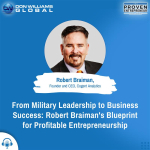
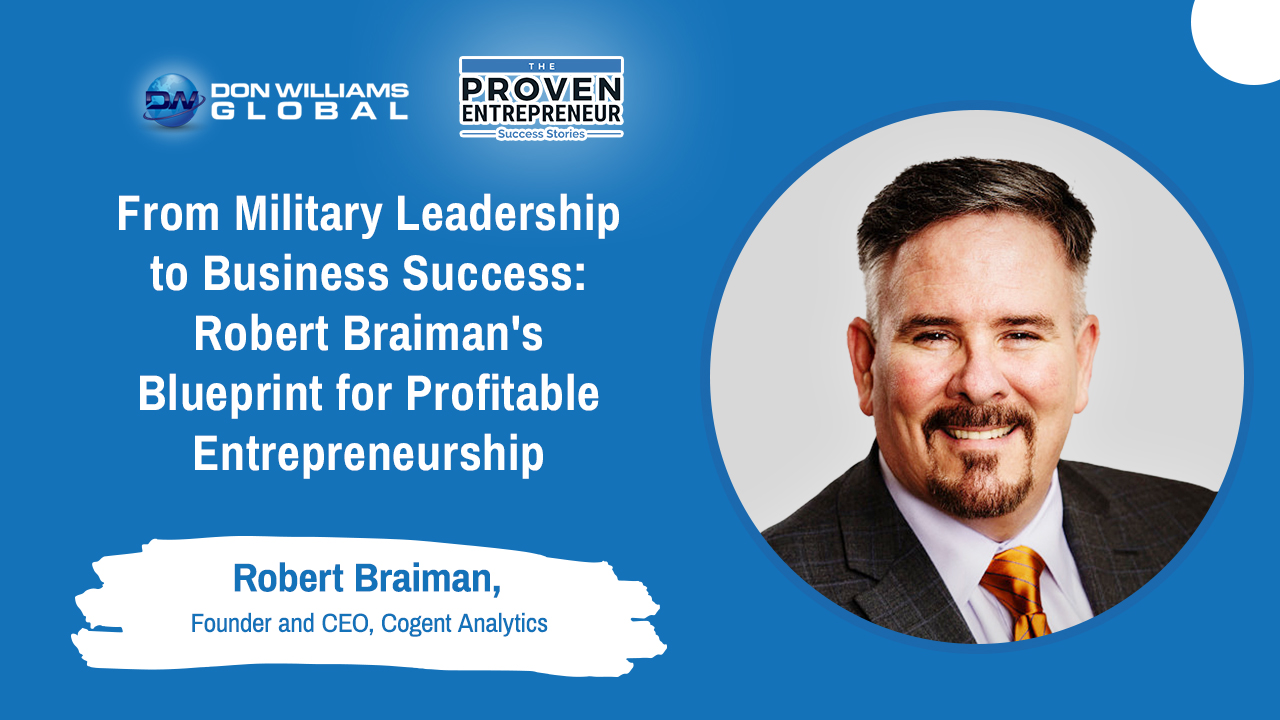
In this powerful episode of The Proven Entrepreneur Show, host Don Williams sits down with Robert Braiman, Founder and CEO of Cogent Analytics, to explore the deeper layers of what it truly means to build and lead a business. From his formative years in the military to becoming one of America’s most respected voices in small business consulting, Robert shares invaluable entrepreneurial journey insights and the lessons that shaped his leadership philosophy. The conversation explores how his military discipline, client-first mindset, and belief in “Main Street, not Wall Street” have driven him to help entrepreneurs across the nation achieve sustainable growth and profitability.
Braiman opens up about the challenges of being a family-driven entrepreneur, the courage to take risks, and the reality of balancing personal and professional life. Together, Don and Robert uncover how business growth strategies, organizational leadership, and storytelling in business can transform not just companies but the lives of everyone connected to them. The episode also delves into Cogent’s signature framework—the Profit Platform—a holistic approach to increasing profitability, improving cash flow, and creating long-term equity value.
Whether you’re an emerging founder, creative agency leader, or seasoned business owner, this episode delivers real-world startup success lessons grounded in experience, integrity, and strategy. Brainman’s advice on purpose-driven leadership, overcoming entrepreneurial burnout, and redefining success will inspire every listener to own their business—rather than letting the business own them. Watch, listen, and learn how to turn your next challenge into a catalyst for growth and long-term success.
For information on how to work with Don visit us at https://donwilliamsglobal.com
You can also reach out to Don Williams at https://provenentrepreneurshow.com
Watch the episode here
Robert Braiman on Leadership, Entrepreneurship, and Building a Purpose-Driven Business
A Don Williams here with today’s episode of The Proven Entrepreneur Show. I have a great guest today, all the way from North Carolina, Robert Braiman with Cogent Analytics. Welcome to the show.
Don, fantastic privilege. Thank you for having me on today.
That’s my honor. So let’s start with this. Tell us what does coaching analytics do? Who do you do it with or for? Why do you do it?
So we have an old, I’ll start with the why. I’m a serial entrepreneur representing entrepreneurs. I’ve been doing it for 22 years. We’re Main Street, not Wall Street. As I’ve said since the beginning of time, entrepreneurs are still the backbone of our country. And being an entrepreneur myself, I became a business analyst many, many, many moons ago and just absolutely fell in love with the family stories and the people and the gut and grit.
Entrepreneurs are still the backbone of our country. Share on Xit takes to be an entrepreneur. So the Y is easy. Cogin Analytics really works in all facets of the business. And I’m sure you’ll ask me a bunch of follow up questions on that Don. So let me not drone on hearing my own voice. I’ll let you pepper me away with the questions.
Okay. Thank you so much. Now I know that you have significant military experience in your background. And so my first question is this, that experience serving our country prior to the time you chose to serve entrepreneurs, how did that military experience shape the way you lead, build teams and run coaching analytics today?
Truly foundational. I have a lot of military members that actually work for Cogent now. I think it’s 25 or 30 percent of our staff are either former active duty members. Many members are still serving in the Reserve and National Guard. it lends itself, know, service is a lifetime journey. And I think if you talk to any veteran, they’ll tell you they service was a choice when they went into the military and I think service lasts a lifetime. So.
Structurally, it lends itself really well organizationally, not just the way Cogent operates, but really when you begin to talk to entrepreneurs about their organizational structure, because as many of your listeners know, you start a business and when you first start, you wear all the hats. And, you know, sometimes it’s hard to give away those hats as the business takes on, you know, different iterations when you grow.
The organizational engineering that the military takes you through, I think, has a direct line into organizational engineering for business. Leadership is critical. A lot of business owners get stuck in the thick of thin things, as I always say, right? They get $5 decisions pressed up.
Leadership is critical. Too many business owners get stuck in the thick of thin things. Share on Xwhen, when that, you know, and it stops a business owner from thinking strategically really about where they’re going and how they’re going to get there. so yeah, I’ve always believed that there was a direct line to not just my military experience, but there’s a lot of entrepreneurs that are prior service members. And I think it, it’s true with our, with our project director team or our marketing team or accounting team. you know, there’s a direct correlative between the way
service members think and the way consulting serves others.
Yeah, I love that. Several years ago, I had the opportunity to speak to about 250 naval officers and enlisted people on leadership. And I was honored to get that opportunity, but doing my research, was like, maybe I should, what I know about the Navy with my uncle served 33 years, but maybe I should dig in and do some research on military leadership and naval leadership.
Mm-hmm.
Seal team leadership, et cetera. And I was blown away at how big a piece servant leadership was and what I think somebody outside of the military would think is typically traditional top-down leadership. And there’s certainly that component, but I was blown away at the amount of servant leadership built in to their core values. And so…
It was a little bit like preaching to the choir because that’s, that’s what I talked about. So great stuff. Thank you. You built Cogin analytics into the one of the top consulting firms for small and mid-sized businesses. Let me ask you, what problem did you see in the marketplace that made you say, I’m going to solve this. I’m going to start a company to do this.
You know, it’s funny, I got out the military and I fell into a J-O-B, which a lot of people do when they first make the transition. And I was an entrepreneur for the first part, that first journey of my life. And it was odd, I was going to, after being a minority partner to begin with, I had reached that
point where I was going to open my thing, be the 100 % owner. And I told my wife that I was going to interview for some jobs. Well, as you can imagine, she asked me if I was crazy. This was three o’clock in the morning, waking up with a start. And I said, babe, you already know that answer. And then she asked me why. And that answer, it was funny. The words came out of my mouth. And I don’t think I gave it a whole lot of thought.
but it’s lasted me for 20 plus years. I said to her, said, know, babe, you’ve been married to an entrepreneur. You know what that journey’s like. And I want to see what the other side does. And, you know, I always say I interviewed for a number of jobs, got a couple of job offers, and I was dumb enough to say yes to the one that said, hey, if you’ve been a president, can you represent a president? Whether it was ego or…
or narcissism or whatever it was, Don, said, wow, I could do that. I’ve been an entrepreneur. That was the beginning of being a business analyst representing entrepreneurs. the interesting thing about it, I kind of did it in many ways before I officially wore the title of business analyst. And at the time I represented a firm that I just, whether it be morals or compass,
that we all live by, I just was not aligned with their core values and knew that there could be a better way to develop a client first small business consultancy. Consulting comes with a lot of bad adages. And when I thought about Cogent and I thought about our core values, honor, courage, wisdom, faith, perseverance, and loyalty, and making it truly a client first organization.
you know, over the last 12 years, are now the premier small business consultancy at America. And the best part of the story is not that first engagement, but it’s the durability of the relationship. When you get a chance to represent families, you know, these are mother, brother, sister, cousin, you know, partners that go into business together that are great at owning a small business, but most often not.
taking true advantage of business of the business. Most often they go in with trades and skills, but not as adept at running the core business of the business skills it takes to run highly profitable. Our adage, Don, is we want to make our clients, we want to improve profitability, increase cash flow, and enhance equity value.
And that has been our mission since the beginning of time and the durability of relationships that we’ve been able to sustain with our clients is probably the most rewarding because you get to see those family stories and the impact that it has in everyday America, know, Main Street, not Wall Street, right?
Yeah, I love how you said that the business of doing business and the average startup founder, you know, Bob was a great plumber and one day Bob said, I’m tired of working for Sam. And so I’m going to open my own plumbing business and Bob was a great plumber, but he probably can’t spell and I’m over exaggerating business. And so that’s a skill in of itself. And
Yep.
Science.
One thing I love that you said about Cogent, seven or eight years ago, I wrote a book titled, Romancing Your Customer, because in Dawnland, it’s all about the customer all of the time. And everything we do, we should be looking at from those glasses of how does this affect my future customers or my prospects, my current customers, and my past. How am I going to do some win back, get some people to come back?
you
And I love how you put that. Okay. So you and your team help business owners face hard truths about their numbers, their people and their leadership. And maybe hard truths and exaggeration, but it’s sometimes reality is hard to face. Okay. And so what’s a, what’s a tough con, anonymous, what’s a tough conversation you’ve had with a client that
that led to a breakthrough.
So I’m gonna bring us back a little bit. Our discovery process as opposed to a hard truth, we call it a discovery. And I always say I’ll do a discovery for any small business owner in America, because consulting does not always fit, right? I have two rules. There’s gotta be an irrefutable financial return and there’s gotta be clients that actually own their problems, which that second part is way harder than the first.
Sure.
But the discovery unto itself is that deliverable because it’s a holistic, it’s an empowerment exercise where we’re able to go in and really look at every aspect of the business in a holistic way. And we developed something called the profit platform that is our approach to representing clients. And that’s comprised of focusing on business development. How does a client make it rain? How do you bring good, healthy, profitable development of business to bear?
Organizational engineering, right? That gets into leadership and right hats and right heads and the right tushies and the right chairs, right? How do you build a team that is most effective? Process engineering, right? Or efficiency. How do I take my product to market and how do I do it in the most efficient way? And how do you measure those things, both financial and operational? Because as we all know, you cannot manage what you don’t measure.
You cannot manage what you don’t measure. Share on XAnd in today’s world of information, being able to discern the right information and being able to make decisions from that information once you have it is that catharsis because as every small business owner will tell you, the first dollar that they give away when they make a bad decision is called profit. Right. And we have a lot of clients that have good businesses operating for 20 years. I have multiple generational businesses.
Yeah.
that maybe it’s passed through three generations or four generations. And Don, you’d be shocked. Well, maybe you wouldn’t because you too represent small business owners. You know, a business that should be making 10, 12, 15 percent net profit most frequently is making five. Well, I mean, that creates real issues for cash flow, the ability to benefit your employees, the idea of giving incentives, the ability to
Mm-hmm.
to offer benefits and get good retention out of your staff. The profit platform gives us the ability to look at that business in those four pillars, right? And take a holistic view of the business and offer that insight to our clients. And we do that many, many, many, many times a week for all of the iterations of entrepreneurs across America.
That to me is the most powerful exercise we go through. now that I’ve told you that story, just this week, we had a pair of sisters that had been in business for over 30 years, and they had run a reasonably successful business, had a very tough circumstance with one son and nephew who…
through the pressures of the business, through the pressures of life, did that most horrible thing. And the impact that it has in everyday families and being able to talk through those issues and the impact that it’s had on the business and the impact that it’s had on their personal succession plan and the staff that worked at this company, I could tell those stories a thousand different ways.
of how very, very real life impacts an entrepreneur’s journey. Because the business doesn’t care, right? You when they have a death in the family, the business doesn’t shut their doors. When they have a divorce, the business doesn’t shut their doors. When, you know, most often the business owner gets to relish in the successes for a half a second and the hardships they get to live with for a lifetime. So it’s being able to have those more comprehensive discussions in and around, you know, because
Mm-mm.
I’ll share with you this, I have said to my staff forever, small business owners don’t just want a better business. They want what the better business provides for them and their families and their employees and their families. Right? That business has an impact on the community in which they live, the church they go to on Sunday. You know, those families that buy their first house or
Small business owners don’t just want a better business. They want what the better business provides for them and their families. Share on Xor get married under their auspices. That’s where think Cogent fits the best is when we can have the life conversations as it relates to their business and then the business conversation as it relates to their life.
Yeah, I love that. you know, just to stay on the business side for second, my business, it’s got 5 % profit versus 15 % profit. You know, life is just easier with a big bucket of cash. I’m just saying, will it fix all your problems? No. Will it fix half of them? Maybe. Okay. And then you’ll have enough cash to get people to help you with the other half. But, you know, most of…
Mm-hmm.
Yeah. No.
Amen.
Our work is on top line and what I tell every client is, if we grow your top line, that will not fix all of your problems, but it will fix about half of them. And it’s kind of the first thing that needs to happen. And then we’ve got some stuff to work with on the other stuff. you can. And I like what you said, of the
Buh-bye.
Now you can make good decisions, right? At least you got revenue coming in the door.
information to decision, the bridge between information and decision. And I’m going to say that data to decision, same thing. So I believe that cogent is like kind of all about turning data into good decisions, getting good data, turning it into good decisions. What’s a really common
Same, same. Yep.
empowerment.
mistake entrepreneurs make when interpreting their financials and how can they fix it?
So a lot of entrepreneurs, just the concept of breakeven, understanding at what point in their business does their gross margin that they make on their sales absorb their overhead and pay the bills, right? Because a business doesn’t make money until they truly understand that point at which a business starts making money. So you can imagine the trickle down effect on. And you’ve experienced this with your clients.
They don’t price their goods and services correctly because they don’t really know what it’s costing them to run their business. They don’t generate enough revenue. And when they do generate enough revenue, it’s not managed very efficiently. So they get wastage in both material and manpower. And that’s what presses down. And I’ll say it again, the first dollar a small business owner gives away always is profit to the point where they become non-profitable.
And countless 22 years representing small business centers, walk in and they get stuck in the complacency of good enough is good enough because they walk into the door to their account and their accountant says, well, at least you made some money. We’ll do better next year. That’s not the right answer. This is, you know, for all the risk you take with your bank, with all the risk you take with the IRS and the government, with all the risk you take with the trade relationships and receivables and the payables you’ve got.
You know, all that risk has a value. Now, you can I always say profit is not about greed. You you got to be able to make a profit to make better decisions. And I love the way you said might fix about half of them because, you know, unless you got some oxygen in the room called revenue, pretty tough to take care of the rest of the stuff. Right. So, you know, it really gets into and sorry for a more long answer, but, you know, you see people
Profit is not about greed. It’s about making better decisions. Share on XSure is.
look at their financials once a month or maybe their accountant will give them their financials and it’s always two months or three months later when their accountants give them their financials. And they do the woohoo, boohoo moment, They look at the top line and then they flip to that last page and it’s like a surprise whether they made or lost money. And that’s what I call the woohoo, boohoo moment. Did I flip the page and did I make money this month?
Wahoo boohoo!
And, you know, with all the obligations you take with all of the responsibilities that you have, a business is intended to be a wealth creation vehicle. Right. And that’s not greedy. That’s that’s because you take all that risk as an entrepreneur. You should feel some level of entitlement to make a profit, pay a fair wage.
A business is intended to be a wealth-creation vehicle. Share on Xtake care of your people and then what’s left over after you get done paying the bank and the government and capital expenditure and growth and all things go along with that, you should be able to take a distribution from your company and build long-term safety and security, generational wealth for your family. So that’s not greedy, that’s appropriate. As long as you’re not taking advantage of others when you’re doing it, run a good business, you are entitled to make a healthy profit.
running the business of the business.
I love how you said that. A business is a wealth creation vehicle. I love that. And I think so many small and early entrepreneurs, they get so wrapped up in the urgent, they kind of forget. They don’t even forget it. They just don’t have time because they’re looking at the wrong things.
vehicle.
Mm-hmm.
You get lost in it.
And so, yeah, I love that and totally, totally agree. Okay, so helped a lot of owners grow and even exit their businesses. And so, beyond the bottom line…
Tell me what you think defines a truly successful entrepreneur.
So that story’s a little different depending on that entrepreneur, right? And, you know, it’s funny, we just had the previous conversation. I’ve never personally done well with the me, me, I, me type of entrepreneur, right? I’ve fired some clients along the way for the, you know, fill my pockets is golem because you have a bigger responsibility when you take
Hmm.
all of these lives under your stead as an entrepreneur. They’re called employees. Right? Now, again, nothing wrong with making a profit. And if somebody can pass through that journey, a business should have strategic growth. A business should price its goods and services fairly. You should have good solid trade relationships. You should be able to live up to your obligations. You absolutely should take care of your kids and your family and pay for college.
set aside money for retirement at the end of the journey. Because there’s only three ways you ever take money out of your business. You take it in the form of active wage, right? That’s your paycheck. You take it in the form of passive income. That’s what’s left over ever. Everybody puts their hand in your pie. And then the exit strategy, which is the value of your equity. And most small business owners now only think about number one and occasionally number two.
And when they get to the end of the game and they’re thinking whether they’re going to sell to their son or daughter, or they’re thinking about selling to an employee, or they’re preparing their business for that third party sale, rarely do business owners contemplate the impact of that final event, which is that transference of equity. And I always say to business owners, the day you start planning your exit is the day you open the doors. Because if you’re not mindful,
Hmm.
about how you run your business every day. Lo and behold, you get to the end of that journey and your business is worth far less than it should have been. Or they choose a number magically that they wanted to have in retirement and they fall well short of that when somebody finally makes them an offer. Or worse yet, if they sell to an employer or a family member,
The business isn’t making enough profit to be able to sustain the debt of that sale. So success, when I talk to business owners, is when they own their business instead of their business owning them, and they can live a full, happy life that is, I mean, that’s where the story gets different for every person. And we work on the portrait of life when we are working with business owners because rarely
Success is when you own your business instead of your business owning you. Share on XHmm.
Can you separate the owner from their business or their business from the owner? Most often it takes on their personality and their value system. So when we work with our clients, we spend quite a bit of time of understanding the clients why, understanding their journey, how did they get there, what was the history? And then most important, what are they really trying to accomplish? And then build from there. How do you accomplish
what you intended in the first place.
Yeah. Love that. Love that. think so many entrepreneurs, you know, we all have business lives, family lives and personal lives. And so many entrepreneurs get locked into, spent all this time on my business life and my family suffers and my personal life really suffers. and, you know, one of the things I share is this. It’s like, look, reality is personal has to be first. There has to be.
Amen.
Amen.
Why are you doing this? What do you want? Okay. And just that simple question, many people have no idea. They’re like, I never thought about what I want. I was like, okay, well, let’s do that before we do anything else. Let’s figure out what do you want? And it’s okay to want something and it’s okay to actually try and go get it. Okay. And you’re much more successful when you know what it is. Okay. You have a mission. You have a mission.
Mm-hmm.
Mm-hmm.
always.
And, um, and so personal first, family second, and the mother’s almost always, there’s a little arm wrestling there and I’m a big guy, so I win. But, um, mom’s like, I always put everybody first. And I’m like, I know you do and God love you for that. But the reality is if you’re empty, you cannot fill others. And so you have to take care of you first, family second, and that business, well, it’s a big part of your life.
You know, if somebody in your family had cancer or, you know, that horrible event that happened for the two sisters, you know, the, the business is going to shrink in importance for a period of time. It’s going to continue and it’s not, it doesn’t really care because it, doesn’t have emotion. It’s a business. Yeah. Business is a business. A shark, swims and eats. That’s it. A business to me.
It’s a business. Yeah.
Everything in the business is either designed to bring money into the entity or to keep money from leaving the entity. And if it won’t fit under one of those two umbrellas, it’s probably could go away. It’s probably not serving the business because the business is, it doesn’t care. I just want to bring money in and I want to keep it from leaving because what’s left is what we call profit. And that’s why a business exists.
So Robert, thank you so much for coming on the show today. I think people are going to want to talk with you or talk with Cogent. What’s the easiest, simplest, fastest way for them to reach out to Cogent Analytics?
Love the way you said that.
Directly through our website, coachinganalytics.com. We have advisors staffing the phones. We talk to business owners each and every day. Don’t feel like it’s a big sales call. Like if you are listening to the show and you just want to talk to an advisor, you know, we have podcasts, have books, we have case studies, we have white papers. You know, we have done a really good job of
populating our website with thought leadership. And if that helps you answer some of your questions, please consume everything that we put out there. And if you want to talk to an advisor without getting the big push, we’re manning the phones every day for that. And God bless if you happen to want to go through the discovery process, we can help.
Love that. And let me just encourage you, if you’re an entrepreneur, well, one, if you’re an entrepreneur and you think you know everything and you’re the smartest person in the room, and that was me for a long time, and it was worse because in a lot of rooms, I was the smartest guy, but that may have said I needed to be in different rooms and I certainly needed to hang with different people. And let me just tell you, you know,
Me too.
Yep.
expert, someone who is expert in not Bob the plumber who’s expert in plumbing, but somebody who’s expert in how to run a plumbing business or manage services prior. doesn’t matter. Talk to an expert. The dividends are off the chart. Many, times in one conversation, you’re like, the ROI was just through the roof.
amazing.
because things that are very evident to them, they’re just in your blind spot. You’d figure it out if you live long enough, you know.
We’re
in 250 employees in 33 states working nationwide. And the thing I’m proudest of, you just said it, the ability to have subject matter experts to help small business centers. With all of these conversations, and you’re right, Don, one small direction to the right or the left sometimes makes the most profound impact on an entrepreneur.
because it gets it out of their head and it brings it to life in a more substantive way. So that’s the big boom. Thank you for saying that because sometimes people get trapped in their own four walls and they forget to reach out to others that might just be the best wall to bounce an idea off.
No doubt, no doubt. So go to cogentanalytics.com and a bunch of free resources. And then of course you can always talk with somebody. Robert, thank you so much for being a guest today. And I reserve the right to recall the witness. So in the future, I’ll call you back. We’ll bring you back.
It’s been a privilege.
Don truly put it. Thank you.
Thank you. That’s today’s episode of The Proven Entrepreneur Show. We’ll see you next time. Thanks. Bye.