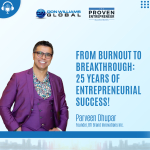
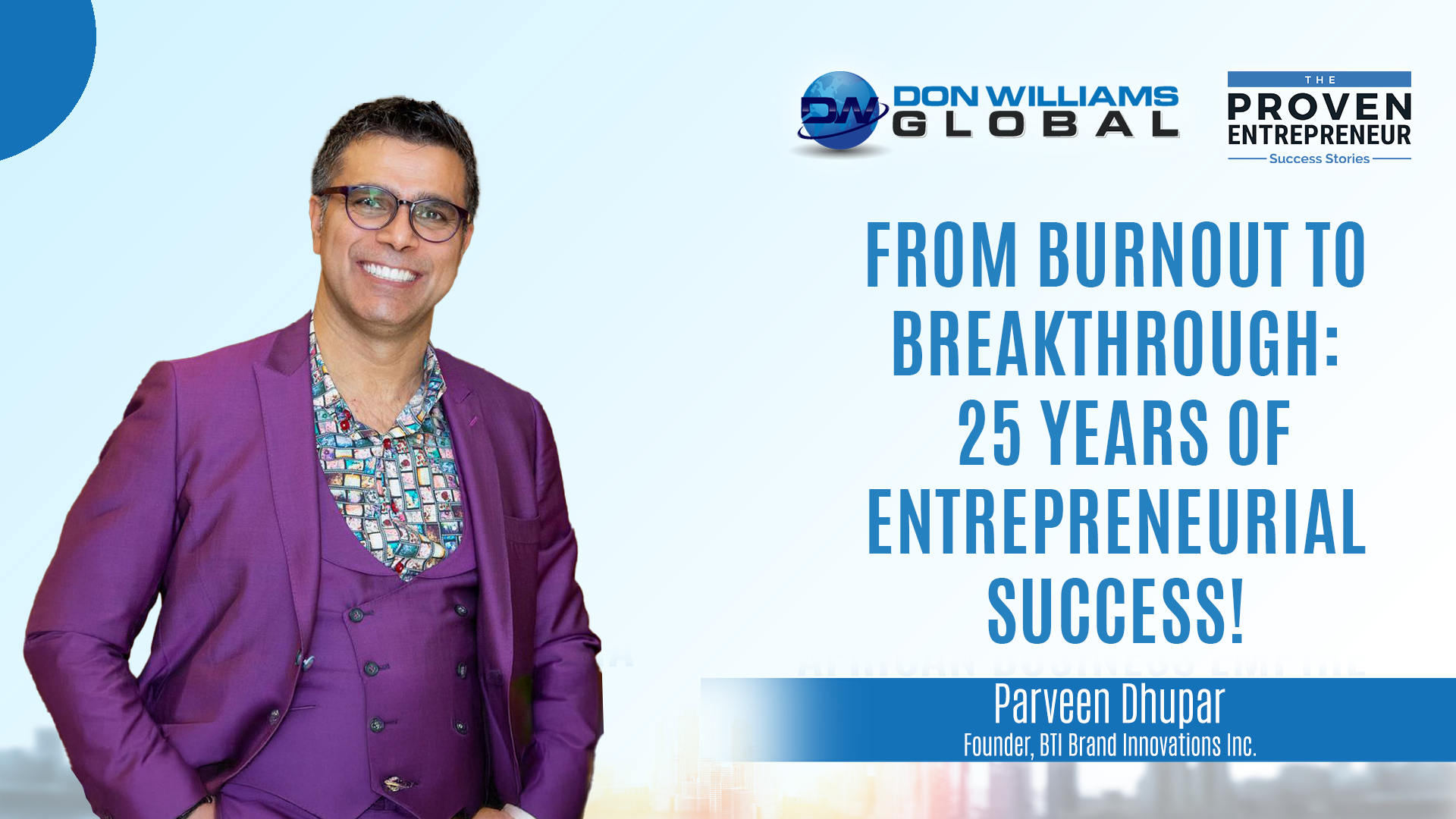
Embark on an inspiring Entrepreneurial Journey with Parveen Dhupar, Founder and CEO of BTI Brand Innovations, in this captivating episode of The Proven Entrepreneur Show. Host Don Williams delves into Parveen’s remarkable 25-year career, extracting invaluable Startup Success Lessons and insights on Building a Creative Agency.
This episode is a masterclass in overcoming entrepreneurial burnout and achieving sustainable success. Parveen shares his experiences with Risk-Taking in Business, navigating the challenges of Work-Life Balance for Entrepreneurs, and the power of Goal-Setting for Success. Discover how he transformed BTI Brand Innovations from a $3 million to a $10 million agency, showcasing effective Business Growth Strategies.
Gain unique perspectives on Branding and Marketing, Creative Agency Success, and Insights on Branding and Marketing Strategies. Parveen emphasizes the importance of Leadership and Storytelling in Business, demonstrating how Storytelling in Business and Experiential Marketing can drive growth.
This isn’t just a business story; it’s a deeply personal narrative. Parveen opens up about Family-Driven Entrepreneurship, balancing personal and professional life, and the pivotal moments that shaped his path. Learn about Overcoming Burnout in Business, Lessons from Failure, and the significance of Purpose-Driven Leadership.
For aspiring and seasoned entrepreneurs alike, this episode offers a treasure trove of knowledge, including:
- Entrepreneurship Mindset: Cultivating the right approach to business challenges.
- Canadian Entrepreneurs: Success stories from the Canadian business landscape.
- Immigrant Success Stories: The drive and determination behind immigrant entrepreneurship.
- Mentorship and Goal-Setting: Practical tips for achieving your ambitions.
Don’t miss this opportunity to learn from a seasoned entrepreneur who has truly seen it all. Tune in for actionable strategies and heartfelt wisdom.
For information on how to work with Don visit us at https://donwilliamsglobal.com
You can also reach out to Don Williams at https://provenentrepreneurshow.com
Don’t forget to subscribe to The Proven Entrepreneur Show for more success stories, actionable strategies, and the best of entrepreneurial wisdom!
Watch the episode here
From Burnout to Breakthrough 25 Years of Entrepreneurial Success!
Hey, it’s Don Williams. Today on the Proven Entrepreneur Show, I have a really good friend from Canada. So much colder where he is than where I am today. It’s about 80 here in Texas today. The birds are singing, the grass and the weeds are growing. And I’m guessing you’re not having that. Parveen Dupar, welcome to the show.
Thank you, Don. I’m looking forward to having this great conversation with you. And actually, the weather here this week has been fabulous. Now, I don’t know what that is in Fahrenheit, but today I think it’s like 14 degrees Celsius, which is fantastic. But on the weekend, it’s going to get cold again. So it’s this Canadian weather. I don’t know.
that’s not bad.
Yeah. I think we’re on the tail end of spring, meaning that summer is right around the corner. I think you’re on the other end of spring, meaning it’s just starting and you may have some winter excitement left in your life. So Parveen, let’s start with this. Now you do a lot of different things. You’re speaker, you’re a facilitator. Okay. But talk to me about BTI brand innovations.
Yeah.
of which you are founder and CEO, yes?
Yes, yeah, BTI is a, I like to say we’re connectors. We connect people to brands and brands to people.
So I’m in the business of solving problems, marketing problems, branding problems. So we’re a fully integrated creative agency that does everything from traditional marketing, digital marketing, and experiential. So we’re a fully integrated creative agency, but that’s an easy answer. Everyone can say that. I like to have more fun with it say, sometimes I’ll say, I sell bullshit, right? And then it’s just starts a great conversation. It’s all about storytelling.
versus just going straight on, I’m in advertising. I think that’s just such a boring answer, right?
yeah, I totally agree. And,
and you know me, I’m big on storytelling, you know, why give an answer when you can tell a story and let somebody really connect. So how long ago did you start BTI?
Yes.
Exactly.
Well, BTI was my third go around as a creative agency. So, I mean, if I share the journey.
BTI itself started in 1999. So we just celebrated our 25th anniversary back in October. It’s fantastic. So BTI has no business partners except for my wife, my spouse. Right? So she’s going to get 50 % anyways and might as well make her a partner from day one. I make it easy. But prior to BTI, I had another creative agency with a very different focus.
Yeah, sure.
which I also started back in 1990. And that agency was package design, consumer promotions, in-store activation. So we were very focused on a certain traditional area. And I brought in partners over time, but I found that I was burnt out. In 99, I was burnt out. I mean, to give a straight answer, was…
I was like, go, go, go. There’s 24 hours in a day and I made sure I didn’t waste a second of that day. And most of those seconds were focused on business and that drive to just earn as much as I can as fast as I can. And then I just looked at my second son who was born in June, 99 and this sort of light bulb went off and said that.
I don’t want to be that entrepreneur that looks back 25 years from that day and say I was not involved in my kids lives. He was my second son. The light bulb didn’t go off the same way with the first son. But something happened at that moment where I just said, I can keep chasing the dollar. But when is enough enough? Right? How much more do I need? I have enough now.
Yeah.
the family priority became number one from that moment on. And yeah.
So let me ask you a question about that. And then we’re
going to go back way back to young pervene. OK, but my question is this. So your journey and my journey are not too dissimilar. I have an older son. Eight years later, I have my youngest son. When my oldest son was born, I was in grind mode. OK, I was a startup entrepreneur. And
You know, if we didn’t go make something happen today, you could have all the air you wanted tomorrow because that’s what we have on the shelves. You know, we were in grind mode. Now, eight years later, when my youngest son was born, that time had passed for the most part. And so I was in a more comfortable place. Similar experience with you.
Absolutely, absolutely. was very comfortable by then. I was so driven to the point where, you know, I made, I had these goals that I wrote down when I was 16. I’ve been very goals driven. And I had a mentor at that point who told me, you know, just write down everything.
And it doesn’t matter how ridiculous it is, review it every week, every month, whenever, open up that sheet of paper, cross things off, add things, make it as crazy as possible. And I was so goals driven that by the time I was 31, when my second son was born, I had ticked off just about everything on that list, but two things, right?
And those two things, one was world peace, still working on that one. what’s that? There you go. There you go. And the second one was getting my 911 turbo. I love Porsche, but I’m sharing that because I had everything right. All my goals were checked off. I was so driven that even from a mortgage perspective,
Hey, get with the program. Pick up the pace. Come on. Yeah.
I knew that if I can make double the payments each month, I knew that I could do 10 % down payment each year. I took advantage of everything and my mindset was always about being debt free when it came to personal life and take all the risks when it comes to business.
Being debt-free personally allowed me to take all the risks in business. Share on XOh, I love that.
Yeah, I love that. A balance of risk and security. Okay. All right. So I’m going to take you all the way back. Five-year-old Perveen. Okay. The house that you grew up in, and I know a little bit about your childhood, but the house that you grew up in, was there an adult who was an entrepreneur that you learned from?
So I’m gonna actually jump two years ahead intentionally to when I was seven. And I say that because when I was seven, it was 1975, we had just moved to Canada. And to me, my life prior to moving to Canada, there’s a lot of, I can’t recall it all, right?
Okay.
Mm.
It seems like everything started when we came to Canada in 75. And when we came to Canada in 75, we lived in government housing. We didn’t have any dollars. In those days, you weren’t allowed to bring anything with you. And he basically had $10 in his pockets. Fortunately, we had some extended family here who supported us and helped us get started. And my father was not an entrepreneur.
My father was a machinist and he taught in a college trade school in India. But when he came here, he could not get a job doing that. he, you know, we arrived on a Friday, my cousin’s wedding was on a Saturday, and on the Monday he went for a job interview, got that job at a startup and stayed there for his entire career.
That was what he did. And he worked as a machinist, worked his way to a foreman. He was not a entrepreneurial entrepreneur in the traditional sense, but he was a risk taker, obviously. I mean, having to come here, leaving behind security that you have in a homeland that you’re comfortable with, working for the government in India, and now coming here, not knowing
My father wasn’t an entrepreneur, but moving to Canada with $10 in his pocket was the ultimate entrepreneurial risk. Share on XWow.
what’s going to happen. All they thought about, our parents thought about was we want to create a better life for our kids, provide a better education for them, and give them a better base.
That was their mindset. So to me, that is entrepreneurial. That is goals driven. There was a purpose behind it. And as an entrepreneur, we have to be purpose driven. I’m purpose driven. That’s what drove him. Now, other than him, I’ve heard lots of great stories about my grandfather who was in the trucking business. And I, you know, and he lost it all.
lost the entire business when the separation of India Pakistan happened. so I’ve heard lots of other stories, but no one in the traditional sense was an entrepreneur in my family from that perspective.
Hmm. Happens.
Well, I…
Well,
I agree. I, I, a recent guest, Sahil Patel, his parents immigrated from India to the U S they were not entrepreneurs in their vocation, but he’s, but he shared kind of the similar thought that isn’t it the highest level of entrepreneurship to leave everything that you know, come with nothing, build a life.
in a country that you know nothing about. And so huge risk and yet made it happen. And so I agree with you and Sahil, I think that’s maybe the highest level of entrepreneurship. It just doesn’t ring the cash register somewhere, but the payoff for both the parents who immigrate and then their children, grandchildren.
is unbelievable. So very immense. All right. So let’s move on. Now you’re through your schooling. You’re 18 years old. I think you joined the French Foreign Legion for a couple of years. Maybe not. Maybe you went to university. I don’t know. Tell me, what did you do?
Hahaha
It’s interesting. So I talked about how I’ve always been about not wasting a second in a day, right? I was so driven because when you have nothing, you want everything. So even in my high school years, I always worked part time and I would say my part-time hours are more than a person’s full-time hours. So I would work 40 hours plus attend school. I would miss a lot of school days.
I’ve always been about not wasting a second in a day—every moment counts when you’re building something meaningful. Share on Xand I probably had the most absentees in my high school, but I graduated with honors. So I only showed up on test days. What that why why I’m starting with that is because I think that I was probably gifted, but not noticed and slid through the, you know, so through the system and my parents who were great.
they were so busy working probably didn’t pay attention to that. Whereas we did with our kids, right? Different helicoptering parents. So I didn’t, know, growing up I was saying, oh, I want to be a doctor or lawyer. I want to do some of this stuff. But I didn’t follow that traditional path. You know, being of Asian heritage, being Indian, if you’re not a doctor, lawyer, and accountant or engineer, you’re a nobody. And…
when I did that test in high school where they tell you what career you’re going to go into, none of those showed up. What showed up was either going to be a garbage collector or you’re going to go into package design. And I was going, what is package design? I had no clue what that was, but sounds better than garbage collectors. So I’m going, okay, this is interesting. And I started doing some research on it and I was always an artist, right? So I was…
Sounds better than garbage collector though. Yeah.
took a lot of art classes in school, was drawing since I was six years old probably or seven years old and I can remember for sure. So I looked into what this program was all about and package design is it’s commercial arts. I looked into where I can further that education and I went to college. I went to a college nearby and did a package design program which gave me exposure to everything to do with marketing and advertising.
So it wasn’t just packaging, there was advertising program, there was some technical parts to the program as well. So it gave me a good base. And then when I graduated, I worked for one agency for a year.
got laid off, the best thing that could ever happen to me, because the day I got laid off, John Maravino called me in his office, the owner of the agency and said, Parveen, you’re the last person I hired, we’re not doing well, I have to let you go, you’ve actually been profitable for me, but.
You know, I’m looking at tenure and I also know that you one day will be one of my competitors. That gave me such a boost to my ego and gave me that drive to go out and do it right away. So I started my agency right then in 1990 and just never looked back.
I love that. And you know, we are brothers from different mothers. I had been very successful in a certain company and the owner, I worked my way into partnership with him. The partnership did not work out and I became his competitor. And there was a little acrimony at the time. It wasn’t a, he didn’t throw a party for me or anything, but we reconciled years later.
There you go.
And because he was one of the finest people, probably the finest motivator I ever knew. And the other statement you made that really resonated with me is I have a friend in Oklahoma City, Pish Patel, and his parents immigrated from India. And he said in my house, it was very clear you were going to be a doctor, you were going to be an engineer, or you would be a disappointment.
And he’s neither of those. He chose a different path, but he’s done really well.
I
like that way of framing it versus me saying you’re a nobody. You’re gonna be a disappointment. There you go.
Yeah. Yeah. It was like
doctor, engineer, or disappointment. You’re like, ouch. Your parents were clear communicators and clarity is kind, even if the content isn’t always that kind. Okay. So looking back across your career, you’ve been an entrepreneur how long now?
Yeah.
since I was 13 years old. I’m mentally 15, physically 31, chronologically 56 right now.
And you’re 24 or 25.
Okay, so you’ve been an entrepreneur a long time. I want you to think back across your career and I’m looking for a hard lesson. And in a career that long, there’s been more than a couple probably. And so, but specifically a lesson where when it happened, it’s like, ouch, I’m limping a little bit. But maybe in retrospect,
A long time.
Now with some time, some perspective, looking back, you’re like, you know, maybe that was the best thing that could have happened. And so do you have a hard moment you could share?
Yeah.
You know, Don, there are many hard moments and there are many, many, many failures. And I think those just make us stronger and better as long as we continue to learn and keep moving forward. I don’t I don’t have no regrets in life, right? But I have one, only one. And only until a few months ago do I no longer look at that as a regret.
Failures make us stronger—as long as we keep learning and moving forward. Share on XMmm.
And
that is about.
14 years ago now, my parents were on vacation in India. My mother never wanted to go back to India. She had health problems, but somehow she was swayed by some people that they can make her better there. So she went, stayed at this ashram who said they could make her better. And…
She was there for several months and my brother just happened to be on vacation there, went to visit them, noticed that my mom’s feet were badly swollen and something just didn’t look right. So he took her, admitted her into a hospital, called us here. have two older siblings and one younger sibling, so there’s four of us. And so this is the second sibling. He called us and he said that,
Mom’s not doing well, this is very serious. You guys should plan to come here.
And during that time, and this is December, and during that time, my eldest brother was actually working for me in my business. And, you know, we had the discussion and said, you know, we both can’t go. Why don’t you just go and keep us posted? So he went and I continued on running my business. And then my mother passed on January 2nd.
in India. So I held on to that regret that I had a choice, I had an option. But I chose my business over being present with my mother. I chose the fact that I needed to be here versus be there with her by her side. And I lived with that regret that I could have been there.
for a long time that I never got to see my mom. I never got to talk to her. And we brought her back here and did all the funeral arrangements back here at home, but I wasn’t there. So I said to myself that when it’s my father’s turn, I’m not gonna let that happen again. And when my father during COVID period, he was actually an LTC, he had suffered a stroke.
many years prior and was in a long-term care facility just because we couldn’t take care of him at home. He had no mobility on one side. We got a phone call during COVID that he’s not well and needs to move into the hospital. I dropped everything. And I was by his side every day for a month.
Even at the hospital, even though you weren’t allowed, we worked the system and they allowed us siblings to go in eight hours each and sit there with him. He had an option. said we could put a feeding tube or we can put them into palliative care. And my dad said, I don’t want a feeding tube. I’m choosing the palliative care. So he made that choice, but he just wasn’t passing. He had been in that hospital for weeks.
And we said to the doctor, said, he wants to go home. He wants to pass away peacefully at home. So we tried to move him. And the day that we tried to move him and get him into an ambulance, he was about to pass. And they said, OK, this is not the right time. So they kept him there. Another week passed. And we said, OK, we just got to get into the hospital.
He well, he can pass in the ambulance. Well, I’m going to be in the ambulance because I knew that I wanted to be there. If something happens, I need to be there. We got him home. He got to see the entire extended family. They all got to say their goodbyes. And three days later, I show up to just my shift now to spend time with my dad between the siblings. I show up.
And I do a end of day huddle with my team. get the phone call with my team and I’m holding my dad’s hand. As I get the phone call, I start the conversation. I could feel that he’s no longer breathing. Right. He says to me before that, goes to Agya. To Agya means you’re here now. And I say, yes, dad, I’m here. And then I take the call and I saw that he, after he had said those words, he stopped breathing. So he waited for me to be there.
Hmm.
I think he knew that I needed to be there, that I was also dealing with so much guilt. So business isn’t just about business. Business is family. Family is just as important. And I think we need to understand where our priorities are. I look back at even entrepreneurs that I’ve idolized over my time. And the one commonality between so many of these
great entrepreneurs that have made such an impact to society have had a terrible family life.
Hmm.
And I’m going, and they all near their tail end have always regretted that they had a terrible family life. Right, so family’s important.
Sure. Well, thank you so much for
sharing. Sorry about your mom and your dad. I don’t know, maybe four or five years ago, I had the opportunity to coach a lineup of speakers, I think seven speakers, nine speakers, who are going to deliver very vulnerable shares from their life.
You know, with a microphone in front of a hundred, 125 people, which is one thing to kind of share one-on-one. And it’s another thing to get up on a stage with the light in your eyes and, share. And, um, it’s one of the best experiences of my life though. Um, one day I coached three, they were all over the world. And then we were meeting at a conference location, but I coached three one day.
I came out of the office, my eyes were red and my wife’s like, what is wrong? And I’ve been crying all day because they were so, heartfelt stories. Well, after the end, one of the people in the audience came up and said, man, these guys were great, but it was so dark. I was like, what do mean it was so dark? And they’re like, everyone was about death or near death. And it had totally…
I totally missed it and I’d been coaching them for months. But what I realized was this, the ultimate human experience.
is death. know, second I guess would be birth. Okay, but we kind of, you know, people of faith know what happens after death.
you know, babies before birth, don’t, they don’t, you know, they don’t know. And, um, and so thank you for sharing up. I appreciate that. Okay. So now I’m going to ask you about, going to change gears altogether. Um, so.
You know, actually,
before you change gears, Don, you just said something there that resonated with you said after death, right? And I kind of ended off by saying that my father’s passing was what I thought I could actually finally forgive myself for not being present. That was what and I and for a time being there, I thought I did forgive myself, but I actually didn’t. I actually didn’t. And how about the after death aspect of it is
Yes.
Very recently, I did a mushroom experience. that experience, when you’re in that zone, I was focusing on my mother. I felt like my mother was communicating with me and she was talking to me. And she gave me that opportunity to finally forgive myself because she said it to me in my thoughts and my feelings and what I was experiencing.
And it wasn’t until then that I actually did finally, finally forgive myself.
Yeah, I love that. And so, you you probably heard that story about, it shows up on the internet every once in a while as a post, and it’s a man discussing atheism versus belief in a superior being. he does the talk from two twins in the womb and
And, and one says, I can’t wait to be born and to find out what the next chapter is and, and what, how that’s going to be. And the other one says, there’s nothing. I mean, scientifically based on all the evidence, there’s nothing there. This is it. And the other, and the other baby is like, but we’ll get to use our mouths and we’ll get to see with our eyes. And the other baby says, no, the evidence says.
everything comes just through the cord. And once we’re separated from the cord, there’s nothing, there’s absolutely nothing. And it’s drawn the parallel between the baby’s pre-birth to human’s pre-death. And it’s an interesting, I’ll just tell the audience, you can Google, can YouTube that, it’ll show up. But it’s pretty interesting from the opinion, the point of view of people who
Only can believe in what they see, touch and feel and other people who can believe, beyond, beyond just that. you know, science, unlike math, math is not a moving target. know, two plus two always equals four. It never comes out to anything else. Science on the other hand, based on what science learns changes. mean,
When I was in school, there were 92 elements on the periodic table and everything in the universe is made of one or a combination of these 92 elements. Well, now the periodic table is up over 100 and who knows where it’s going to end, but there’s some, that’s maybe a subject for another day. next subject, sir. I’m looking for a warp speed moment in your business. So a warp speed.
Hahaha
Sorry, eh.
moment. So, yeah, so, you know, on Star Trek, Captain James T. Kirk, fellow Canadian, he would ask for Mr. Scotty Warp Speed and they would go from, okay, and so your business is going along pretty good. Things are good. Okay. Things are great. Comfortable, breathing, playing, having fun. And all of sudden,
a warp speed moment, okay?
Yeah.
Yes, yes, yes.
Yeah.
the right hire, a strategic move, pure luck. Okay. But all of sudden you get that hockey stick. My Canadian friends will like that hockey stick analogy. Okay. That hockey stick of extreme growth. Do you have a warp speed moment you can share with us?
Yeah.
Yeah, you know, I’m really proud of the team that we’ve built. Currently, it’s made up of all A players and there’s no room for B and C players here. It’s all A players. Everyone feels like they have ownership and they have decision making power and I’m not in their way. But it wasn’t always like that.
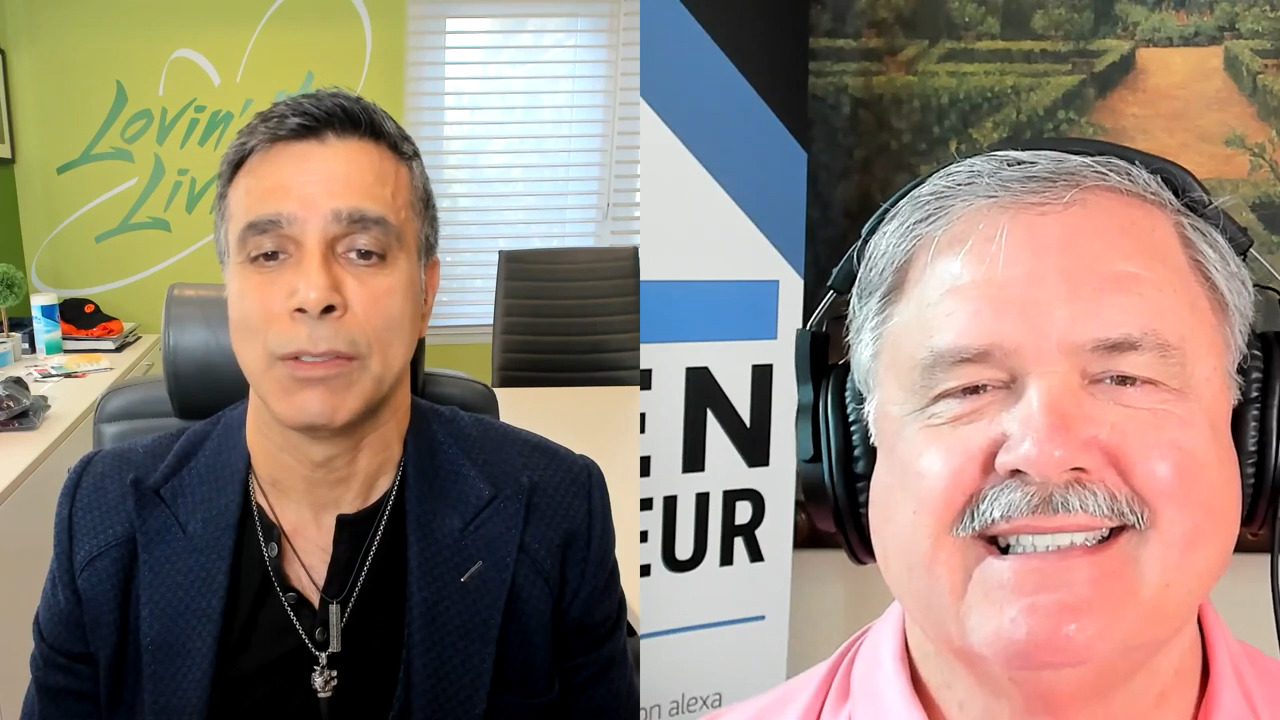
There was moments where I was probably the biggest asshole in the world and I probably blew up like crazy and I’ve had so much personal growth and I had different leadership styles over my 25 years of BTI. But when we talk about a warp speed moment where we had this real exponential growth, that 10x moment was during the lockdowns coincidentally, right?
you
During the lockdowns, we landed a cannabis account. Cannabis is legal in Canada. I joked that I don’t smoke. I don’t drink alcohol. I’ve never smoked cannabis in my life, but I became the largest drug dealer in Canada. And it was a brand that had just started. They were a private company. And they…
They had built a nice cult-like following because they were private, were young entrepreneurs, they were indigenous too, the three of them. And they had just built a nice kind of following and we figured, and they knew they had a problem to solve. They didn’t have a strong brand, they didn’t have a website, they didn’t have anything. So we engaged with them and it was probably the quickest close I ever did. In 30 minutes I was, you know, I had.
They said, yeah, get started on the website and we need a campaign and we need this. So we went from a, you know, a $3 million agency to a $10 million agency, just like that. And this one account, we grew that we based, I became their CMO, essentially. They didn’t have a leadership team. It was just them. had no SLT. So I became essentially their outsource CMO, made all the marketing decisions.
Wow.
told them that they needed to invest in or suggested that they needed to invest in a sales team. So we don’t have that. Okay, put a proposal together. So I engaged with some people I knew, brought them on as managing partners, and we started the sales agency side to our business. So I had 36 reps across Canada, 36 part-timers, and just grew this brand. Within two years, they were acquired for $950 million.
right? Publicly traded company who kept us on board as their agency and also engaged with us to take care of all their brands, which was a great experience. It was a great, great learning experience. An industry that, you know, has had lot of challenges recently, but
you
It was a great growth experience. And I learned a lot about letting go around that time, to be honest. Right? So that sales agency was a big risk. I knew nothing about sales representation, but I hired the right people, brought them on and rewarded them well as managing partners. And they ran with it.
Love that. So, like three thoughts that really resonate with me. One, and things I share with my own clients, is you are one phone call, one conversation, one client away from unbelievable good things in your business. Okay. And so, I don’t care how hard it is today, what you’ve been going through, how long you’ve been going through it.
Literally many, many entrepreneurial business can point back to one client, one phone call, one meeting. That was the pivot that changed everything in their lives. Two, take every meeting. If somebody wants to meet with you, you meet with them. Okay. And I’ve had clients over the years tell me, Don, I’m not going to do that. And I’m like, my gosh, if they want to meet.
You meet, you don’t know what’s on the other side of the door. Okay. And when you went into that meeting, you had no idea. Okay. That I’m going to walk into this meeting with my $3 million a year business. And the outcome is I’m going to be a $10 million business. Pretty chop chop. Okay. And, and then third, it’s not the what it’s the who. Okay. I went and got.
the right people, rewarded them well, and got out of the way because the bottleneck is always at the top. And so if you want to remove the bottleneck, you typically got to remove the top. That’s just the way it goes. So, okay. Love, love, love that. All right. Toughest question I’m going to ask you. I’m going put you in a time machine. Okay.
Yeah.
just like Star Trek, kind push in a time machine, going to transport you all the way back to 20 year old, Perveen. And you’re going to get 60 seconds to share something that you know today that you wish you knew back then that would have sped you along in your entrepreneurial journey, your family journey, your personal journey, or all three.
So into the time machine you go all the way back. takes a little while to get back to 20 with you. Okay. Here’s 20 year old Parveen. What do you share?
When people ask me that, I always respond the same way. Should’ve, would’ve, could’ve are words that are not in my vocabulary. Because I am who I am today because of my journey along the way. And I would not say a single thing to my 20 year old self. Because I would want my 20 year old self to live that journey and go through it the way it needs to happen.
I wouldn’t change, I would not change a thing because it’s that journey that’s made me who I am today. If I didn’t have those failures, I would not have learned the lessons that I’ve learned. I would not change a thing, good or bad. I would not change a thing.
I love that.
I love that. Now, Parveen, we’ve published maybe 150 of these episodes. I have asked that question on every episode. It’s probably the only question I’ve asked on every single episode. I’ve heard all kinds of different answers. Never heard I wouldn’t change one single thing. And so I appreciate your perspective and appreciate your gratitude at what you’ve experienced and realizing that without…
every step along the way, you’re not who you are today. I love that. Okay, so if somebody wants to reach out, says, I want Parveen to come talk at my conference. I want Parveen’s company to represent my brand. I just want to talk to Parveen. He’s a cool guy. How do they reach you?
Awesome. Well, simplest way is my email. So the spelling of the name is Perveen. Well, the name’s pronunciation is Perveen, spelled Parveen. So it’s P-A-R-V as in Victor, E-E-N as in Knight, at team, T-E-A-M, B-T-I dot com. BTI, the best there is. That’s how you reach me.
Love that. Parveen, my brother, thank you so much for coming on the show today. You’ve been great. And I’ll hope to see you. I think I’ll see you in Hawaii in a couple of weeks. So thank you so much. We’ll see you all next time on The Proven Entrepreneur Show.
Yes, appreciate it. Thank you, Dawn. Really grateful. Thank you.