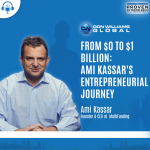
Welcome, listeners! We’re thrilled to have you join us for another inspiring episode of the Proven Entrepreneur Show. In today’s episode, host Don Williams sits down with the remarkable Ami Kassar, founder and CEO of MultiFunding. Get ready to dive into an engaging conversation that explores the highs and lows of entrepreneurship, the intricacies of business funding, and the resilience required to build a billion-dollar company.
In this episode, Ami Kassar shares his incredible journey from starting MultiFunding 15 years ago to achieving the milestone of $1 billion in business funding. You’ll hear about the challenges he faced, the lessons he learned, and the strategies he used to help entrepreneurs secure loans transparently and effectively. Ami’s story is not just about numbers; it’s about the impact his company has had on job creation and business growth, making it a must-listen for aspiring entrepreneurs and business enthusiasts.
Don and Ami also delve into the myths surrounding business lending and the importance of finding the right lender. Ami discusses how MultiFunding has debunked common misconceptions and provided responsible lending solutions to thousands of businesses. With a default rate of just 1.1%, MultiFunding’s success is a testament to their commitment to ethical and effective lending practices. This episode is packed with valuable insights and practical advice for anyone looking to navigate the world of business funding.
Finally, Ami reflects on his personal experiences and the importance of resilience in entrepreneurship. From his early days in South Africa to moving to the United States and starting his own business, Ami’s journey is a powerful reminder that success often comes from perseverance and adaptability.
Tune in to hear Ami Kassar’s inspiring journey and gain valuable insights into the world of entrepreneurship and business funding. Whether you’re an aspiring entrepreneur or a seasoned business owner, this episode is packed with wisdom and practical tips to help you succeed. Don’t miss out on this engaging conversation with one of the most influential figures in the world of business funding.
For information on how to work with Don visit us at https://donwilliamsglobal.com
You can also reach out to Don Williams at https://provenentrepreneurshow.com
Listen now and be inspired to create your own legacy!
Watch the episode here
Hey, Don Williams here with today’s episode of the Proven Entrepreneur Show. Proven Entrepreneur is exactly how I would describe today’s guest. Welcome to the show, Amit Kisar.
Thanks for having me, buddy. How you doing?
Man, I’m wonderful. I’m so thrilled that you’re here. So I think back to, I believe we met in a hallway in Macau. And I think you walked up to me and said, are you Don Williams? Which is always a loaded question. It’s like, depends on what you want. And that’s been the beginning of a great friendship. Thank you so much for, and you’re not shy, but.
One thing I always try and teach people is man, walk up to people you don’t know, stick your hand out, tell them who you are, shake their hand. You never know what could happen. Yeah. So you’re the founder and CEO of multi-funding based in Philadelphia, I believe. Yeah. And so tell us a little bit about, when you started it, and what you do. And I think I just saw a post.
Walk up to people you don't know, stick your hand out, tell them who you are, shake their hand. You never know what could happen. Share on XExactly right. ⁓
Correct. Correct.
that had one of my favorite numbers. like numbers are infinite. There’s an infinite number of numbers, right? But this had a number in it, okay, that started with a B. And man, I’m excited by that. So tell us about multi-funding, Ami.
Right.
that’s it.
The billion dollars is close, we’re building up to it.
I love building up to a billion dollars. Okay. It’s amazing.
Yeah. So I started multi-funding just over 15 years ago. And what I wanted to do was build a service where entrepreneurs could come and in a completely transparent manner, find out their loan options and alternatives that were available for them. And really what we do is we advocate for people through the load process and help them figure out what they need, what’s best for them and help them actually go out and get the loan.
95 % of the time we’re paid a commission by the lender and it doesn’t cost the borrower anything extra.
Love that. So you’re not the lender,
which sometimes puts a lender and a borrower at times are adversaries.
It can be, but I think it’s pretty fascinating. We’ve broken a lot of the myths about lending. So first of all, we will in the next 30 days, barring the world blowing up, cross a billion dollars worth of funding, which is an exciting milestone for us. ⁓ what I love about that is the impact it’s had. Like we’ve helped create tens of thousands of jobs and that’s…
a billion dollars with a B. That’s amazing. Congratulations.
all responsible lending. I was talking to my team about it a little earlier today. A billion dollars of loans and probably tens of thousands of businesses we’ve interacted with to get those. I’ve been yelled at by four customers in 15 years, which I think in this kind of business is remarkable. And we were just running our default data on our SBA portfolio and
1.1 % of our loans have gone bad. Now, I don’t want any loans to go bad, but 1.1 % is remarkable. And 70 to 80 % of the time, our borrowers and our lenders don’t actually need each other. So the myth that the best lender for you is in your backyard may or may not be true anymore.
I love that. And I think we’re finding out that the best insert, whatever service here may or may not be in your backyard because the world is certainly getting much smaller.
Your world is getting smaller. so that theory of big problem, SBA has a branding problem, not to similar to EOS implementers or different things. Like if you have a crappy experience with an EOS implementer, then you just assume EOS is crap. Even though that might be that particular implementer that you had an experience with. And it’s the same truth. Your friend.
Yes.
has a crappy experience with an SBA loan and bitches to you about it. You just think SBA is crap. But what you don’t know is if they were working at a lender and you what the hell they were doing and you don’t know what shape their company was in. And so there’s a big branding problem out there that we tried to deep punk. We funded with last year, we funded with 22 different lenders.
that’s amazing. That’s amazing. And on 22 different projects or.
⁓
probably about a hundred and something different projects.
that’s amazing. That’s
amazing. That’s how you approach a billion, a billion with the B, a billion dollars. That’s amazing. Okay. All right. So thanks for sharing about multi-funding. We’ll get your contact information. Lots of people are going to call and want you to help secure loans. But before we do that, I want to take you back to your childhood home. We’ll take you all the way back to five-year-old Ami. Do you remember five-year-old Ami? Okay. Good. In your house.
window.
I do,
And everybody’s house was a little different, but in your house, was there an adult that was an entrepreneur?
You know, it’s interesting, was talking with this a lot about my brother because we just did the 200th edition of my podcast. And so he was the guest and we were talking about how our childhood might’ve influenced our entrepreneurship. So I was born in South Africa and we moved to the States as a family when I was eight. And my dad had a private practice in, in
South Africa, so we definitely saw him kind of figuring all that stuff out. And then when we moved to the States, he moved into academic medicine and then started his own private practice again a couple of years later when he got on his footing. my two brothers and myself were all really second generation immigrants. And there’s no doubt in my mind that what we saw growing up in that community.
as many families came over and most of them tried to get going and get their feet here on the ground in this country. There’s no doubt in my mind that that influenced our journeys and our paths. We all took different journeys, but I think it all influenced us.
I love that. And I was interviewing a guest who was first generation. His parents came from India with $20 in their pocket and didn’t speak the language. and, and he said, no, my dad was a janitor and my mother worked maybe for the post office. He said, but they were probably the best entrepreneurs I knew because, you know, they boldly with, with raw courage got on a boat and traveled halfway around the world to a world they didn’t know.
to a language they couldn’t speak and they figured it out. And that, and as you and I both know, that’s a big part of entrepreneurship is we keep jumping out of airplanes, building parachutes on the way down. We keep figuring it out many times after, you know, after we’ve launched. So, okay. After that, you go to university, you join the merchant Marine, you’re in the SEALs. What did you do?
What the hell?
I went to Brandeis from undergrad and then moved back to California and worked for two years and then went to business school. still not quite sure why, but I did and had a job and then started my first company in the dot com bubble days, which blew up.
went to work for the largest issuer of credit cards to small businesses in the United States for several years. Was the chief innovation officer, learned a fortune. And then that blew up in the great recession. I got fired by the bankruptcy trustees on a Friday and I started multi-funding on Saturday.
I love that. so I quit a job for a company that I had helped grow and the owner didn’t pay me as agreed. And so I quit on one day and became his competitor the next day. Yeah. So, okay. Thinking back across your career, and I know the answer to this is, there’s many, but what I’m looking for is a hard lesson.
Good for you.
something that happened that when it happened, it’s like, ouch, that really hurts. But maybe today in retrospect with the perspective of time, you can look back on that hard event and say, you know, it really hurt. I didn’t like it, but maybe it was the best thing to happen at the time. Do you have a hard lesson like that to share?
Look, I think there are a lot of them and the way I try to live my life is don’t cry over spilled milk. Right? Which is not always the easy way, but like shit’s gonna happen, right? And it’s how you choose to react to it and how you choose to move on through it.
I love that.
I buy that, it’s not what happens, it’s how you take it. Yeah.
Well, as you take an example, I worked for a billion dollar company. I was a chief innovation officer. Life was great. Highly entrepreneurial job, you know, making ridiculous amount of money. And I was probably retired there. And the company had been around for a long time and no one would have ever dreamed it would fall apart. And it did in their great recession.
Yeah.
I got fired on Friday and I started multi-funding on Saturday.
Love that.
Now, maybe in retrospect, I sometimes I advise people now to try to take some time to give themselves some grace before they flip over something. I didn’t follow that, that own advice. But it seems to me that over the years of there’ve been obstacles, I don’t let the obstacle just destroy me. just push through it and I move on.
Yeah.
And
even now, and I feel for them, many of the entrepreneurs who are just hammered by these tariffs, they’ll get, most of them will get through it, right? And they need scaffolding and they need support and they need help, emotional and business model help and stuff right now. But this kind of like, this too will pass. This too shall likely pass. And if the world blows up.
This too shall pass.
It
won’t matter. It won’t matter. Okay, so I love that kind of Omni philosophy on resilience. I have a really good friend here who he shares what he calls the concept of next, that when something goes wrong, he just says next and moves on.
It won’t matter, we’ll all be gone anyway.
My son was a preemie 11 weeks early. And I have a picture of him in my office at home, holding up with my palm of my hand and he’s like three and a half pounds and he’s got tubes coming. You would never know it now. The kid’s not a kid anymore. He’s doing spectacular. And whenever I think I’m having a shitty day, I go pull up that picture. I’m like,
Okay.
Hey, my life’s gonna be fine.
Yeah. Yeah.
And, boy, that’s true. What’s the old saying was I had the blues cause I had no shoes till on the street. met a man with no feet. Somebody always has it worse. And I mean, you know this about me. I’ve been a big proponent and a daily gratitude practice. And man, if you practice gratitude, you will take those bumps a lot better in your life. ⁓
Look, sometimes
they’re bumps and sometimes they’re craters, right? Like your business right now is 80 to 90 % dependent on the China supply chain. Right now you just got hit by a crater. Okay. If you were running a hotel business and COVID hit, you got hit by a crater. Okay. And so positivity is important and gratitude is important and you will get through it. But when you’re hit by a crater, it’s no freaking fun.
Positivity is important and gratitude is important and you will get through it. Share on XYeah
Yeah.
Nope,
nope, no fun. Yeah. It would just make it better. It won’t necessarily make it good. Yeah.
It will help it and it’ll,
it’s important, but it’s like, need gratitude and you just like, got tough decisions to make and you got to get gritty and flexible and all that stuff. It’s not easy.
Okay. So now I’m looking for a warp speed moment. Things are going pretty good. You make a right higher, you make a strategic change in direction, you do something and all of a sudden, Hey, things were going great. And now they’re just unbelievable. Do you have a warp speed moment you can share?
like great and then they crashed were great and they really weren’t great.
great and they really went great.
You know, it’s not how I build my business. So, like we’re about to cross a billion dollars and I would never dream that we would fund a billion dollars when I started this thing. Okay. And somebody said to me today, well, how quickly are we going to get to three billion, five billion?
And we’ll do it and we’ll cross it, but we won’t do it faster than we can and uphold our core values.
I don’t need to do it in, okay, good, it took me three years to cross 100 million and 12 years to cross from 100 million to a billion. And it’s not gonna take me 15 years to get to two billion, it’ll probably take me three or five or whatever, but I’m not in a rush. As long as we maintain our values and our principles and our service levels, we’ll fund as fast as we
There you go. And as long as you’re taking care of customers, that’s all that counts. team, yeah, well, know, Herb Kelleher, I think was the first CEO who said, hey, the customer’s not always right. I’m going to take care of my team members and I’ll let my team members take care of my customers. And I will provide such great experiences to my team that they will in turn provide great experiences to my customers. And you know, guess what? That strategy works.
and team member.
100%.
We live here by no asshole rule.
I love that.
customers act like an asshole, they don’t stick around. The bank or a lender or a partner acts like an asshole. They don’t stick around. So no matter how fast they might theoretically help us grow.
Yeah, well, let him.
Yeah.
Yeah. Well, I, I’ve so agree with that. in one of my companies, you know, we typically will fire at least one client a year. And it’s like the works. Okay. But the clients not. And, and so they need to go find somebody who’s a better fit for them.
Funding
business is hard. I’d rather do it for somebody I like.
Yeah, agreed. Okay. So what about if I had access to the encyclopedia knowledge of Aami? And I said, man, I want a golden nugget to share with all the listeners from the Proven Entrepreneur Show. Reach into the vault and bring out a big shiny golden nugget and share it with us.
think I would say that be careful that your past experiences may or may not be relevant to what you’re currently dealing with.
Be careful that your past experiences may or may not be relevant to what you're currently dealing with. Share on XI love
So you might look upon something and say, I dealt with something very similar to this before. I’m going to do it this way. But the circumstances around where you dealt with it the last time might all be different. And so you always should look in the rear view mirror for wisdom. And same when you go in for mentorship, be mindful of
you’re asking for advice or experience shares from because their experience shares may or may not be relevant to what you’re doing.
Love that. I think it was Dennis Waitley who said, you know, people make decisions based on what happened.
wonder what’s happening and certainly makes sense to try and make decisions based on what’s happening. Experience can be a very valuable, but probably best viewed like the rear view mirror in a car. I’m going to keep a little eye on where I’ve been, but I’m going to put a big eye on that windshield on where I’m going. And that probably makes the most sense. Okay. Toughest question I ask everybody on me.
100%.
I’m put you in a time machine. Okay. You and I are old enough to remember when time machines first came on TV and movies. I’ll put you in a time machine. I’m gonna send you all the way back to 20 year old Ami. And you’re going to get about 60 seconds to share something that you know now that you wish you knew when you were 20. So into the time machine you go all the way back. Ami, meet Ami. What do you say?
I think life is just gonna be a journey and you’re gonna learn and grow along the way. And you have to be patient and give it time and be kind to yourself through the process and try as hard as you can to live to your core values. I feel blessed every day I get to run a business that is aligned with my core values.
Love that.
And not many people could say that, right? And I’m passionate about what I do. Like, I like getting up and coming to work.
Yeah,
very few have core values and even fewer are living to them. Yeah.
So
I think some of that problem.
Okay. I love that. All right. So if we have listeners who want to explore funding, what’s the easiest way to reach out to multi-funding or to you directly?
Yeah,
best to reach out to multifunding.com and you can get all of our contact information there and tons of information about us.
Awesome. Ami, thank you so much for being a guest on The Proven Order.
It’s been great. Thank you so much for having me.
We’ll see you all next time on the proven entrepreneur show. Thank you.
Thanks, Don.