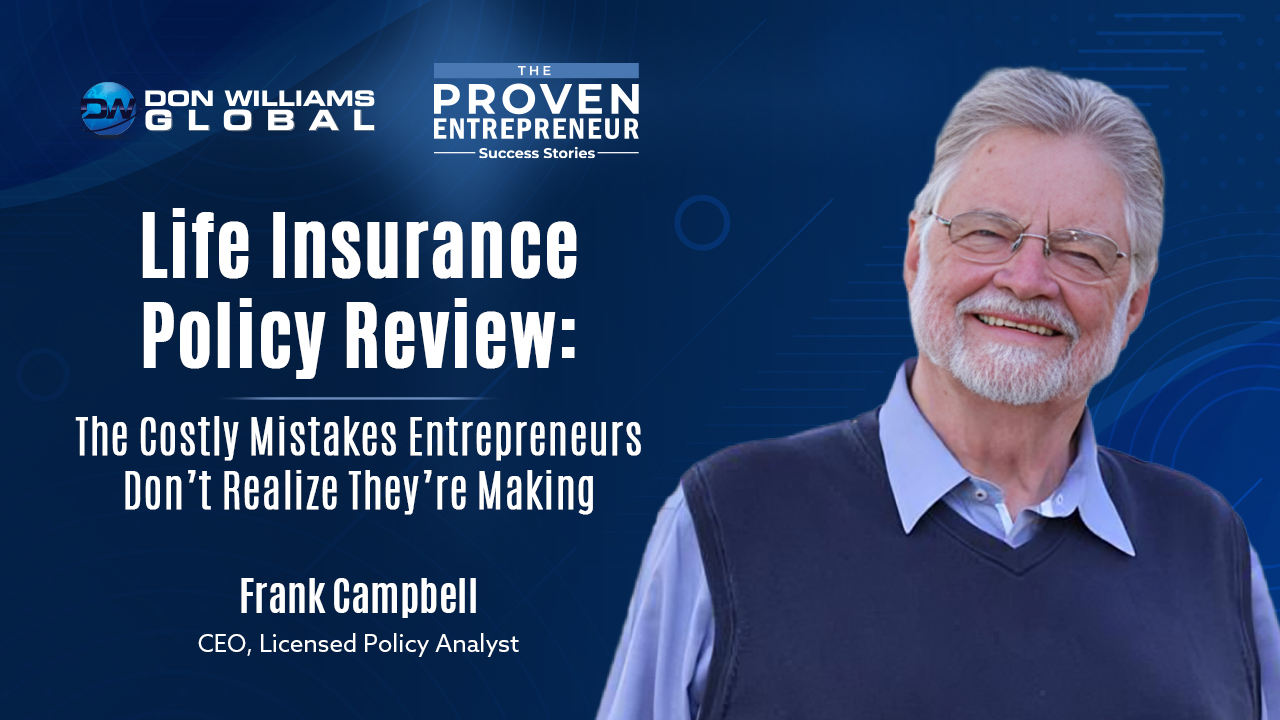
Entrepreneurs often assume their coverage is secure. Frank Campbell explains life insurance mistakes, policy lapses, beneficiary errors, and why regular reviews matter.
Most entrepreneurs believe life insurance is something you buy once and forget. According to Frank Campbell, that assumption is one of the most common life insurance mistakes made in entrepreneur financial planning. In reality, policies evolve quietly over time. Costs change, assumptions weaken, and what once looked solid can drift toward a life insurance lapse without warning. This is why a regular life insurance policy review is critical, especially for founders who focus heavily on growth but overlook long-term protection. Understanding why life insurance policies fail starts with recognizing that many contracts rely on conditions that don’t always hold for decades.
One reason these problems stay hidden is the presence of hidden fees in life insurance policies and internal cost increases that are rarely explained clearly. These issues often surface years later, leaving business owners shocked that a policy is no longer performing as expected. Frank Campbell frequently sees life insurance beneficiary mistakes layered on top of these issues, where policies fail to reflect current family or business realities. This highlights what entrepreneurs misunderstand about life insurance: insurers do not actively manage outcomes for policyholders. Without oversight, life insurance policies that don’t perform as promised can quietly become liabilities rather than protection.
So how often should you review life insurance? Frank Campbell recommends treating it like any other serious asset. Learning how to review a life insurance policy every five years helps identify early warning signs and prevents life insurance policy assumptions that cost families money. The signs your life insurance policy is failing are usually subtle but consistent, and ignoring them can undermine even the most careful insurance planning for entrepreneurs. For leaders focused on executive financial protection planning, a policy review is not about replacement, but clarity. The goal is simple: ensure the policy still does what you believe it does.
For information on how to work with Don visit us at https://donwilliamsglobal.com
You can also reach out to Don Williams at https://provenentrepreneurshow.com
Watch the episode here
Life Insurance Policy Review Mistakes Entrepreneurs Make: Frank Campbell Explains What Fails Over Time
Hey, Don Williams here with today’s episode of The Proven Entrepreneur Show. my gosh. I have a great guest topic we’ve never talked about and one that’s kind of new to me, even though I was in that industry for a long time, but I didn’t know exactly what we’re going to have shared with us today. I have Frank Campbell from Stratis Financial Partners with us today.
Welcome to the show, Frank.
Thank you, Don. I’ve been looking forward to being your guest.
Well, it’s my pleasure. And so, you know, we’re going to talk today about life insurance and we’re going to talk about, I always thought all life insurance paid because it’s pretty simple. died, you know, but maybe that’s not true. And I do know there’s a significant lapse rate. So, so Frank, first question. Most people think,
They’re insured until it’s too late. What’s the most dangerous? No, here, let’s start here. I’ve lost my mind. It’s the end of the day. Tell us about your company, what you do, who you do it with and why you do it.
Well, I was happily retired and I was having a really good time, but it was all about me. And I’d had a successful career as a financial advisor, but I wasn’t quite done yet. I had this list, 30 things you haven’t done in 30 years. in month 14, I was on number 28. So.
I could either make another 30 or I could say, can my skills add some value to the world? And life insurance, there was a court case that came out that talked about the proper care and handling of a life insurance policy. Basically, don’t take it for granted, treat it like money. And most people aren’t. And many trust companies weren’t doing it either. It’s just simple logic.
Life insurance should be treated like money, not something you buy once and forget about. Share on XSo I decided that I was going to put something together to help people understand what they have, not to replace it, but to fix it. I went to some of my colleagues and told them what I was going to do, and they started laughing at me. Said, that’ll never work. So they told me I couldn’t do it, Don. That’s probably why I did it.
Yeah, I love that. Got a little entrepreneur in you. It’s like, don’t tell me what I can’t do. Sit back. You know, in Texas, we’d say, hold my beer and watch this. ⁓ you know, that’s kind of how that goes. So, okay. Well, people do think they’re insured many times until it’s too late. What’s the most dangerous false assumptions you see really smart, successful people making about their life insurance?
Hahaha! ⁓
There’s really two dynamics that make it work or not worked on. The first one is some life insurance policies have unconditional guarantees. If you pay this premium, we will pay at least that death benefit. That’s simple. But most policies have conditional guarantees and people take them for granted. So if we get this rate of return,
And if we don’t raise the internal charges on the policy, then you’re going to be fine. But historically, over the last 20 years, they haven’t performed at that level. They haven’t given you the interest rate they were projecting, or they changed and raised their costs a little bit because it was getting expensive in the home office. And what that does is take money out of the policy and it shifts the
problem, the burden back to you. So if it does this and if we don’t do that, you’ll be fine. But if we don’t, it’s on you. And people don’t know that.
Mmm.
I was licensed as an agent and a broker and did business in 40 some states in life and health. I knew the difference between, you know, limited cause and all cause. And so all cause, if you die, they pay. But did not know about the intricacies of the inside of the policy as far as that goes. So I think you patented
a product that you call the Stratus Policy Assessment. Because you saw something broken in the life insurance industry, what made you realize the industry wasn’t actually protecting people in the way the people believed?
Yes.
Well, I thinking more about the people, The industry is the industry, and the people need the protection. But life insurance is unpleasant to talk about. It’s complex, and it’s easy to get overwhelmed. So we put together our policy assessment. We go to the writing company and get specific information about that policy.
And then we filter it back into our format. And what you get back is one page with everything you need to know about your policy in a way that a 12-year-old can understand. And it took me three years to put that, to perfect that so I could do it. So I want you to know what you have so you can make an informed decision about what needs to be done. And a couple of…
It’s a couple of examples. When we review a policy, the most common problem is a beneficiary arrangement. I neglected to put on my third child, so that ought to be on there. Or my first wife is still the beneficiary on the policy, and that might make my second wife a little upset. But most of the time, it’s just you didn’t realize that
Hmm.
Something happened. It didn’t perform to the level that it’s supposed to. And you get an annual statement on these policies, Don, and it says, oh, in small font, there’s this thing, this old story about the big print gives it to you and the small font takes it away, right? And the small font will say, we found it necessary to raise our costs of insurance from 23 cents a thousand to 26 cents a thousand.
Yeah.
And it sounds like nothing, but it can shorten the lifespan of a policy, take it from age 100 to age 84. What they ought to do is say, Don, you’re paying 100 a month, and it hasn’t been going as well as we planned, but if you’ll pay 130 a month, you’ll still have the same degree of security and safety that you wanted when you bought the contract.
Mm.
You don’t get that. Now, that you as an individual can make an informed decision, right? But if you don’t know that it’s running out of gas, it’s not going to make it.
Most people only learn there is a problem when they receive a letter saying the policy ran out of gas. Share on XRight.
Yeah, interesting. All carriers?
Almost all.
Almost all. Yeah. and you know, insurance companies, you know, they bailed out the government and the depression. They’re typically the ones with the money as far as that goes. So when, when you review a policy and that one pager says, Hey, this probably can’t be saved. This, this one is, this policy is going to die.
What’s usually wrong and like how shocked are your clients when you give them that message?
Don, a lot of times they come to me with that message. They bring in what I call the letter. And whatever company it is, it’s the same thing. Dear Mrs. Gargoyle, you didn’t know this, but your policy ran out of gas. And now you’re going to have to pay a lot more to keep it going.
Hmm
And they put that back on Mrs. Gargoyle. So she didn’t know. The reason she didn’t know is because she bought the policy 15 years ago and the agent said, you’re gonna be fine. And then she put it in a drawer and never forgot about it.
Right. Yeah. And the average, I’m not going to knock insurance agents too hard here, but you know, I think there’s about 300,000 in the state of Texas and the average insurance, know, insurance is so complicated. The average agent doesn’t know everything about the policy they’re representing to you. And I don’t care if it’s on your car or your house or your life. I mean, it’s just impossible.
No.
to know everything in there. So sometimes when policies fail, you’ve been called as an expert witness. Without naming names, what’s a lesson to every entrepreneur?
should learn, should be on the lookout for with their insurance.
You need to have it checked every five years.
Okay.
we’ll stop and put air in the tires in our car. Once in a while we’ll check the oil or get it changed and we’ll certainly look at our retirement fund and see how that’s doing.
But we never get around to looking at the life insurance. And so it sits there, and maybe it’s good, and maybe it’s not.
Out of a hundred people, about eighty have something wrong with their policy and assume they are in the twenty who do not. Share on XIf I talk to a room of 100 people and I say that, I’m going to, what the truth is, 20 of them have a policy that’s beautiful. They don’t need anything. The other 80 % have something that’s wrong and maybe we can fix it. But everybody seems to assume they’re in the 20.
Hmm.
and it just doesn’t get done. just lift up the hood once every five years and make sure that somebody that understands this stuff is there to quote it. My expert.
What are a couple ways that somebody could fix it?
Well, it depends on what’s wrong. That beneficiary arrangement I mentioned to you, that’s the most common thing we see, Well, how about if we just change the beneficiary and bring it up to date? If you haven’t died yet, it’s a real easy fix.
Yeah, right. Really hard after the fact.
Yeah, there was a case where the where the policy was 13 years old and we reviewed it. was a good policy. We told the client that we showed him why it was good. But the beneficiary arrangement had his wife and two children as the beneficiaries.
We review our investments and retirement accounts, but we rarely get around to reviewing life insurance. Share on XBut after that, he had another child and never included that child on the beneficiary arrangement. Now, I’ve talked to attorneys that say they can go into court afterwards and get it fixed if it needs to be. But why? If we can just, with a piece of paper, it, then you don’t have to go to court. You don’t have the time, you don’t have the attorney, and everything goes the way you want it to.
Yeah.
Yeah. Yeah. Save you five or $10,000 by not having to have an attorney go do it. So, um, so if, if a listener, if a founder entrepreneur watching our talk today wants real peace of mind, what are, what are three things their insurance should absolutely do for them?
It should be there for their beneficiaries. It should not be something that’s going to cause them a problem five years from now that they weren’t expecting. And it should be with a good company.
Yeah, love that.
By good
company, Don, I mean financially. There are some companies that are really good and they manage in favor of their policyholders and they’re looking out 80 years. But there’s a whole bunch of them in some household names that aren’t as well off financially and they’re not thinking about the clients as much as they are the next quarter’s analyst evaluation.
They make compromises on the policies and they’re the ones that are most likely not going to perform as well as they needed to.
Gotcha. Yeah. and, and just so the listeners know, you know, there’s a invest that there are rating services. And if I had a nickel for every time I talked with a insurance executive, especially live insurance, who said, now we are really conservative. I mean, they’re all kind on the conservative side, but it doesn’t, but they have shareholders and pressures other than, you know, the insured.
And so you want to watch out for that. Okay. So, final question. I’m going to start a sentence and I’ll ask you to finish it.
All right.
Insurance fails you the moment.
You take it for granted.
Insurance fails you the moment you take it for granted. Share on XYeah, I think that’s a really good lesson. Taking things for granted is not a good idea. ⁓ certainly not with, know, life insurance can be a cornerstone of your personal and corporate balance sheet and can be such a great piece of your financial today and future.
Go.
And I highly recommend to you, the listener, that as you look for life insurance, get somebody who’s a real pro, okay? Not somebody who sells 17 different types of policies and life is one of them. There’s some people out there that all they do is life and they’re very knowledgeable. And the other thing I think I would recommend is if you have a policy and you’re not comfortable
with the terms and conditions and that policy is probably 25 pages and you need to be an attorney or you need to be Frank to figure it out. But maybe you reach out to Frank and let him analyze that policy. So Frank, what’s a good way for somebody to reach out to you if they so chose?
Don, the best way is through my website, but before they reach out to me, they might want to read my ebook. It’s on Amazon. It’s called How to Do a Proper Policy Review. No beneficiary left behind. It’s an easy read, and I gave away all my secrets. So you want to know all these things? Read the book. You can also go on my website. That’s StratisF.
Okay.
cake.
and you won’t have to pay Amazon. But most people say it’s a good read and gives you things to think about. If I could give you a different analogy before we part, I have to confess, I’m a car guy. And I’ve also got one fabulous mechanic who puts up with me. And like,
Yeah.
One old car, I’ve got a car with a carburetor on it. Most mechanics don’t understand what that is. But now and then I get a break and I say, I’m gonna take a trip and I’m gonna go to Amarillo and back. And I don’t want anything to happen. If this car breaks down, it’s your fault. And he says, okay. And I leave him the car and a couple of days later, he calls me back and says, you can go to Amarillo and back, you’ll be fine.
and he’s never failed me in 15 years. Whatever I do with one of those cars, it makes it there and back and I can enjoy the ride. I don’t have to worry about a tow truck. Well, that carburetor, he doesn’t understand carburetors either, but he’s got a guy who does. So I never see him. If the car needs something with the carburetor, he calls the guy while the car’s there. He comes in and fixes it and I got what I want. I dropped it off.
pick it up, I don’t have to worry about the details, and the car makes it. That’s by analogy for the insurance. Let’s make sure it’s going to make the trip up there and back, and you get peace of mind, you get confidence, and the money is there to replace what needs to be replaced if you’re not here.
Love that. Frank, thank you so much. Been very informative. I’m pretty sure people will get the ebook. Pretty sure people will reach out and do some policy reviews. It’s been my pleasure to have you on The Proven Entrepreneur Show.
Thank you, Don. One last thing. Somebody told me to be successful in business. You only have to work a half a day. And it doesn’t matter which 12 hours you pick. So thank you for allowing me to share my entrepreneurship, Don.
Yeah, I buy that.
Yeah, thank you. Hey folks, that’s today’s episode of The Proven Entrepreneur Show. We’ll see you next time. Bye now.