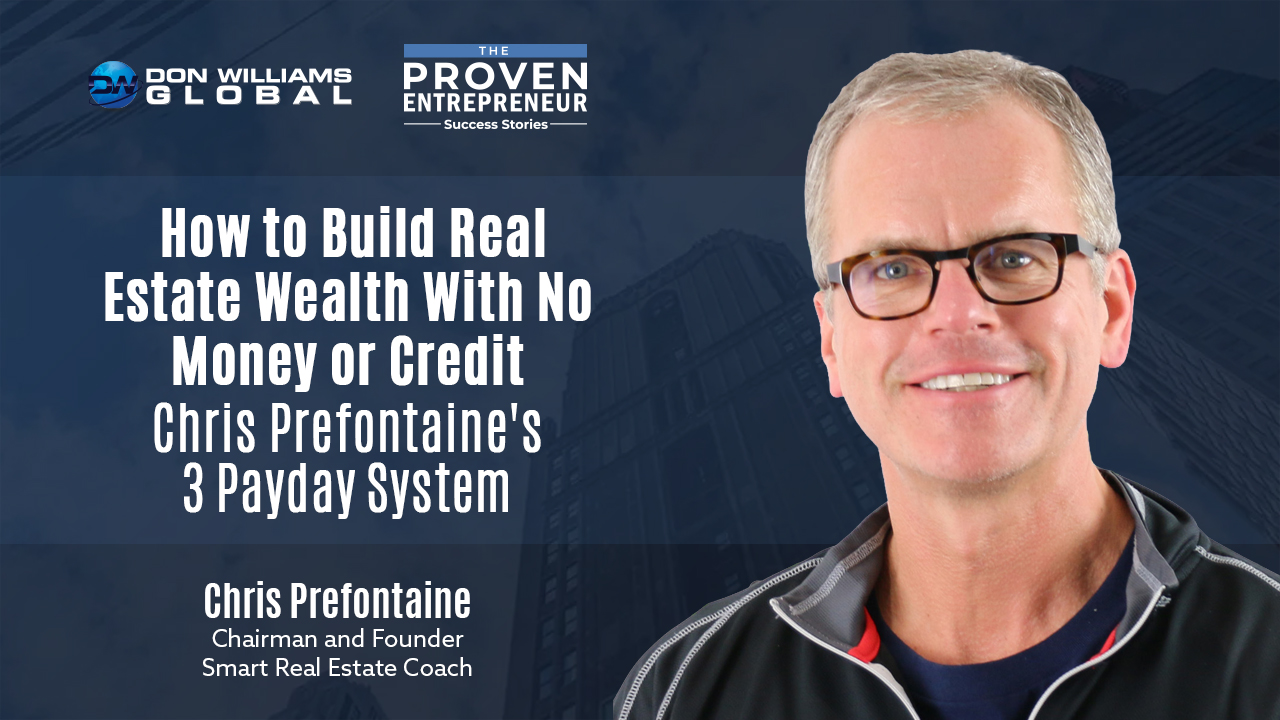
Most people believe that building real estate wealth requires a strong credit score, a hefty down payment, and approval from a traditional bank. Chris Prefontaine, founder of Smart Real Estate Coach and a 34-year veteran of the real estate investing industry, spent the first half of his career believing the same thing. That belief collapsed along with his finances in 2008, when the real estate market crash wiped out everything he had built, including a waterfront property in Newport, Rhode Island, a thriving brokerage he had sold to Coldwell Banker in 2000, and the financial foundation he had spent decades constructing. What followed was four years of rebuilding his mindset before he ever touched another deal. When he finally returned to real estate investing, he returned with a completely new playbook: no bank loans, no personal guarantees, no more getting paid only once per transaction. Through creative real estate strategies including subject-to financing, where an investor takes over the seller’s existing mortgage without refinancing, and lease purchase agreements, where the investor controls a property without owning it outright, Prefontaine built a family-run business that now operates across more than 80 markets in the United States. His story is documented across multiple episodes of The Proven Entrepreneur Show, hosted by Don Williams, and has helped thousands of investors in the Wicked Smart Community close real estate deals without relying on traditional financing, regardless of whether the housing market is rising, falling, or stagnant.
The core of Chris Prefontaine’s approach to no money down real estate investing is built around what he calls the Three Payday System, a federally trademarked model that structures every creative real estate deal to generate three separate income events from a single transaction. The first payday is the upfront cash collected at the time the deal is structured. The second is a recurring monthly income stream, similar to the cash flow produced by a traditional rental property. The third and final payday arrives when the property sale completes and the investor collects the back-end equity. This model was designed specifically to move investors away from the transactional treadmill that defines most wholesale real estate and fix and flip strategies, where income stops the moment the deal closes and the investor must immediately chase the next opportunity to keep revenue flowing. According to the National Association of Realtors, the majority of first-time real estate investors cite lack of available capital as the primary barrier to entry, yet subject-to financing and lease purchase deals require neither a down payment nor lender approval, making the Three Payday System one of the most accessible frameworks for building passive income in real estate across any market cycle. Prefontaine is equally emphatic about one rule that applies to every deal without exception: never sign a personal guarantee. A condominium conversion project he ran in Providence, Rhode Island before the 2008 crash, where units that sold at over 170,000 dollars could not move for 52,000 dollars after the market turned, cost him a decade of financial recovery and stands as the clearest illustration of what personal liability in real estate can cost an investor and their family.
For entrepreneurs and new investors researching how to start in real estate investing with no money and no prior experience, Prefontaine’s three-step framework offers a grounded and practical starting point that applies well beyond the real estate industry. The first step is to choose one specific niche within real estate, whether that is creative financing, wholesaling, fix and flip, or land investing, and commit to it based on personal values and long-term fit rather than short-term income projections. The second step is to identify a mentor or coach who has operated through multiple real estate market cycles, built a life that reflects the kind of success worth modeling, and has a track record that extends beyond a bull market. The third step is to commit to that niche and that mentor for a minimum of three to seven years without deviating, which Prefontaine argues is not a timeline for success but a commitment structure that eliminates the shiny object syndrome responsible for most early-stage investor failure. Research from Harvard Business Review supports this position, finding that entrepreneurs who maintained a single focused business strategy in their first five years significantly outperformed those who pursued multiple models simultaneously. For investors ready to explore creative real estate investing further, Prefontaine offers two free resources with no credit card required: two bestselling books available at threepaydaysbooks.com/proven and a 25-minute Masters Class at smartrealestatecoach.com/mastersclass, both designed to help investors evaluate whether the creative real estate model is the right fit before spending a single dollar on coaching or education.
For information on how to work with Don visit us at https://donwilliamsglobal.com
You can also reach out to Don Williams at https://provenentrepreneurshow.com
Watch the episode here
How to Build Real Estate Wealth With No Money Down Using Creative Real Estate Investing
Don Williams
Hey, it’s Don Williams here with today’s episode of The Proven Entrepreneur Show. I got a real treat for you today. I got a real estate, a legitimate real estate guru. Okay. And there’s like a zillion of them out there, but most of them are not the real deal. This is legitimate guru, Chris Prefontaine with Smart Real Estate Coach. Chris, welcome to the show.
Chris Prefontaine
Thanks Don, I appreciate it. I want to know what not legit is, but I know actually. I actually know. So thank you.
Don Williams
Yeah,
it’s the same thing happening, you know, in AI right now is like, there are a lot of AI experts and there are some of them that truly have real game, real skills, but there’s some of them that learned, that are teaching what they learned last week.
Chris Prefontaine
Yeah.
Yeah, yeah, I totally agree.
I was kind of being facetious because it’s rampant. I agree.
Don Williams
Yeah. Yeah. Well for, for, I don’t know, 40 years, people have been, you know, Dave, think Dave Del Dotto was maybe the first guy and, and, and he actually was, uh, and as a super guy, I’ve met Dave a couple of times, but anyhow, uh, I fell down the rabbit hole and you let me go. And so that that’s on you. So, so before we get into Q and a Chris,
Chris Prefontaine
One of the first.
It’s all good.
Don Williams
Tell us where you are, what you do, who you serve, why you do it. Give us your story.
Chris Prefontaine
Yeah, yeah. if you want to peel back anything, let me know. Cause I’ve been at this 34, gosh, going on 35 years now, uh, next this fall. Um, so I, are in New Port Worth Island. That’s where I’m broadcasting from. And I have been at this, like I said, 34, 35 years, but the journey, and I’ll just be very brief with this. The journey was, you know, like a lot of people.
I tried out different niches in real estate. I built homes, all basically very creative without getting bank loans way back when I was in my 20s. This would have been 1990 what? 1991. I owned a realtor executives franchise, so I had a broker hat on back then, mid 90s. I sold to Coal Banker in 2000 and then running up to the crash, I got annihilated in 2008. I called it the debacle.
coming out of that and I was stuck for four years in my head because as an entrepreneur it’s good for people to know like it’s a headspace most of it. Skill set all that stuff you can learn on the headspace not so easy to learn. So I was stuck from 8 to 12, 2008 to 2012. When I came out of it I kind of said all right what are the rules like what how am I gonna operate because I was not getting back in and nobody’s prodded me to get back in real estate. When I did I said okay fine no more signing personally on banks no more using gov as my own money like we set up
parameters, right? No more getting paid once on a deal, like a treadmill, you know, so we created some things. That morphed into where we are today. So that’s what I want to give you the backstory. So when I say we, it’s a family company, has been since 2013, myself, my son, my son-in-law, my daughter’s not active anymore because she’s got two kids, my grandkids, but we’re still a family company and we do our own deals creatively, creative real estate, locally here, but
In addition to that, in the wicked smart community now, we do deals all over the country. This is, think we’re in like 80 markets the last I heard doing deals because, the difference you opened up with this kind of the difference with us is we don’t sell stuff and go, okay, like good luck. We sold a unit, right? What we do is we go in the trenches with the community members and do deals. And we’re tied to them sometimes for like one to five years on one deal to make sure they get through it. And of course we revenue share. It’s a win-win.
So that’s how our model differs. We care about getting deals done as quickly as we can, and we obsess over those metrics. So that’s kind of like a 34 year history in about four minutes yet, but I’m from New England so we can go quick.
Entrepreneurship is a headspace game. Skill sets can be learned. Mindset is harder to learn. Share on XDon Williams
Yeah. And we could tell that you were, you were from further East than East Texas. And, you know, I was in Boston a year ago, and. Snowed in Boston a year ago. Yeah. and so if you’re from Texas, you really shouldn’t go to Boston in January, but, but I met a lot of wicked smart people, you know? And, and so loved all that. Okay. I’m going to,
Chris Prefontaine
Hahaha.
You bet.
Yeah, why?
Good, there you go.
Don Williams
I’m going to ask you a couple of questions. right. What’s the biggest lie people believe about building wealth in real estate?
Chris Prefontaine
Um, by far it would be that you need money to do so. and look, I spent 17 of my first half my career thinking that, you know, when I was a realtor, you’d think I know all this creative stuff. I didn’t, I didn’t until I dug in after the craft. So it’s having money gobs of, you know, money or great credit to go get money, but either way money. No, you don’t need it. I was broke after the crap.
The biggest lie people believe about building wealth in real estate is that you need money to do it. Share on XDon Williams
Okay. Love that. And I think that’s probably, I think the average person thinks that I got to have 20 % down. got to have, I got to have whatever I got to have. I got to have a 750 credit score to be able to acquire property. And yeah. And so I, mean, I can share, I became a house salesman, not a realtor, but selling homes for a new home builder in the
Chris Prefontaine
⁓ yeah.
Yeah. Yep.
More for commercial, right? Like it’s crazy.
Don Williams
A in the late eighties. And, and I’ve always kind of made my bones on the revenue side, bringing in more business. sold 17 houses my first month. That’s a very good thing, but I can remember my manager calling me in saying, Hey, you can’t sell 17 houses in a month. And I’m like, are you going to pay me? And he said, yeah, I’m going to pay you. And I’m like, okay, well then don’t worry about how many houses I’m going going sell a lot.
Chris Prefontaine
That’s a good thing.
Don Williams
Okay. I’m not your average guy. so, um, uh, and I didn’t know I couldn’t spell house. but, but, but I knew how to deal with people. So, okay. Question two, you built success in real estate without what most people think you got to rely on a bank. got to have traditional financing.
What, I think I know the answer to this, but what made you realize that was the wicked smotopath?
Chris Prefontaine
Well, I mean, it was out of need, right? So it’s reality is I had no money, right? So I little context for everybody. Entrepreneurs will appreciate this. After the crash, I went from a home overlooking the harbor in Newport, Rhode Island, the water, I mean, it’s gorgeous. To get that property now, it’s probably upwards of six or seven million to having to sell that off and move into a one bedroom, 976 square foot apartment with my wife. Selling the cars, walking to our…
my little hole in the wall office down the street when I restarted, like literally everything was a restock. And so there wasn’t like, Oh, how should we restart? It was the only way to restart is get creative with how you’re to start. you get, mean, my credit was in the toilet, Don. And I didn’t know that low of a credit score exists. I think it was like, whatever fives, whatever the low would be and no money. Like I was negative.
So when I say start from scratch, my wife and I have been married 40 years this August. It felt like when we just started, which was 1986, that’s what it felt like. Like, okay, we’re starting, what’s the budget? No, we had no money. So then we said that the creative is the only way to go. Now in hindsight, I’ll answer the question different. In hindsight, everyone, in my opinion, I’m biased, should know creative. Why? Because whether the market’s up, down or sideways or flat or the interest rates or politics, doesn’t matter. When you know creative,
You’re comfortable bopping away even because you can in any market, any market. That’s now in hindsight. That’s why we did it. Right. But at first it was I have no money. How can I buy a house? Right.
When you know creative, you can operate in any market, any market. Share on XDon Williams
Love that. And I think many, many entrepreneurs, you know, they lose a little bit of their creativity when they get a little cash, you know, and, and there’s some real beautiful moments in that creating something out of literally like nothing. ⁓ I can remember I started my first company at $6,000 and we were pretty well broke the day we opened the doors. mean,
Chris Prefontaine
100%. Yeah.
Mm.
Don Williams
Like I needed to sell something to somebody today. and, so there’s some beauty in that.
Chris Prefontaine
That was me,
needing a deal like I needed oxygen. mean, you know what the worst thing we did to your point? A year, I think this is like COVID time. Around COVID, we had one of our equity partners came in, got excited about what we do and said, well, what about all the deals that your students can’t do? The sales won’t do no money. Why don’t I put a pool of money up with you guys and we’ll loan it to anyone that wants to do that. Biggest mistake we ever made.
Don Williams
Hmm.
Chris Prefontaine
We gave people
a crutch, they were no longer looking for the great, it was the worst thing they ever did, to your point of when you have a little money, things change. So I tell people to come in, even in different higher levels that coach with me, that have money. I some people leaving six, seven figure jobs coming to us now. say, act like you don’t, just trust me for a minute. Just go with what I’m gonna teach you, then later on you can parlay things into it.
Act like you do not have the money. That is when creativity stays alive and better decisions get made. Share on XDon Williams
Yeah, I think that’s good counsel, even for proven entrepreneurs, act like you’re broke, whether you are or not, you know? So I was going to ask you, what was the most painful? No, I’m still going to ask. I know what’s the most painful event, 2008, and you know, that wiped out, you know, lot of people in the country, but on a specific deal.
Chris Prefontaine
Yeah, yeah, every day.
Don Williams
What’s like the most painful real estate mistake you can recall and how did it, how did it mold you to who you are today?
Chris Prefontaine
I could pick so many in 34 years, but let me give you one that was pre-crash, which was probably 25%, if not more, the reason I took a slide. We were doing condominium conversions. And for those of you that don’t know, just, you buy a multifamily, four, five, six, 10, you could do a hundred units, doesn’t matter, anything four or more. And there is a multifamily and all you do is you change the engineering to be condominiums.
Don Williams
Ha ha ha ha!
Chris Prefontaine
You then sell them off. being, I’m simplifying. You sell them off as individual units. Well, just where I got this idea before it did flop. I was having breakfast with another entrepreneur one day. This is way back. My kids are young and he told me about this guy that taught him how to do kind of minimum convergence. I’m like, that sounds like a good idea. I just started doing them. Made a ton of money doing it. But during the crash in Providence, Rhode Island in the city, we bought a six, I think it was a six or a seven. Bought a, like, caught a,
round number 400 grand, started converting the units and selling them off for about 180 grand each, 170, sold two. Then like a light switch went off, the crash happened. Don, we couldn’t give them away for 52 grand. So there’s a few lessons there to answer your question. One is I brought private money on top of private money. Let’s say two different people involved in that deal. That was painful because I didn’t.
file when I went through my crap, I stuck with it and just took care people. It took me a decade. So it was very painful. When you sign personally on money, that was a painful lesson. That was part of that crash lesson, right? Don’t sign personally. I don’t care when or how why. Don’t do it.
When you sign personally on money, that risk lands on you and your family. Do not do it. Share on XDon Williams
Yeah. Good, good advice. I’m going to repeat that because that was like so wise. When it comes to that personal guarantee, Chris and Dawn say no, yet, never, not going to do it. It doesn’t matter. Okay. If it’s a business deal, then the business ought to be able to accept the risk. You shouldn’t, you and your wife and your kids, your grandkids shouldn’t have to.
Chris Prefontaine
Even if you have 880 credit, don’t do it.
Don Williams
except that risk. so, it’s okay to say no to a deal. Some of my best deals, and we’re fortunate that we own commercial and residential income properties. Some of my, some of my very best deals are deals that I said no to, that I didn’t, I didn’t do. And no, we didn’t make any money on them, but we didn’t lose like other people lost. So, you know, real estate is an interesting, probably,
Like never before, residential real estate is probably in a never before spot right now. Here in Dallas, Fort Worth, prices are still sky high. People are not, but if you were a residential real estate agent or broker, you would say it is a slow market. Houses sit for a while to sell. And then just this week.
And I don’t know if it’s actually happened or if it’s just, you know, talk, but like the Black Rocks, et cetera, be out. They’re not going to be able to residential property, which, you know, should alleviate upward pressure on pricing. So talk to us about how do you make money in real estate? No matter.
If the market’s up, down or sideways, I think you said, cause I think it’s sideways right now.
Chris Prefontaine
Yeah.
I would agree, it’s probably floating. Yeah, uncertain, I guess would be a good word. Okay, the short answer is creative real estate. I caught real estate on your terms before I even knew that, okay, for hundreds of years, creative real estate’s been around. I didn’t create it, we just created a system, wrapped a ball around it and put support to it. And then how you make money, let me say the end result and go back. So we trademarked, remember I said I was tired of a bunch of things and I made new rules. One of them was don’t get paid once anymore on a deal,
It was great, it treated me great, but getting paid once then go do a deal again, it sounds like a treadmill to job now in hindsight, right? So for those of you that are looking at different niches, understand that some you’re just gonna pigeonhole yourself into a job. So people try to leave their JOBs, we help people with high, I told you high salaries transition, well a lot of them said to me, well I tried wholesaling, I tried fix and flip, I just felt like I was creating another job. Yep, you’re absolutely right. So.
How you make money is don’t do that, do instead what we call the three payday system and we federally trademarked it because it allows you to create cash right when you do a deal. Okay, that’s what you’re used to in real estate. Then it allows you to launch an income stream like you would like an income property like you have, but then it allows you to put a third payday in place when you cash out. Well, that’s like, if you were never gonna open a restaurant tomorrow, it’s not kind of a perfect model. Money now, money over time and money long-term, right? Any business. So that’s how you do it in real estate and you do it.
Creatively meaning you don’t use banks you do on a financing what they call subject to existing financing when you’re not signing you’re just paying them along and Third least purchase where you don’t own it you just control it so without we don’t have time today But those three ways of how you buy creatively and how you make money is you you practice the three payday system with which we’ve kind of cornered the whole entire market on literally
Money now, money over time, and money long term is a far better model than getting paid once and starting over. Share on XDon Williams
Love that. Okay. So if somebody was going to start today, okay. And, you know, the market, who, who really knows, you know, when I started selling houses and sold 17 a couple of years later, the first month, a couple of years later, I was in Oklahoma city and there was over a two year supply on MLS and man, couldn’t give a house away.
Chris Prefontaine
Yeah.
Yeah.
Don Williams
I mean, people were like, take over my payments and I’ll buy you two round trip tickets to Hawaii. And, and nobody’s taking them up on the deal. but if somebody was going to start today and they, they’d never done it before. Like what’s the first step? What’s one action item they could, they could start with and they might need help later, but what’s, what’s like the first thing they could do.
Chris Prefontaine
Yeah, yeah, crazy.
I’ll give you first and if you’re okay with it, I’ll give you three steps that I’m thinking of. Cool. Before I give you the three steps, a lot of people conventionally, we talked earlier, what are some mistakes? Well, a lot of people think I’ve got to go get my license. I held the license for a while just for the listeners to know, and I also ran a brokerage where I had agents working for me. And I can tell you, don’t do that in hindsight. Here are the three steps instead. One.
Don Williams
Okay, I’m good.
Chris Prefontaine
Pick a niche in real estate. There’s a lot of cool niches. I’m biased to create it, but there’s a lot of great niches, right? Pick one that you can morally, ethically and value-wise get behind. And why I say it that way, Don, is you can flip land behind a computer and never talk to someone. You can look at fix and flips and wholesaling, which means you have to, you have to steal the property at 60 or 70 cents on the dollar. So it’s a little bit more predatory than what we do, but some people love it.
I say pick a niche you can get behind in every way. So that’s step one. Cause you’re to know where you’re going, right? If not, it’s shiny object syndrome and you it’s like drilling well, you never hit water. Second step would be, this is so important. Pick someone in the niche that has gone through some market cycles and is where you want to be. But back to the moral and ethical and kind of values, pick someone that also you can get behind and model because you and I at our age, both know people that have screwed up.
relationships with kids or spouse because they had success. I know too many. So for me, that’s not me. Like I want the whole picture or I don’t want to follow that person, right? But you pick, you pick someone that you can follow that’s been through times. Cause to your earlier point, when you opened the show, so many people have been in this business for a couple of years, sadly, a couple of months and they’re teaching. It’s just insane. So find that third and last step, put the blinders on for three to seven years and
Don’t deviate, don’t get shiny objects syndrome. Like in other words, people call me and go, okay, I’m gonna try what you guys do for six months. I then don’t do it. You’re wasting time. You’re gonna be pissed off and frustrated because real estate’s not getting rich quick, even though every social media ad that’s hitting you is telling you it is. It’s not. And they rent a Lamborghini and they rent a castle. That doesn’t, it’s not working. So pick something that you can say, I’m gonna commit to this for three to seven years. I’m not telling you it’s gonna take you that long to do a deal. I’m telling you if you pick that, your commitment level will be lined up properly to not quit.
That’s all. So long answer, then you ask, but I hope that’s okay.
Don Williams
No, wise counsel and truthfully people, I would tell you, you could take those three principles and they’re universal to any industry that you want to step into. ⁓ Entrepreneurs, myself included, more so earlier, but still there’s still a little bit of me that wants to chase shiny things that come by. Maybe that’s the next hot
Chris Prefontaine
Any you bet. You bet.
Human nature, right? We all.
Don Williams
great thing. know, so I think that’s amazing. Well, Chris, if somebody listening to the show wanted to reach out to get a smart real estate coach, how would they reach out to you or your company?
Chris Prefontaine
Yeah, thank you. I’ll give you two links because to your earlier point, I’m big on free only because I don’t want you to spend 10 cents until you go, Hey, that lines up with those three steps. I’ll do that. And if not, no, nothing lost except for a little time. So you can get our books. You don’t have to go to Amazon. The best sellers will send two out of the four right over to you. Just go to three, the number three, three paydays books.com forward slash proven. Just so I know it’s from a Dawn show. We’ll honor that.
And it’s not one of those free offers, Don, where you go free offer and you go all through the screen and then it says put in eight bucks for shipping. That’s not free. This is free. You won’t be asked for a credit card. Secondly, I did a recent, we posted a new, it’s been out for years, but we posted a new one January 1st, what we call a master’s class. It’s me for about 25 minutes or so. You don’t have to deal with anyone watching over your shoulder. You don’t have to get pitched on anything. You are just gonna watch a class that I teach.
for 25, 30 minutes, go to smartrealestatecoach.com forward slash masters class. Both of those are free. Enjoy and if there’s something you wanna look further, I’d love to chat with you.
Don Williams
Love that. Chris, been a pleasure to have you on the show today. You are a breath of fresh air in that big, hairy, gnarly industry called real estate. And so I’m grateful for you to be in with us today. You bet. That’s today’s episode of The Proven Entrepreneur Show. We’ll see you next time. Thanks. Bye.
Chris Prefontaine
Thank you for having me, Don. Appreciate it.