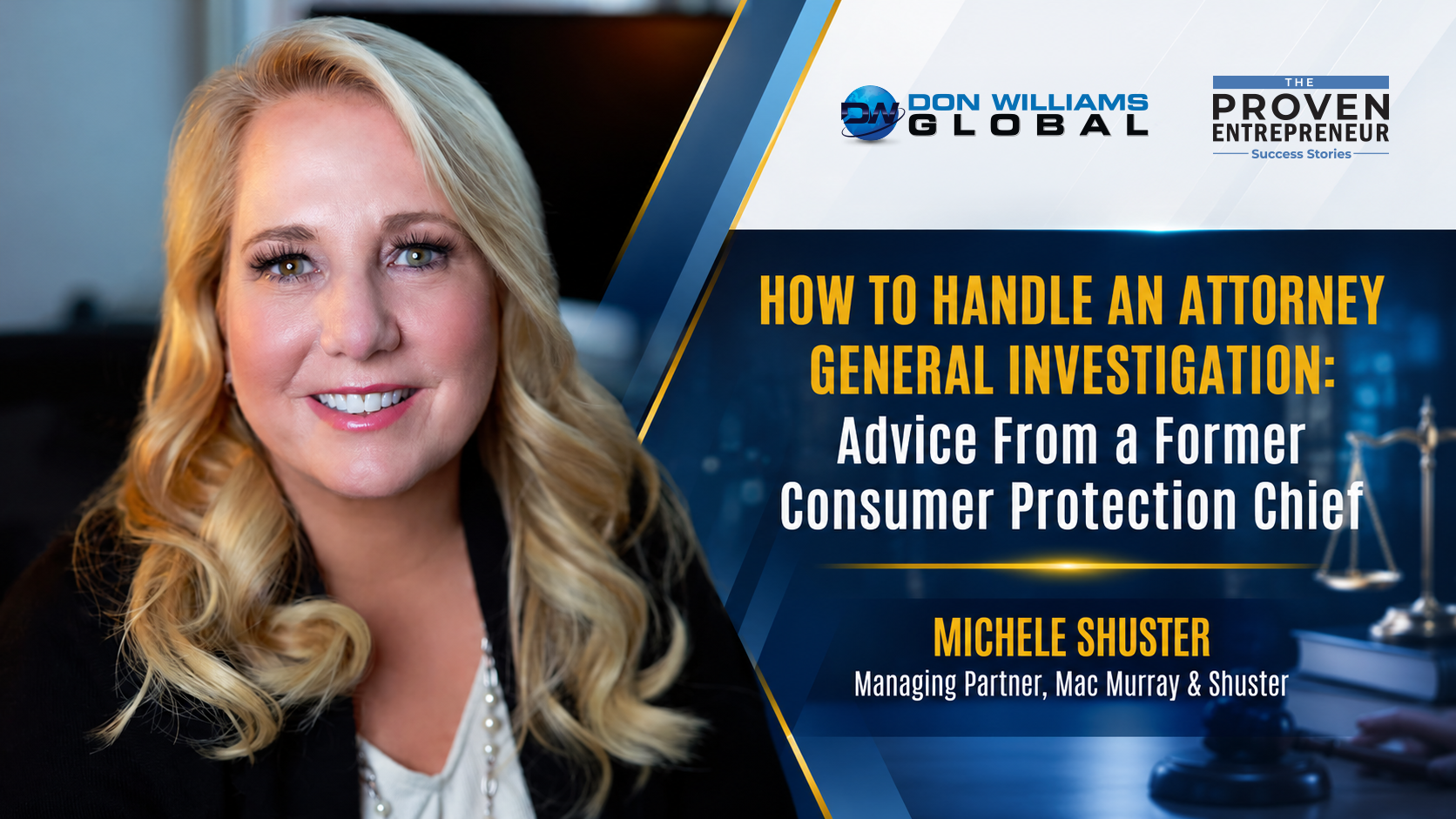
Most business owners do not land in front of a regulator because they set out to break the law. They get there because consumer protection law, with its broad rules against unfair or deceptive acts and practices, is not intuitive. Michele Shuster has seen this from inside the Ohio Attorney General’s office and from the side of the companies she now represents before the FTC, the FCC, and state attorneys general. Her view is that attitude matters as much as the facts when you are invited to talk with an attorney general investigation team. The full episode explains what she watched go wrong and what she says works in most cases.
Then comes AI, and the conversation gets personal. Michele talks about her concern over what she calls cognitive resignation, and about the legal risks she sees as businesses use ChatGPT and other tools in daily work. She explains why AI generated phone calls used for marketing are already covered by existing rules, which makes TCPA compliance and consent a live issue for any company doing customer outreach. She also raises a data privacy and litigation point about AI chats that every founder, marketer, and manager should hear before the next prompt gets typed. Her advice on working with professionals who understand rules across all 50 states gives business owners a practical place to start.
Behind the legal advice is a story about entrepreneurship, family, and purpose. Michele describes starting her law firm when her job ended, taking on a case that required travel to dozens of states, and learning how to fund a business before the first client check arrives. She credits her father, a World War II veteran who built a long career from the bottom of a company, for the lessons that still guide her leadership style. Host Don Williams adds his own stories about running companies and dealing with regulators. If you want startup, marketing law, and business growth advice that comes with real experience, this episode is worth your time.
For information on how to work with Don visit us at https://donwilliamsglobal.com
You can also reach out to Don Williams at https://provenentrepreneurshow.com
Watch the episode here
How to Handle an Attorney General Investigation: Advice From a Former Consumer Protection Chief
Hey, Don Williams here with today’s episode of the Proven Entrepreneur Show. And today we are joined by one of the nation’s leading voices at the intersection of the law, marketing, privacy, and consumer protection. Michelle Schuster is the founding partner of McMurray and Schuster in Columbus, Ohio. Now, she doesn’t look this
old enough to do this, but for more than twenty years, she has advised businesses across the country on navigating complex advertising, telemarketing, and privacy regulations. She’s represented clients before the Federal Trade Commission, the Federal Communication Commission, multiple state attorneys general. She helped shaped Ohio’s Do Not Call Laws.
While she served in the Ohio Attorney General’s office, and she played a key role in landmark TCPA cases that changed legal, the legal and marketing landscape nationwide forever. What makes Michelle especially fascinating is that she’s seen consumer protection from both sides, inside government enforcement and alongside businesses trying to grow responsibly.
In a highly regulated world. Today we’re going to talk about leadership, entrepreneurship, AI, compliance, privacy, and what business owners need to understand now to protect and scale their companies intelligently. Michelle, welcome to the show.
Don, thank you so much. That is the most serene introduction I think I have ever received. And I very much appreciate that because we’ve had a little bit of a hectic day today.
Well well it’s it’s
it’s my pleasure and and Michelle has had a hectic day, but she still showed up because she’s she’s a believer in keep every promise. And I I Michelle is a friend to me. I’ve known Michelle mm most of those twenty years, maybe all maybe more than that. And and so you’re in for real treat today. So before
We strap you in the chair and put the bare bulb over you and say we have ways to make you talk. Tell us about McMurray Schuster, what you do, who you serve. Give us get tell us about your business.
Yeah, yeah. So our law firm will be celebrating twenty years next year, which is just so hard to believe. And thank you for saying that I’ve been a lawyer for twenty years. It’s been a lot longer than that, and we don’t want anybody to do the math. So th thanks for ending it with that, with that, Don. But you know,
We started the law firm 20 years ago with myself and basically three other former consumer protection chiefs. And it was somewhat a necessity because we were with a party that had been voted out of the AG’s office. And so we had to decide what was the next what was the next step and met with those
Three people that would become my initial partners. And we sat down and you said, you know what, we’ve been seeing how the law firms do this on the other side. We can do this much better. And at that same time, the former attorney general Betty Montgomery was leaving the auditor’s office and she decided to come and join us. And if I would have tried to plan the dream team to start the law firm 20 years ago.
That would have been it, and I would have never thought it possible. Betty is still with us 20 years later, and just such a gem. you should invite her to do one of these, Don. She’s amazing, amazing woman and has such an amazing story. but but you know, that’s how we got started. And one of our first big cases involved a cable company that had run into trouble with 50 states attorneys general. And
That that’s a lot
of trouble, Michelle. That’s a lot of trouble. It’s
It’s a lot of trouble. It’s a lot
of trouble.
but the good news for us was the law firm that was representing them on most of their other matters was conflicted out of this case. And so they referred it over to us, and the company trusted us to meet with all 50 states attorneys general and to settle that matter for I think it was somewhere around five million dollars 20 years ago. And just to put that in perspective, that same company ended up settling a lawsuit with the FTC probably.
about 10 years later and it was the largest judgment at that time ever issued by the FTC. So when I said we really landed with the dream team, that was just a great example of it.
but talking about being an entrepreneur and really needing a gut check early on, big companies don’t fund expenses up front. So imagine starting a law firm and having to travel with two of your attorneys to 50 different states in a very short period of time. and so it was one of those things where we’re like, well, you know, this does seem like a really good idea, but God, this is expensive. So there was a little bit of a gut check, but I remember when that first check came in, I looked at my partners and I said, We’re gonna be okay. Everything is gonna
Big companies do not fund your expenses up front, so landing a major client can mean spending heavily before the first check arrives. Share on Xbe just fine. So and we’ve never looked back. It’s been it’s been a tremendous ride. but you know similar to that first case that’s what we do with companies. we help them
proactively comply with the marketing and advertising laws, all of those consumer protection laws that are about what you can and can’t say in marketing, what medium you can use, what type of consent you need, scrubbing against all the do not lists, all of those types of things. And then I I jokingly say those of them that don’t come to us for compliance, come to us for litigation. So we have a very active litigation group as well. And we have a network in all 50 states still that we we travel abroad for a lot of our
Litigation.
I love that. And so a
coup a couple of things I want to highlight. You became an entrepreneur, not really partially maybe out of a profit motive, but primarily because your job went away. And and so we gotta go do something, and we either have to go do it with for somebody else, or I think I like me as a boss better, and so we’ll just go do that. And so I I I love that. I think many entrepreneurs begin.
in that kind of I’ll say clumsy, though the the maybe the most elegant manner possible, you know, when you just look
Yeah. That’s probably right.
at it with the right glasses. And then and then the hey, this is expensive and clients don’t advance. big c big corporations certainly don’t. And so we got to figure out how to fund this and
And there might have been a couple nights where you were breathing in a brown paper bag saying, Man, I hope the money’s gonna last until the money comes in. And and then I I’d be remiss if I didn’t point this out. So to close issues with 50 state attorneys general for $5,000,000 That’s
unbel I y should be in the hall of fame of
And it should.
legal representation. and so you
It sh it should.
would know if you’re looking to be proactive, which I certainly encourage you to be, or you’re looking to fix something that was broken, you’d have to look long and hard to find someone who would serve you better than Michelle Schuster. And so okay,
That’s so kind of you to say. Thank you.
so
Thank you so
One thing I would
say though, Don, that I think you and I both need to point this out, to be very clear, I think most entrepreneurs are unemployable. So I think a lot of us come to this journey because, like you mentioned, you know, working for others is difficult. We kind of we seek our own path. we do things because it’s the right thing for the client, it’s the right thing for the employees, and not necessarily the most profitable thing to do. and that
That doesn’t serve corporations well very often. but it it does give I would say most of us entrepreneurs such an incredible sense of purpose. You know, it’s just not going to work for a paycheck. It’s a purpose. it matters not just to me, but to all of those people we work with. And it’s something that I am thankful for. Thank God every day that He has blessed me with the ability to be an entrepreneur and I wouldn’t change anything.
Most entrepreneurs are unemployable. We chase purpose, not a paycheck, and we do what is right for the client and the team, even when it is not the most profitable choice. Share on XYeah, I I love that. And I I became an entrepreneur really out of aversion to authority. My father
Mm.
was my father is a United States Marine. I grew
huh.
up spit shining my shoes, getting my hair cut every Tuesday, and I love him and I love everything about my childhood. But between my makeup and my upbringing, I’m not very good with authority.
And so I always said I could be a great follower if I could just find a great leader. And and I wasn’t a great leader in the beginning, you know,
Yeah.
but but at least I didn’t have anybody to blame but myself and and
That’s right.
that I could live with. And like most entrepreneurs, you learn and earn and grow and and you get better. And and so that’s been
My journey and very common with a lot of the people. Okay, I’m gonna ask you five or six really tough questions here. Okay. Here we go. Yeah.
Okay, all right, hold on. Let me get ready.
So, Michelle, you’ve seen consumer protection from both sides, the government side
Mm-hmm.
and the business side. If if I put you on the spot and said, What do you think is the biggest mistake companies make that gets them into regulatory trouble, which is not a good place to be.
Yeah, yeah. Well, I think what gets him in trouble is I don’t think people want to get in trouble. I think most people are good people. They want to comply with the law. But these regulations, these laws around consumer protection that just really broadly prohibit unfair or deceptive acts or practices, it’s not, it’s not intuitive. And so I can tell you from my experience having been the consumer protection chief and on that regulator side, companies would come to us in one of two ways. One was,
You know, we have big power for powerful attorneys, and we’re gonna take you on and we’re gonna take you down and we’re gonna show you that we’re the boss. The problem is that most of these companies don’t realize is the AGs are very selective about who and what they go after. And then they have a whole staff of attorneys that don’t have to bill by the hour. And so if you start a conversation that has that air or that attitude about it with the regulators, you have now become their pet project.
Start a conversation with regulators by trying to take them on, and you become their pet project. They have attorneys who do not bill by the hour. Share on XAnd so you would be shocked how many times I saw that. And you would be shocked at how many clients start with the Michelle, this is what we want you to do. But what it can tell you is approaching the AGs, and this is universal, or regulators in general, with you know, this is what
Our intent is we want to comply with the law. Did we make a mistake? Can we talk about that? You know, what what does that look like from the AG’s perspective? And you know, we have these policies and procedures in place. this was either a one-off or you know, we just got it wrong and we want to make this right. what can we do to cooperate with your office?
And so, you know, that is, I would say, you know, 90% of the time the right choice, the right way to go. Now, there are some AGs that are just so far off field and outside of their jurisdictional limits that you have to approach that much more aggressively and proactively, but that is the exception. So underestimating those AEGs, those assistant attorney generals that are out of law school for a couple of years is always a huge mistake. you know, they have one area of the law they have to concentrate on.
When regulators invite you to talk, lead with your intent to comply, ask whether you made a mistake, and offer to cooperate. That is the right call about 90 percent of the time. Share on Xthe laws are skewed towards the regulators. it’s just you you want to go in a cooperative fashion. So I I really do think having that perspective is critical for clients if they’re if they’re, you know, being invited to come talk to the regulators.
Yeah,
yeah. I I I so agree. You know, a hundred years ago, one of my companies, we had one of those invitations.
Mm.
And and I was a little shocked and I was very naive and very young. And I literally called the assistant AG and said, I don’t think I’m doing anything wrong, but if I am, I’ll stop and can I come talk?
Yes, that’s an excellent approach.
And and
and he said yes. And I got on a plane and was there the next day. And and you know, we had done something wrong. We didn’t know we had done something wrong, and I was properly contrite and did my best to fix it. And it it went away. I mean, there was some expense, there was some pain, you know, but there was not huge expense and there was not huge pain.
And so
And hopefully
not huge headlines, because that’s really usually what businesses are trying to avoid. They don’t want to be that huge headline. And that that’s a great example. Yeah.
Yeah, and we we averted we avoided that and so that was
that was great. And so I I just think that, you know, Michelle aptly stated they have an unlimited budget, they have unlimited time.
Keep that in mind if you get into that position. They you do not have unlimited time. You do not have an unlimited budget. Okay. I want to talk about AI. Sure.
Can I say one other thing before we leave?
‘Cause I think this just so
succinctly summarizes what we’re talking about here. And so Betty Montgomery, who is I think the best government official politician there has ever been, she does she did things because it was the right thing to do. And that’s that’s sometimes rare to find. Actually I would say
Yeah.
very rare to find nowadays. But anyway, she would break it down when companies were approaching her or when she was determining whether she should file a lawsuit or try to work it out with the company. She said, Michelle, you have to break it down into two categories. Are these sinners or are these savables?
If they’re sinners, we’re gonna go after them. If they’re savables, we’re gonna work with them, we’re gonna educate them, and we’re gonna bring them where we know they can be. And so I think that thinking about it when you approach the AGs in that way, am I a savable? And you want to be a savable as a company, you definitely do. then I think it really it, you know, it
A former attorney general sorted every company into two groups: sinners get pursued, and savables get educated and helped. Be a savable. Share on XIt’s it changes the attitude. I will tell you though, I did have a recent matter with an AG’s office that was clearly unreasonable and we had to be extremely tough and it ended up going away. So this isn’t a blanket, it always needs to be like this. Sometimes you really do have to draw the line in different places. But yeah, it’s interesting you’ve had that experience and it’s interesting that you and I haven’t shared that, so
Yeah, well
i yes, and over a couple of decades. but I and and Betty sounds like a holder of immense wisdom. you know, I think that’s probably the posture government should take. If if they’re bad actors, let’s treat like bad actors and if they if they made a mistake, let’s let’s help get right and and go on and and change the world for however they’re doing that.
Okay, I I have to talk
We might.
about AI because everything today is AI this, AI that. Okay, so and I almost hate to say this AI is moving faster, like everybody knows and everybody talks about. But as opposed to regulation, AI is really running past regulation right now. No
Mm-hmm.
way to keep up. What do you think entrepreneurs and marketers should be paying attention to today?
before it becomes a big problem as as regulation does catch up.
Yeah. Well, just more broadly than that, this is the primary issue I have with AI. It’s a complete cognitive resignation is the term that I have seen out there before that I just so aptly
describes what we’re seeing right now. I have serious concern for the young attorneys that come into law firms now and they don’t have to sit down and really think through these very complex issues and they just plug it into a legal AI or God forbid, you know, Chat GPT or something, Claude, whatever, something like that. It it is just
You know, it it is such a disservice to them, to the clients. Now, I’m not saying you don’t use AI tools, you do, but you really need to sit down and think through these things and not just stop learning how to analyze things. I have a real concern for this generation. I’m really pushing that at our law firm that how we use AI. but what I would say is so if we if we look beyond that, if we look at where the regulations are.
Using AI is fine, but you still have to sit down and think through complex problems yourself, or you stop learning how to analyze things. Share on XRight now,
you know, aiming to try to stop some of the concerns that they have. It falls into a couple of different categories. obviously in your and my industry, customer outreach is is become a huge use of AI. So, you know, AI generated phone calls, customer service, those types of things. And you know, the laws that have existed for a very long time regulate the use of pre-recorded or artificial voice. And so the laws don’t have to change for that. You do have to have
consent if you’re using this using ai artificial voice to make marketing telephone calls so that’s not new and we’re seeing a lot of people really get tripped up on that on that issue not understanding that those laws already apply you know plus from the privacy perspective
Laws already require consent for marketing calls made with an artificial voice, so AI generated calls are not a new legal question, yet many businesses get tripped up. Share on Xyou really have to make sure you understand what type of AI that you’re using and whether the information that you’re providing that system is shared in the system. You know, is this a generative AI function that you are turning over information to? And it has a lot of different potential issues. Just from the you know, from as an attorney, you you can’t do that because you have an attorney client privilege, but from a company standpoint, it’s the same issue with turning over.
potential trade secrets or information into those. Now I think most entrepreneurs have gotten well educated on this and they’re they have closed systems that are eliminating a lot of those different types of issues but what we’re seeing now in litigation is that courts are determining that chat
Conversations used in AI are discoverable. And so just stop and think about that for a minute. That if you do get caught in litigation, you could be required to turn over all of your chat conversations. And so, you know, if you do run into a legal issue, please don’t go ask AI how to respond to that and put in all the facts because if that’s produced in litigation, that’s a significant issue. So, and then just privacy.
If you face a legal issue, do not ask an AI tool how to respond and feed it all the facts. Courts are finding those chats can be discoverable. Share on XBeyond that. There are privacy concerns with consumers being required in some states to provide consent to share certain information about them. So this is an area where you really want to work with professionals that understand the 50-state implications and what you can and can’t do because this is an area where an ounce of prevention is definitely worth the pound of cure.
No doubt.
And I, you know, just anecdotally, I I think that most entrepreneurs reach out to a law firm when they have problem. A few when they’re trying to prevent problems. And I’ll just say this the prevention is so much easier, so much better, so much less expensive than the cure. And and and truthfully, the firm.
Actually probably prefers to work on the prevention side. Yeah.
Most entrepreneurs call a law firm after a problem and few call to prevent one. Prevention is easier, better, and far less expensive than the cure. Share on XMuch more fun. yes,
the clients are much much better to work with on that. Yes, yes.
Yeah, yeah. okay,
so next question. You helped shape T C P A legal battles that impacted businesses really nationwide. Was there a moment during those cases when you realized this is gonna change everything forever?
You know, it’s so funny I did have a moment like that. And it is just so strange how it all came together. And I I do think some divine force drives things. And I was with my law partner, Helen McMurray, who I’ve known for forever, and she and I decided to take the afternoon off to go see, and I’m forgetting the name of the movie, but it was the Ruth Bader-Ginsburg movie that came out, I don’t know, probably five years ago now.
And so we took the day off and we went and we saw it. And the end of the movie is coming. And I’m like, wow, I feel so inadequate right now because look at what this woman accomplished, you know, against all odds. And a few minutes after that, the decision came down in a Supreme Court case called Facebook versus Dugad. And
On behalf of PACE, the association that Don and I were talking about, we had filed a brief asking the Supreme Court to take a position that we really didn’t think we were going to be successful with, but made all of the sense in the world. And it was basically determining what it meant to be an automatic telephone dialing system. And the determination of this was very critical because if you were just using something to automatically dial, then every company in the United States could potentially have an issue if they’re using any kind of automated system. And
we Don and I could talk about this for hours, but I’m not gonna go into all the details, but that literally came out as I was walking out of that movie. So it it was I was like, okay, maybe I have done a few things. but I’ve just been incredibly lucky to work with some amazing groups that had amazing people in it that put me in positions that I could be involved with some of those important issues. Very lucky.
You know, I don’t know if you’ll remember this, but there was a an action taken by that association. and I think twenty-eight companies signed on to that and it was against the FTC. Yeah. And I didn’t know this. And and and I stood with the industry. I I I thought it was wrong.
And so my company signed on. I I was unaware, but when it was filed, my company, the name of my company is Alliance. Yeah, so it was Alliance et al. versus the Federal Trade Commission of the United States.
Yeah. Versus the F.
And and that that’ll make you catch your breath. yeah, so
Yes, I know exactly what you’re talking about. That predates me, but yeah. Yeah.
Yeah, that that I I was like, I I didn’t you know, because the other were like national banks and monster insurance company and people who had been much more yeah, but but
Vested, yeah. Right.
that was alliance at all. And I was like, guys, I don’t know that I signed on for that, you know.
I was
in the AG’s office when that was filed. And so you know, we were very involved on the other side of that litigation with the FTC. And so it’s interesting.
Yeah, for sure.
It’s interesting how our paths have crossed on.
It it it is, it is. Okay, so we’re into the final stretch. I can see the checkered flag waving and we’re gonna get to the finish line. You know, you’ve really built an extraordinary career in law, but I also know in in leadership, both in your profession and in your communities, looking back.
What adversity or challenge do you think most prepared you to become the leader you are today?
probably being a middle child. No, actually, you know, I I have stood on the shoulders of giants, starting with my father.
And swore I wasn’t gonna get emotional on this, but unfortunately he is no longer with us. But
Sorry.
he he was born in nineteen twenty six. He was the baby of ten children.
And both of his parents were passed by the time he was 18 years old. he was in World War II, he lied about his age. he started out as a janitor. Actually, he was a flora boy, it was below a janitor at U.S. Playing Card Company. And he worked his way up over 50 years at that company to be vice president. And
Just an incredible man that I was so lucky to have as a father. So I would say it definitely started
from the time I was able to walk or talk with my dad, you know, just just little lines of wisdom, you know, it’s he’s like, it’s not your friends who make you, it’s your enemies who break you. So don’t make enemies. And I mean, what a great thing to tell a young child, right? Don’t make enemies.
Yeah.
And you know, maybe that’s one of the ways that I was led to the path of being a lawyer too. You know, I I felt very strongly about doing the right thing and helping people.
Okay.
And I definitely got that from him. I can remember when I was little, he would sit at our kitchen table, and this was before computers, you know. This was you had to pick up the phone and call people. And he was this incredible consumer advocate. If somebody had a problem with a business, my dad was so tenacious. He was not going to get off the phone until he got whatever it was that this friend of his needed. And sitting there and listening to him as a child was like a master’s class in how to negotiate. and then you know.
just throughout my life. I’ve been so blessed to have so many incredible people, include Don, you’re one I would include in that, that I have just been so lucky to meet and know and to learn from. And you know, I’ve just always considered myself a a student and maybe not even not so much a leader as a student, but you know, I learned early on.
So so says all the best leaders.
I mean, you take care of the people around you, right? That is a fundamental belief I have. And I let good people in. If you are not a good person, you don’t get into my circle. So I just you know, it’s it really comes down to such simple things. And then if you create a life that is principled for yourself and for your family, then the rest just becomes
it becomes easy. I’m not saying there’s not challenges all the time. Every day I have some kind of challenge, but i there are challenges I love and I look forward to. And so I I just I feel incredibly lucky and blessed to have been surrounded by amazing people and to
Create a life that is principled for yourself and your family, and the rest becomes easy. Share on Xjust have been able to see the way they do things and it’s the best education. better than law school, better than an accounting and finance degree, anything, any anything like that. So yeah, definitely where it came from. Plus I’m a hell of a poker player. from learning how to play cards before I learned how to walk from my dad. So I’m thankful to him for a lot of things. Yeah, I think so.
Think that’s a great skill for an attorney who might be a litigator at times.
I think that’s a great skill. So, you know, folks, what I what I heard there, if you’re a parent, realize everything you do, your kids are hearing. Sometimes they’re hearing your words, sometimes, but everything you do, they’re hearing. And and we all can learn.
From other people. And if you have that open-mindedness, people will show up accidentally, coincidentally, except there is no accent, there is no coincidence, to help you along your path. And I I have been the benefactor, I’ve been benefited from that many, many times in my life. So,
Yeah, I have no doubt.
Michelle, this has been
A wonderful interview. I reserve the right to call recall the witness because I have other things I want to ask, other things I want to talk about. We’re just out of time. And so yeah, thank you so much. Hey folks,
We’ll accept the reservation. Thank you.
Michelle, thank you. I’m very grateful. Hey,
My pleasure.
folks, that’s today’s episode of the Proven Entrepreneur Show. We will see you next time. Thanks. Bye.