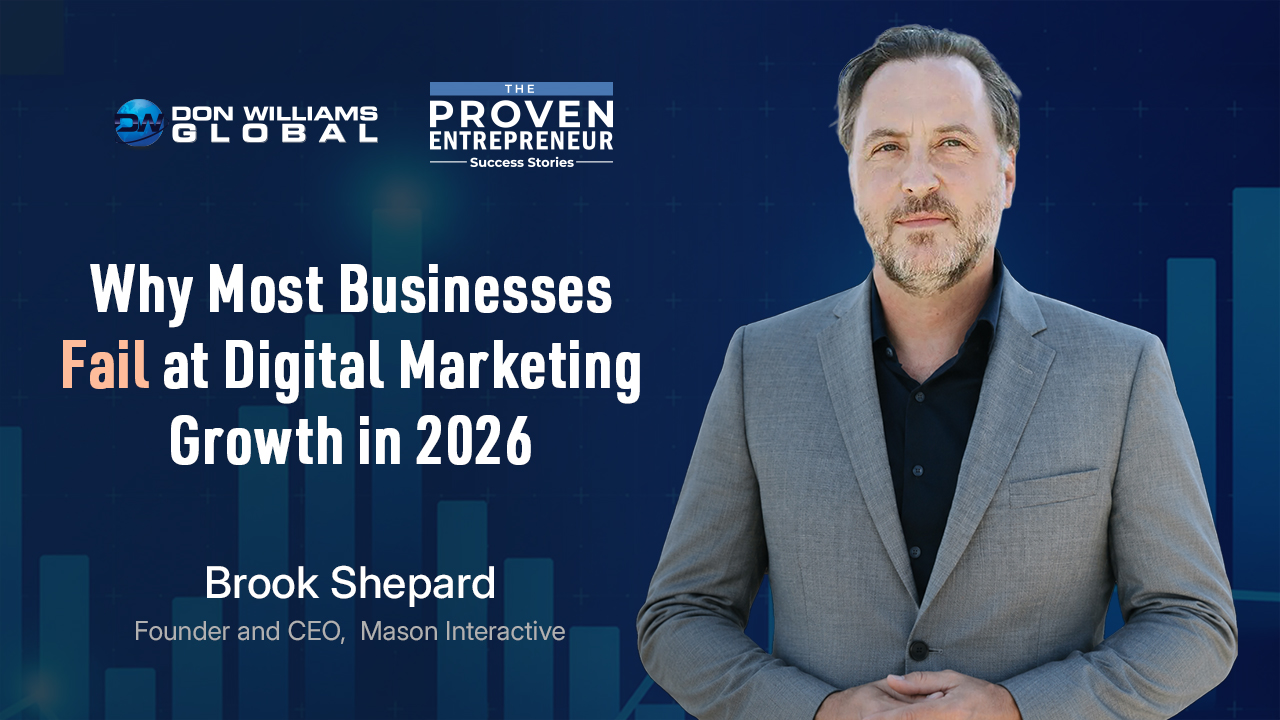
Most companies believe scaling a business comes down to finding the right marketing hack, lowering acquisition costs, or improving ROAS. In this episode of The Proven Entrepreneur Show, Don Williams sits down with Brooke Shepard, founder of Mason Interactive, to discuss what actually drives long-term business growth in modern digital marketing. The conversation explores entrepreneurship, performance marketing, customer acquisition, ecommerce strategy, lead generation, advertising psychology, SEO, paid media, and why many brands quietly stall even after increasing their marketing budgets. Brooke shares insights from managing large-scale advertising campaigns and helping businesses grow from startup level to multi-million dollar revenue brands.
The episode dives deep into digital advertising strategy, growth marketing, AI in marketing, agency leadership, subscription business models, and the pressure companies face from investors and efficiency metrics. Don Williams and Brooke Shepard break down why businesses often focus too heavily on low-cost leads, short-term performance reporting, and marketing efficiency while overlooking customer lifetime value and sustainable growth. The discussion also covers ROAS optimization, data-driven marketing decisions, business leadership, brand trust, and how companies can balance automation with human judgment in today’s changing advertising environment.
Entrepreneurs, founders, ecommerce brands, agencies, marketers, and business professionals will find practical lessons throughout this conversation. From customer retention and scalable marketing systems to company culture and founder mindset, the episode offers a realistic look at what separates businesses that continue growing from those that plateau. If you are interested in digital marketing trends, entrepreneurship, business growth strategy, lead generation, advertising management, customer acquisition strategy, or scaling a company in 2026, this podcast episode featuring Brooke Shepard and Mason Interactive delivers valuable insights worth listening to.
For information on how to work with Don visit us at https://donwilliamsglobal.com
You can also reach out to Don Williams at https://provenentrepreneurshow.com
Watch the episode here
Unlocking Growth: Human Insights in a Tech-Driven Marketing World
Hey, it’s Don Williams here with today’s episode of The Proven Entrepreneur Show. Fresh off the subway in Manhattan, our guest today is Brooke Shepard with Mason Interactive. Mason Interactive is an ad agency. Brooke, welcome to the show.
Thanks for having me, Don.
Man, thrilled to have you. What a treat. before we get into Q &A, tell us what does Mason Interactive do? Who do you serve? Why do you do it? How long have you done it? Give us your business story.
the why is it is existential. So Mason is named after my 17 year old son. I formed it pretty much when he was born. We are a full service advertising agency with offices in New York City where I am now Charlotte, North Carolina. And about two years ago, we acquired an agency in Los Angeles. So we have the LA presence as well. We are an advertising agency. We strive to be a one stop shop. We’re not owned by private equity. the only
agency that I know of, it’s not owned by private equity that can offer pretty much everything digitally to clients. And that means search, social, programmatic advertising and TV and some print and affiliate marketing and SEO and email marketing. so we try to, an award-winning creative who were just nominated for our first Clio award. And the clients we serve generally, thank you. Yeah, it’s pretty cool. The clients we serve generally fall into two general buckets and one of them is higher ed.
Yeah, that’s cool.
So colleges that need more masters candidates to apply to their PhDs. And the other general bucket are what we call emerging direct to consumer brands. So we work with global multinationals like Casio and Mary Mecca and Italy. But we also work with a startup dress company in the Lower East Side of Manhattan or a new purse startup based out of London. So one stop shop for those kinds of brands. These are the clients that generally across our 60 clients.
Awesome. Love that. So tell me, Brooke, in a world where we’re becoming more and more obsessed with tools and tech for marketing, what’s a human advantage that you think most brands overlook that drives conversion and loyalty and revenue that works?
Yeah, that’s a great question because we are inundated with tech and we spend a lot of time formulating memos for clients to walk them through new updates from Google and what does AI Max mean? What is the Andromeda update meta mean? The one of the things I think is really important is and I say this, I hope without sounding boastful is, we’ve been in business for 17, 16 years, 17 years. We have over a billion dollars in assets managed. We’re larger than a lot of our clients, right? And so
And some of clients are bigger than us. but we have all this experience and this human tribal knowledge of the company of what it takes to get a company from a million dollars in revenue to $30 million in revenue. And we’ve done it a number of times and some other people, but we’ve done it a number of times and the human knowledge that a team has about that and how to do it, I think is really important. I’ll give you an example of that in today’s
In today’s economic environment, by which I mean interest rates largely, private equity is driving a lot of decisions in businesses and entrepreneurs will take a little bit of private equity or someone’s family office. And with higher interest rates being prevalent, a lot of those funders, those lenders are demanding efficiency. And what they call efficiency generally is ROAS, return on ad spend. If you focus relentlessly on return on ad spend, you will eventually efficient yourself.
of business. And I know that and I can prove it. I don’t always say it that way to prospects and clients, but like just trying to explain to someone that growth, you can’t cut your way to growth. Someone I admire very much says very often, you can’t cut your way to growth. having been through that a bunch of times is more important, I think, than the latest cool tool, all of which we’re using, right? We’re totally AI enabled, but the experience of having done it, I think is probably more equally important at the least.
You can't cut your way to growth. Share on Xto the ability to use those tools.
I love that. And I love that you cannot cut your way to growth. know, in my own business, I help people drive top line and that won’t solve all their problems, but it will solve about half their problems. And then they’ll have enough money to kind of figure out how to solve the others. And then, you know, my, the anti-Dawns people who work on the other side, they work on bottom line. And I’m like, I think that needs to be worked on.
Yeah.
But you can only cut your way so far. mean, there’s a limit to what can be trimmed and there is no limit, zip zero zilch nada on how far you can go up. so, ⁓ you know, so it’s like, where are you going to put your effort? Come on. Okay. What about a hard truth? So what’s an expensive mistake you see companies make with digital?
That’s a great way of phrasing it.
And why do really smart people keep doing it?
because of interest rates. Also, I do. think it certainly correlates interest rates. A mistake that people make is thinking that there’s a dogma around process. The industry changes so quickly that we have a state-of-the-art, wonderful case study on our website with a client, Taste Coffee Roasters, and it’s about a year old, and it’s out of date. The tactics that were super valuable a year ago are not as relevant right now.
because of interest rates.
And people not wanting to hear that is a mistake that people make. they’ll focus on clients. And the clients get to decide what they want to do. We talk a lot about how our job isn’t to do what the client asks. Our job is to give the client our best advice and then do what they ask. So clients get to drive what we’re going to do after our advice to them. And some people will come in and say, I need to…
I need to produce five ads a day. And that’s my dog, but I’m not challenged. It will not be challenged or I need to provide five pieces of creative a week, or I need to only cut when things go to a certain point. And I think being dogmatic about your process and not looking at what the data is telling you because it was state of the art a year ago or five years ago is a really big mistake that people make. I think the corollary to that is people fall for pitches around data and integration and things that I don’t think really.
You know, think meta and Google have all the audience intelligence in the world. And I don’t think there’s really like a secret sauce that makes that better. And people fall often for this idea of like, this company over here has a data layer that will enable me to see more information about meta. I think you’re not gonna. And I think a lot of people fall.
Yeah, I love that. One thing I learned with my first company, gosh, almost 40 years ago now, is we took our marketing budget, we took our ad budget, and we spent about 85 % of it on what we knew, what we had proven worked. we were pretty dialed in. We could almost tell you exactly how much we were going to get back based on that ad spend. But…
We also earmarked 15 % of our budget for experimentation because we knew after a couple of years, I figured out everything that works will one day quit working and you have to do something else. And so you might as well find it before you need it. It’s painful to do it the other way around. pressure test question. When a brand is under pressure,
Everything that works will one day quit working and you have to do something else. Share on XIt is, yeah.
this target, shrinking budgets, high expectations. What separates teams that build trust from those that lose it?
know if I had a perfect answer for that, we’d have a nicer car and our company knocked on wood, it could all fall apart tomorrow. Our company is doing okay with the 60 clients and 35 colleagues, self-funded. But when people get in that spiral, the only thing that can get them out of it is a lot of consensus building and patience. And not everyone has patience or not everyone wants to hear my ideas about consensus or my staff’s idea about consensus.
You know, we have a client that sells.
sells air fresheners. one of the things they do with the air fresheners is before they hired us, they were focused relentlessly in what they call efficiency. And that meant they wanted new air fresheners in the door at the lowest possible cost. And what we helped them realize, it was a joint effort, I didn’t educate them on this part of their business, we did it together. We were able to get them to understand, or together we were able to get the board to understand.
But the real profit in these air fresheners in this company doesn’t come from getting the lowest new customer in the door. It comes from the resale of the filters for the air freshener on a subscription basis. And so if you, if you get, I’m going to make up some numbers here. If you get a customer in for a hundred dollars, but you can only get in 10 of them a day and you can get in customers for $150. Now you can get 30 of them in a day. So pay 50 % more, get three X the number of customers.
They were looking at that as inefficient. Why would we pay 150 when we could pay 100? And then we got them to sort of together, we understood that that was actually the opposite. That 150 was more efficient because the sooner someone got in the door, even if you lost a little more money upfront, the sooner someone got in the door, the sooner they were plugged into the subscription model of getting the filters on an ongoing basis. And going through that is, and I don’t always do it successfully. have many failures in this arena, but going through that and getting a client to understand that and showing them the data and getting them to understand that.
growth is acquiring new customers and not just at the lowest possible cost all the time is important. And it’s a lot about consensus and really just speaking someone’s language. And everyone’s, everyone, one thing I’ve learned is that all clients, most clients have different ways of viewing their own metrics. And I’m not going to convince them that their metrics are wrong. So I have to learn what’s important to them and then help coach them through how they see.
Growth is acquiring new customers and not just at the lowest possible cost all the time. Share on XI love that and it’s very popular. So we have to set expectations and you do. I don’t argue with that, but in reality, your client comes with expectations of their own and many times they don’t communicate what those are. And you’re going to have to meet or manage when you don’t meet those unknown expectations. And that’s just the way of the world.
It ain’t fair. It ain’t right, but it is the way that it is.
Yeah.
It’s that way with colleagues too in the office. We talk about a lot about, and I could do better with this, but we talk a lot about having an open and sincere feedback loop at the company. I’m so much more likely to fix your problem if you tell me you have that problem. I might fix it if you don’t tell me what it is. But if you tell me you have that problem, that you don’t like the vacation policy or the 401k policy or the coffee machine in the office, if you tell me those things, I’m much more likely to fix it. And you’re right, Don. If the client says upfront,
My problem is I have X and my boss says Y. Much more likely to solve that problem for them than if they don’t tell me. And they don’t always tell you. Sometimes it’s a game of guess.
Yeah. Yeah. Can’t you read my mind? Yeah. And then the other thing that I really liked that you said, you you have to, it’s not always about the lowest cost per acquisition. And so I learned this 40 years ago with lead gen is that, you know, a $16 lead was really inexpensive. A $250 lead for the same product seemed really expensive.
But the difference was our revenue per lead, which is just revenue per sale divided by your leads. Okay. Our revenue per lead on the $16 lead was only $30. Our revenue per lead on the $250 lead was $1,000. And so you got to carry the math all the way through. don’t let anybody fool you.
Yeah, this is exactly right.
You know, about, about, we’re, only going carry the math a little of the way through. That won’t work. So.
Now,
a very smart guy, known name Dale Leatherwood, who used to work in an agency and now runs a college, says, I can get you lots of leads, and this is relevant for lead gen and not econ, but I can translate. I can get you lots of leads, I can get you good leads, I can get you cheap leads, pick any two. Meaning I can get you lots of good leads, but they won’t be cheap. I can get you lots of cheap leads, they won’t be good. I can get you really good cheap leads, I won’t get you a lot of them.
And it’s a true construct. Like I can get you any two of the three you want, but there’s no such thing as fool’s gold and I can’t get you endless great leads at the cheapest. doesn’t work that way. Everyone else is buying the same media to get those leads.
Yeah, the way I teach it is this, if you look at the vector for quality, and then there’s a vector for quantity. And so if you want the absolute highest quality, you can have that, which you can’t have very many. If you want the lowest quality, you can have tons of them. And then the reality, I think, is this. Each client, maybe with the help of somebody like Mason Reck,
I interact with for Don Waynes Global, they have to figure out where’s the happy point of intersection for their business. Because the sales side only wants the best leads, the guaranteed buyers. I show up, the check is written and they’ve serving me a piece of hot apple pie. And that’s what a sales rep wants. The company on the other hand, kind of wants the cheapest leads that they can get in quantity. there is a…
an intersection between those two vectors that’s a happy spot for each client. And it’s typically unique to the client. What’s good for client A is not good for client B, but just a matter of managing and finding those expectations. Yeah. So,
Everybody talks about growth hacks, man, where marketing and advertising is concerned. It’s like, pull me the magic rabbit out of the hat. I mean, I know you got one. I know you got something up your sleeve. And I think the answer is, yeah, there’s no magic.
We
say it during the sale, it’s part of our sales script. Now we have a unique process that’s enabled many companies to grow. We have a long track record, we have good case studies, but we do not have a, we have a process that’s unique to us. We do not have a magic rabbit. There is no button that your previous five agencies have failed to click in your meta ads that we know about, that we have access to that they don’t have access to. It’s not the case. And so no, there’s no magic button, but people hear what they want to hear. We say that in the sales script, but people hear sometimes that there is a magic button and then they’re like,
I didn’t, click it. I couldn’t have been more clear with you, but yeah, there’s no magic growth hack. I am very suspicious of what I call DTC Twitter. So I guess it’s X now, but people that are endlessly posting on X about their Twitter growth hacks. just, don’t, it’s showing up every day and working hard and persevering in the face of adversity that gets you to where you want to go. It’s not a magic switch.
I love that. And what you’re hearing folks is this Mace Interactive is operating based on principle and they’re doing it over and over and over again. And that’s what makes it successful. I’ve never found the magic trick. I’m hopeful, but I’ve been looking a long time, haven’t found it. So let’s talk legacy for a minute. If people remember Brooke Shepherd 10 years from now.
What do you hope they say changed about how companies treat their customers online?
turning 50 this weekend, and so I’m thinking more about legacy. Thank you, thank you, thank you. In terms of what my family would say about me, in terms of the business, the way I think about the legacy is my, and I’ve been part of some really cool rocket ship growth in clients. I mean, I’ve been part of taking clients from spending $1,000 a month to $2 million a month profitably, I’ve done that a bunch of times. And it’s really enjoyable. And I’m lucky enough to have staff with me, colleagues.
Congratulations and happy birthday.
that I’ve had the pleasure of working with for 16 years or 17 years. We have a number of people that have left and come back because the grass wasn’t greener. And I take a lot of pride in the fact that we’re able to retain some really smart, great people that want to work with me. think, that, that I think a lot about, and there’s such a gratifying thing about, about growing with a colleague that can teach you and I can teach them over, over time about going through things. My greatest professional success would be.
If I could step away from the business at some point in 10 years and it succeeded without me. And I think that if I could develop a company and a culture, and it’s really hard, if I could develop a company and a culture where I can be on the board and I can be involved in planning, but I’m not needed anymore. I’m superfluous to the requirements of the organization. I would view that as a great legacy. I’d be very proud of myself for having done that. And don’t know if we’ll get there, but that’s what I’m trying for.
Yeah. And I think that’s the evolution. Most founder led companies at the day they were founded, the founder was the chief, the cook and the bottle washer. They did everything. And they probably started out with one client that came somewhere. That’s, that’s kind of how they launched. And then you start adding staff and,
And most, even though they call themselves CEOs, they’re probably more presidents. They’re in charge of seeing that the buttons are pushed and the levers are pulled and all that jazz. And that’s not really a CEO role. And so then the next, the next step is to get off the org chart, off the operational org chart with the CEO. And, and then ultimately to step.
and off the org chart altogether and be the owner. and, the, I’m fortunate that I own several companies and, and my wife is really smart and I’m kind of smart, probably. And, I don’t know, maybe 10 years ago, she wanted to go, we went to Thailand for two weeks and I was kind of breathing in a brown paper bag. my gosh, everything’s going to fall apart in two weeks.
And you know, it didn’t. Was it perfect? No. Was it perfect when I was in town running it? No. A little different kind of imperfect, but still not perfect. And then the next month we went to China for a month. And the one thing I coach and I’ll just give this to the audience is this, is if you want somebody to sit,
in the captain’s chair. Get your butt out of the chair. Until you let somebody sit in it, you have no shot of ever making that happen.
If you want somebody to sit in the captain's chair, get your butt out of the chair. Share on XToday we had a board meeting where I let the two, there were three people on the call and two people, three people led the year end wrap up of what went wrong and what went right. And they presented it to the board and I’m the board and I mostly listened to that conversation. I was not involved in polling and I gave them my past reports that they’d seen because I wanted them to have the skill and the chance to do it because if I got hit by a space laser tomorrow.
it’s better that they have some practice. Those leaders of the company beneath me practiced doing it and they did great. They didn’t do it the way I would have done it, but they did a good job.
Yeah. Yeah. Well, that’s that principle that I just shared in motion is let people get out of the chair, let them sit down, let them lead and will it be perfect? Probably not. But I would argue when you’re doing it, it’s not perfect either. And so who cares? So, Brooke, if somebody wanted to reach out to you or to Mason Interactive,
Yeah, I think you’re right.
What’s the easiest way to do that?
If go to our website, masoninteractive.com, hopefully there’s a number of forms on there that’ll pop up. Anything that gets filled out on there, I’ll get a copy of. You can reach me that way. You can also reach me on LinkedIn, Brooke Shepherd. There’s another Brooke Shepherd that owns an advertising agency, so choose the one that looks like me. But LinkedIn is great, and any of the forms on our website will come directed at me.
Yeah. And you think you got it bad. My name is Don Williams. I know five of us and I’m only related to two. And so, so it’s shocking. So, Brooke, thank you so much for sharing, your brain and your heart today. I’m grateful.
You
Thank you, sir. Appreciate it.
That’s today’s episode of The Proven Entrepreneur Show. We’ll see you next time. Thanks. Bye.