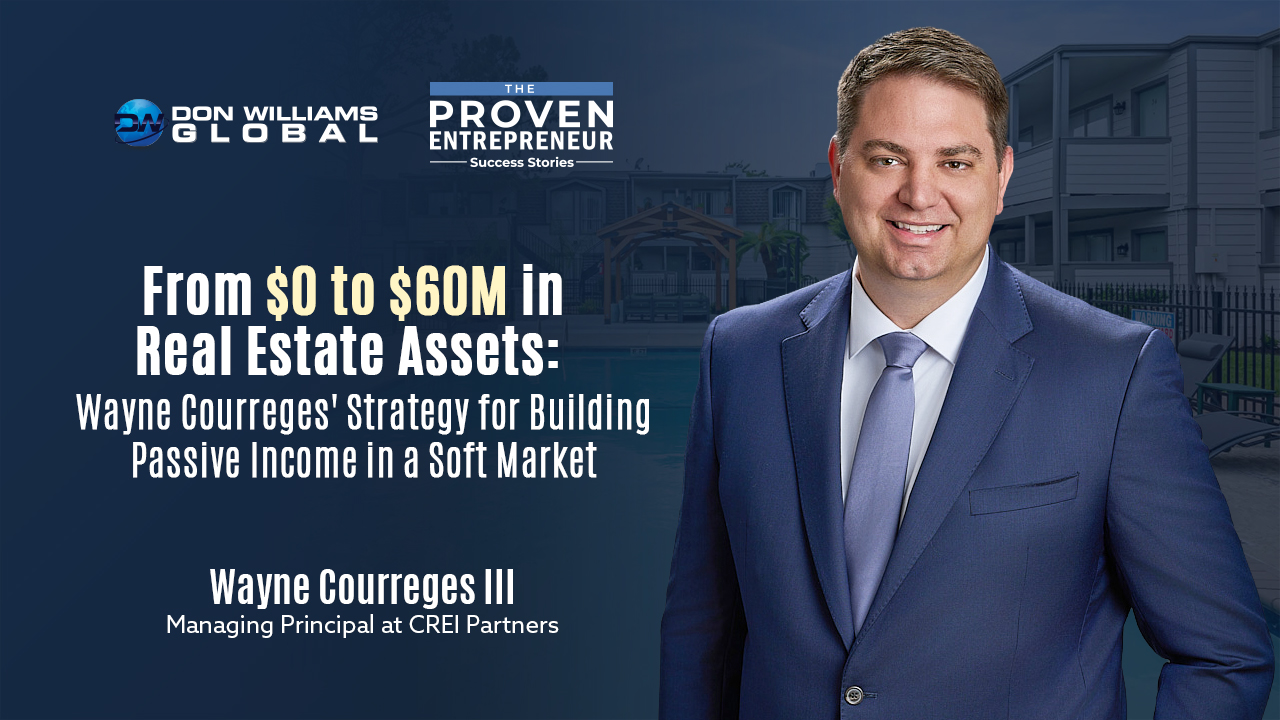
Wayne Courreges spent 16 years as a W2 employee at CBRE, working with institutional investors and some of the biggest names in commercial real estate. By all accounts, it was a good gig. But there was something missing. You’d reposition an asset, add value to it, and just when things were performing, the company would sell it and move on. That constant uncertainty about what he was actually building led him to start CREi Partners in 2019 on the side, and by 2023 he went all in. Now, with $60 million in assets under management, Wayne has learned something most people get wrong about markets like we’re in right now. Everyone looks at the softness in commercial real estate and thinks it’s a bad time to invest. Wayne thinks it’s the best time if you’re actually paying attention. When interest rates went up, property owners who financed at two percent couldn’t refinance their deals. They can’t sell at a profit. They’re stuck. For someone with capital and patience, that creates the exact kind of opportunity that doesn’t come around every year.
Here’s what separates Wayne from the people who have quietly disappeared from real estate over the last couple of years. He talks about having grit, which sounds simple until you realize what it actually means. It means when everyone else is running one direction, you stay calm and go the other way. It means communicating constantly, especially when things aren’t going well. It means treating everyone in the deal—the investors, the lenders, the property managers—like partners instead of people you need to pressure into better performance. He limits his firm to two to four deals a year instead of chasing bigger numbers. That’s not slow growth, it’s sustainable growth. He only hires when his bandwidth forces him to, which means the team expands at the same pace the company is actually capable of handling. This approach sounds boring compared to guys who were buying everything they could during the frothy years, but those guys are the ones struggling now. Wayne’s still buying.
The part that gets overlooked is how much Wayne focuses on education instead of sales. He has a free coaching program for accredited investors because he believes people should understand what they’re getting into before committing capital. Eighty percent of his portfolio is multifamily housing, which is boring on purpose. People need somewhere to live, so the cash flow is stable. The depreciation benefits are real. It’s not sexy like development deals or Bitcoin, but it works. He built his company around something he calls RIDGE values—respect, integrity, dependability, grit, and execution. Every meeting starts by recognizing who showed those values that week. It sounds like something a motivational poster would say, until you realize what happens in a business where people actually live by that stuff when pressure mounts. They don’t panic. They don’t blame. They lean in together. That’s what separates people who survive downturns from people who fade. And in real estate, that separation matters more than anything else.
For information on how to work with Don visit us at https://donwilliamsglobal.com
You can also reach out to Don Williams at https://provenentrepreneurshow.com
Watch the episode here
Blog Topic
Hey, Don Williams here with today’s episode of The Proven Entrepreneur Show. I got a great guest. I think he’s, think he’s wandering around the U S and an RV, but, but like for a while, like for almost a year. And so our guest today is Wayne Courageous, the third, and we’ll talk about that third year thing here in a minute with CRE Partners in Real Estate investment out of.
I Brian, Texas. Yeah, so that’s just down the road. I’m outside of Fort Worth. so, Wayne, welcome to the show.
That’s it.
Thanks for having me, Don. I appreciate the time and excited for the conversation.
Yeah, we’re thrilled to have you. So thank you so much. Now, my name is actually Donald L. Williams II. And then I did that horrible thing and my oldest son named him Donald L. Williams III. But he goes by Trey. If you called him Don, I don’t even know if he would answer. And so I admire that you stuck with it and that’s great. So.
Yeah. Yeah. I
wanted to name my son the fourth, my wife wasn’t having it. So he became Hunter.
Yeah. Yeah. Well, I wondered when he had his son. but I didn’t, I didn’t think he would be since he goes by Trey, which, you know, was kind of a cute nickname off of the third. but my grandson is Luke. And, so, and so that’s fine. But when all of us are together and the whole Williams clan, which like, there’s a bunch of us are together. The joke is always who’s the real Don Williams.
Yeah.
Yeah.
And I assure everybody I am. So Wayne, tell us what you do, what CREI Partners does, who you serve, why you do it. What’s the story for your business?
Yeah, so we help accredited investors diversify and grow their wealth through commercial real estate investments. And I have been in the commercial real estate industry about 19 years and 16 of those I was working with CBRE, a large institutional group. started CRI, started CRI partners in 2019 and did the whole nine to five pays for your five to nine mentality until 2023.
And then in 2023 went all in. right now we have about 60 million assets under management. We’ve got a lot of investors who don’t want to be in the day to day real estate investing. You they enjoy what they have going on in their life. They don’t want the headaches of real estate, but they want the cash flow and the depreciation and the benefits that come with real estate ownership.
Yeah, love that. so CBRE was originally Coldwell Banker Commercial Real Estates where the CB came from. And so that’s where you started and then started on your own in 2019. Kind of interesting because 2020 was an odd year, like for the world. And 21 wasn’t any more normal, probably, but survived that and now 60 million in…
as an entrepreneur it's good for people to know like it's a headspace most of it. Skill set all that stuff you can learn on the headspace not so easy to learn. Share on XYes.
assets under management, that’s a lot. so congratulations. And I am a real estate investor in both residential and commercial property. And here in 2025, commercial appears to be, to me, a little soft. And I think it’s because of that 2021 thing where everybody went home and then some of them didn’t come back. And so…
What was occupied space is now vacant. I’m guessing, is that national? It’s not just here in Dallas Fort Worth.
Yeah. So mean, they’re from an office standpoint, there are definitely, you know, lot of vacancies, but I’ll tell you, you know, it seems so I’m, I focus heavily more on multifamily. 80 % of our portfolio is multifamily and then the other 20, 25 % is development. And in that development, it’s primarily in Bryan College Station. But we primarily own 100, 150 unit multifamily properties and between Houston and San Antonio primarily.
We’ve got to build the rent community, which is pretty awesome. It’s 98 single family homes that think of it like horizontal multifamily instead of vertical. So you still have a property manager, you still rent it out. And then we have some 20 by 50 storage, but yeah, from an office standpoint, know, I, with my career, especially with CBRE, you know, I saw lot of ups and downs with office, but I do get a sense that people are going back to the office. I mean, all of our team members at Sierra Partners.
We work Monday through Thursday in the office and then Friday is work from home. So there’s a little blend, but I think what a lot of people are finding is to get that culture, the training atmosphere, et cetera, there’s got to be some in-office work. we don’t primarily invest in office, though we’re developing in-office retail in Bryan right now.
Yeah. And listeners, if you don’t know, know, um, College Station Bryan, there’s a little university there, uh, the name of Texas A &M. That is an economic juggernaut for that area of Texas. So, okay. I’m going to ask you, nobody tells you this question. What part of commercial real estate or maybe just entrepreneurship in general that looks great on the outside?
Just follow on.
but is harder, messier, more problematic than most people realize.
Yeah. I’ll hit on the entrepreneurial one. And if we want, if we have time, we go to the commercial real estate side. So on the entrepreneur side, you know, I was a W2 for 16 years and CBRE was an incredible company to work for. was working alongside, you know, some great Titans in commercial real estate with MetLife, JP Morgan, TIA, Cref, Liskos on them. And these are institutional quality people, very sophisticated and
you know, have a number one goal for themselves and that is to grow their investors. And a lot of times those investors are, you know, pension funds and et cetera. But what I find is that it’s a different stress. you you as a W-2 employee, no matter how well you are doing your job and sometimes too well, because the property, in my case, work again, CBR, we would reposition the asset and then guess what? It’s time to sell. So then there’s that uncertainty.
And over time, you know, it’s sort of like, got used to it, guess, and, make sure I had some savings in case, you know, CBR, you couldn’t find a spot for me, which they always, you know, fortunately they always had a spot. But when you get onto the other side of the coin, true entrepreneurship, you know, at first it seems like, man, I remember being really stressed about hiring. Well, actually I remember going to the office, going outside, calling my wife. We hadn’t really talked about me.
jumping all in on my time side gig. And I was like, hey, man, if we lose everything, are we good? we gonna, and she’s like, yeah, I mean, we’ve been married a long time. And so was like, okay, well, I’m gonna give my three week notice. I was gonna give them a little longer than two weeks, because I had been with them a long time. So was like, I’m gonna do a three week notice. And that’s what I did. And we went all in and of course we had other investments and cashflow coming in. So it allowed that safety net. But that was a big stress point. And then the next stress point was like, okay, I need a higher,
I need to hire someone. And in that point, it was more of an executive assistant slash investor relations person. And so we hired that person and that was pretty stressful, but you know, got that person. And then we hired the second, which was a portfolio manager. And now we hired a marketing person and now we have an analyst and now we have an institutional partnership person. So it’s just funny how like the stresses and like, man, I don’t think like that seems like a lot, you know, things get a little bigger. I would say at the end day,
For me, the stress is just different. Now it’s balanced and I’m feeding. And, but if I flip it, cause I love mindsets and know, it’s also the fuel that pushes us. Like we’re at 60 million, but this year will be about 150 million on the projects that we’re doing. So it’s like the fuel to take care of the family, within the work. It’s like, I’m not just taking care of my family. I’m taking care of, you know, other families too. It, it, pushes us to work together to get bigger.
ideas and thoughts. yeah. ⁓
Yeah, love that.
So I’ve been an entrepreneur long, long, long time and coach and consult many entrepreneurs. And it’s always kind of humorous to me when they’re like, if we just get to this level, everything will be great. And that doesn’t paint a rate on their parade, you know, because at every level there will be a new devil and something else you have to kind of maneuver that you didn’t maybe have to maneuver at the, at the lower level. So, okay.
Next question.
about a costly lesson. What’s a specific deal, specific decision or season that hurt at the time, but maybe today has turned out to be a really valuable lesson for your career.
Yeah, I love that question.
Yeah, I love it. So yeah, when you talk to real estate investors, they they’ve been in the business long enough. There’s one black guy. And fortunately, I’ve got one black guy. And, you know, we’re still hey, we’re still we haven’t lost anybody’s capital. We’re still working through it. But so twenty twenty two, twenty twenty one, it was a really frothy season in real estate. A lot of people were buying deals when they didn’t, you know, they were buying them for
you know, I guess in hopes that the markets would just continue skyrocketing and everyone would just continue being very successful. I started the company in 2019, but I didn’t buy my first asset until end of 2021. And then in 2022, we turned down most properties, but I found this diamond in the rough. And if I look back, I probably wouldn’t do much different in that timeframe because I was buying an asset in a great location.
under price per door was much less than what others were doing. It was an off market purchase, but we bought that. I used bridge debt in the sense that it should be used. And a lot of people are using bridge debt to get from, to buy an asset because it didn’t hit certain debt service coverage ratios for Fannie Mae and Freddie. So they’re doing bridge debt, but there was no real huge value add to it.
but anyway, so I was used, it was risky. I used it in the sense of like, Hey, this was a property that was owned by a doctor in Los Angeles. and you know, the property, you know, needed a full renovation and you know, that was for me, I felt comfortable with the business plan. So I moved forward with it and, did the, the, business plan within eight months, far as renovating and doing all the things that we need to do to turn the asset around.
Risky.
And then the market side just completely whammed us in every single direction. Insurance doubled. The cap rates with interest rates started increasing. The leasing market, everything just really softened. And there’s not like one day where it all just went away. This is like multiple days turning into years of just nothing but grit and fighting for our investors and working through that process.
Because whether the market's up, down or sideways or flat or the interest rates or politics, doesn't matter. Share on XAnd so, but what that has changed though, ever since that property, I have only bought from a multifamily standpoint, properties that cashflow day one with fixed rate debt. And so our investment thesis changed drastically. Now people make a lot of money and do extremely well in those deep value add projects. What I learned during that is I don’t have the skin to go through that. mean, it has aged me 25 plus years going through that property.
you
Why working with the lenders, doing a modification of the loan, we moved that from a bridge debt to a fixed rate debt, over communicating to investors. I mean, this is a time where a lot of foreclosures, a lot of deals went south. And we’re still working through that process with the lender and just being good owners. So there’s positive in anything, but it is a lot of work. And that lesson learned for me, and this could be different.
When you sign personally on money, that was a painful lesson. That was part of that crash lesson, right? Don't sign personally. I don't care when or how why. Don't do it. Share on XEverybody has a different investment strategy, but for us, there’s a dopamine hit when I do a quarterly distribution to investors. And then of course the K-1, you know, around the tax season. so 80 % of our portfolio is that. Now we do have that 20 % that is more opportunistic development type, which has a higher reward, just like if you were buying a stock or investing in a business that has higher risk, higher reward. But yeah, I would say that’s
For me, the biggest challenge we’ve had, the other ones, they have their day-to-day situations where it’s grit and nothing’s ever easy, Don. You know that, nothing’s easy. So I’ll never paint that, but it’s like nothing’s more challenging when you have a property that you just can’t change what’s going on in the economic scenario. just, the cycle’s a real estate, so.
Yeah. I can remember the first commercial property I bought and I knew nothing. And if you’re listening today and you know nothing and you’re an accredited investor, it makes sense to talk to somebody like Wayne because he knows, it was a long, long time ago that he knew nothing. A long, long time ago. And so I went to the lender and this was an office building, multi-tenant office building. And I was like, I want a loan.
10 year fixed rate loan. And they kind of looked at me and said, well, you can’t get a 10 year fixed rate loan. I was like, why not? And they’re like, well, could we do a seven year call and a three year amortization and redo it? And I’m like, look, I’m from Kansas. I’m a farm boy. I don’t want to do that. I want a 10 year fixed rate loan. And I stuck to my guns and I got that. And I was very bankable at the time. They didn’t want to say no.
So pick something that you can say, I'm gonna commit to this for three to seven years. Share on XBut, but you know, then the funding game, once I closed, then the funding game started and it was a couple of years. like, what the heck am I doing here? but, love real estate, you know, the depreciation and the, and the cashflow and the appreciation, you know, which ebbs and flows at times, but over time it just ebbs. I mean, it just, I mean, it just flows. mean, it just, grows. So,
Okay.
So you talked little bit about, you know, things not going according to plan. And there’s a lot of things in real estate that can, you know, market shift, deal stall, pressure mounts. What do you think separates leaders who rise in that environment from those who quietly, or there’s been some here in Dallas Fort Worth lately that were loudly faded out. I mean, pew! And they were gone. So what?
What separates the, the stairs and the levers.
Yeah, it’s interesting you say that because there are a lot of people that were allowed that are being really quiet right now. And at the end of the day, like…
And I think I’ve got this lot in the Marine Corps and just my life growing up. It’s just constant grit. You know, when people are running, I’m going in like, want to tell everybody this is the worst time to buy real estate is not a good time run away. want everyone to really feel that so that I can buy all the real estate in the world right now. So if you’re listening, like this is a horrible time to buy, unless you’re an investor, a true investor, this is the greatest time to buy because there’s capital is really hard to get. So the market’s not frothy.
There’s not, you know, people, you these owners, they’re having a hard time refinancing because interest rates are up. So, and as you mentioned, Don, like typically there’s five or seven year loan terms, 30 year amortization, but five to seven. So they can’t refinance it. They can’t, you know, sell at a profit. So those are opportunities. And that’s why I said no for so many years. Yes, I’ve got that one black eye. Every real estate investor is going to have at least one black eye. If they don’t go find somebody who
you know, has really gone through the shithole because it’s, it’s tough out there. But what I’ll say is that, you know, people with grit who go through it and then over communicate, during that process and have like partnership minded, like everybody. I mean, it’s not just the investors impacted lenders are impacted service partners. You’ve got to, you’ve got to have, sort of a quarterback in the situation where, you know, you see the bigger picture. You’re trying to lead from the front.
You’re not blaming people, you know, or, you know, and, you know, that’s why I never kick anybody who’s been down down because at the end of the a lot of different people had to look at a deal, everything from an appraiser, the lenders, debt, like a lot of people had to give a blessing before closing. Right. And so, but I also feel that, you know, people are growing too fast. Like for us, we do.
two to four deals a year. We asset manage, we take on the full brunt of owning the asset for our investors. But we do that while we’re also expanding our team. Like when I decided like, okay, now it’s time to hire that next person, it’s because my bandwidth was low and now it’s going to the next one, know, furthermore. So we’ve grown in this market because we’ve been finding opportunities and we’re not going to be a company that’s going to outgrow what
our internal capabilities are. So hopefully that makes a little sense. It’s a lot of grit, a lot of love for the game. I mean, this is a blessing to be in commercial real estate. And I hope that whoever’s listening, whatever industry you’re in, it’s a blessing to be in your industry. Like I only know commercial real estate. Out of the Marine Corps, I’ve been in commercial real estate all my life. And I’ve got a mindset coached on who’s like, when you have all the money in the world, what are you gonna do? And I said, I’m gonna still do real estate because that is…
That’s who I am. I’m always thinking that. So if you don’t have that joy for real estate, don’t do real estate, but passively invest, whether it’s with CRI partners or others, learn about it. We have a passive investor coaching program. It’s a free program. There’s no sales pitch or anything, but passive investor coaching.com. And it’s just all the information that accelerates learning about this type of investment class. So that when you are talking to sponsors and
You know who are doing some are what we’re doing, you know, know what to ask know what to look for so I’m just passionate about education first and then also for being a commercial real estate and Being able to survive when other people are you know bowing out it’s too tough. So they’re gonna find ATMs or Bitcoin or Car washes like yeah, y’all go to car washes now you see car washes at every other corner and it’s because Most people have heard mentality
While us, we’ve doubled down on multifamily housing. Everybody needs a place to live, great depreciation, great cash flow. And so that’s what we’re gonna continue doing.
I love that. Okay. I’m to talk to you about legacy years from now. When people talk about Wayne courageous, the third, what do they, what do you hope they say you stood for beyond the deals and beyond the numbers?
Yeah. I just want to be known as a good person. mean, I’m an Eagle Scout, former Marine. You know, we’re about to do a national jamboree with Scouts that I’m a Scoutmaster for. You know, we, I, this time of the year, you know, we’re talking in January. I know this show may be aired, you know, in a few months, but, you know, we’ve already had conversations one-on-one with our investors. I love hearing, you know, their experience with us. What can we improve on?
Money now, money over time and money long-term, right? Any business. Share on XSo I just want to be known as a good person that did right. And, you know, really try to do everything I can to execute on what I say I’m going to do. we, we have ridge, what we call ridge values at our company. It’s respect, integrity, dependability, grit and execution. and we, every meeting we start with going across the room, like who’s, who’s showed ridge values. And then we have rich days at one floating day per month is called a rich day. But I really try to drill that in my team.
I mean, if you’re living by respect, integrity, dependability, grit and execution, you couldn’t do anything wrong in business. Like you are, you you’re going to be doing just fine. So yeah, I just want to be a good person.
Sounds like a great culture and you know, we know culture beats strategy all day long. It just does. So if somebody wanted to reach out to you or to CREI, what’s the easiest way to do that?
Easiest way to go to CREIpartners.com, click on the let’s talk and schedule a time with our investor relations team. But you know, I would even step back from that and go to passiveinvestorcoaching.com. If you’re interested at all in passive investing, whether it’s CREIpartners or anything, you’re like, you’re a credit investor. And I really focus on credit investors because this is not a liquid investment. You are investing in alternative investments. And so for me, it’s like there’s a chapter in life when
this makes sense. And if you feel like, this time makes sense, at least to learn more about it, or maybe you don’t even know what a credit investor is. Well, that’s more reason to take passiveinvestorcoaching.com. No sales pitch. I just give a lot of content. So that’s a way, but creipartners.com would be a great starting point as well.
Great. Wayne, thank you so much for coming on the show today.
Thanks for having me on Don, I appreciate you.
You bet. That’s today’s episode of the Proven Entrepreneur Show. We’ll see you next time. Thanks.