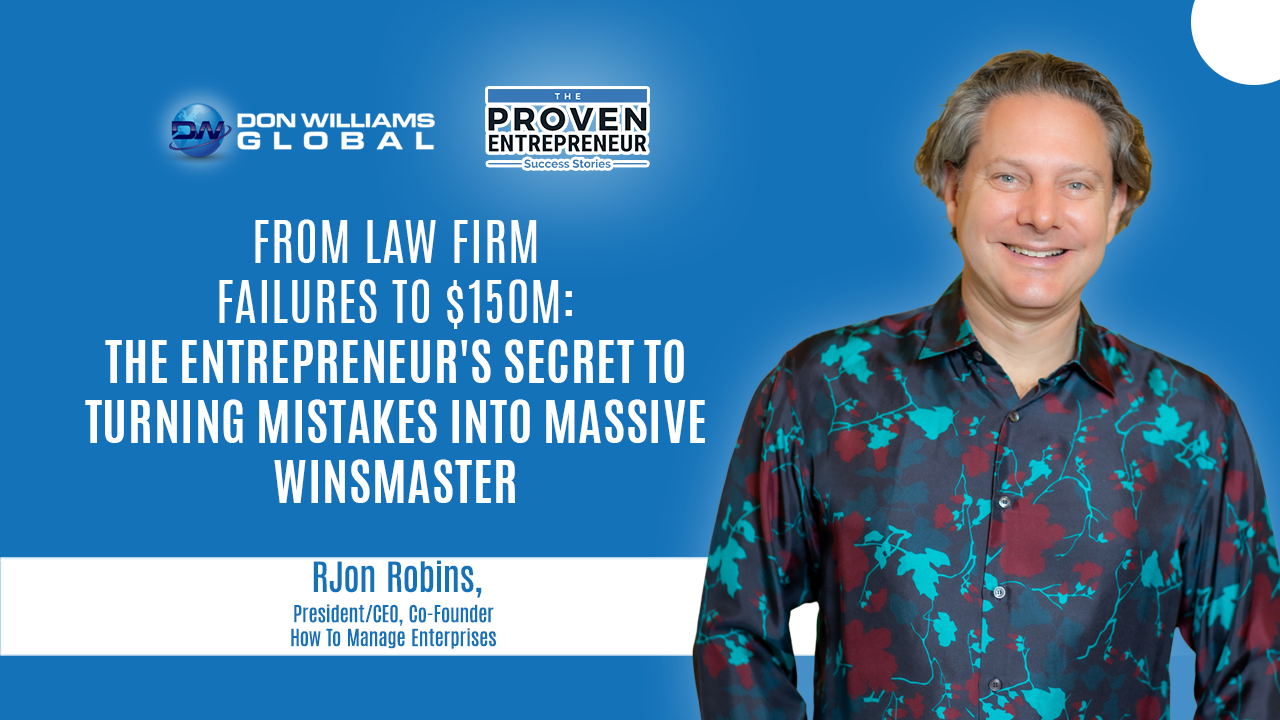
You think you have a law firm, but you actually have a business. You think you have a restaurant, but you actually have a food business. This simple distinction separates entrepreneurs who scale to millions from those stuck in survival mode. RJon Robins, who built a $36 million organization, discovered that 54 percent of business failures start from management problems, not execution problems. The core issue: entrepreneurs confuse the job of the technician with the actual business. A lawyer gets lost in practicing law while the business of selling, marketing, and getting paid slowly deteriorates. This structural blindness happens when you’re too in love with what you do to see what your business actually needs.
The real secret nobody tells you: in entrepreneurship, you don’t win more by issue count—you win by making your big wins far outweigh all the small losses. RJon’s $3 million hiring failure became the catalyst for a complete business pivot that will grow his company from $35 million to $150 million in three years. Why? Because the failure was catastrophic enough to force radical thinking. If those executives had only sucked halfway, he would’ve tried incremental fixes and stayed stuck. Total collapse forced total transformation. This is what separates entrepreneurs: they treat everything as a test, ship fast, learn faster, and keep pushing forward.
The strategy that works: build an audience, give massive value, build trust, then ask what they need. Most entrepreneurs do the opposite—obsess over their product and hope customers show up. Instead, audience comes first, product second. Once you have loyal followers who trust you, they’ll tell you what to build next. Structure your entire business around solving real problems for real people, not pushing your idea. That’s how you scale.
For information on how to work with Don visit us at https://donwilliamsglobal.com
You can also reach out to Don Williams at https://provenentrepreneurshow.com
Watch the episode here
Why Most Entrepreneurs Fail at Scaling: The Business vs. Practice Trap
Hey, Don Williams here with today’s episode of The Proven Entrepreneur Show. I have a real treat for you today. I have somebody who is rare in the human community. Our guest today is a very successful entrepreneur and a licensed attorney.
happened to have
gone to law school because I didn’t know what to do after college.
Well, that is a pretty rare combination other than people you’ve taught. RJ Robbins, welcome to the Proven Entrepreneur Show.
Thank you for having me, I appreciate it. My pleasure to be here.
Yeah, my pleasure. Now, those
of you who know me know I’m all about customer experience and the way to get customer experience perfect every time is to think about things from the other person’s point of view, not from our own point of view. And I just want to share. So our John and his team, okay. And you guys know me, I’m like the king of wow. They have outwowed me. They sent me a book. Okay. That our John wrote.
And then a little bit ago, the office called and said, Hey, we got cookies. And I’m like, who sent cookies? And they’re like, R. John, some guy named R. John. I’m like, I’m going to talk to R. John in a minute. So anyhow, R. John’s out wowing me. Which I’ve never seen happen before. And I’m, and I’m truly, truly impressed. So, thrilled to have you on the show and ask you five or six questions about your life. And, as you know, this show is designed to help non-entrepreneurs take that first step into entrepreneurship.
or entrepreneurs to take the next step. So you built…
I
think we’re all entrepreneurs. think we’re born, I think all human beings are inherently entrepreneurs. Some people just don’t find themselves in a situation for it to become expressed. It’s latent in everyone. Everyone’s an entrepreneur.
We're all entrepreneurs. I think all human beings are inherently entrepreneurs. Some people just don't find themselves in a situation for it to become expressed. It's latent in everyone. Share on XCould be.
Could be. I certainly think that when you put your problem solver hat on, kind of regardless of what problem you’re trying to solve, you are flexing your entrepreneurial muscles because entrepreneurs at their very core are solving problems. And if I solve problems for customers, I can have a successful business. If I solve problems for staff, I can have a successful team.
If I solve problems for vendors, I can build a great network of support. And so it’s all about solving problems. Entrepreneurs do it in a business fashion. But I also think I had a guest one time tell me, my parents came from India with $20. And that was the greatest example of entrepreneurship they ever saw. And I was like, well, certainly the greatest. It’s very, very courageous. Leave everything that you know.
get on a boat, have 20 bucks, go to Canada. Pretty tough. And, entrepreneurs certainly do some of that. So let me ask you a question. You’ve built a very successful business helping attorneys be better business people. Okay. What’s the one of your businesses? Yes. What’s the number one issue
one of our
with attorneys that prevents them from being great business people.
Well, the biggest problem that lawyers in particular have is they don’t really understand that it’s a business. I used to be a small law firm management advisor with the Florida Bar’s Law Office Management Assistance Service. So for four years, I lived in the belly of the beast. And it’s a document. In fact, we’ve worked with over 9000 solo and small law firms up to about $10 million in revenue.
during those four years and by we it was me and two other people so mostly you know, was a third of that And when I wasn’t in the office fielding calls from from lawyers on every aspect of starting marketing managing buying selling growing you name it law firm I was out in the field fixing broken law firms because 54 % of the bar grievances that are filed start off as a avoidable business management problem business management problems lead to all kinds of
other problems downstream in law firms and other businesses as well. Certainly all regulated businesses. And when I wasn’t doing that, I was in front of audiences. 50 to 500 or more entrepreneurs whose business happened to be a law firm, right? That’s the way you got to think of it. I’m a lawyer. My business is my business. The business happens to be a law firm.
over over over and over over again, it became a joke. I don’t have a business. I have a law firm. Well, no, you have a business that is a law firm. I don’t have a business. I’m a doctor. No, you have a business. And I would ask this question. I’ve now posed this question to tens of thousands of lawyers since 19…
99 I’ve been posing this question in front of audiences large and small and the question is what is the business of a law firm and There was a time when I used to keep count and I like I lost count when I got like 30 or 40 correct answers in all these years, right and and lawyers confuse the job of the lawyer with the business of the law firm doctors confuse the job of the doctor with the business of the medical business the medical
practice. Restauranteurs confuse the job of the chef with the business of the restaurant. Hoteliers, innkeepers confuse the job of the hospitality person with the business of the hotel. People the world over confuse the job of the technician who produces the product or the service or the experience
with the business that’s there to market, sell, produce, deliver, get paid for that product or service. So the answer for lawyers is the business of a law firm is to sell, produce, and deliver legal services and get paid for legal services. That is the business of a law firm. The business of a hotel is to rent rooms. The Ritz Carlton and the Motel 6,
are in the same business. They’re in the business of renting rooms. They pursue different strategies to do that. McDonald’s and your favorite restaurant, assuming McDonald’s isn’t your favorite restaurant, hope, ⁓ they’re in the same business, right? It’s just, you know, let’s say your favorite restaurant is like a nice steakhouse, right? And they’ve got, you know, linen tablecloths and fine china and, you know, silverware and a uniformed.
Ha ha ha.
server who comes to your table, McDonald’s bolts plastic tables to the floor and gives you your food in a bag, right? But they’re both fundamentally in the same business, which is marketing, selling, producing and delivering a food product to a hungry customer. So the number one mistake that lawyers make, which is the number one mistake
entrepreneurs everywhere I go make is they confuse the job of the technician with the business of the business, right? And I’m speaking especially to your audience who is thinking about starting a business, right?
Don’t be so in love with your product or your service or your skill that you lose sight of what the business is really all about.
Don't be so in love with your product or your service or your skill that you lose sight of what the business is really all about. Share on Xlove that. And I can see where in my own practice, you know, I’ve helped numerous law firms and it’s not uncommon for them to kind of miss the business versus the practice of law.
kinds
of entrepreneurs do this. They get into the business because they know how to do something, right? And pretty soon they’ve cobbled it together into something of a practice. It hasn’t really matured into a business yet, but they’re earning enough income from it that they can’t afford to do anything else. And then they get stuck because they never really stop to think of it like a business. A really wonderful book is
Yes.
is Michael Gerber’s The E-Myth Revisited. Anyone who is thinking about starting a business or you’re in the early stages, you owe it to yourself to listen to that book.
Yep, very good, very good. So tell me this, what’s the most painful mistake you’ve made as an entrepreneur that you wouldn’t want to repeat, but you’re glad it happened because of what you learned?
the most painful mistake I’ve made as an entrepreneur in the…
10 years since we launched the business we have today and it’s grown to 36 something million dollars in gross revenue? Or do you want me to tell you the most painful mistake that I made as an entrepreneur in the last year? Or do you want me to share with you the most painful mistake that I’ve made as an entrepreneur in the last quarter? Or the most painful mistake I made as an entrepreneur in the last month? Or the most painful mistake I made as an entrepreneur in the last week?
or the most painful mistake I as an entrepreneur yesterday or the most painful? I mean, it’s already 11, it’s almost noon. I’ve already made some mistakes. mean, you gotta give me a time horizon here to tell you the most painful mistake, because I’m constantly making mistakes.
I’ll clarify.
Yeah, I’ll clarify, but I do want to make a point to the audience. Notice our John has made a couple of mistakes and all successful entrepreneurs make a ton of mistakes. We just win more than we lose. It doesn’t mean that we don’t lose. So let’s just go for the 10 year. Yeah.
Can I just say something, Don?
I don’t win more than I lose.
okay. So I think maybe on issue count, that could be correct, but on financial, yeah, yeah, yeah. And so.
dollars. Correct.
I’ll lose, I’ll lose, I’ll lose, I’ll lose, I’ll lose. And then this idea that I was like, basically didn’t even take it seriously. I thought it wasn’t even gonna work. But I figured, what the hell, we’ll give it a test. Bam! Another $10 million business. Out of nowhere. Who saw it coming? Right? The other idea that I was in love with, it was the best idea ever.
Yeah, I-
love that.
It doesn’t work. You don’t know. Anyone who tells you that they know is just lying. They don’t know. Everything’s a test.
Yeah, yeah. Had more than a couple of those.
Yeah, I totally agree. So I was on a
call with a client this morning who they struggled horribly, you know, no paychecks, hard conversations at home. How are we going to pay the payroll? How are we going to pay our vendors for seven years? But in the next two, you know, they had a $20 million exit. And, um, and so there’s a lot of that in entrepreneurship where if you look at the
a number of issues or the time, maybe you were on the downside, the majority and sometimes the far majority of the time, but the upsides can be so good that it all works out.
I did a
once done where, um, my, my then head of marketing and I, she and I got on stage in front of, I don’t know, 500 of our, of our, of our clients. And we did a whole presentation of really creative, amazing. If I do say so myself, if I dare to say so myself, brilliant.
marketing campaigns. mean, these were some seriously creative, brilliant, amazing marketing campaigns. And we did about a 45 minute presentation, kind of like laying out the strategy behind it, showing the tactics, showing the implementation, showed the creative and all that. And the audience was impressed. These were some really high level, amazing ideas, very well executed by the way.
And then we gave the punchline. What they all have in common is they all failed. It just didn’t work, you know? And then there’s that thing that we just threw together, like on the fly, almost as an afterthought. And for some reason, it worked. Who knew, right? Which isn’t to say you shouldn’t plan, is not to say you shouldn’t strategize. It isn’t to say, because I got lots of things where I didn’t plan it.
Yeah. Yeah, it’s-
And that’s why it failed. I don’t want to give the audience permission to just do everything half-assed. I’m just trying to make the point that, you know, everything is a test. Everything is a test. Everything is a test. Everything is a test. And if you treat everything as a test, then you never fail. Right? I’ve never failed. I just keep learning things.
Everything is a test. Everything is a test. Everything is a test. If you treat everything as a test, then you never fail. I've never failed. I just keep learning things. Share on XI love that.
I think you win or you learn and learning is just a little slower winning. And so that’s just, and that’s just how it goes. And I totally agree that if you’re lost in the paralysis of analysis, oh my gosh, pull the trigger, make it go. Okay. Even a junkie first draft is better than no first draft. And so put it out there, see what happens. You might be surprised. Okay. Biggest problem.
You win or you learn and learning is just a little slower winning. Even a junkie first draft is better than no first draft. Share on XMy very first product
done, my very first info product that ever produced and sold. All right.
It had a typo on the front cover. and I know for sure, and this was a really interesting experience for me as a new entrepreneur, I know for a fact that the typo did not prevent anyone from buying it, and I know that the typo did not cause anyone to return it.
And I know it didn’t prevent anyone from buying it because obviously they didn’t know about the typo until after they bought it. Yeah. And the way that the thing was packaged in shrink wrap, there was like a cover letter. And it wasn’t until you broke the shrink wrap, removed the cover letter that you could see that there was a typo on the front cover. You get what I’m saying? And the only two that I got returned, guess what? They were still in the shrink wrap.
Yo!
which means they didn’t return it because of the typo. And that was one of those happy accidents that taught me such a valuable lesson of just ship it. Seth Godin has a wonderful book you can download for free. He used to sell it, now he gives them for free called Ship It That Will Change Your Life. I highly recommend that to everyone. You can download it for free on his website as a PDF, Ship It.
All right.
Yeah.
Love that. You know, one of the things Don Williams Global does, we help people write books and we’re not really a true publisher, but we’re more of like a book coach. And we just released a book, I don’t know, last four or five months, 1985 National Championship quarterback, Jamel Holloway, his story. And you know, today you do an audio book and you do a Kindle book and you do a paperback and you do hardcover.
And I’m not directly in the editing line before that book gets published, but on the hardcover, we misspelled the star’s last name and published the book. People bought the book. Somebody who bought the book said, by the way, this is misspelled. And so we corrected it, but we didn’t have one returned.
Oops.
because we went out to everybody that had bought that book and said, Hey, we made like a horrible mistake and we misspelled his name and you can send it back. We’ll send you a new copy or you can keep it. may be a collector’s edition and we didn’t have one return. Yeah, we didn’t have one return. And so, ⁓ I,
feel like this amp is upside down.
Yeah, and
I hope no one in the audience is taking this as license to just be sloppy. I think that the point that we’re trying to make is you don’t have to be so worried about stuff. People don’t, just get it done. Make it better later.
Nah.
Get it done. So, biggest problem, 10 years, okay, building this great business that hurt, but in retrospect, maybe was a very positive thing.
I would have to say it’s gonna have to be around hiring. I would have to say it had to do with hiring. I was talking with my wife yesterday about a team of really smart people who have very impressive credentials who we hired and then fired.
And the whole process, the whole experience was less than 18 months. And during those 18 months, it cost us about $3 million. We lost $3 million. And I mean, that’s no fun to lose. There’s no way to say it’s fun to lose $3 million. It sucks. And
What my wife and I were discussing yesterday is that
Thankfully, these people didn’t suck half as bad as they sucked. They sucked all the way as bad as they sucked. Because had they sucked only half as bad, there’s a very real possibility we might have tolerated it and put up with it and tried to work around it. But because they sucked
Hmm.
as fully bad as they sucked. It forced us to make a major pivot in our entire business model, which is now
going to 5x our business from around $35 million to about $150 million in the next three months, I’m sorry, three years, 36 months. And had they not sucked so bad, I don’t know that I would have been so aggravated and frustrated and pissed off and ready to just burn the ships.
and start over. So that was a mistake. mean, so I know I keep citing books. There’s a really great book called Thinking in Bets by Annie Dukes. you can’t judge a decision. You can’t judge a decision, a mistake or not a mistake after the fact. You have to judge the decision based on what you knew at the time, right?
So you do as much research as you can reasonably do. You do all the analysis that you can reasonably do. hire, please, if you’re watching this podcast, if you’re listening to this podcast, do not be a freaking idiot. Hire professionals. Hire professionals, hire professionals, hire professionals who can compress decades into years and years into months and months into
minutes because the number one problem you’ve got in business is you don’t have enough time. Right. It’s not that you don’t have enough time in the day. It’s that you don’t have enough days on the calendar to get everything done that you need to get done. And you don’t have time to figure it out yourself. So hire professionals who can shortcut shortcut shortcut shortcut the process. Anyway back to my point. My point gone is.
based on what we knew at the time when we hired these people, right? Because we weren’t careless, we weren’t reckless, we weren’t lackadaisical, we weren’t sloppy. Based on what we knew at the time, it was the right decision to hire these people, it was the right decision to put them in the positions that we put them in, it was the right decision based on what we knew to do what we did.
it’s only after the fact that we can look back and say, if only I had known then what I know now, I would have done things differently. But, you know, that’s not how life is. So I’m not gonna say it was a mistake. I’m gonna say one of the most painful learning experiences that I had was hiring these people who, I know this is gonna sound
Good slot.
maybe strange for me to hear me say it, but these people who I, for the most part, genuinely like, genuinely respect, genuinely appreciate, and when I say they sucked, I mean, they sucked at their job, they didn’t suck as people, right? And, you know, they suck. Whose responsibility was it? It was mine. It was my responsibility to decide on the strategy. It was my decision to decide to hire them. It was my decision on the positions we put them in.
Yeah.
So ultimately I suck too. So this isn’t like throwing them to the wolves, right? We as a team made some really, really, really smart, well-reasoned, thoughtful.
strategic decisions that we did an extremely good job of executing on. And thankfully we executed on these decisions really, really, really fast. So we were able to discover in only six months that there were the wrong strategic decisions and there were the wrong people to be in charge of these strategic decisions. So, you know, sometimes failing fast is a blessing.
much better than a long, slow, agonizing suffering.
You know.
Well, I don’t think there’s any doubt about that. And failing, many people view as the opposite of success. It’s actually part of the path. You have to have failings. Doesn’t mean you’re a failure, but you have to have failings to be successful. And I can tell you after a couple hundred interviews of very successful proven entrepreneurs, many times the bigger the failing, the larger the future win.
Little failings, little wins. Big failings, big wins.
yeah, I mean know exactly why that is.
Listen, there’s a reason for that. That’s because when the failure is complete, yeah, it forces you to do things in a radically new and different way. It’s when the failure is not such a big failure that you try to hold on to it. You try to salvage it. You try to avoid it. It’s like at some point when it’s just a complete utter total tear down failure, it’s a blessing.
When the failure is complete, it forces you to do things in a radically new and different way. When the failure is not such a big failure, you try to hold on to it and salvage it. But when it's a complete utter total tear down failure, it's a blessing. Share on XBecause you don’t have to mess around trying to save it anymore. It’s done. Start over. Change directions. Do something new. Learn. Move on.
Yeah, love that. Okay, tough question. It all went away today. Big failing, big problem. It all goes away today. You’re starting over tomorrow.
What strategy do you take?
That one’s easy. First of all, I would have it all back in 24 months. In fact, I would not only have it all back in 24 months, it would be better, it would be faster, it would be easier. You are basically, what you’re describing as a tough question is my secret fantasy that I think of sometimes in the middle of the night of burning the whole thing down and starting over without all the legacy, right?
I got a $36 million organization with 120 or 130 employees and managing something like 600 law firms. provide CEO services and COO services and CFO services and CMO services and sales training services and staff coaching services and bookkeeping for like hundreds of law firms. We got the largest bookkeeping business for law firms, for small law firms in the country. And I did that on the side, right?
Wow.
That’s not even my, I mean, it’s one of the businesses. If I had to start completely over from scratch today, my God, I would have so much free time to just focus on the marketing, the messaging, and creating brand new services that I don’t have time to get to right now, because I’m busy doing all these other things. So the strategy, the strategy would be build an audience.
That would be the strategy. Build an audience, give value to the audience, give more value to the audience, build trust with the audience, and then ask the audience, what do you want or need? They would tell me what they want or need after I’ve built it and given them enough value, and then I would create the product or the service to satisfy their need, and I’d have the whole thing back in 24 months.
The strategy would be build an audience, give value to the audience, give more value to the audience, build trust with the audience, and then ask the audience what do you want or need? Share on XYeah, love that. And listeners, please key on that. Everything Arjan talked about was seeing things from the other person’s point of view. How can I give them the most value? How can I deliver more value? How can I increase that value? And then what can I do? What else can I do to help you? So Arjan, if somebody in the audience wanted to reach out to you or the company, what’s the easiest way to do that?
So first off, we’ve had a waiting list for the better part of three years. So how to manage small law firm has a waiting list. Our bookkeeping business has a waiting list. Our sales training has a waiting list. Our workshops are now only for current members, current clients. We don’t take people from the outside anymore because there’s too much of a waiting list. So what we did was we created a waiting room.
that we let people participate in for free while they are on the waiting list. So you contact my team. First of all, before you even contact my team, get a bunch of free resources. Listen to some of our podcasts. Go to our website at howtomanage.com and download free resources. Sign up for a free workshop.
sign up for a free webinar, go to Amazon, buy one of my books, listen to my podcasts. Let us give you all kinds of free resources to make sure that this is really what you want, right? Because spoiler alert, I’m not everyone’s cup of tea, you know? And yeah, so take advantage of all the free stuff, right? And then,
Me either.
In the process of taking advantage of all the free stuff, you’ll find a link to schedule an appointment with someone from my team. But the appointment is not to schedule a sales call. The appointment is to schedule a meeting with a reference librarian type of person who’s going to say, okay, what are your problems? What are your challenges? What’s going on in your business? So we can share the right free resources with you, right? And then they’ll probably follow up with you and say, hey,
Did you get it? Is it working? Is it the right thing? Is it helping you make more money? Depending on what your problem is, right? Maybe you got a marketing problem. Maybe you got a sales conversion problem. Maybe you’ve got an intake problem. Maybe you got a staffing problem. Maybe you got a financial controls problem. I don’t know what your problem is with your business, but depending on what your problem is, they’ll get you the right resources. And then they’ll follow up to make sure you got them and that it’s working. And we’ll just keep giving you more stuff. And then at some point,
We don’t really even have to say very much. You will probably say, I want more. And we will say, we have a waiting list. And you’ll say, what do I do while I’m on the waiting list? And we’ll say, you can participate in the waiting room. And you’ll say, how much does that cost? And we’ll say, that’s also free. And then you’ll say, well, why wouldn’t I say yes to that? And I’ll say, I don’t know. Maybe you’re a stupid idiot who likes to suffer. Maybe that’s why you won’t do it. But unless you’re like a serious, hardcore, help-rejecting complainer,
Of course, you’re going to take advantage of the waiting room. It’s free. And then you’re going to come to our live events for free. You’re going to participate in live workshops for free. You’re going to participate in live Q &A for free. mean, it’s just tons of stuff for free. And then when your number finally comes up on the waiting list, you either say, yes, I want in, and the deposit is applied to your first month of retainer. Or you say, no, I don’t want it, and we give you the deposit back.
And believe me, there’s people behind you who will be very happy that you made that decision, because they’ll grab your spot. So the long story, I’m sorry, the short answer to your question, Don, and I appreciate you giving me this opportunity, is go to howtomanage.com. And from there, you’ll find a portal into our universe.
Love that.
Love that, love that. And hey listeners, you’ve just heard from the Delilahmah of marketing that when you want to reach out, you can join our waiting list. You can’t buy anything. And that’s marketing done at a Yoda mastery level. And so thank you for sharing that.
Well, it also pisses me off. mean, it’s no fun. I could literally probably make a few million dollars extra right now if I was willing to lower our standards to fulfill the waiting list right away. But then of course, long-term, we would dilute the brand.
Yep. So love that.
Well, thank
you for the recognition and the compliment. I appreciate that.
Yeah, well, truly amazing. mean, I’ve been doing this a long time. know thousands of entrepreneurs around the world. We’re about 200 episodes in 500,000 downloads. And ⁓ thank you very much. Thank you very much. But let me tell you, what our John shared with you today is rare air. so listen to this over again and see what you missed.
Congratulations for that. That’s fantastic.
All right, John, thank you so much for coming on the show today. It’s been my pleasure to have you.
I really appreciate you having me. Thank you. And I enjoyed the talk.
Thank you.
That’s today’s episode of the Proven Entrepreneur Show. We’ll see you next time. Thanks. Bye.