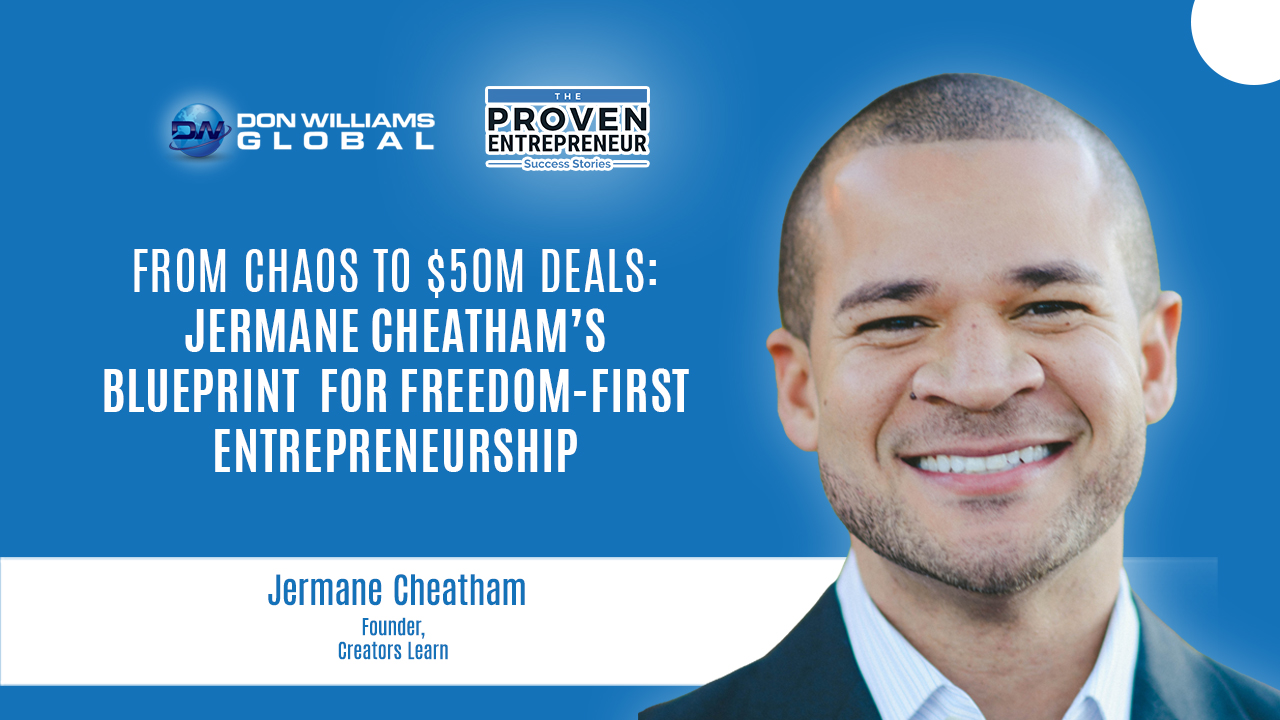
The Jermane Cheatham interview on the Don Williams Proven Entrepreneur Show offers a clear look at how entrepreneurs can build a simple business without losing control of their time. Jermane explains how business freedom strategies help founders make better choices and stay focused on steady progress. His approach gives simple business tips for founders who want clarity and stability.
A key theme is the creator vs victim mindset insights he learned early in life. He talks about how to shift from survival to creator mindset in a way that helps entrepreneurs stay grounded. He also shares why sales without scripts builds more trust and reduces friction.
The episode highlights how to build a freedom-based business through smart choices and strong partnerships. Jermane explains how to leverage referral partners for rapid growth, which helps founders scale without constant pressure.
The conversation offers mindset tips for entrepreneurs who want balance and guidance on how to stop overworking and still grow. It is a reminder that founders can build simple businesses that support both progress and freedom.
For information on how to work with Don visit us at https://donwilliamsglobal.com
You can also reach out to Don Williams at https://provenentrepreneurshow.com
Watch the episode here
Jermaine Cheatham Interview: How Founders Build Simple Businesses and Real Freedom
Hey, Don Williams here with today’s episode of The Proven Entrepreneur Show. I got a great guest today. got Jermaine Cheatham. Jermaine, welcome to the show.
Great to be here, Don. Looking forward to it,
So looking forward to this. been looking forward to it ever since you booked, you know, the guest book, you know, in advance. And so, I knew this was coming up. tell, tell us to begin with what’s your business, who do you serve? What do you do? Why do you do it?
It’s always a loaded question because we’re multifaceted. But I guess in a nutshell, really, my inspiration is entrepreneurs. And I really want them to succeed and build simple businesses. So I really helped them build financial freedom, number one, lifestyle freedom, number two. But more importantly, I want them to have fulfillment in what they do. And so that’s what I focus on. And there’s really a few areas how we do that. We can dive into that later. But that’s who I serve. And that’s what I do it for.
My inspiration is entrepreneurs. And I really want them to succeed and build simple businesses. Share on XAwesome, how long have you done that?
Well, I’ve been an entrepreneur since I was 10. So I have a passion for this. So actually, serving them in different capacities throughout the years, really. But purely from a consulting basis where I’m actually helping them with their businesses from the lens of simplifying it for about six years now. But in essence, I’ve been doing it my entire life.
love that. I love that. And so, you you use the word simple and, you know, something I share with my clients regularly is this. So like this part I’m going to share with you, this is simple genius. And like almost all genius is simple. If you can’t explain it, okay. You don’t know it. and businesses that are really complicated and have a lot of moving parts, they’re hard to scale. They’re hard to make.
make anything happen unless you’re AT &T or Verizon or somebody who was an entrepreneurial business 150 years ago. And now they’re a Fortune 10 company. So I know that you speak regularly about choosing to being a creator instead of a victim. What was the moment you decided that was going to be your narrative?
be around six years old because I grew up in a lot of adversity and I really had two choices. either succumb to your circumstances and situation and environment or you blow past it. And it’s a definitive choice. I think Einstein said it. He said the most important first decision anybody ever makes is, is the world friendly or is it hostile? And I had to face that question.
You either succumb to your circumstances and situation and environment or you blow past it. And it is a definitive choice. Share on XMm-hmm.
you know, as a six, seven year old, and you don’t really know until you go out into the world to talk to people and figure out like what’s real, what’s true. You can’t, you can’t trust hearsay. You can’t trust the news. can’t trust secondhand accounts. Life is only experienced first person. And, I wanted to explore that idea, that question. And so I realized the world is friendly as long as you’re a creator of your reality. And the only way you do that is
Go into the world and see what’s going on. Try to help, try to serve, try to be the best you can be, and then put your head on the pillow at night, go to bed, and turn the page and start excited the next day for the next mission.
Life is only experienced first person. Share on XI love that. And so I do think that’s a choice. You can see the glass half full or half empty. I think that was a pretty heavy choice for a six or seven year old to have to make. so kudos to you for being years ahead of your chronological age to kind of figure that out because I would think most six, seven year olds probably don’t.
don’t see it that way. You know, they, you know, we, all only know what we know and there’s so much more out there that we don’t know. And the only way to find out you got to get out there and see it, do it, try it. Life is an experiment man. And so, you know, go experiment. So I think over the last couple of years, you’ve done like 50 million in deals. And
Your background is you had some, an unstable childhood. I guess that’s how I’ll put that. What mindset did you use to turn chaos into leverage and clarity into business?
think really the mindset is you have to figure out what vision do you have for yourself? Like who do you want to become? What do you want to experience in your time here? We all die. And I had that realization at a young age. And so I’m like, okay, this ends. What am I going to do with it? Am I going to sit around and play video games or am I going to go explore? It’s like Helen Keller has this great quote. says, life is either
an adventure or it’s nothing. And it’s true. And so the mindset was, okay, what is the best way to see what’s true about the world and people and am I good enough? And what are these people all about? And so my first step into that entire environment was sales, because you’re going to learn really quick. If you’re any good, you’re going to get your teeth kicked in with nose.
Yeah.
cold calls, door-to-door sales, you name it. And so that fortifies your mindset that no is not no, it’s just data. It’s not about you. It’s not about your ideas. It’s just data. Use it, refine, and try again tomorrow. And you kind of learn this resilience where it doesn’t matter. It’s just someone’s opinion about an idea, okay?
So, know, sales is like one of the key skills and I don’t believe sales is pitching or scripts. Sales is talking to people and listening to people. That’s it. A conversation like we’re having here, Don, that’s all sales is. You know, all these gurus want to make it into something bigger than it is. It’s not. But it’s like the number one skill you can ever learn is how to talk and listen to people. And that was really my first avenue to build this mindset of
Anything’s possible through other people.
Sales is talking to people and listening to people. That is it. Share on XYeah, I love that. And you and I are brothers from other mothers. I grew up, I started out on the sales side and today I help people sell more of whatever they sell. And I tell people all the time, I don’t know how to make people do things, you know, short of having a gun and, know, short of force. But I know how to make it easy for people to do things.
And people want to do things that are good for them. And so if you, if you can position your product, service or experience to where, you know, the value of owning it is worth more than their dollars, they’ll throw their money at you. You know, if my money is dirt compared to what you’re going to provide me, give me what you have, take my money and let me go on down the road.
you know, because everybody’s trying to do the best they can for themselves. And so when you talk to people from that standpoint, it certainly gets a lot easier. And I think that same amount degree of influence is foundational in leadership, which, which, you know, is maybe a different kind of selling, but, you know, it’s all influence. It’s how can I get people to see things the way I see them? So.
I love that. When you transition from employee mode, okay, to founding creators learn, what definition of success did you set for yourself?
question the I’m kind of a weirdo because I don’t really believe in goals
Hmm.
because
two things happen. Number one, you reach the goal and it’s anthoclimatic because you realize it’s fun for a day, but now I got to set another goal. So it becomes a hamster wheel. There’s no satisfaction. Or I don’t reach the goal and I’m disappointed. So it’s a lose lose situation. I like infinite games where I can play it to the day I die and I enjoy the process along the way.
So I don’t think about it from the lens of I wanna have this particular goal. I have directional goals, but I put in processes and systems that I can execute every day that I enjoy doing. This is where the fulfillment comes into play. And so that’s how I think about goals. I don’t know if I’m answering your question, I’m getting off on a tangent, you know, it’s… ⁓
I do not really believe in goals. I like infinite games where I can play to the day I die and enjoy the process along the way. Share on XHmm.
No, no,
no, I-
It’s
for me personally, it’s always about like, what am I doing every day? Because to getting back to your question is, it’s, I want to wake up every day excited and excitement is what I pay attention to. Am I excited about what I’m doing? Because if there’s resistance, I’m going the wrong direction or I’m doing it the wrong way. And I’ve done enough experiments to figure out there’s, can get, you can go the right direction.
Hmm.
and get to the same place, but take a different path and still get there. And when you actually enjoy taking that walk versus one where you’re in the snow and the rain and you’re miserable. And so I really, I really pay attention to, am I excited? Am I grateful? I, am I enjoying the process? Cause again, things that we don’t like doing. It’s silly.
I always felt if it, if it
was too hard, probably doing something wrong. If it’s too hard, probably just doing something wrong.
Yes. there, there,
you know, Don, there’s, there’s a great quote, I think it’s by Charlie Munger. No, no, I’m sorry. It’s Warren Buffett. And he says he was looking at different stocks and he has, he looks at a hundred stocks and 99 of them go into the too hard pile.
Hmm. Yeah.
And I think about that from a business
lens, like too hard doing that, too hard doing that, too hard doing that. And you find the thing that you would naturally gravitate towards anyway, which is where your natural skills are, what you’re good at and what you enjoy doing. Just do that.
Yeah. Yeah. I love that. I can think back when I was a newish entrepreneur. Well, we were just pounding our head on the walls and we couldn’t really kind of figure it out. And we opened an office in another town and instantly everything turned around and it just had to do with the amount of competition in the current markets that we were in compared to going to a market where it was.
green grass and high tides and blue oceans. And it was just like, my gosh, why are we doing, why aren’t we doing that? And so, you know, we did 22 more of those and, you know, there’s nothing wrong with, easy doesn’t mean there’s nothing negative to easy. Easy might mean you’re actually doing it the right way. And, I think sometimes entrepreneurs, you know, get that a little,
crosswired in their heads. So I know resilience is a key theme. Would you share a failing? I don’t really believe in failures, but would you share a personal failing or setback that when it happened, you thought, man, ouch, but that it actually became a real positive in your career?
I would say one of them won’t let me caveat. This is I have a lot of beliefs and I don’t believe in failure I don’t believe it’s the thing. I believe it’s a figment of the human imagination. I believe it’s just data So with that being said Don ⁓ I would say you know, one of the interesting, you know data points is going about sales the wrong way and trying to go
Hmm.
Okay.
to the customer directly instead, and I wasted years doing this, trying to sell one to one. Instead of thinking strategically, which I learned through doing one to one that there was a better way, because I had to find a better path to my destination, is figuring out, instead of me trying to convince and get a hold of and do all these things, I was trying to get into healthcare space. Who already has all the doctors in their network?
Hmm.
And who already has the doctors in their network that already has the doctors trust? And so I thought about it and I realized, well, you know, medical device salespeople talk to hundreds of doctors every week. And why don’t I connect with those people? Cause then they can bring me in to their realm of influence to all their doctors and actually use my service to help them sell their service to the doctors. So it becomes a win win.
win without me doing any of the selling, the marketing or the branding because my device salespeople do it for me. And so this is about leverage, simplicity and working with other humans because that’s all businesses. know, the thing about people get misconstrued what businesses businesses is just simply working with other people’s psychology. And if you think about the psychology of trust through a referral network or through a strategic partner,
you
Yeah, I love that.
There’s no negotiations, there’s no sales, there’s no convincing, there’s no scripts, they’re just signed contracts. 90 % of the work is done. And so I always think to myself like, entrepreneurship is so simple, sales is so simple. If you think about it from the right lens of what you’re selling, who you’re selling it to, and how you’re going about getting that product or service to that person.
I love that. And you you touch on trust there and I share this all the time, you know, no trust, no trust, no sales, no sales. That’s just all there is to it. And trust is a bridge built gradually between humans, regardless of the relationship, but where you’re leveraging someone who already has that trust, you know, you’re accelerating that gradual construction of trust.
because you already have it. And then the fact that all three parties win, and I think that’s key to relationships with humans. If you want to do very well, and we’re all in the people business, I don’t really care what business you think you’re in, we’re in the people business, but everybody’s got to win. And if there’s a loser, it’s just not going to work. It’s not going to be as successful as you.
you want it to be. Everybody’s got a, I think there’s a, I don’t know whose proverb it is, but you got to let the other guy eat part of the pie. Everybody has to win. Okay. You can’t, you can’t have it all. And so I too, I’m not a great big believer in, I’m not really a believer in failure. think, I think people have, I think failings, they have events, but
But I really kind of see that a little differently. think either you win or you learn and learning is just a little slower winning. It’s still winning. It’s just a little slower than, hey, I bust the tape in front of everybody else or whatever. so if you have to look at it like that, but I do believe that.
You
If you could pull back, if we were going to get into Jermaine’s golden nugget treasure chest of things that you know, and you could share like one nugget with our listeners, what would be the most important thing you would share today to help somebody on their journey?
in entrepreneurship.
would say to focus 100 % on your energy and strategy on maximizing personal freedom versus maximizing growth in the business. Because ironically and paradoxically, the more you build a freedom-based business where you can spend time with your kids, you can go on vacation, you can go to the gym, you can take walks, you can read a book.
You have downtime. Ironically, your business actually operates better. You’re more creative, you’re more resilient, you’re more calm, because you’re not working 16, 12, 10, eight hours a day. I have a belief if you work more than four hours a day in your business, you’re working on the wrong things.
If you work more than four hours a day in your business, you are working on the wrong things. Share on XYeah, it’s counterintuitive. Okay. It sounds like, no, if things aren’t going well, I need to work harder. Okay. But probably, you got to keep it in balance to where your brain has a chance to breathe. Okay. You’re not just reacting to this fire and that emergency and that urgency. And you can actually think and, know,
prime your creativity, many of the best ideas will happen for you on the beach, on a mountain, whatever’s your thing, but not behind your desk, not in your office, and not at your house, someplace away. And I was horrible about that for probably the first 20 years of my entrepreneurship.
I literally did not take a vacation. I don’t want people to feel sorry for me. It took a lot of three and four day weekends, you know, and there’s nothing wrong with that. But there’s also something to be said about going to China for 26 days, spending three weeks in Italy. There’s something to be said about getting away for a certain period of time.
to kind of rejuvenate your spirit and your soul and your brain. so, and then the other thing is this, is if you’re trying to grow your company, common complaint is, know, my people won’t step up and lead. And I’m like, well, you actually have to get your butt out of the leadership chair for them to have an opportunity. And if you, if you’re sitting in the chair every day, no, they’re never going to step into lead because they’d have to sit on your lap. It’s not going to work.
It’s just not going to work. okay, Jermaine, you are my brother from another mother. like on the TV show, the legal TV shows where they say, I reserve the right to recall the witness at a later date. I am reserving the right to recall you because I think there’s some rabbit holes we can go down that will be really beneficial to some people.
If somebody wanted to reach out to you or your company, what’s the best way for them to do that?
Yeah, so if this resonates, have them go to creatorslearn.com. Again, there’s creators and then there’s victims. Yeah, so creatorslearn.com. And what they can get there is I have a freedom formula. It’s called the salespreneur freedom formula. Because if you’re an entrepreneur, you’re also in sales. And if you’re a salesperson, you’re also an entrepreneur. And they can learn about my frameworks in the formula. Basically, we talk about what to sell, who to sell it to.
I have a freedom formula. It is called the salespreneur freedom formula. Share on XYeah.
and how to sell that thing where you’re able to create this financial freedom, lifestyle freedom, but also fulfillment because you’re strategically having fun with partners that win too. So you can check that out at Craters Learn.
Love that. So creatorslearn.com and I can’t stress how much I agree with Jermaine. It’s so common with entrepreneurs, even that have successful exits because they didn’t, they didn’t build the freedom in and they were very successful financially, but because they didn’t build in the personal freedom and the family freedom, they’re unfulfilled. They’re like, so is that all there is? Yeah. I walked out with eight figures or, but.
Is that all there is? And so a lot easier if you build that into your life as you’re going about it than try and find it for the first time when you’re 50 and you’ve exited your 20 year overnight success story, you know, that type of thing. So it’s remained my pleasure to have you on the show today. Thank you so very much.
Thanks,
Don. It a time,
Yeah, that’s today’s episode of the Proven Entrepreneur Show. Thank you so much and we’ll see you next time. Bye now.