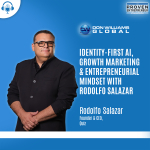
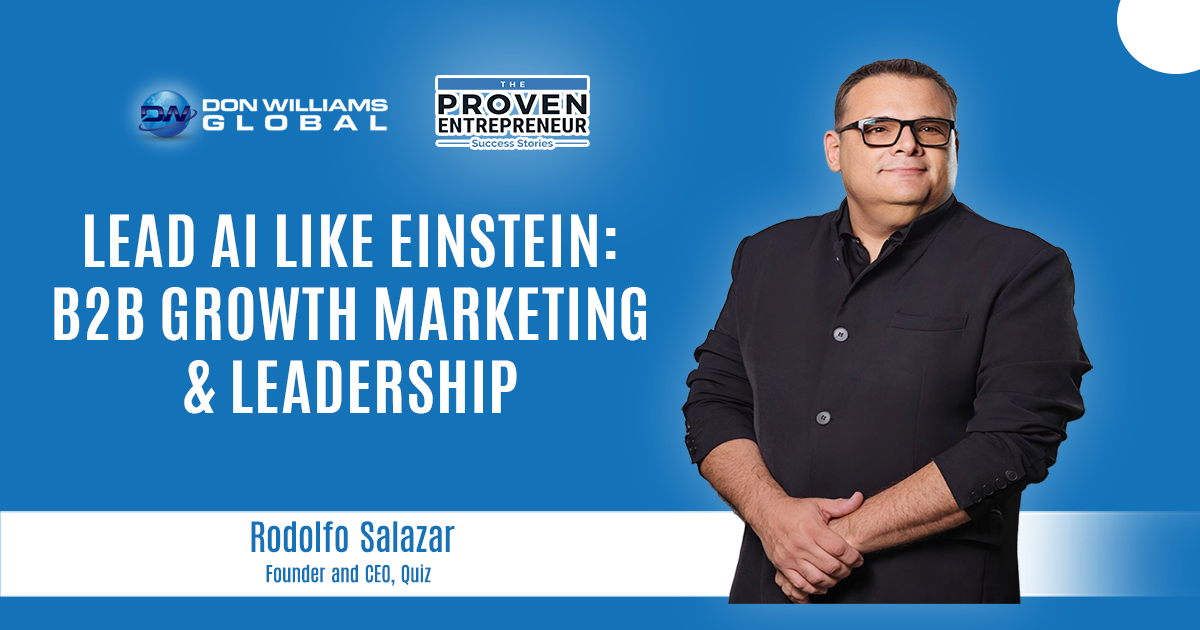
He refused to bend his values for a global CEO—and got fired outside the boardroom door. That moment forced Rodolfo to rebuild, expand across 19 countries, and rethink growth for a post‑pandemic, AI‑driven world.
In this episode of The Proven Entrepreneur Show, Don Williams sits down with Rodolfo Salazar, founder of iDigital Studios and QUDOX—a growth marketing company born after the pandemic to help brands build full‑funnel growth ecosystems. Rodolfo has worked with 400+ brands across 19 countries, from the US to Singapore, and shares the hard lessons behind a failed multi‑country expansion (opening five offices at once) and why cookie‑cutter playbooks don’t work anymore.
You’ll learn why the only constant is change, how to build a team with “Change DNA”, and why AI is a tool—not your identity. Rodolfo’s “Lead Einstein” analogy will change how you prompt and manage AI: give crystal‑clear context, retain human judgment, and keep leadership, empathy, and creativity at the center. If you’re a US entrepreneur, B2B marketer, SaaS or agency founder, contact center/BPO leader, or a corporate exec turning founder, this conversation cuts through the noise and shows you how to play offense in 2025.
For information on how to work with Don visit us at https://donwilliamsglobal.com
You can also reach out to Don Williams at https://provenentrepreneurshow.com
Watch the episode here
Lead AI Like Einstein: B2B Growth Marketing & Leadership
Hey, Don Williams here with today’s episode of The Proven Entrepreneur Show. Now this is a real treat. Our guest today is a close personal friend in San Salvador, El Salvador, and Rodolfo Salazar. Welcome to the show.
Hey, thank you. Thank you for having me here, Don. I’m really excited and I’ve seen the work you’re doing with your podcast and well, the work you’re doing overall connecting people and connecting ideas. So thank you. Thank you for having me in this podcast.
It’s my distinct pleasure. met Rodolfo, I met you, I’m not sure, three or four years ago, and pretty rapidly Rodolfo invited me to come to El Salvador and meet with a group of entrepreneurs there. And if you haven’t been to El Salvador, it’s like one of the undiscovered gems of the world. When we left, my wife was like, are we moving to El Salvador? And it’s like, I don’t think we are.
it.
But, you know, over there by Surf City, could see something happening. You know, I’m just saying, I can see something happening. Rodolfo, tell us what your current company is and what you do and who you do it with and why you do it.
Sure. So today I run two companies. One of them is iDigital Studios, which is a digital development studio where we do applications, we do web apps and a lot of software on that side. And on the other side, I have QDocs, which is Q-U-D-O-X. It’s a quantum paradox. It’s like the mix of those two words.
And we are a growth marketing company. We built this company right after the pandemic, thinking about how can we think about the future because now this new future where we’re at after the pandemic.
needs something different in terms of a company that will help in terms of marketing and advertising. So we built QDUX thinking of that and we are a growth marketing company and we have 360 degrees of things that we can do for helping companies grow. So we basically do growth ecosystems for companies and for entrepreneurs.
I love that. And I know the answer, but I want to be sure that everybody hears this. So you are based in El Salvador, but you have clients all across Latin America, the US, et cetera, correct?
That’s right, we have worked with more than 400 brands throughout 19 different countries in the world. And I think that the furthest country we have worked with or companies we have worked with in a country is Singapore. We’ve worked with several companies in Singapore.
Yeah, I think that’s about 7,000 miles west of El Salvador. If you go any farther, you’re actually getting closer ⁓ back. so, I’ve been fortunate over the years where I worked with clients on every continent, but Antarctica. And I’m looking for somebody in Antarctica.
Very fun.
Yeah. ⁓
Mm-hmm.
where I can say, I’ve worked with somebody on every continent, but there’s just not very many people and they’re all scientists. And so they’re not too concerned about doing more business and selling more. So I don’t know if that.
you
Yeah,
we’re still missing Africa, Antarctica, and a very good part of Europe.
Okay. Well,
maybe I can introduce you to some people in Africa and a part of Europe. So thank you for that. Okay. So I’m going to take you back. Before you started your first company, what did you do professionally?
So before that I was in the corporate world. I was an executive of the corporate world. I worked for three, well, four different companies in the tech world. I worked for Telefonica. Well, before that I worked for Sprint.
Then I worked for Telefonica, then I worked for Microsoft for a very long time, and then I worked for Dell. And from that, I started working for a multinational company that does call centers, converges. And so my world is about technology and about how to drive
ideas through different networks and online.
love that. So I don’t think I knew the part about Convergis and I don’t know if you know this about me but I’ve owned contact centers for 38 years.
Yeah.
so I was in charge when I worked for Dell, I was in charge of the strategic communications for the six largest contact centers of Dell.
But I was based in the El Salvadorian operation. Dell had an operation here with about 4,000 employees. And so I was part of that company. And that company was sold by Dell and acquired by the company that then was acquired by Convergence.
I
love that with some of my good friends today, and I think they have about 8,000 employees today, but they started out as an internal Bell South Center and a couple executives bought the call center operation. you know, many people don’t realize this, but call centers or contact centers or BPO or, you know, whatever label you want to put on them. In many parts of the world, those are like great, great, great jobs.
Ha
Mm-hmm. Yeah.
Yeah.
And they’re very positive for the economy because, you know, an employer who has 4,000 employees in San Salvador, that’s a player. Okay. They’re making a real impact on the national economy.
Mm-hmm. Yeah, it is
So Dell made a big impact in the country. They brought the contact center and they actually made the contact center industry explode. Right now we are in El Salvador. We have around, I would say 35 to 40,000 people working in contact centers, thanks to Dell. Now Dell is not here anymore, but if you see everyone that work at Dell,
that time are now the people that are managing the contact centers that are around. So it’s a very good thing to have for a country the contact center business.
Very good. Probably 25 years ago, I met the, probably the equivalent of the secretary of state of the Dominican Republic. And he said, we want to be known as the call center Republic because it just provides so many jobs that are consistent and steady. okay. Let’s talk about the bridge between all of that great corporate experience. But before you started your…
first agency before you had your first like real client, first major client. What motivated you to, to reinvent how you saw yourself as, I’m a corporate guy. I’ve been working with Dell and Microsoft and convert and converges by the way, is huge company. If you don’t know a huge company, how did you
How did you cross that bridge of, Hey, I’m going to go be an entrepreneur.
I’ve always wanted to be an entrepreneur. To tell you the truth, before I went to work for Telefónica, I built and destroyed three companies. I founded the first company when I was about 20 years old.
That was an English teaching center for corporations. Then I founded another company that did computers. We did clones. We did computer clones. And then I mixed the two companies and I became this…
PC clones.
mixture of someone that taught how to make clones and how to speak English. But then my first daughter was coming, so I got married very young. I got married when I was 25. So when my first daughter was coming, when I was 27,
Okay.
I really thought I don’t want to give this unstable entrepreneurial life to my daughter because you know was very young so you don’t know many things at that time. So with that I just started looking for a job and that was my first job that I got with Sprint.
So that’s why I got out of that road of entrepreneurship. then.
all my work experience, remember every time I was learning something, I was learning it and understanding it, and I said, I’m going to use this in my company. I’m going to use this one day. One day, this is something that I will use. I know that I can take this and use it somehow. So I was just putting things in my bag. And in 2002, I was still working for Microsoft and I came with
 Identity‑First AI & Growth Marketing: AI for Business Owners/caption]
Hmm
the name of the first company. And I said, no, this is the name of the company. My first company name was IdeaWorks because it works. So I started thinking now that I was not just building this foundation with all the knowledge I was getting everywhere because when you’re working for these corporations, they have so much knowledge. They give you so much.
And so I was taking all this information and saying, this knowledge, I’m going to use it in IdeaWorks now. So, you know, years went by and in 2010,
Probably I was too close to the sun. That’s the way I could explain it. I was too close to the sun. So I was very close to the CEO and the board of directors of this large BPO. there I came into this experience where I had to choose my
my character my values or obey the system so and you know i i have this very fresh i told this to the ceo of the company he was also president of the board remember someone very powerful and he i told him that maybe i was making a career limiting move
but I could not do that because of my characters and values. And he didn’t say anything for a period of time. He called me two weeks later to go to headquarters. So I had to travel six hours by plane to his office.
And someone was outside of the office when my turn came to talk to him. Someone was outside of my office and telling me, you’re fired. He’s not going to receive you. So this is where ideas kick in. Thank you very much. I’m in this stage of my life.
Yeah.
It’s going to be very difficult to get another employment the same way. Being in El Salvador, you know. So I tried, but 10 months later, it just came to me. This is something I have to do. It’s either I do it or I die. So.
So that’s that.
My wife is going to want some income coming in the house.
I can’t not do anything. Yeah. Well, I think there’s a good moral in that story, Rodolfo, is that, you know, an entrepreneur is best served who they know their own personal values. They, they set values for the company that are parallel and support their personal values.
And my experience is if you take, know, if you, if you sacrifice your values for the dollar, the dollars will never be enough for that. so, interesting, you know, I started my journey. I had helped a gentleman build, go from three locations to 11 and
Yeah. Yeah.
You know, I was the top sales guy, the top sales manager. I eventually ran all the offices, but we had an issue. And even though I made a lot of money and had an unbelievable amount of freedom, we had an issue that I couldn’t resolve. so I left and became his competitor. But you know, that’s how it goes. Okay. So.
Now your agencies…
Operate across countries and cultures. Okay. And you know, there were certainly a way everybody, the world operated pre COVID. Okay. Here in the U S you know, the great stay homes kind of what we call that. And, and then they operate differently today. Tell me what is a mindset or behavior.
Yes. Yes.
Mm-hmm.
Mm-hmm.
that you think entrepreneurs will need as they go into the future.
Wow, so I think that the only or the biggest enemy that any entrepreneur has is their way of thinking towards change. And now we are looking and we seeing change that happens so fast. So we have to get
The only or the biggest enemy that any entrepreneur has is their way of thinking towards change. Share on XOr we have to be someone that understands that weird feeling that you have. That feeling that comes up when, remember when you were learning how to ride a bike? So you were riding the bike, but you felt like, I’m going to fall. Yeah, so that feeling, you have to get used to it.
Maybe I’m falling?
Because right now we are in a world where there’s so much complexity. And within that complexity, so many things happening and changing so fast. So mindset, the mindset of an entrepreneur needs to have the DNA of change within.
And I think that that’s going to be the… And that was one of the things that we embraced when we came out of the pandemic. The first thing we did, you know, we, had a beautiful brand. I love the name IdeaWorks and I love the brand that we have done. We were recognized in all Central America and in the different countries that we have worked with.
because we had a very good reputation and a beautiful brand. I can show it to you. It’s something that we can sell because it’s beautiful. But we came out of the pandemic and we said, everything is going to change. We cannot say that we didn’t change. We have to embrace this. And the way that we embraced it is that we declared IdeaWorks obsolete.
And we said that was the past and now this is the future, not the present. And everyone in the company is so used to change things, everything within. have we have a framework to change, but that means that we’re already thinking that this will not be the same when we end the year, probably when we end the trimester.
Yeah.
So
we are just in constant change, planned change if you want to see.
Yeah, I love that.
I think the only thing that you can count on being constant is that everything is changing. certainly with the, you know, we’re about, well, we’re coming up on three years into chat GPT being released to the public. And, you know, there was a lot of AI that was happening 20 years before that that people don’t know about, but
I think the only thing that you can count on being constant is that everything is changing. Share on Xbut to where it was really out in the public and exponentially, geometrically accelerating.
Yeah.
You know, you got, you got to be light on your feet. You need to make, you know, what’s the old saying? Some people make decisions based on what happened. and, what’s happening or what’s going to happen. And we need to be somewhere in between what’s happening now and what’s going to happen because it’s all changing. Okay. So I want to, I want to take you back. I want to ask you.
Mm-hmm.
Mm-hmm.
about one of your biggest failures. And I know as entrepreneurs, we know that failing is part of winning. It’s not the opposite of, it’s required. Yes, absolutely. How did that, what was that experience and how did it shape how you boldly went into the future?
Failing is part of winning. It’s not the opposite of, it’s required Share on XYeah, yeah, of course. It’s learning, learning.
Well, so what you think is sometimes what you think that will make you grow faster is going to other countries and opening up offices. So for me, doing that not well planned, doing that bootlegged.
Hmm.
was the biggest mistake I’ve ever had because we had a great operation in IdeaWorks in El Salvador and we already had a lot of different companies working with us regionally. So we said we should just plug and play what we have here in other countries. We did a lot of work in terms of planning, but we didn’t think about
how of establishing something. So the idea I had was get local partners, logical, you need local partners, get local partners and get local people and replicate what you have. That sounds perfect for another time because right now we are in such complex times.
that cookie cutters do not work. So I try to do a cookie cutter for El Salvador, Guatemala, Honduras, Nicaragua, Costa Rica. So I opened five offices at the same time, together. And with different partners in different countries. So.
Mmm.
So what learning do I have from that is the first thing you have to have in your mind is how to do things in place for the countries. Because at the end, instead of going and opening up offices, we could have just opened up commercial.
offices, which is what we’re doing right now. We open up commercial offices and we do all the work with the people we know and where we can control the ambience we can control.
So in the failure, in the piece that I call my failure, I think that there were too many variables. Different partners, different people working for me, different organizations, and the only umbrella was Rodolfo.
Yeah, well, that sounds like a lot at one time, you know. So, okay, last question.
Yeah.
So you have this ample storage of wisdom and knowledge about entrepreneurship and technology and AI. And I know that. So if you could share one nugget, a tool, a tactic, a mindset, one nugget that would provide real value
to our audience today, what would you share?
Sure. in terms of AI, everything that’s happening with AI, we have to think of identity first. So first, you need to understand who you are. You need to tell people who they are.
and you need to make them understand and you have to understand that AI is not an identity. AI is a tool. It’s something that you use that has a lot of knowledge and that can do a lot of things for you, but it’s a tool. So that’s number one. Number two. In the following years, we’re going to have
AI is not an identity. AI is a tool Share on XEveryone is going to have this AI multiplying our capacities. But we have to think of them this way. And I make this comparison when I’m giving the trainings to executives. tell them, think of this as if you had Albert Einstein. You brought Albert Einstein to El Salvador to work for you.
So, and you say, Albert, go get me two pupusas from the Galerias del Escalón, which is a mall. You know, Albert Einstein will look at me and will say, huh? And you know, the Albert Einstein that we have in AI will not just go, huh? But he will try to answer. He will give you so many stupid results.
Hehehehehe
So you have to tell Albert, you have to say, hey, Albert, pupusas are this tortillas made of corn that have a filling inside that are our typical food. And we have all these flavors. And only that, I’m going to tell you, Galeria del Escalón, if you take ways and you use, this is the application, you tell, you have to be very specific in very simple things.
Mm.
to give the best context. So think of that. Think that you will have all these consultants on your hands. Anyone. And I was listening to Bill Gates last time in an interview. He was saying, yes, before I used to have all these consultants that if I had a question about water, I could call, hey.
So he had access to know, you know, the best person that would talk about water. Now you have access for that. I have access to that. So I need to understand what type of questions I will make and how I will manage to have all these consultants work towards my goal, my idea, understanding very well what’s my identity.
and my identity is just filled by you. So you have to understand your identity. And you have to give identity to your people. They will need to understand who and what they are to give the final decisions to, not the AI.
Yeah.
Because at the end, the criteria of decision making and leadership should remain in us. People.
At the end, the criteria of decision making and leadership should remain in us. People. Share on XI love that. And,
and, and, and, you know, you brought like my, probably my favorite subject in entrepreneurship, leadership. so foundational skill to all leadership is communication. Clarity is kind. Clarity is kinder than really nice words that are unclear.
Okay. Clarity is kind. And when you communicate with people, clearly that’s excellent leadership. The same thing is required when you communicate with AI, you have to communicate clearly and literally you have to lead Albert Einstein. You have to lead the AI for where you want to go. Okay.
Yeah
Otherwise, it will decide on its own where to go.
Yeah.
And you know what you’re saying is it’s very true. So communication leads to empathy. So leadership, empathy. And believe it or not, because people are not saying that AI is creative, but creativity is really our thing.
So we, will not, AI will do very creative things or sorry, will emulate doing creative things. We are the ones and you know, creativity is based on so many human things and one of them is failure. AI will not be prone to failure. We are. And that’s what makes.
Right.
the big difference and you will make the big difference in your work environment. If you teach people leadership, empathy, creativity, connection. That’s it.
That’s it. Okay. Tell us how someone in the audience would reach out to your company or you in case someone wants to learn more about you or your companies.
Sure, so I have a hub under my name, rudolfosalazar.com, which will be easier. But then you can find my company’s Q-Docs, it’s Q-U-D-O-X dot I-O. And then iDigital Studios is iDigitalStudios.com.
Awesome. Rodolfo, thank you so much. Been my distinct pleasure to have you on the show today.
Well, it’s been great and I think conversations like this should happen more often and more people should be around this fireside conversations.
I
agree. That’s today’s episode of The Proven Entrepreneur Show. We’ll see you next time. Thanks. Bye.
Podcast Transcript in Spanish
Hola, soy Don Williams con el episodio de hoy de The Proven Entrepreneur Show. Es un verdadero gusto. Nuestro invitado es un gran amigo en San Salvador, El Salvador: Rodolfo Salazar. Bienvenido al programa.
Gracias por invitarme, Don. Estoy muy entusiasmado. He seguido tu trabajo con el podcast y, en general, la forma en que conectas personas e ideas. Gracias por tenerme aquí.
El placer es mío. Conocí a Rodolfo hace tres o cuatro años y, muy pronto, me invitó a El Salvador a reunirme con un grupo de emprendedores. Si no han estado en El Salvador, es una de las joyas por descubrir del mundo. Cuando nos fuimos, mi esposa dijo: «¿Nos mudamos a El Salvador?». Yo respondí: «No creo que lo hagamos».
[Se ríe].
Por Surf City ya se veía que algo estaba sucediendo. Se notaba movimiento. Rodolfo, cuéntanos: ¿cuál es tu empresa actual?, ¿qué haces, con quién y por qué?
Hoy dirijo dos empresas. Una es iDigital Studios, un estudio de desarrollo digital donde creamos aplicaciones móviles, aplicaciones web y software. La otra es QUDOX (Q-U-D-O-X), cuyo nombre nace de “quantum” y “paradox”. Somos una empresa de growth marketing. Fundamos la compañía justo después de la pandemia, enfocados en el futuro y en cómo debía transformarse el marketing y la publicidad. Creamos QUDOX con esa visión. Ofrecemos capacidades integrales (360°) para ayudar a las empresas a crecer. En esencia, construimos ecosistemas de crecimiento para empresas y emprendedores.
Me encanta. Y sé la respuesta, pero quiero que todos la escuchen: tienes base en El Salvador, pero clientes en toda América Latina, Estados Unidos, etc., ¿correcto?
Así es. Hemos trabajado con más de 400 marcas en 19 países. El mercado más lejano con el que hemos colaborado es Singapur, con varias empresas.
Creo que está a unas 7,000 millas al oeste de El Salvador; si sigues avanzando, vuelves a acercarte. He tenido la fortuna de trabajar con clientes en todos los continentes excepto en la Antártida. Sigo buscando a alguien allá.
[Se ríe]. Sí.
Para poder decir que trabajé en todos los continentes. Pero allí no hay mucha gente, y la mayoría son científicos; no están muy enfocados en vender más. No sé si suceda.
A nosotros aún nos faltan África, la Antártida y una parte de Europa.
De acuerdo. Quizá pueda presentarte a algunas personas en África y en Europa. Gracias por eso. Bien, vayamos atrás: antes de iniciar tu primera empresa, ¿qué hacías profesionalmente?
Venía del mundo corporativo; fui ejecutivo. Trabajé en cuatro empresas de tecnología: primero en Sprint, luego en Telefónica, después muchos años en Microsoft y finalmente en Dell. A partir de ahí pasé a una multinacional de centros de contacto, Convergys. Mi mundo es la tecnología y cómo impulsar ideas a través de diferentes redes y canales en línea.
Me encanta. Creo que no sabía lo de Convergys. No sé si sabes esto de mí, pero he sido propietario de centros de contacto durante 38 años.
Sí. Cuando trabajé para Dell estuve a cargo de las comunicaciones estratégicas de los seis centros de contacto más grandes de la compañía, basado en la operación de El Salvador. Dell llegó a tener aquí unos 4,000 colaboradores. Esa operación fue vendida por Dell y adquirida por otra empresa, que después fue adquirida por Convergys.
Algunos buenos amigos míos empezaron como un centro interno de BellSouth; hoy tienen unos 8,000 empleados. Mucha gente no lo dimensiona, pero los centros de contacto —BPO, como quieras llamarlos— son trabajos muy buenos en muchas partes del mundo.
Sí.
Y aportan mucho a la economía. Un empleador con 4,000 personas en San Salvador es un actor de peso: genera impacto real.
Totalmente. Dell tuvo un gran impacto en el país. Trajo el centro de contacto y catalizó el crecimiento de la industria. Hoy, en El Salvador, diría que hay entre 35 y 40 mil personas trabajando en centros de contacto, en gran parte gracias a ese impulso. Dell ya no está, pero muchos de quienes trabajaron allí hoy dirigen operaciones del sector. Es muy positivo para el país.
Hace unos 25 años conocí al equivalente del secretario de Estado en República Dominicana y me dijo: «Queremos ser conocidos como la República del Call Center». Provee empleos estables y consistentes. Bien. Hablemos del puente entre esa experiencia corporativa y tu primera agencia. Antes de tu primer gran cliente, ¿qué te llevó a reinventarte —de ejecutivo en Dell, Microsoft y Convergys— a decir: «Voy a ser emprendedor»? ¿Cómo cruzaste ese puente?
Siempre quise emprender. Antes de Telefónica fundé y cerré tres empresas. La primera, a los 20 años, fue un centro de enseñanza de inglés para corporaciones. Luego monté una ensambladora de computadoras —hacíamos clones de PC— y después combiné ambas, enseñando a armar PC y a la vez inglés. Me casé joven, a los 25, y a los 27 esperábamos a nuestra primera hija. Pensé: no quiero esa inestabilidad para mi familia, así que busqué empleo. Mi primer trabajo fue en Sprint. Dejé el camino emprendedor, pero cada aprendizaje en lo corporativo lo guardaba pensando: «Algún día lo usaré en mi empresa».
Clones de PC.
Exacto. En 2002, aún en Microsoft, se me ocurrió el nombre de mi primera empresa: IdeaWorks —porque “it works”—. Entendí que no solo estaba acumulando conocimiento, sino construyendo una base para IdeaWorks. En 2010, probablemente me acerqué demasiado al sol: estaba muy cerca del CEO y del consejo de una gran BPO. Tuve que elegir entre mis valores y “seguir el sistema”. Le dije al CEO —que también presidía el consejo— que quizá estaba tomando una decisión que limitaría mi carrera, pero que no podía hacer lo que me pedían por mis valores. No dijo nada. Dos semanas después me llamaron a su sede; volé seis horas y, al llegar, alguien fuera de su oficina me dijo: «Estás despedido. No te va a recibir». Fue un punto de inflexión.
Sí.
Conseguir un empleo similar desde El Salvador sería difícil. Lo intenté, pero diez meses después me quedó claro: tenía que hacerlo. O emprendía, o nada. Y emprendí.
Mi esposa siempre dice que algo tiene que entrar a casa; no puedo quedarme sin hacer nada. Hay una moraleja: un emprendedor se sirve de conocer sus valores personales y alinear los valores de la empresa con ellos. En mi experiencia, si sacrificas valores por dinero, nunca será suficiente. Yo inicié tras ayudar a un empresario a pasar de tres a once sedes…
Sí.
Yo era el mejor vendedor y gerente de ventas; luego dirigí todo. Había un problema que no pude resolver; me fui y me convertí en su competidor. Así es. Ahora, tus agencias operan entre países y culturas. Antes del COVID —el gran “quedarse en casa”— se trabajaba de una forma; hoy de otra. ¿Qué mentalidad o conducta necesita el emprendedor hacia adelante?
El mayor enemigo del emprendedor es su actitud frente al cambio. Los cambios hoy son vertiginosos. Hay que acostumbrarse a esa sensación incómoda, como cuando aprendías a andar en bicicleta y sentías que podías caer. Vivimos en un mundo complejo donde todo cambia rápido. La mentalidad emprendedora necesita llevar el cambio en el ADN. Fue lo que abrazamos tras la pandemia. Teníamos una marca preciosa —IdeaWorks—, reconocida en Centroamérica. Pero dijimos: «Todo va a cambiar; no podemos decir que nosotros no». Declaramos a IdeaWorks obsoleta: eso era el pasado; ahora viene el futuro. Internamente adoptamos un marco de cambio: asumimos que nada será igual a fin de año, quizá ni a fin de trimestre. Cambio constante —planificado.
Me encanta. Lo único constante es el cambio. Estamos a casi tres años de la salida pública de ChatGPT. La IA ya venía de lejos, pero cuando se hizo masiva, todo se aceleró.
Así es.
Hay que moverse ligero y decidir entre lo que pasó, lo que pasa y lo que pasará. Debemos estar entre el presente y lo que viene. Bien. Cuéntame de uno de tus mayores fracasos. Los emprendedores sabemos que fracasar no es lo opuesto a ganar: es un requisito. ¿Qué aprendiste?
Pensar que crecer más rápido era abrir oficinas en otros países. Hacerlo sin una institucionalización robusta fue el mayor error. Teníamos una gran operación con IdeaWorks en El Salvador y negocios regionales; dijimos: «Repliquemos». Planificamos, pero no diseñamos el “cómo” institucional. Busqué socios y equipos locales y quise aplicar el mismo molde en El Salvador, Guatemala, Honduras, Nicaragua y Costa Rica: abrí cinco oficinas a la vez, con socios distintos. Hoy sé que necesitábamos adaptar in situ para cada país. En vez de oficinas operativas, debimos abrir comerciales y ejecutar desde entornos que controlábamos. Demasiadas variables bajo un solo paraguas.
Suena a mucho al mismo tiempo. Última pregunta.