What if the secret to winning the Kentucky Derby wasn’t pedigree or price—but poop, persistence, and a PhD-level understanding of biomechanics?
Meet Jeff Seder, a Harvard-educated misfit who walked away from Wall Street and into the stables—armed not with a saddle, but with science. In this unforgettable episode of The Proven Entrepreneur Show, host Don Williams uncovers the wild, brilliant, and often hilarious journey of the man who turned the horse racing world upside down.
Jeff didn’t just challenge the status quo—he obliterated it. While the industry obsessed over bloodlines and million-dollar studs, Jeff was measuring heart size, stride efficiency, and yes, even the weight of horse poop. Laughed out of rooms and dismissed as a madman, he spent 30 years building a data empire in secret—until one day, he predicted a Triple Crown winner and proved them all wrong.
This episode is more than a story about horses. It’s about grit, innovation, and the kind of entrepreneurial madness that changes industries. You’ll hear how Jeff:
- Built a 48-dimensional AI model before “AI” was cool
- Invented medical devices in a cornfield with MIT dropouts
- Turned a $155K horse into a $50 million legend
- Learned the hard way that success takes decades—and a little chaos
For information on how to work with Don visit us at https://donwilliamsglobal.com
You can also reach out to Don Williams at https://provenentrepreneurshow.com
Whether you’re a founder, a dreamer, or just someone who loves a good underdog story, this episode will leave you inspired, entertained, and maybe even a little obsessed with horse racing.
Watch the episode here
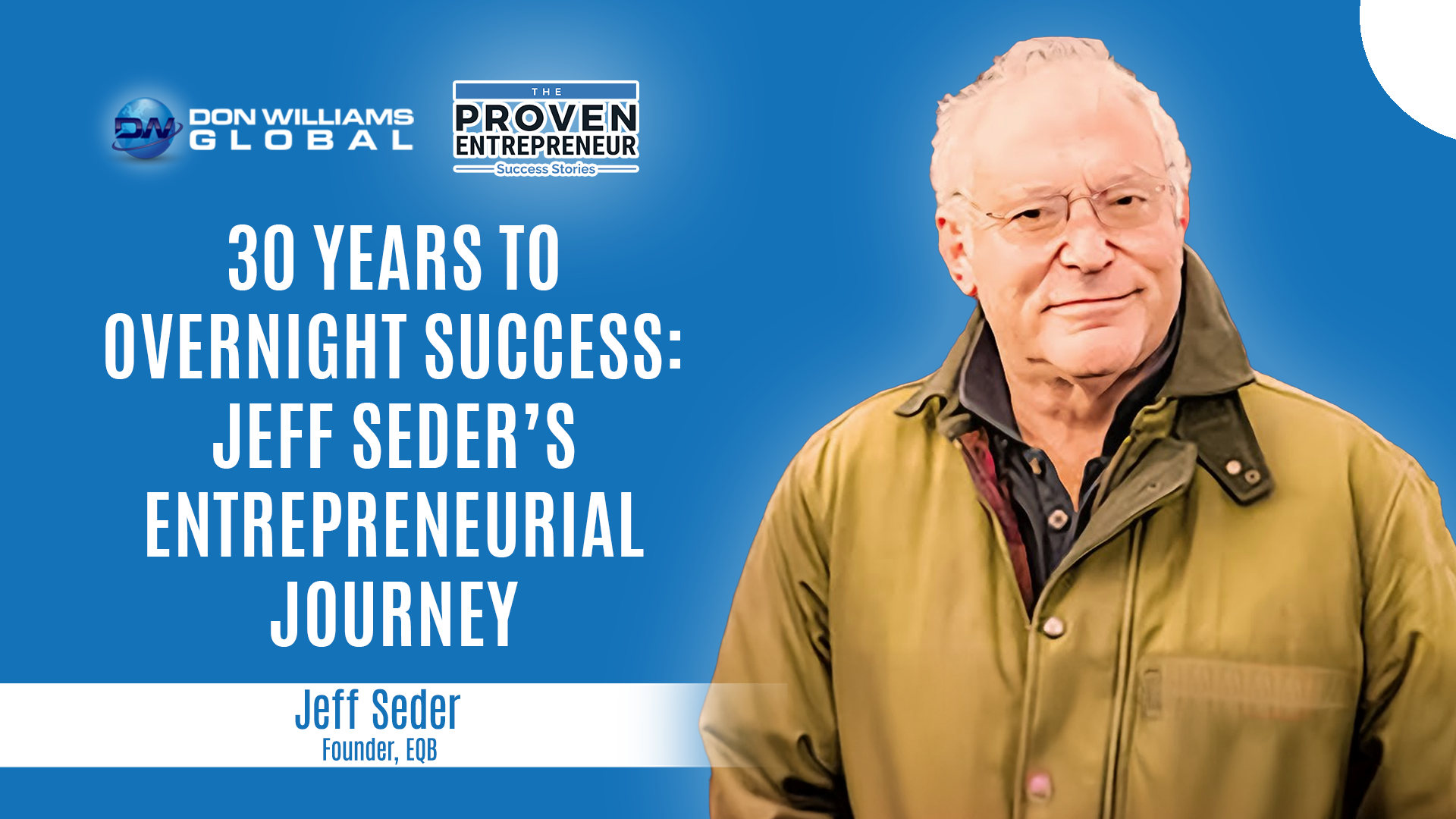
30 Years to Overnight Success: Jeff Seder’s Entrepreneurial Journey
Hey, Don Williams here with today’s episode of the Proven Entrepreneur Show. I got a real treat for you. I got somebody who’s had a Kentucky Derby winner, had a Triple Crown winner, and is maybe the most accurate predictor of horse race winners on the planet. Jeff Seder with Equine. Tell me again, Equine. Biometrics. OK.
metrics.
Welcome to the show. How are you, Jeff?
I’m fine. Thank you for having me, Don.
It’s my pleasure. You know, the purpose of this show is for entrepreneurs to hear real stories from other entrepreneurs lives and to learn. And so, I’m, I’m thrilled to share your story today. And I’m going to start off with kind of a funny question. I think amongst other means, I think you predicted a Kentucky Derby winner using horse poop and math.
Thank
Can you tell us what you do?
Well…
We’ve not only predicted Kentucky Derby winners, we’ve had Kentucky Derby winners. We’ve had two that were second. We’ve been in the Kentucky Derby almost every year with something we bought at an auction for below the averages that are at auctions, not million dollar purchases. fact, $155,000 average. And we’ve had three world champions. We’ve had the first Triple Crown winner in 37 years, and it’s all documented and
verifiable on it from independent third party sources. And you can see the details of it when we bought them, how much and for who and all that stuff on our website, EQB.FYI, not.com, it’s .FYI. But I think that the rumor about the horse poop is because at one point when we were looking at every conceivable piece of data about horse racing, we did in fact measure the weight of horse poops on the way to the paddock. You know, they fight over a pound or two for the jockey, but
Then the horse may poop 15 pounds walking to the paddock. So we thought that might be interesting. we have over 40 years collected massive data bags of all kinds and we’re data analytics. We predate the money ball and I’m an entrepreneur. So I should be on your program.
An entrepreneur. That’s, that’s classic.
That’s the horses. I started
with no money and no credentials and no nothing. And it was 20 years of starving to death. then I tell people it was easy. It only took 30 years and several million dollars of private research to be an overnight success. But I’m still because ⁓ I’m still notorious in the industry. mean, a lot of them hate me. The entire industry, the value of these big farms and everything, the most important variable to them is the pedigree.
It only took 30 years and several million dollars of private research to be an overnight success. Share on XYeah, that’s kind of how those overnight.
and value and breeding is where you make your money and stuff. And I just threw all that out the window. So I’m a total disruptor. I piss these people off. I started with the United States Olympic Sports Medicine Committee way, way back when they just started in the 70s. And we didn’t have the parents at the tryouts. And we do DNA and we do all kinds of stuff. But pedigree, which is the thing that values these sources and the whole industry is built around.
We’re the disruptor and the threat to that. can spend, you can take your multimillion dollar mayor to a multimillion dollar stud fee and your chances of getting a really good horse are maybe 1%, 5 % occasionally. We don’t do that. And our numbers are five, six, 10 times that what we do without pedigree. We use pedigree to determine how much to pay for a horse and how much it’s going to be worth in the market. That’s it. So we are.
Ouch.
That’s.
The bad boys in analytics and horse racing is not popular because it’s going to completely disrupt the industry.
Yeah, I
love that. So tell me, if your average investment into a horse is $155,000 and you’ve been wildly successful, at the Derby, what’s the average investment into a horse on the field?
Well, they go from $40,000 to three, $4 million before they were ever raised when they were babies. The average at the auctions where they’re buying the kind of horses we buy is $300,000, $400,000 for the real good ones. But we get hopefully the hidden value ones. We did, for example, for one of our major clients, he invested $40 million over four years. And at the end of six years, he had back $64 million.
It was number one stable in the United States and it had the first Triple Crown winner in 37 years. We were in the front page center of the New York Times the day before the Triple Crown. It was, think June, June something on 2015. If you want to go back to New York Times and there’s a of me inside of the article. So, page center. In fact, I don’t know if you know the New York Times, but every day they have a quote of the day.
That’s amazing.
And the quote of the day that day was what I had told him when he put the horse in a yearning auction and it was so your house don’t sell this horse. And he bought it back for 300,000 and then ended up being worth 50 million. That was a good day, it was all a bad day because if he had sold it, everybody else would take credit for it. course, as well as he wouldn’t have not gotten the money.
I love that!
Yeah, that was a good day. That was a good day.
Yeah.
He had other problems in business and foreign stuff and this and that, but not from us. He was a smart, decent guy. really, he was something else.
Yeah. Well, and that’s the entrepreneur’s way.
Many
entrepreneurs, if you look at 90 % of their career, they’re failing. It’s a big win here or there.
Oh, yeah, I started that.
had to do outside projects. did. I have three degrees from Harvard, including law and business. My dad was not happy when I went with the horses. But I. And I just I went for I was 26. I went for a blind date at a riding stable to ride rental horses with a girl. And I started falling in love with the girl. I fell in love with the horses and I became obsessed.
I’m Eddie Watson.
And then I got as a when I graduated, I was looking around for something to do with horses. And I I found the the US Olympic Committee was just starting their scientific stuff because these Germans were killing everybody with theirs. And and I saw what could be done. And nothing was the horses were the same as 300 years eyeball intuition, pedigree and bullshit. So I knew there was something for me there, although it took it when I found out.
We found out that the data on elite athletes was so different. It was different than normal as injured or sick is from normal. So you couldn’t help it all until you got the data. So one of the things we’re doing then was building databases on elite athletes, see how they’re different and they are different. And to do that on horses, found the equipment didn’t even exist to get that data on horses. I had to invent it. I had to go to black box suppliers of the defense industry and near Washington DC. had to hire engineers from MIT and doctors from Harvard.
Bye bye.
and biomechanists from the major universities, and veterinarians from the University of Pennsylvania. And I had to pay for all that. I was doing leveraged buyouts. And I made a lot of money in it all, in the research. I used to call it barn burgers, because that was what we could afford to eat. And we had a lot of detractors. I got to tell you how I got my first break. My first break, I was making presentations at some of the major stables.
Ha ha ha ha.
And I went to a guy who’s a super entrepreneur named Ken Ramsey in Kentucky. It’s been very successful. And he 200 mares. And I went to him and I made this big presentation and he sat back and he said, well, make one recommendation. Let’s see what we get. I said, no, no, that’s not how it works. You have to do this. He says, no, make one recommendation. Here’s Mike. You can do anything you want on all my horses and tell me make one recommendation. So I went into the farm and I spent a week and I came back and I said, uh,
I want you to take this horse and enter it in the Belmont Stakes three weeks from now.” And he burst out laughing. He said, it’s a mane, it’s never won a race. He had a new stallion he was trying to promote named Caddiansus and it was from the first crop and it was named after his grandson, Nolan’s cat. Nolan was the grandson. he, so he said, I said, no, you don’t understand.
What’s going on in all these dirt races, especially the Kentucky Derby, where none of them have run that far before, is they’re all slowing down. The guy who looks like he’s passing everybody at the end, he’s slowing down less than the others. It’s like dogs. It’s a logarithm. Hold on a second.
Go ahead.
Yes.
I’ve learned that in the Olympic committee with the swimmers. They’re all, so they could take a 25 year old young guy and watch how he slowed down in a repetitive athletic motion and fit it to a curve and then extrapolated out to see how he’d be competitive at a hundred yards a year or two later and it works. So I was doing it on horses and this horse, he was not fast, but he did not slow down. And so he was got his time for the Belmont stakes, the longest breaks of the triple crown, a mile and a half was going to be good.
Even though at six, at three quarters, they’d only run him in sprints and he wasn’t competitive because he couldn’t run that fast. So he said, okay, I’ll do it. He paid the money. don’t know, it was like 200,000 to get it into race late. And then his trainer was pissed. His trainer’s a top, you know, in the world trainer and he didn’t want to do it. And the day before the race, in a daily racing form, they had like this horse is this good and they started going, ah, blah, blah. And then there’s the idiots and the
sure.
the silly ones and they mentioned us, of course. I never got an apology. And then, so when I get there, he’s telling the trainers, telling the press he had nothing to do with it. It’s the command performance. So I’m up there, I’m in the stands right with them all. And they start out and of course he leaves the gate and he’s dead last and he’s trailing the field. And I’m thinking I got to hide under the table, right? And I’m thinking, oh God, please, this is my chance. And so.
About halfway through the race, he starts catching up. They’re really just slowing down. then about three quarters of the way, he’s just right in the back of the fat pack, right? And he starts passing people. And at the end, he was definitely going to win if he had another three or four stripes. So he was third in one of the most prestigious classic races in the world. Out of the first crop of this new sire. So instead of a maiden that was worthless, he had something special. And to prove it wasn’t a fluke,
He then went to the Louisiana Super Derby for a million dollar race and did it again. So that I got a client. So I actually started some money. And then based on some of my performance there, I got this other guy, the Egyptian guy that we took right to the Triple Crown and the World Championships. people still, a lot of people still say, well, he has theories. I was thinking, they don’t understand the stuff that sells in the race horse business on Pedigree.
Yeah.
They have statistical list and that’s all absolutely silly. you know, it’s like there’s guys selling stuff on the pedigree based on, for 2000 years, they’ve been studying statistics as a science so that there’s a large database and there’s patterns here and there. It’ll tell you whether they mean anything, right? But they sell every pattern. Look, look, this horse had a, this combinate, this match had a good horse. It doesn’t mean anything. And the horses aren’t
fruit flies, they have like one fall and it’s almost never by the same combination, the same sire on the same mare. And the data bank is over the years is so corrupted by the big trainers and the drugs and the different businesses. You know, it’s just it would be like trying to predict boxing by having huge databases of the height of the socks and the type of underwear they wore. And then using that with AI to be sophisticated analytics is ridiculous.
But it’s right now the state of the art in horse racing. That’s what they do. And it’s not what I do. So, and now, now we’re in year 10 of the DNA stuff and we’re way ahead there. And once again, the general stuff has been the way they’ve approached it is not scientific. I was pre-med at Harvard to begin with and I was Magnet, Commodian, Phi Beta Kappa. So while I’m not, you know, I’m kind of a jack of all trades, I hire the best people, but I’m not a dummy about that stuff myself.
Hey, and that’s a secret listeners. I hire the best people, local billionaire here in town, oil and gas business. Two things I learned from him. One, hire the best people on the planet, not just in your area, the best people on the planet. Yeah. And, and that’s the second thought. Somebody asked him in front of me, they said, well, how much do I pay him? How much, when do I know it’s too much?
Yeah, they’re different. They are different. Pay up. It’s worth it.
And he said, with the best people on the planet, you can’t really pay them too much. They will demand to give you a return.
I got that one. That’s been my experience.
Yeah, you know, the difference is that they’re between chicken poop and chicken salad. know, between the elite athletes and the normal. It’s different.
There you go.
Okay. So let me ask you a question. You’ve been called affectionately and probably not the money ball of horse racing. What’s the wildest point you’ve used in calculating odds and it might’ve been horse poop, but is there something more wild than that that you’ve analyzed?
You know
Well, think that one of the secrets is people are always looking for the magic bullet. the truth is the best horses are not one the greatest stride or the greatest, biggest heart or the biggest something. Everything’s good. They don’t have a hole in them. They may not have the best of anything, but they don’t have the poor anything. So it’s really
a combination. So one of the things I discovered was I have 48 variables. So I map all the data into a 48, a virtual 48 dimensional space with all those variables to find and found, you know, the clusters. It’s called multivariate discriminant analysis. And it comes out with a prediction that’s expressed as a percentage likelihood of, but you’re going to get what you’re looking for. And of course, if you put in poop data, you don’t get anything right. If you put it in side of the socks with a box, you got to know, you got
I published studies in refereed, the leading scientific journals, refereed on my dad on some of the stuff on the horses. My studies were not 12 ponies in a lab. They were 12,000 race horses at major racetracks over 10 years with every second of their racing records. I published a couple of papers like that. You can download from my website and see what they are. We got a lot more than that. I think that what’s the wildest thing about us is that we’re not one thing.
where this we are in a set. We’re we’re AI in the sense of actual intelligence. We had the patients and the money and we invented the machine. I invented the first portable ultrasound machine so I could go into a stall and do a cardiac analysis of horses and the way they were doing it, their protocol didn’t work reproducibly. So I invented a new one, a different transducer, went on the other side of the horse, a different transducer with different power.
And now everybody uses it. should have patented that. I did patent some things. I mean, so I think that I quote AI actual intelligence. So we got the data nobody else has. We built the machines to get the data that nobody else has. And then we had the patients and the money and the time and the experts to use it in a way that almost never ever gets used anywhere. know, 48 dimensional graph. For real.
And this was with shitty computer power. I had a textile company that I owned that marketing and I had a room, a room full of computers to do this back then. And I had to go over like telephone modems from racetracks in Florida. I rented a whole floor and a hotel next to the racetrack. And I had the cables going all over through the halls to the different rooms with the modems and the PCs. We built a bone scanner out of a
The first, an Apple IIc. Actually, it wasn’t even an Apple, it was the knockoff. I forget what they were called. We modified that to do the first ultrasound stuff and bone scanning. got patents. The bone scanner won the new medical device of the year in 1986 in Europe as a non-invasive bone scanner because it was… I won’t go into all the science of it, but it did. It came out of our lousy little falling down
farmhouse in a cornfield with a couple of guys from Harvard and MIT who were ne’er-do-wells, know, who were earning nothing and weren’t doing what they were supposed to do because their parents were pissed.
Yeah.
Okay, so let me ask a question. What’s one
truth you’ve learned about winning in racing and in business that most people just miss? They just completely miss it.
boy, that’s a hard one. I think what it is is you have to always ask why. When anybody tells you things, especially if you’re trying to innovate or understand, how do you know is the key question? And then don’t just take it, go research it. Half the time it’s a crappy study somewhere and everybody’s, there’s a whole mountain built on this teeny weeny, you know,
base of sand and you have to go back there and find out what the truth is. When I started, they would make fun of me about the gait analysis, the quadruped locomotion poop. So one of the first papers I published showed that all the textbooks, all the stuff, all the veterinary answer, they had the gait wrong for a race horse. Why? Because it was all done on ponies and horses and labs and that poop. They didn’t know what the gait of it was a race horse.
And so I published it and I published it so they couldn’t say, you know, with experts there and I had the right equipment, I had the right everything, the right people. And it was like on 10,000 horses over, I don’t know how many years, it wasn’t something you could just dismiss. And so it was like in your face, you think, don’t know, I don’t have the expertise to do this. You don’t even know what the game is of a real race horse when he’s going flat out on the racetrack, which by the way, for something like Secretariat, he’s airborne three times.
three times he’s not bearing any weight on any leg within each stride. He’s flying. And that’s one of reasons why the really good racers break their legs because instead of loading one leg off gradually off another one, they’re coming down from outer space on each leg.
Wow.
the impact.
And when they didn’t know the impact, I had to bury force plates in the track at Delaware Park and then have cameras, special cameras. had film, video wasn’t available except for hundreds of thousands of dollars. 500 pictures a second coordinated the force plate in the racetrack, transducers on the hooves of the horses. And we discovered things about what they’re doing and why so many get hurt. Our horses don’t get hurt. We haven’t had a single breakdown.
They’re all the industry. It’s a big thing. had to ban racing because horses break down. They do the tracks wrong. They do the rest of it wrong. They buy horses that we know are going to get hurt. We’ve got the techs and we keep them in our horses. Just don’t break down. They race them when they’re six and seven. The others are all too injured to run after. They’re three or four. So the resistance to what we do has been huge and it used to drive me crazy. But I find this side, that’s my vantage. They’re giving me a free free pass.
Hmm.
Yeah.
Why
complain? So after I die, then the probably all jump all over all of it. Even the first harmony. Invented the first harmony meter that was accurate on horses for like interval training and stuff that they were using. Highly meters that weren’t giving them the right information. The temperature was too cold. It was too high. It was wrong. Maybe some human meters. Horses have an inverted T wave in their QRST complex. And there were all kinds of reasons why they got the wrong numbers. So we had to invent one that was actually accurate.
Well, just like an artist, it’s more valuable after they’re gone.
And then the only people who bought it were the research universities, although they had schools and we couldn’t sell them to the trainers. And finally somebody stole one at a racetrack and we had a party. Somebody wants it. But it went into all our data, you know, it was a big deal. So.
Share something with us that you’ve learned about leadership from analyzing multimillion dollar horses that every CEO should know for their business.
Thank you.
Wow.
I think it goes well, of course, there are always variables that you can’t figure out or you don’t know are important or you can’t measure like whether they’re trying or not. I’ll get into that later.
I think it’s a fact.
To me,
just your stick-to-itiveness, your persistence of 20 years as a pariah in the industry. Nobody liked you. Nobody liked what you were doing.
I told him that
this is a damn dog’s ass.
Shut up, ass.
Okay, go ahead.
Just the fact that you stuck to it, you believed in it, you had a mission, you weren’t gonna quit.
Yeah, they call me Dog Zoa.
I’m called Dog Zoa in the vetting world because I help some of the whale vetters with their hand-gapping stuff because of the data I have on horses. This horse is going to go the distance, that kind of thing. What was the last question you asked me though? Because I had an answer for it. ⁓ I tell them about leadership.
Is it leadership?
I think it goes back to what I first learned working with the Olympic Sports Medicine Committee, that the elite, the elite performers are different. And the more you understand what their differences are, the more you’re to succeed because you’re going to go after that. I staffed some of my company, my companies was here. So I took bankrupt companies, turned around and sold them for a lot of money. And one of the things I did was
Elite performers are different. The more you understand what makes them different, the more likely you are to succeed. Share on XI found young people that were ambitious, were smart, hardworking, know, not just one of these, you know. And I didn’t I never went by traditional credentials. I always had to meet them and talk to them. And then I just went after the like I was doing with the athletes. I was going after people with something special.
And if they had some of something that wasn’t special, that was a pain in the ass, I put up with it. It was more hurt that so I had a group of, I guess, misfits. mean, somebody would call that they were. We had a crazy bunch. I had a a big picture of a Chinese character that’s for chaos framed and put up in my office. And there was all kinds of shenanigans and fucked up stuff, but I didn’t care about that. I mean, don’t care.
Yeah.
I think people worry too much about what it looks like, what everybody thinks. know, just, quality is quality and you need to go for it and you need to make up for whatever their other problems are and just deal with it. That’s my, I mean, so what do I know? That’s what I’ve done and it’s worked for me.
Quality is quality. You need to go for it and make up for whatever their other problems are. Share on XWell, I think
eagles don’t flock. And so you find them and you put them in their role and you enable them to go do their job. You don’t make them go do their job. you may.
Occasionally they
do it below because they’re so ambitious. It’s worth it. It just did.
Yeah, you manage,
you manage processes, but you lead people in the best organizations. So looking back, when things were
I think
that’s a great line. Manage processes, but lead people.
Yeah. Yeah, for
sure. So like in the dark days, in those 20 years before you were an overnight success, what kept you going?
father. I don’t know. I guess I’d had so many privileges and protections that I couldn’t imagine failure. It was always going to be right around the corner. I always had faith. I just believed in myself. I was goddamned if my dad was going to be wrong about it. So I think that’s it.
I couldn’t imagine giving up.
Yeah, yeah,
I love that. I think that’s very common with entrepreneurs is it’s going to get better next week, next month, next quarter. I can hang in there.
Yeah, can’t we still?
Coffee mugs, it’s a marathon next Tuesday torture test. That’s what they discuss. staff presented that to me. We’re all in the marathon next Tuesday torture test.
I love that.
Jeff,
if we could open your mind and pick out a golden nugget, something you’ve learned in your path that we don’t know, but you know, what would that nugget be?
I don’t know about that, but I’ll give you another thing that was critical to my success. about year 12 or something, I hired somebody to come break a yearling horse for me because I couldn’t do it because I fell off and broke my arm. I was a rider. I jumped six foot walls when I was roaring over the countryside. Anyway, I got good at it because I was part of my horse passion.
But I hired this woman and she had worked for Hall of Fame trainers. She had been the one of the second woman jockey United States and lied about her age to do it. She had trained horses. She’d done it. She’d been on horses since she was two years old in the back in a basket on her grandmother’s hunting horse, fox hunting. And I hired her to break this horse and she got interested in what we do and she started to help us. And
That was the turning point because before that we were like pointy-headed guys doing the difficult right and the basics wrong or half-assed. She brought us 300 years of developed what there was of real expertise about resources. Then we figured out we had to layer on our technology over that, not try to replace it. That was a breakthrough.
I was doing the difficult right and the basics wrong—until I learned to layer technology over real-world expertise. Share on XThen things started to soar. So I think, yeah, I think there’s a nugget. I was so arrogant and I had three degrees of hot poop from Harvard and I was qualified for the Olympics in wrestling and it was all kinds of poop. And I thought I was hot poop and I was arrogant, abrasive son of a gun And lunch was off in these clubs. But I learned, you you really have to start, you can’t ignore what’s out there in
and experience basics. I mean, I’m ignoring pedigree, but not based on that. you have to.
You have to build on what’s there and be humble enough to know that you’re going to be adding on, not recreating a lot of stuff.
When I think the best teams are comprised of a players
with different skills. And so she brought a skill set to your team that you didn’t have. And so.
Yeah, we didn’t have. I think
I look out, I look at the optimeter and she looks out the window to see if we’re off the ground.
Yeah, yeah, that works. Okay. Hardest question. Last question. Hardest question I’ll ask you. I’ll put you in a time machine. I’m going send you all the way back to 20 year old Jeff. And you have 60 seconds to share one thing that you know now that you wish you knew then that would have made things easier, better, faster, smarter. Into the time machine you go. Here’s 20 year old Jeff. What do you tell him?
my god.
my god.
Be patient. It’ll be okay. Don’t despair.
I love that. I love that.
I think be patient is wise words for every entrepreneur. How can someone in the audience reach out to EQB or to you?
Well, there’s our website, eqb.fyino.com. It’s .fy, like for your information. And you can contact us through that or my website. My email is just J Cedar, J F E D E R D as in talk, J Cedar at eqb.fy. And
Awesome.
reach out through the website or at Jeff’s personal email, he’ll reply. And Jeff, it’s been my distinct pleasure to have you on the show today. Thank you so very much.
Thank you so much for having me. I appreciate it.
Yeah,
my pleasure. That’s today’s episode of The Proven Entrepreneur Show. We’ll see you next time, maybe from the racetrack. Who knows? Thanks.
Thank you.