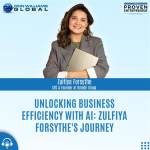
In this insightful episode of The Proven Entrepreneur Show, host Don Williams interviews Zulfiya Forsythe, the founder and CEO of the Omadli Group. Zulfiya shares her inspiring journey from corporate life to entrepreneurship, detailing how she helps businesses optimize their operations using AI and data analytics. Discover the challenges she faced, the strategies she employed, and the valuable lessons she learned along the way. This conversation is packed with practical advice for aspiring entrepreneurs and highlights the transformative power of AI in modern business operations.
Zulfiya delves into the importance of clean and reliable data, emphasizing its role as the “new raw oil” in the age of AI. She explains how her company conducts AI audits and implements workflow automation to streamline business processes. Her insights provide a clear roadmap for businesses looking to adopt AI and data analytics effectively.
For information on how to work with Don visit us at https://donwilliamsglobal.com
You can also reach out to Don Williams at https://provenentrepreneurshow.com
Tune in to this enlightening episode and discover how AI and data analytics can revolutionize your business operations. Don’t forget to like, comment, and subscribe for more inspiring stories from The Proven Entrepreneur Show!
Watch the episode here
Transforming Business Efficiency with AI: Zulfiya Forsythe’s Journey
Hey, Don Williams here with today’s episode of The Proven Entrepreneur Show. I have a great guest for us today. She comes in from Boston, Massachusetts. Her name is Zulfiya Forsythe, and she is the founder and CEO of the Omadli Group. Welcome to the show, Zulfiya.
Thank you so much for having me down.
That’s my pleasure. I love Boston. I was just there not too long ago, got snowed in, canceled my flight, but not because of weather in Boston, because of weather in Dallas, Fort Worth. How strange. And then when I did get to come home, they rerouted us and I got stuck in Memphis for a couple of days. So crazy, crazy, crazy, but not Boston’s fault, Midwest winter time. So tell us what does Omadli Group do?
What’s your superpower? Who do you serve?
Sure, absolutely. We help businesses to buy back their time in their business operations with latest technology. Either we’re looking at the AI solutions or we’re looking at basically anything to do with the data.
awesome. so data analytics, data science.
Yes,
that’s right. So when it comes to either we determine either it’s a data analytics or AI solution that’s needed to optimize this business operations, put some processes in and visibility for business owners to scale, to grow and actually know where’s what’s happening with their business. Where’s their leakage? And, you know, it’s we always want to grow as entrepreneurs, but we need what we track improves. So if we don’t have numbers that out there for us in real time,
and we just wasting so much time on manual tasks, then it’s really hard to achieve our goals.
And so many times, I mean, I’ve talked with so many entrepreneurs, so many times entrepreneurs are flying a little by the seat of their pants. They’re kind of like cowboys in the old west and yeehaw, I can do it. But if you have big data, you know, the data may actually be the most valuable asset of the company. ⁓ Just knowing what insights that data can provide. And typically you’ve got to have a professional do it.
Yes.
Yes.
or you gotta be in that business. Because it’s a very specialized skill. So how long have you been doing it?
Yeah.
Yes. So I’ve been doing that since 2021. So I’ve been doing for a while and data is like a new raw oil. That’s what it is. And especially in times of AI, it’s so important to have a clean data, reliable data, then also to have not biased data as well that you’re making your decisions upon. So you actually have got that clarity.
Data is like a new raw oil. That's what it is. And especially in times of AI, it's so important to have clean, reliable data. Share on Xtotally agree with that. It’s like the old garbage in, garbage out. Same, same, same. And in fact, my oldest son is a data scientist. And so I wouldn’t say I know a lot, but I know a little more than a little about data science. tell me, you started your business in 2021. I remember 2021. We were still in the middle of, I’ll just call it the great stay home.
That’s right.
That’s awesome.
Um, in the States, we were all kind of staying home. Um, we weren’t staying home as much, maybe in Texas as you were on the Eastern Seaport, but, but still we, we did have a little, um, market disruptor, um, 2020 and 2021. So how brave to start. me, tell me how you started your business.
That’s right.
Yes.
Sure,
absolutely. So actually I started in 2020 as a sole entrepreneur, but I’d registered my company in 2021. So I got laid off from COVID as COVID happened and I was just, all right, let me try this freelancing. Let me try to see if I can help somebody with my skills, everything that I’ve learned so far. And I remember so my first client, I applied to a bunch of jobs on Upwork, for example, one of the freelancing sites.
And then a months later, I got the first person responding to my proposal. And I was like, oh my gosh, this is real. And I was so scared because coming from corporate, you have team, have managers, you have peers, you can go back to ask questions. And here’s just persons like, I’m going to pay you money and we want to make sure you actually deliver. And I was like, ah, all right. It’s basically, I like, I don’t know if I can do this. And things needed to be turned out so fast. Like the turnaround time was much rapid.
But it turned out well and I was like, all right, I can do this. I can help people. And I got positive feedback and then I just kept it going. And then I got a full-time job and I still kept it. I went full-time working as entrepreneur since 2023. So I worked two jobs. Like I got a full-time corporate job and I still kept it and still kind of like, you know, learned a lot on my corporate job as well. I worked at the Renal Care Association. So.
I have a lot of healthcare experience looking at the patient data, treatment data, lots of kind of data. And yeah, and then just start still kept helping my clients on the side. And then in 2023 went full time.
What a great strategy for a, you know, some entrepreneurs are 18 and start in the garage, you know, the tech geniuses of the world, but many others spend some time in corporate, learn great skills. Okay. And, and then launch. And I loved that you shared, Hey, I was doing my entrepreneur thing, but it was kind of my side hustle. I had a full-time job that was paying the bills. wasn’t stressed. Okay. And then.
Yes.
Yeah.
That’s right.
I’m guessing that when the side hustle out earned the hustle, the hustle went away and the side hustle became your main thing.
I was working till two o’clock in the morning at that time. was the grind and I just, yeah.
It’s the grind. startups,
man, they’re grinding. They just are.
It's the grind. Startups, man, they're grinding. They just are. Share on XThat’s right. And I still value all the experience that my manager was giving me, all my corporate experience. Every time you would tell me, oh, well, whenever you do something, think of on the other person, of the user. How are they looking at the data? What kind of metrics they would like to see? What kind of insights they would like What kind of answers they want to get out of this?
basically out of this reporting that you put together, for example, out of this data you put together and aggregate, what are you trying to solve for them? So like I always, every time now I work with a client is still kind of like, all right, now that I teach that to my team members as well, kind of just, all right, like put yourself in the shoes of the user. Is this helpful? What kind of pain points is this solving? Is this answering their questions? Or are we just putting numbers on the, on a dashboard per se, you know?
Human Interaction 101 is how do I see it from the other person’s point of view? Everybody cares about their point of view. Nobody really cares about the other person’s point of view. And so when you’re selling, you’re just so far ahead if you can see it from your customer’s point of view. It’s much easier to deliver what they want than try and get them to want what you deliver. Just totally night and day. OK, so congratulations.
What is ROI?
Yeah.
Thank you.
Coming up
on five years, okay, that’s kind of a magic number for entrepreneurs. Like 85 % of businesses fail in five years. I’m guessing you’re going to make it. Tell me about a hard lesson. Tell me about something that happened in the Omadli Group’s experience where you’re like, that hurt.
sales. It’s a hard part is you know that you can help a business to win. You know that you can make their process efficient. You see it so crystal clear and like still kind of like trying to show them that I know I can help you, but like, let’s, let’s do this. Let’s not wait. Let’s not, not, not drag our feet. Basically let’s go buy back your time. Let’s go spend your valuable.
Sales. Yeah.
executive time into more strategy, into creativity, into like you need to, because as a business owner, sometimes we’re like strapped, right? Like, no, we can do it all. We’re trying to go lean. We’re trying to be kind of, you know, smart with their money, but sometimes it’s not really smart because we spend a lot of time. I see business owners spend a lot of time in manual.
manual processes, manual tasks, manual tracking, manual follow ups, lack of follow up because they’re overwhelming. But then when I see this, I was like, I know I can help you. So I can go and like Warren Buffett, for example, what does he do? He reads all day and then he just thinks all day. Right? Best strategists are, they go out there on a nature, beautiful nature to engage their creativity, to think of these business ideas, to expand their business.
He does, yeah.
But they need a time to process and reflect. But as a business owners, well, this is too expensive or, you know, it’s okay, I can get by, I can get by. And then it’s like just this rat race where saying things and then you see the pain. Well, my business is not growing or I’m a bottleneck or, you know, now, yeah, my business is not growing. I’m a bottleneck.
I’m spending too much money on overhead cost and then I have a high turnover from a team that I’m building also from the customers that I’m having as well.
Just about any time there’s a savings in labor, it makes sense to invest because eventually labor will chew up whatever savings you think you’re having by doing it yourself, by doing it manually. So, okay, thank you for sharing that hard lesson. What about a golden nugget? One piece of wisdom you know about entrepreneurship or data analytics that you could share with our crowd today.
that’s a good one. So I think I want to also, so this year, this is I’ve noticed, a lot of people started waking up in terms of business adopting AI and everybody’s like, I want, like, I want, I want to make sure my business is AI proof. How can I get AI? And then the reality is when I talk to these businesses, they still operate like it’s 2012. So sometimes when we look, like, all right, let’s talk, let’s look at your processes. That’s what we do, we do AI audit.
Hmm
And because I have a data background, I also say, well, you know what? You don’t need AI. This is just pure reporting automation. Or this is just workflow automation, for example. You don’t need to spend money on AI yet. And we need to clean up your data. We need to put data infrastructure so you don’t take your notes somewhere on yellow pads or keep all how you, for example, how you do your inventory management, everything in your head that you cannot scale and pass it on to someone else, for example. Just because
And then multiple teams just don’t have SOP processes. Nothing’s documented. So let’s move you into that path for success and let’s put things in order for you. keep the organization, let’s organize your business operations basically, and then move to AI together.
I love that. so let me just put those in a little different words. Maybe you need to build a proper foundation with your data processes before you build AI on top of that. If you build it on the dirt, it’s probably not going to be accurate and you’re going to be unsatisfied. And AI is evolving so rapidly that it pays to be sure that you’re doing it right.
That’s right.
That’s right.
because you could really go down a rabbit hole that you don’t want to go. Okay, toughest question I’ll ask you. Okay, I’m going to put you in a time machine. I’m going to send you back and I’m going to introduce you to your 20 year old self. Now, I don’t know if you’re in college or backpacking across Europe or in the merchant marine. I don’t know what you were doing when you were 20, but you’re going to get
Yeah.
about 60 seconds to share something you know today you wished you knew then that would have helped you along your path. Okay, so I gave you a little time to think there. Into the time machine you go. Sophia, meet Sophia. What would you say?
would say believe in yourself and the ideas that you have, just try them. Just whatever the ideas, if you want to create certain type of business or service, try it small, start somewhere. Don’t doubt yourself and don’t ask for permission of someone telling you, yeah, this is a great idea. You should go do it. Just do it. you want to bake something and sell it to others, if you’re really passionate about the food, or if you want to do data analytics, go help businesses and put data together.
and help them to get the clarity on their business. Or if you want to launch a jewelry, go do that. If you’re passionate about that and then just something small that you don’t need to take permission from someone else to go do that. And then it’s okay to fail.
love that. And so it all starts with mindset, learn something new, act on it, go do something, and then realize, and some entrepreneurs kind of have a perfection mindset, okay, which makes it hard for them to accept failure. But truthfully, failure is not the opposite of success. It is in fact, part of the success journey.
Failure is not the opposite of success. It is, in fact, part of the success journey Share on XYeah.
And what I’ve found about 150 interviews so far is that the bigger, the big successes followed a big failure. Little successes followed little failures. It’s almost like if you add them together, it all evens out. Yeah, it is.
Yeah, it’s endurance. It’s like sports. When you go
out there and then how much pain can you endure is how far you can go.
Endurance is like sports. When you go out there, how much pain can you endure is how far you can go. Share on XYeah, don’t quit. Keep going. OK, Sophia, how would we reach out to you? How would we reach out to a Omadli group?
Yes.
Absolutely. So you can find me at Zulfiha Forsyte and omadligroup.com. And then you can also find me on LinkedIn at Zulfiha Forsyte or Instagram. share daily on tips and tricks on AI and solutions. And actually, if you want to message me and say like AI, I would know that you come from this podcast. Say like, Don AI, that I know that you’re coming from this podcast. And then I will share with you just a quick AI assistant that I…
that I have for you.
love that. Sophia, thank you so much. It’s been my pleasure to host you on The Proven Entrepreneur Show.
Thank you.