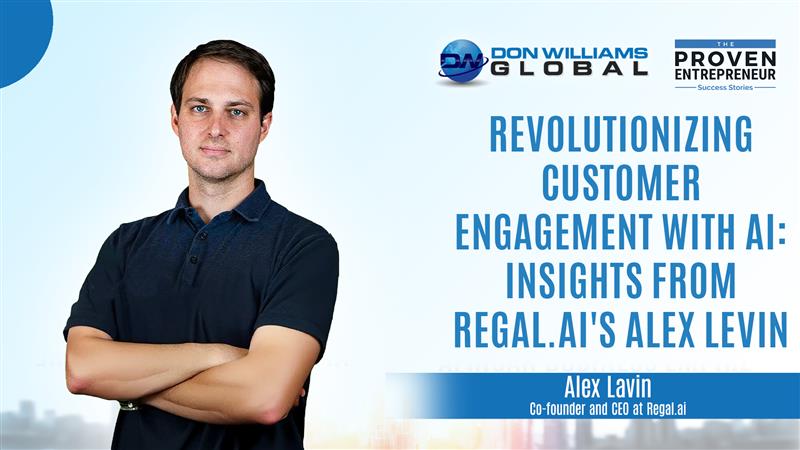
Welcome to The Proven Entrepreneur Show, where host Don Williams brings you transformative insights from the world of entrepreneurship. In this episode, Don sits down with Alex Levin, co-founder of Regal.ai, a company at the forefront of AI innovation in customer engagement.
Alex Levin shares his compelling journey from a traditional business background to leading Regal.ai, a tech company revolutionizing customer interactions with advanced AI agents. Discover how Regal.ai’s AI agents handle 20-40% of customer interactions for large enterprises, making voice communication not only efficient but also cost-effective. Alex delves into the evolution of AI technology, the economic benefits of voice AI, and the strategic decisions that have propelled Regal.ai’s growth.
The underlying technology now makes it so that there's no implementation costs. Share on XKey Topics Discussed:
- The role of AI agents in customer interactions
- Economic advantages of voice AI over traditional methods
- Alex Levin’s entrepreneurial journey and lessons learned
- The future of AI in customer engagement
- Strategic decisions that led to Regal.ai’s growth
This episode is packed with valuable takeaways for top executives, entrepreneurs, and sales professionals. Learn about the economic advantages of AI in customer service, the importance of maintaining high hiring standards, and the benefits of a usage-based pricing model. Alex Levin’s insights offer actionable advice on leveraging AI to enhance customer engagement and drive business growth.
Never lower your standards when hiring. Share on XIn this episode provides sophisticated yet accessible insights into the world of AI and entrepreneurship. Alex Levin’s story is not just about facts; it’s about the transformation and discovery that unfolds as he navigates the challenges and breakthroughs in the tech industry.
For information on how to work with Don visit us at https://donwilliamsglobal.com
You can also reach out to Don Williams at https://provenentrepreneurshow.com
Tune in The Proven Entrepreneur Show to gain valuable insights into the world of AI and entrepreneurship, and discover how Regal.ai is revolutionizing customer service. Don’t miss this episode packed with actionable advice and inspiring stories!
Watch the episode here
Revolutionizing Customer Engagement with AI: Insights from Regal.ai’s Alex Levin
Hey, Don Williams here with today’s episode of The Proven Entrepreneur Show. Got a really good guest today. have Alex Levin, co-founder of Regal.ai. So AI that’s actually doing something, not just somebody that’s an AI expert, which the world seems to be full of. Alex, welcome to the show. Yeah, thrilled to have you. So tell us a little bit, what does Regal.ai do?
Thank you for having me.
We build AI agents for large enterprises and help them customize those agents for their specific business and their specific customers. And I’d say most of our customers, AI agents now do between 20 and 40 % of the volume of customer interactions, whether it be support or sales or maybe some operational use cases like scheduling and reminders.
And so I think I know the answer to this. So mainly voice application, right?
Yeah, we’re very long voice. So when I first started in contact centers, was taught contact centers are a call center. Just get rid of those interactions. And what do you do? You hide the phone number, you make self-serve flows, you do everything you can to send people to a chat bot, whatever it is. And…
you know, that solves one problem, it lowers your costs, but actually like it makes customers feels like you don’t really care about them. And that’s bad, right? Because it creates a turn problem among your customers as there were loyalty. So I think I understand why businesses thought that, you know, talking with the customer on the phone with a human was expensive. The nice part is now with these voice AI agents, it’s not expensive. It’s actually the cheapest way of engaging with the customer. So voice went from being the most expensive to the cheapest channel.
you know, which really changes how you can think about engaging with your customer. You know, could put a phone number everywhere now. You can have the IGN in your app and, you know, there’s zero wait time. There’s no sort of retraining, right? Their agents act like your best agents constantly. They have access to all your data. So it’s a very different experience for the customer.
You know, people often ask why now like this pro this idea has been around for a long time. What’s changes the LLMs the underlying large language models from open AI, Anthropic, Meta, Google are getting billions of dollars pumped into them and the quality of those models. And the sort of more realistic voices that are available now have made this finally like really possible. And so it’s, you know, super exciting for me because I’ve been in this industry for a long time that we can finally search really use AI agents in production and
give people back this voice channel. It’s funny, when you see the youngest generation, they’re not sort of text first. They’re so used to Siri and Alexa and voice notes and whatever, they’re like immediately on it. It’s actually kind of the millennials that were kind of sent to text and sent to chat and SMS that are kind of the weird ones. But the older generation and the youngest generation are like already voice first. So it’s actually my generation that maybe is a little bit behind.
Yeah, I love that. And so I don’t know if you know this about me, but I’ve been in the contact center business for 35 years. And so, Oh my.
So you’ve seen a lot of these transitions and a lot of
this promise. Like, you know, we’ve been promised for years that there would be better automated voice, whatever. And I don’t know, for years it was pay 500 grand upfront and 100 grand a month just to like train the models and blah, blah, blah. It just wasn’t worth it and it wasn’t good.
Something has changed. The underlying technology now makes it so that there’s no implementation costs. You pay a variable fee per minute, the eyes on the phone. The quality is great. Like, CSAT is between 85 and 95 % for these agents. Like, it’s a completely different product now.
Yeah. Love that. Love that. know, just let’s talk about the economics, you know, so, um, if a U S company is outsourcing to us contact center, they’re probably paying 40 to $60 an hour for, for that communicator. If they’re hiring internally, maybe it’s a little less, maybe it’s 30 an hour loaded. If they’re going offshore, maybe it’s 15 an hour, but when they’re
automated, it’s a fraction of even that number, and there’s no subjectivity. The system is going to answer appropriately every time.
Yeah, and the other thing
that people sort of forget is the 15 an hour is 15 an hour for 60%, 65 % utilization. So AI agents, if you’re spending 10 cents a minute, it’s whatever that amount of $6 an hour, but it’s 100 % utilization. So the $15 an hour is not comparable directly to the AI agents. What we usually do is take people through an exercise. go US-based labor is around $1 a minute per talk time.
Offshore is maybe 30 cents a minute per talk time and AI agents are 10 cents. So it’s a fraction of the cost for the talk time. There’s no after call work. There’s no bathroom breaks. There’s no I’m going to quit. It’s a different world.
totally different world. So appreciate that. Okay, I want to take you all the way back to little Alex. So your family home five to 18 years old, and everybody’s home was a little different, but in your home, was there an entrepreneurial adult? Was there an example for you?
Yeah, my father worked for a small business and sort of, you know, eventually like bought the business from the previous owner. And so like we saw sort of, you know, buy low, sell high, like make margin and like what, you know, how do you hire people and what happens? So that was definitely useful from an early age. And, you know, coming into like college, things I thought were normal, but understanding, you know, revenue and employee, like just were foreign to other people. So that was certainly helpful. I think I never wanted to be in sort of the type of business my father was.
is
just a more traditional business. When I left school and saw tech business, I said, that’s a whole different way of doing it. Like, let’s do that.
Yeah. Love that. And it’s, it’s interesting when, when the kitchen table is also the boardroom table sometimes for the conference room table, you know, kids just pick up a certain amount, you know, kind of by osmosis. So after that, you went to university, you joined the merchant Marines. What’d do?
Yeah.
So, I left home pretty early. My brothers and I all left at 13 to go to boarding school by choice. We wanted to sort of have a different kind of experience for high school. And then all of us went to liberal arts colleges. So it definitely like as a family, we believe in education and through liberal arts education. So I studied philosophy and psychology, which is not very useful, let’s say for the direct job I’m doing, but more and more, I do think that the skills around
know, reading and writing and sort of influencing and convincing people of things like those are the most valuable skills. so highly recommend the role arts to people, not sort of a functional education in college. And then, like I said, I realized I didn’t want to be an academic and I was very interested in going into business. And I realized that if you were going to be the CEO of a company one day, you had to understand how the sausage was made. They weren’t going to put somebody, a CEO that hadn’t figured out how you build software. And so I.
need to be an engineer necessarily, but I went and became a product manager to work with engineers and help build product.
Awesome. Is Regal AI your first company?
So I have been to many different companies, never as the founder and CEO. So before this, I’d always work for the founders. And it’s interesting to see how different people organize the company and run it and do initiatives and goals and those things. And there’s some things that you take and some things that you don’t like. And so finally then, five years ago now, my co-founder and I said, want to be the, we have something we believe in and we want to be the ones who are the ultimate arbiters. And so, obviously now sort of on a new adventure.
Yeah, I love that. And so it’s always somewhat of an enigma to me. And I don’t think you’re the sole, but the entrepreneurs that launched their entrepreneurial journey in their forties or fifties that come out of corporate. they worked at Hewlett Packard or they worked at Apple or FedEx or wherever they worked someplace really, really corporate, but they have unbelievable skills that that entrepreneur who started in his garage when he was 19, he probably doesn’t.
He may have them now, but it took him a long time to put all that together.
Yeah, look, but I would,
I would put both the 19 year old and the HP one person, you know, health, sorry, if you were a packet person in the same bucket, which is they don’t have enough at bats at the things that matter for early stage companies. So at early stage companies, so much of it is setting goals, hiring, firing, doing the tactical day to day work. Neither of those people have the skill.
The skill that really, the only way to hone that skill that is so important is being at early stage companies, maybe not as a founder, but again and again and again, because that’s where you’re learning that stuff. The 19 year old just has never seen it. And the HP one person had other people doing all this stuff for them. Sorry, the Huard Packard person had other people doing it for them.
Yeah, they’re going to see it for the first time when it’s live and when it’s really important. That’s not good.
Yeah, which is not good. You know, I get a lot of…
texts
and emails from friends going, how do I do this thing? it’s like, well, stuff that was second nature to me, because I’ve been at these companies for a long time, stops them for a week. And in the end, that’s the whole game is how do you move more quickly than the company next to you? And if you are stopped constantly by these things, it’s bad. You know, I recommend to everybody go work for somebody. If you want to be an entrepreneur who has a similar size company to what you want to do and learn on their dime, go make mistakes where they’re going to pay for them. And that’s the trade-off. They’re going
okay with it. If you build a good company for them, they’re willing to pay for your education. And so like do that. Don’t go learn and spend your own money making mistakes.
I think that’s wise counsel. Maybe why the average entrepreneurial business does not survive five years. They just don’t have, they’re under capitalized, not only cash, but knowledge and people and it takes all three. So looking back, how old is regole.ai? Five years, congratulations. Okay. And looking back across the last five years, I want to ask you about a hard lesson. something, something that
Yeah.
Five years.
an event that was like, ow, that kind of hurt, or maybe that really hurt. But maybe today with a little more perspective, turns out it was really a positive in your path.
So
lots of hard lessons. I don’t know how many of them were true positives now. So like in terms of learnings, I’d say the best one always is never lower your standards when hiring. Every time I’ve gone and said, well, we really need this thing. And I know this person doesn’t do X, let’s just like fudge it. It’s a bad decision. And so I think that’s the most important one to keep a bar on is make sure you have people that fit the criteria you’re actually looking for for that role.
you know, terms of positives coming out of something like that, yeah, we have a different hiring process now, you know, look for different profiles, like have a team that we’re very excited about. So eventually, you know, you do sort of get better at holding that standard, even when things are sort of growing very quickly. But that’s one of the hardest ones, I think, especially if you’re a small business and there’s not three salespeople, there’s one. So if you hire the wrong salesperson, that’s really important. There’s not three finance people, there’s one, you know, so a lot of times I talk to small businesses,

people and they feel, you know, kind of held hostage by some of their employees because they feel like, well, the employee doesn’t do what I want, but I can’t do anything. I can’t say anything because if they were to leave, I would be done. Well, the good news is probably you’d be fine even if they would, you know, left and you should sort of move more quickly to create a world where it’s going to be a better situation for the company and for you.
Sure.
Yeah, I love that. And after many years as an entrepreneur and many years as a consultant, it almost always boils down to the who. The what’s important, but it’s not nearly as important as the who. Having the right people in the right seats with the right mission. So, okay. Thanks for sharing that. What about a warp speed moment? Things are going along pretty good. And then all of the sudden you make a certain hire, you make a strategic move and
You get that hockey stick growth. Anything like that you can share with us.
Yeah, I mean, I think some are due to us. Some were just due to the market. You know, for a long time, we’ve been talking about how to use better data to drive automation. And there was a lot we could do, but it’s only in the last 18 months that really the technology has enabled us to truly have autonomous AI agents that are handling and gate, know, these customer conversations entirely on their own. So that was a technology change outside of us that led to sort of a lot of sort of growth. think internally, you know,
One of the decisions that was very helpful for us is instead of pricing on a normal sort of SaaS basis, we price on a usage basis for customers, which basically means that they can come in and say, you know, I think I’m going to spend this much and there’s some, you know, price we give them for it. And if they use more, they spend more. If they use less, they spend less. And, you know, I think that is very freeing and allows customers to grow faster. The downside to usage based or consumption based pricing is if you don’t have committed guarantees from the customer,
means that if they go through a bad time or things are down, you can also have revenue drop. So there’s positives and negatives, but ultimately I think we found a pricing model that both allows customers to get onboarded very quickly and then we allow them to commit to dollar amounts to get discounts, which gives us certainty that the revenue is gonna stay.
Yeah, I love that. And in that industry, in the contact center, call center industry, the direction for pricing has kind of been going that way for a while on technology, humans, the whole thing. And so, you know, kind of pay for what you use. And many times, just for the audience, many times there’s going to be, you’re going to have a minimum commitment. Okay.
Yeah.
what used to be, and Alex referenced this earlier, what used to be really cripplingly expensive, know, call center technology and automated call distributors and IVR and all that stuff that used to be, you know, you could very easily invest a million dollars in a small call center. Okay. Now, pretty much you can get everything you want, including an AI
agent who’s actually going to speak at regal.ai, actually going to speak and interact with your customer. They’re never going to oversleep. They’re never going to be late. They’re never going to go to lunch and not come back. None of those people problems that contact centers are kind of known for. And I’m in that business. So I’m not derogatory towards contact centers, but it is part of the reality.
No, and
it’s both ways. So it’s not only that it’s hard for companies, it’s not what a lot of people want to do. Like the churn rate is like 40 or 50 % a year in that role. there are great roles in contact centers, and those will stay. the escalated managers, the people designing scripts, the people figuring out what to do for customers, those roles are not going to go anywhere. But the tier one repetitive, brutal job for collecting payments,
AI is better at that and it’s not a job that a human really loves to do. you know, allow over time the AI to take that so the humans can focus on things that are higher order rather than sort of the first tier.
Yeah, love that. And for anybody who’s paying any attention to AI at all, you’ve seen how fast AI is improving. mean, when ChatGPT came out, I guess it was 18 months ago now.
seems and, and truthfully, it’s moving so fast now. I was speaking with somebody the other day and they’re like, you know, we basically recalibrate every 90 days because what we were working on and that technology we’re so far beyond that. And,
Yeah,
particularly we work with large businesses and for 18 months a lot of large businesses are trying to work directly with OpenAI or Anthropic or Google to build AI agents for contact centers into their business or for calls into their business.
Most of them are moving off that premise now because in 18 months they’ve seen to your point so much change and even with 100 dedicated people and they haven’t been able to keep up and they’re starting to realize that the better mode during this high change period is to work with companies that are responsible for staying on top of what is possible. Look, there may come a day where the change slows down and in that case,
Some companies will build it themselves and some companies will use sort of, you know, self very self-serve platforms that are quite easy. But in a time where it’s changing very fast, what I think even very large businesses are seeing is that you’re better off working with a vendor who’s going to partner with you than it is, you know, working by yourself, trying to build these tools.
Yeah, totally agree, because it’s just moving at the speed of light. So, okay, if I could open your brain, okay, and I said, Alex, I want one golden nugget to share with the audience, okay, something that you hold near and dear to your heart that’s been very beneficial to you in your entrepreneurial journey. Do you have a nugget you could share?
Yeah, you know, and I think it’s a bit trite, but I’ll use it anyway, which is so much of life is just sort of showing up and being curious. You know, I can’t tell you how many opportunities I’ve gotten just because, you know, I’ve been interested in something. I’ve showed up, I’ve asked a question and I, you know, I understood or I didn’t understand and I kind of went a little bit down the rabbit hole. Like that’s where opportunity comes from. Like, you know, I think if you have the time in your life, you know,
So much of life is just sort of showing up and being curious. Share on Xbut you have the time in your life to engage with something deeply like that and be very curious. I think personally, you’ll get a lot of fulfillment. And I think that’s how you then find real opportunity. The people who come in and say, well, I want the promotion or I want X, it’s not how you get it. that’s not, yeah, it comes from the process, not demanding the outcome.
Yeah, love that. And so I think the Japanese concept is Shoshin, which approach everything with a beginner’s mind and some curiosity and see what you can learn. And as I advise my clients, you could be one meeting, one phone call, one learning away from massive change in your life.
So many entrepreneurs, know, one, some major client that totally changed their business and their life. And so, don’t think you know everything. You might know a lot, but, but open your mind and learn when you can. Okay. Toughest question I’m going to ask you. Put you in a time machine. It’s like Star Trek. I’m to take you all the way back to 20 year old Alex. And you got 30 seconds.
to share with your 20 year old self something you know now, you wish you knew then, that would have been beneficial to you since that time. So in you go, Alex meet Alex, what say you?
Yeah, I don’t think I would change that much. mean, perhaps like, you know, within my world, it would have been in San Francisco faster rather than New York. I think New York has become a very big tech hub, but when I started, I wanted to try and stay in New York and East coast. And it just wasn’t where all the learnings were. And I had opportunities to go work for, you Google and other sort of early war then, you know, Facebook, like very exciting companies that I didn’t take them. And that was a mistake.
Okay, yeah, hard to notice, but that hindsight sometimes is so much more clear than…
No, but
even then it was clear that there was more happening in San Francisco. I just was caught on the idea that I wanted to be on the East Coast where I had family, where I had more relationships, where I thought that there would eventually be a potential. And it was just raw. You don’t have to think so long term. I could have gone to San Francisco for three years and had an incredible experience. It would have been transformational the amount I’d learned. I would have learned much more there than in New York.
Yeah, love that. Okay, sir. How can we support you? How can a listener reach out to you?
Yeah, if you’re doing a lot of phone calls with your customers, especially if you’re a larger enterprise, we’re happy to help show you how our customers use AI agents to automate more and more of these calls. We do also have AI agents for email and text and chat and other channels as well, if that’s interesting. And you can go to regal.ai or email us at hello at regal.ai.
Love that. Alex Levin, thanks for coming on the show today. It’s been my pleasure.
Thank you for having me.
That’s today’s episode of the Proven Entrepreneur Show. We’ll see you next time. Thanks. Bye.