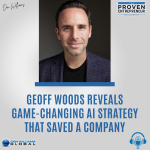

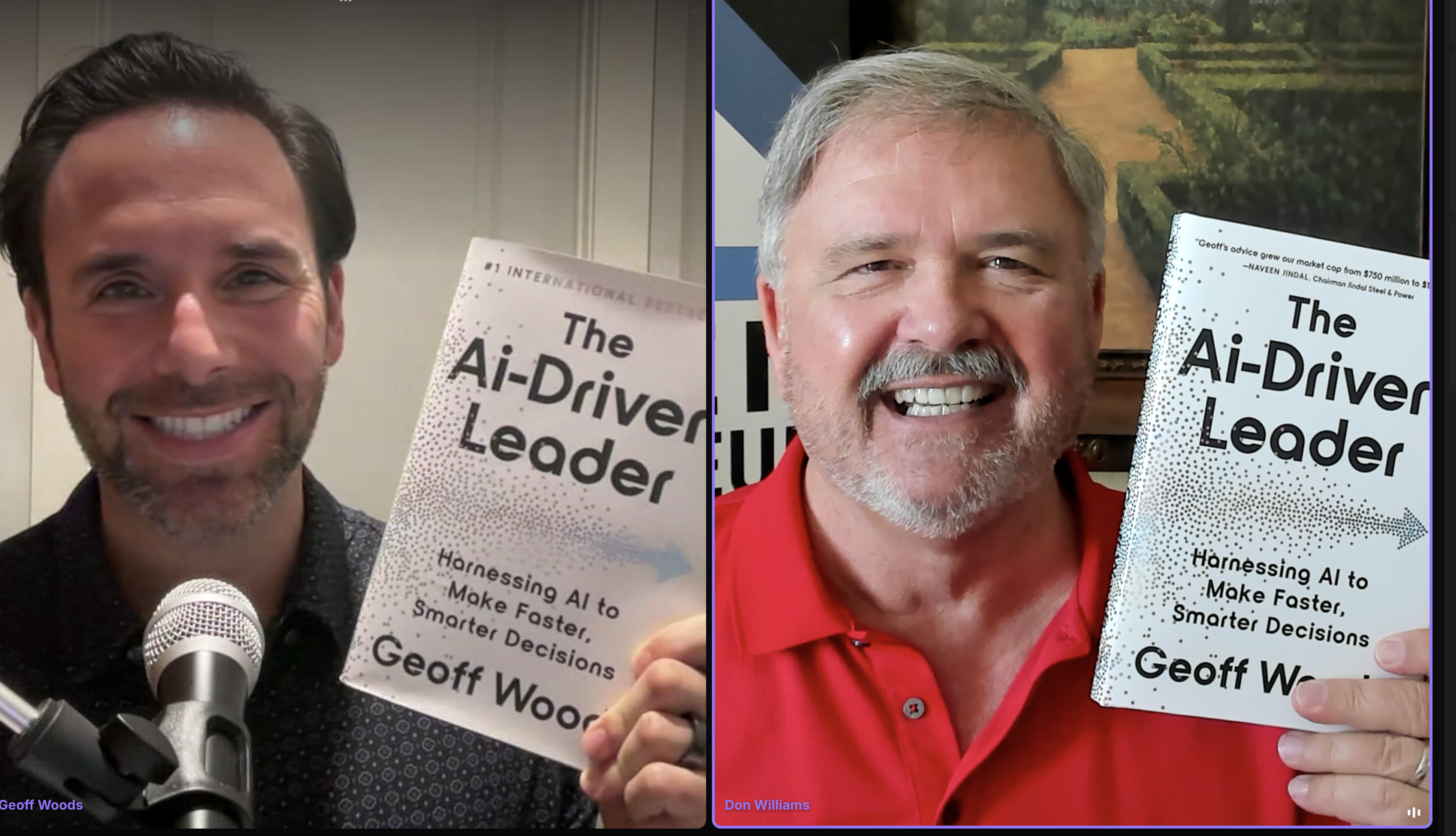
Welcome to The Proven Entrepreneur Show. In this illuminating episode of The Proven Entrepreneur Show, host Don Williams sits down with Geoff Woods, author of the #1 bestseller “The AI Driven Leader” and founder of AI Leadership. From his surprising start as a professional hip-hop dancer to becoming a transformative force in AI leadership, Geoff shares his remarkable journey from medical device sales to scaling companies and driving billions in growth.
Discover how a chance encounter with “The One Thing” authors Gary Keller and Jay Papasan changed the trajectory of his career, and learn about his groundbreaking work at Jindal Steel, where he helped drive the company’s market cap from $750 million to $12 billion. Geoff reveals his innovative approach to AI adoption, introducing the concept of AI as a “thought partner” rather than just a tool, and shares a powerful real-world example of how this approach saved a manufacturing company from bankruptcy.
The conversation takes an intimate turn as Geoff opens up about personal challenges, identity, and the valuable lessons learned along his entrepreneurial journey. He also introduces The Collective, his vision to unite 10,000 executives in leveraging AI for positive business transformation. Whether you’re an executive looking to harness AI’s potential or an entrepreneur seeking inspiration, this episode offers invaluable insights into the future of leadership and technology.
For information on how to work with Don visit us at https://donwilliamsglobal.com
You can also reach out to Don Williams at https://provenentrepreneurshow.com
Don’t forget to subscribe to The Proven Entrepreneur Show for more success stories, actionable strategies, and the best of entrepreneurial wisdom!
Watch the episode here
Geoff Woods Reveals Game-Changing “AI-Drive Leader” Strategy That Saved a Company
Hey, Don Williams here with today’s episode of The Proven Entrepreneur Show. Man, do I have a mind blowing guest for you today. I have author Jeff Woods, just published the AI Driven Leader, great book. I multiple copies. I’ve been giving copies away. Jeff, welcome to the show. Man, I’m thrilled that you’re here today. So I’m going to take you all the way back to little Jeff. So age five.
Thanks so much for having me, Don.
In your childhood home, okay, was there an adult entrepreneur in your home that set an entrepreneurial example? Was your kitchen table the board table? No. Okay. all right. Love that.
But this became a defining moment for me, actually, because, yeah, so, you know, great parents, they always encouraged me, do your best, forget the rest. Very supportive, but I followed very much the traditional path. Work hard in school so you can get into a good college. Work hard in college so you can get a good job. And over the course of probably the first, man, seven years of my career, I was so focused on climbing the ladder.
Please share.
that I wasn’t asking is the ladder even leaning against the right wall.
And it came to when I was in medical device sales and I was very successful, President’s Club winner every year, making a ton of money, great work-life counterbalance, but I was completely unfulfilled on the inside because deep down, growth is my core value. I felt like I was playing below my potential. And for me, that was actually painful. And I remember vividly being in Lake Tahoe for our national sales meeting.
Love that.
walking out of one of the sessions early, because I just couldn’t stand it anymore. I’m staring up at the mountains and asking myself, when in the world am I ever going to be able to build a business that makes a big impact in the world and delivers real security for my family? I walked into the, uh-huh, I walk into the next session and on every chair was a copy of a business book called The One Thing.
What a great, defining moment.
which had been written by Gary Keller, who started Keller Williams and his co-author Jay Papasan. Jay walks on stage, delivers an amazing keynote, and the whole time he’s talking, Don, I have this Jim Rohn quote in my mind that you’re the average of the five people you spend the most time with. I had five amazing friends at that point. I didn’t have any amazing mentors. I didn’t have any entrepreneurs that had big businesses that were making a big impact in my life that I was investing time with. And I found myself thinking.
What would my life look like if Jay or Gary Keller were two of my five? And when Jay came off stage, I literally sprinted down the side of the ballroom and almost tackled the guy. And that began a relationship that ultimately what I had no idea was that the one thing had already become one of the highest rated business books of all time. But that created a problem because they wanted to make it a company. But Gary’s one thing was running Keller Williams. Jay’s one thing was writing books with Gary. My one thing became the one thing.
They became two of my five and they taught me to think and act like a CEO and scale big companies.
I love that. Now, so Jeff, I’m going to take you back to little Jeff again or bigger Jeff. Okay. cause cause I want to, I want to connect the dots from childhood to, I did the right thing. got good grades. got into a good school. got a good job. Okay. So what was your first J O B? What’s the first thing you did?
Yeah.
You
where people put money in your back pocket for your effort.
I was a professional hip hop dancer in high school. Dead serious.
I love that.
So I’ve done about 150 episodes. You are the first and maybe the only ever professional hip hop dancer.
Yeah. Yeah, yeah. Yeah, I
my very first jobs was I got paid to dance.
I love that, love that. Okay, so when you graduated school, left your parents home, where’d you go to university? UT, Santa Barbara. Okay, UC, Santa Barbara. Excellent school. Okay, and you majored in entrepreneurship.
UC Santa Barbara.
So this was actually interesting. It was my my senior year, I’m doing an internship for a tech company. And right before graduation, I sit down with the CEO and I asked him, what job should I get after school? And he looks at me Don and he says, Jeff, you are asking the wrong question. You should be asking, what are the skills I can master that are so valuable, they’ll serve me no matter where I go. And what jobs will help me develop those skills? Best career advice I’ve ever had because I was so focused on
attaching myself to a job fitting inside a box and he’s saying no, what are the skills that if you can match them put you on a certain trajectory. Based on my my personality, he suggested I go into sales. So he said go work for Xerox or IBM because you’ll get the best sales training in the world. So I went to work for Xerox, found out that people don’t really like their copy or rep that led to medical device sales, which then led to entrepreneurship.
Well, medical advice sales pay so much better than copier sales anyway. It’s a different scale.
It does and you can try to get
and you get to wear scrubs and try to get your wife to call you McDreamy.
there you go. So I got to ask only because you offered. Did she, does she? No. yeah. Okay. All right. Well, your wife sounds like my wife, you know? Yeah. So we have that in common. Okay. So you had your defining moment at this conference. The one thing became the one thing. When, how long did it take you to launch into entrepreneurship?
No, absolutely not. Absolutely not. Hey man, I still got things to aspire for.
Yes.
Yes.
Well, that was entrepreneurship because they literally Gary and Jay said, we’ll be your board. will allocate a set amount of dollars. I was the president and the co-founder. had to start the business from nothing and scale it. But I had them as my mentors and guides.
It was right then.
Wow.
Well, and great, I mean, Gary Keller, great mentors, built a little real estate empire, Keller Williams, largest in the world. And so, but I also want to point out something to the audience. So, Jeff had some stimuli. He saw Gary Keller, he had an epiphany and he acted. I ran and almost tackled him. Okay. And so many times,
If you’ll just have the courage to ask, act, and then ask somebody, you’ll be surprised at who might say yes.
So this was another defining moment. It was Jay who was speaking on stage, Gary’s co-author. When Jay finished speaking, 1500 people in the audience gave him a standing ovation. Every person sat down and I was still standing. The defining moment for me was my mind was telling me to sit. My heart was telling me to go.
My mind was telling me to sit. My heart was telling me to go. - Geoff Woods on seizing opportunities Share on XOkay.
And I literally remember going, you’ve got to do this. it like, I was trying to protect myself from failing or maybe being rejected, but the heart won. And that’s what led me to sprint down the side of the ballroom and opened the whole door.
I don’t think you know this, but my second book, I’ve now written eight, published six, two in editing, Romance and Your Customer, but it talks about following your instinct, your intuition and your heart. Don’t ignore your intellect. You need your brain. Your brain’s really important, but it’s so much easier to influence people if you play from your heart. Okay. And so I love, love, that. Okay. So tell me.
Mm.
Mm. Mm.
100%.
Are we still operating that company? What company do you have now? What do you do now? Who do you do it with? What do you like to do?
Yeah, so fast
forward. I own AI leadership, which is a company that helps executive teams strategically adopt AI to accelerate growth and build a competitive advantage. How I went from the one thing to that, I scaled the one thing, sold my interest back to Gary and Jay. I had a two year non-compete, went in-house with a client called Jindal Steel.
which is a giant steel company out of India. I had been coaching their chairman, Naveen Jindal and several of his execs. And when he found out I left, he said, hey, would you come in house? And I said, maybe, what’s the job? And he said, you tell me. And so I stepped in as chief growth officer over all their companies, which they had about 100,000 people across the world, India, Middle East, Africa, Australia. I took them from 750 million to 12 billion as a market cap in four years. While I was there, part of that was AI.
I saw ChatGPT when it literally within 30 days of it coming out and hitting the world. And I had that college mentor in my head saying, what are the skills you can master that are so valuable? They’ll serve you no matter where you go. And when I saw AI for the first time, I saw it as a skill to acquire. And so I just prioritized figuring this thing out very quickly realized that using it to write a better email was a waste of time, but started asking, what are the things I need to do?
What are the skills I can master that are so valuable, they'll serve me no matter where I go? - Game-changing career advice by Geoff Woods Share on Xas a C level executive of a public company that deliver the highest returns. And the answer was strategic thinking and decision making. And so I asked how my AI helped me think more strategically or make faster, smarter decisions. And the moment I cracked that, I was at the chairman’s house in India and I made the pitch. I said, this is the future. And he goes, I agree. I said, we should drive this through the whole company. He goes, I agree. I said, this is so important that you should own this as chairman of the board. And he goes,
I disagree. You do it. Which being an entrepreneur, I immediately committed and said, yes, walked out of his house and said, shoot, I don’t know what I’m doing. But a lesson I learned from Gary Keller is that anytime you’re hitting a ceiling of achievement, you’re just missing a person. And so I asked, who am I missing that if I could bring them into my world could help me gain the capability to drive AI through our organization, that person became Google.
And so now I’m in India every quarter, I’m at their headquarters in Gurgon and they’re teaching me how the technology works. How do you identify use cases? How do you tune models? And after driving it through the company and seeing results, that’s when I was like, okay, I’ve got a bigger opportunity for me to step out and write a book about this and build a company about this. So that became the AI driven leader, which hit number one. And then AI leadership, I just feel like I’m bear hugging a rocket ship right now and it’s awesome.
Love that, love that. And there’s another principle there, the principle of just saying yes. So the chairman asked you to do something. You didn’t actually have it all figured out. Okay. Not qualified. I was being much more generous than you. Okay. Not qualified. I didn’t have it all figured out, but still said yes and said, I’ll figure it out. And untold fortunes in entrepreneurship through all of history from people who said yes.
I was not qualified.
when common sense probably would have been to decline the opportunity. But many times other people can see things in you that it’s sometimes hard to see when you look in the mirror. So, love.
So true. And I’ll
take that back. I was qualified because nobody knows what they’re talking about in AI right now. So but I did have the right mindset to say I will stick with this and I will acquire the relationships and whatever I need to have the skills and the rest is history.
I love that. And I think with AI, I remember when chat GPT first rolled out, okay. And it was like, okay. And then, in my own companies, we are, I would say high level users of multiple flavors of AI, video, audio, text, et cetera. However, even though I think we’re a high level user, I actually met you.
I watched you speak on stage and you shared one, and it was like a couple sentences and the entire talk was phenomenal. But in those couple sentences, was like, that is a game changer. It was collaborating. I’ll let you tell it. I know what I’m talking about.
What was it for you?
using AI
as your thought partner and having it interview you.
Yeah. So do you mind sharing a little bit about that?
Yeah, sure.
Sure. So most people who are using AI, well, let me back up even further. I literally interviewed over 200 executives one on one for my book, the AI Driven Leader. This blew my mind because 100 % said it was the future. 100 % said they would adopt it. Less than 5 % had done anything. And the reason why is they didn’t know where to start. And then they felt like they were falling behind.
So for me, it was about how do I show an executive how to go from zero to one using this in a way that matters at an executive level. And what I knew from my own personal experience is that the majority of people are using AI like Google or like an assistant. They’re going into it like a really smart Google, asking questions and expecting answers, or they’re treating it like an assistant to help them do 80 % of their work.
that really only drives 20 % of their results. It’s their to-do list. I have built a career on getting executives to focus on the 20 % priorities that drive 80 % of their results. So I don’t care about the 80 % on your to-do list. I don’t care about treating it like Google because at an executive level, your ability to think strategically is the difference between growing your business
or going out of business. But there are all these things that stop us from not enough time, not easy access to the right data, biases and assumptions, pressure to do more with less and deliver results yesterday. Those kill your ability to think strategically. But if you, instead of viewing AI as Google or an assistant, if you raise your standards for it and view it as a thought partner that has to interview you,
by asking you one question at a time to help you think through your most complicated problems or come up with non-obvious solutions to achieve your most ambitious goals, baby, can you find another level of performance?
And let me just repeat, it’s baby, because I met Jeff, listened to him speak, I don’t know, six, eight weeks ago. Okay. And unbelievable in my own experience of using AI as a collaborator and to help me be a thought leader and the amount of clarity and how much deeper it’s able to provide solutions.
is off the chart.
Yeah, can I share an example of what this really looks like? So I sat down with a group of CEOs, I did a forum, and so you probably had eight or 10 guys in the room. And I just asked, what are your biggest problems that if we could use AI to help solve them would unlock a new level of growth for you? Now, even my question off the beginning is going to frame it to the 20 % that drives 80 % of the value. I’m not like, give me some simple way you might be able to use AI. I don’t care.
Please do.
I care about you driving growth of your business. I wanna talk about those things. One guy looks at me and says, okay, that’s easy. I run a manufacturing company. I leased a whole bunch of equipment from this company in Japan. Things have shifted in my market and the debt structure is bankrupting us. We have to get it restructured or we will go out of business. And I go, okay, what have you done? And he goes, we tried everything.
We did this, we did this, we did this, we did this. He’s listing off all these things he tried and he said, none of it has worked because this is a publicly traded company in Japan and it’s gone all the way to the board and they are refusing to restructure the debt because they think it will make them lose face in Japanese society.
I have no next step. We’re probably going out of business. Can AI help? Don, that last question, can AI help, is the question. Your ability to make an impact with AI is only limited by your imagination of can it use it for a specific situation? And the answer is don’t know, but approach with curiosity and try. So I literally pulled up in this case, chat GPT, nothing special. And I gave a
Framework for a prompt that I probably use 90 % of the time I think of writing prompts like Ingredients in a recipe when you cook dinner for your family you pull certain ingredients out of your fridge and you use them my favorite recipe for communicating with AI is context role interview task Context you got to give it lots of context role you tell it who you want it to be so you can tap into that person’s
expertise because AI has been trained on 200 million books worth of data. I’m not an expert in every situation, but AI can be if you give it the correct role. Interview, you ask it to interview you to pull things out of your head so it can accomplish a task. So context, role, interview, task. So here’s what the prompt was. Context. I run a manufacturing company. We leased a whole bunch of equipment from a company in Japan. Things have shifted in the market and the debt is now killing us. We’re going to go bankrupt if it doesn’t get restructured.
Here’s all the things we’ve tried. One, two, three, four, five. I listed every one in detail. None of it has worked because this is a publicly traded company in Japan. It’s gone all the way to the board and they’re refusing to restructure the debt because they think they’ll lose face in Japanese society. I have no next step. We’re probably going out of business. That was the context section. So some of you who are listening to this are going, it can do that? Yeah, this is not Google folks. This is a different game. Roll.
You are an investment banker with deep expertise in restructuring debt. Interview me by asking me one question at a time, up to three questions to gain more context. Then I want you to complete the task of generating five non-obvious strategies I could deploy to get the board to restructure the debt. That was one prompt context role interview task. Sent it.
Yeah.
And it immediately came back and asked, do you have relationships with any influential executives in Japan that this board would respect? Don, I look at him and he goes, my gosh, I would have never asked that. And I’m thinking, of course not. You don’t have 2000 years of Japanese society in your head, but AI does. Turns out he did. He knows a lot of the right people. So we feed it back to AI and then it asked two more questions about how he had navigated.
Japanese society in the past and came back and said, here’s your five non-obvious strategies. Number one, it called the saving face consortium. Said you have enough relationships with the right people in Japan, approach them to acquire the debt. Give them really favorable terms. Your debt will get restructured. The board will save face. Don, I look at him and his whole body language has changed. And I can tell he’s holding back tears.
And he literally looks at the guys in his form and he goes, I have not slept in 90 days. I had been making peace with the fact that we are going out of business. But in less than 10 minutes, I got hope. And we texted a few months later, Don, and he said the ball is moving and I actually think this is gonna get done.
The power of strategic thinking and AI: From hopeless to hopeful in 10 minutes. Real story shared by Geoff Woods Share on XAmazing. And I love how you frame it. So I’ve a voracious reader my whole life. I a big stack of books behind me. Those are on my to-do list. have books everywhere. But, I don’t know how many books I’ve read, thousands literally, but not millions. Okay.
And even
of those thousands, which you’re probably better than most, what percent of that collective knowledge can you recall and apply in any moment?
I tell my wife all the time, my brain is full. For me to bring in new information, I have to push something else out. I’m just full.
Yeah. And this, this
is the thing, everybody who’s listening is you have been wildly successful based on your ability to apply the minority of what you have learned, which is insignificant compared to the collective information of the world. So if you can realize that with your thought leadership, you are the thought leader, you can partner with AI as your thought partner to tap into infinite amounts of data.
that it can recall 100 % of in under a second. Your thought leadership plus its thought partnership is a crazy synergy that you can use to build a competitive advantage.
Crazy, crazy synergy. Crazy, crazy. Almost magic. Almost magical. Yeah. Okay. So thinking back into your entrepreneurial career, it’s a new mouth. I’m just trying it out. Tell me about a hard moment. Something that happened sometime, because it’s not all unicorns and rainbows. We know that. Something that happened sometime that when it happened, it’s like, ow, that hurts. But maybe in retrospect, it turns out that it was
Yeah. No.
Yeah.
Very, very positive, though at the time it certainly did not feel positive.
It always is if you’re measuring correctly. When I exited the one thing, I sold my stake. I woke up the next morning feeling deeply depressed. When I was a kid, I was bullied pretty severely and I grew up frankly hating myself. And for me, success became the bandaid to heal the wounds that never healed.
Hmm.
Hmm.
I thought if I could be more successful, then people would respect me or like me. And when I got to become the face of the one thing, this is a very popular book. a, you it came with a lot of notoriety, a lot of respect. Suddenly, I’m going into the boardrooms of fortune 500 companies facilitating their strategic planning, and they’re looking to me to do this stuff. And it worked. I mean, the things that it did for that six year old version of Jeff that’s still inside and hurting
it was it pacified all of it, but never healed it. And when all of a sudden I woke up and said, I’m no longer the face of the one thing I didn’t know who I was. Because I attached my identity to my work instead of aligning my identity. And the thing that I learned here, Don was, you are you not what you do. And that led to six months of deep inner work of rediscovering who am I.
Yeah.
And how do I, moving forward, make sure that I align what I do with who I am? And the big gift here was when you look at AI, so many people are afraid of it taking their jobs. When I think subconsciously they’re afraid it’s gonna take their identity, because they’ve attached themselves to their work. And this has put me in a position now to be able to look at people and say, AI can only enhance you.
because it can never replace you.
Yeah, I totally agree. think it’s a hollow argument that AI is going to replace humanity. To me, it’s humans first, AI second. And that’s just what it goes. OK.
Yeah. Now let’s be
clear, AI will, this is the same in any technology. I literally, chapter two, I studied all the major technological disruptions. Technology changes the skills that we value and the processes that we follow. Your job is the skills you apply and the processes you follow. It does not take jobs.
It changes the skills that are valued and the processes that are followed, but it does not eliminate the need for the human. What it does do is free you up from things that are currently occupying your time that frankly you’re playing below your level. And it frees you up to rediscover who am I and how do I harness my unique strengths as a human that I can never replace to deliver even more value.
If you’re a growth minded person, you see it as an opportunity. If you are a fixed minded person, you see it as a threat.
Yeah. It certainly is that 80-20 rule. It allows you to concentrate on the 20 % that 80 % of your results will come from, where you can actually be in your purpose. And when you are in your purpose, life can almost be magical. Things just happen better. Okay. So, maybe the toughest question I’m going to ask you. Okay. So I’m going put you in a time machine. I’m going to send you all the way back.
to 20-year-old Jeff. You’re going to get about 60 seconds to tell 20-year-old you something you know now you wish you had known then that would have sped you along the way, prevented an issue, basically benefited you in some manner. So into the time machine you go. Here’s 20-year-old Jeff. What do you share?
You can have everything in life you want if you help enough other people get.
so love that. Okay. I don’t know that Zig said it first, but you know, and when you are, when you write books and you’re a thought leader, sometimes you’re like, did I think that? Did I hear that? I’m not sure Zig actually said it first, but he said it loudest and most often. Yes, it is. And, and you know, maybe rightly so. So Jeff.
It. Yeah.
Add to it, it’s attributed to Zig Ziglar.
Great interview. Thank you so much. Like they say in court, I reserve the right to recall the witness. I already see another episode sometime, but if someone in the audience wanted to learn more about you, wanted to learn more about your company, how would they reach out?
Sure, so first, if you have not read the AI Driven Leader, it’s everywhere, Amazon, Audible, ebook. It hit number one in its category for a reason. It is packed with use cases and actual prompts that you can use. There’s a full-blown prompt library at the back of the book. I highly recommend you pick up a copy of that. The website is aileadership.com. The core of what we do, Don, I believe,
that if you try to navigate AI alone, you’re going to lose. It’s just moving too fast. And then you’re also competing against the big dogs that have more money. And so I genuinely believe that no one succeeds alone and the greatest path forward is together. So my vision, the core of our business is called The Collective. I am creating an executive network of AI driven leaders. And my vision is that over the next 10 years, we have 10,000 executives who are all driving AI in their company for good.
and that we are centralizing our knowledge on how we’re using it so that my team can then create all the playbooks and roadmaps and systems that you need to drive this in your company. And we give it to everybody. So you learn more in a year than you could in a lifetime. And if you are an executive who believes AI is the future, who wants to drive it through the company, but just isn’t sure what steps to take,
That is the place that I would encourage you to check out. You can check out the collective on AIleadership.com. It is application only. It’s very tightly curated because we want to make sure that we have the right people in the room doing this, but we’re literally creating the future of work together.
creating the future of work together. I love that. Okay, folks, this is the book. It’s everywhere. Get a copy. Reach out to Jeff at his company. Jeff, thank you so much for joining us on The Proven Entrepreneur Show today. Thanks, folks. We’ll see you next time on The Proven Entrepreneur Show.
It’s my pleasure, Don. Thank you.