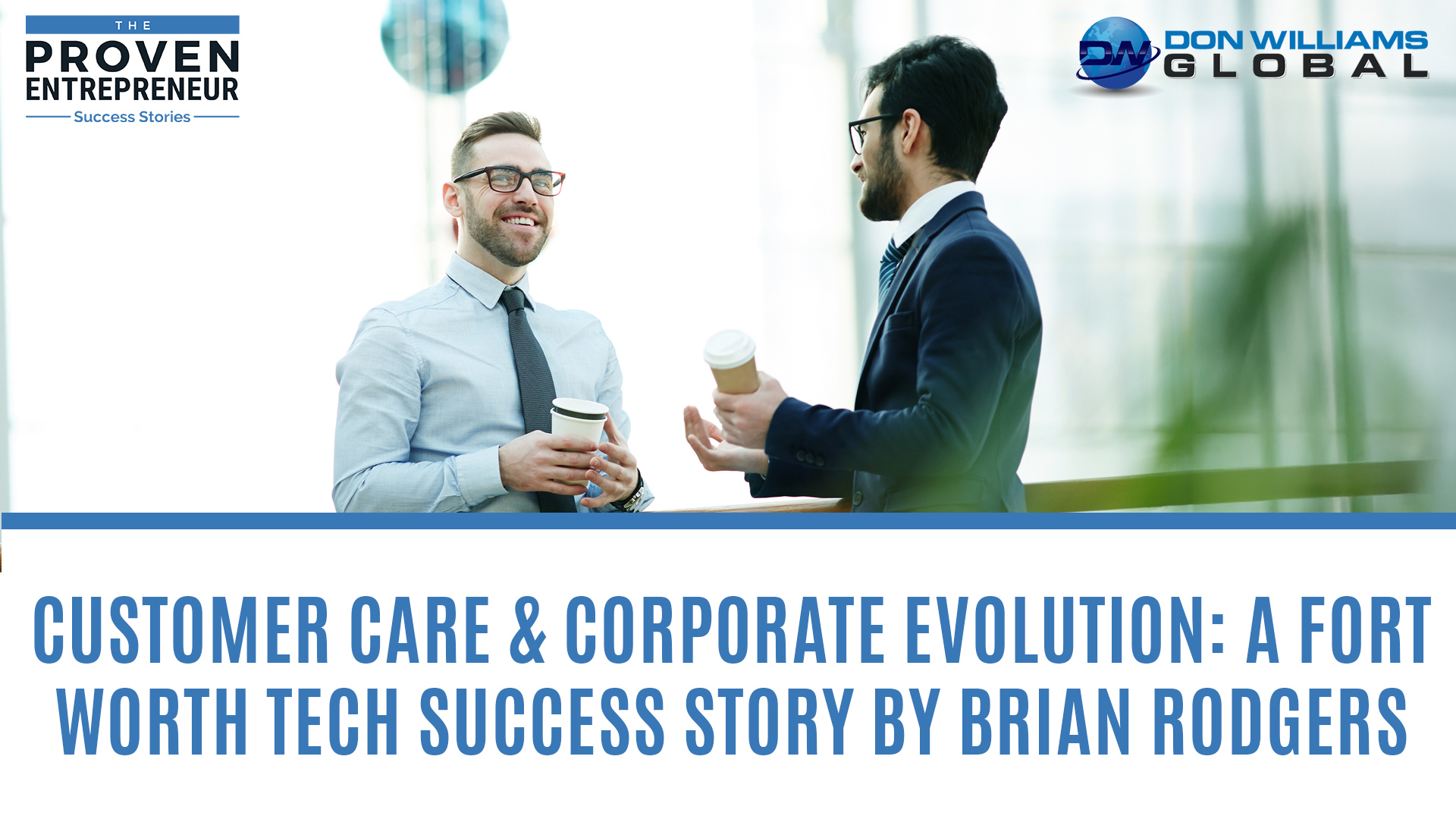
In this electrifying episode of The Proven Entrepreneur Show, host Don Williams sits down with Brian Rodgers, the visionary founder of Aeko Technologies, to unpack a remarkable entrepreneurial story that proves success knows no age limit.
At 41, Brian made the bold leap from corporate IT director to entrepreneur, transforming his passion for serving people through technology into a thriving managed IT services company. Listen as Brian shares his raw, unfiltered journey of:
- Breaking free from soul-sucking corporate environments
- Turning a borrowed office space into a growing tech business
- Navigating the challenges of the 2020 pandemic
- Learning critical lessons about customer communication and team leadership
- Overcoming self-doubt and embracing personal strengths
Dive into a conversation that’s part business strategy, part personal development, and entirely inspiring. Brian’s story is a testament to the power of purpose-driven entrepreneurship and the importance of believing in yourself – no matter your age or background.
Whether you’re an aspiring entrepreneur, a seasoned business owner, or someone seeking motivation, this episode offers invaluable insights into building a successful business with heart and purpose.
Don’t miss this powerful conversation that will challenge your assumptions and ignite your entrepreneurial spirit!
For information on how to work with Don visit Work With Don Williams
You can also reach out to Don Williams at https://donwilliamsglobal.com.
Watch the episode here
Customer Care & Corporate Evolution: A Fort Worth Tech Success Story by Brian Rodgers
Hey, Don Williams here with today’s episode of The Proven Entrepreneur Show. I am so excited for our guests today. One, very good friend of mine. Two, client. Three, super entrepreneur. Welcome to the show, Brian Rodgers.
Thanks Don, appreciate being here.
man, we’re thrilled to have you today. And so you are close friend. And so we’re both in the Fort Worth, Texas area. You’re kind of south and I’m kind of north, but Fort Worth is somewhere in between us. And you’re wearing purple today and you wear purple a lot. Why do you wear purple, Brian?
Proud Horned Frog alumnus from TCU. And I’m so proud that it became my company colors and went from there.
Yeah, there you go.
Yeah, awesome. so tell us the name of your company and what you do.
So name of the company is Aeko Technologies. Aeko is the Hawaiian word for eagle. And it came out of me talking to my young kids whose school mascot was the eagles at the time. And we were trying to find a name for what was a techie company. I said, I need something that sounds techie. And they went through Google Translate and found it. And it’s actually worked out really well. We are an IT managed services provider.
Where essentially, to summarize it, we act as the IT department for small and medium-sized businesses. We take, I come out of the corporate IT world, recognizing that there’s a need to bring some of those standards and those norms to the small business space and Aeko was formed.
Yeah, awesome. And so how long have you owned Aeko Technologies?
So I started Aeko in October of 2016. I started it from scratch. It was me sitting in an office that was borrowed from an attorney friend of mine who had a spare place for me to sit. In May of 2017, I was able to acquire a local competitor. And that’s when I was really able to kind of bring on certainly revenue, staff, and things like that to really kind of get going.
Yeah. So basically grew the company primarily through acquisition or significantly, maybe better said. Yeah. One big jump. Awesome. And, and started out in 16. So you were a ripe four years old when we had that pandemic, stay at home, don’t go see people thing for about a year or so. And, I’m sure that was somewhat challenging in your business.
Mm-hmm. One big jump to be sure.
huh.
Was yeah, I was I was actually out skiing when the toilet paper shortage of 2020 began We were up in the mountains and On the drive back on that saturday is when all the this discussion of what was going to be happening? With the state getting shut down and everybody having to stay home was going on and I had been keeping in touch with my staff and That sunday I went ahead and said before
Actually, the decree came out. said, guys, we’re going to execute our business continuity plan. Go ahead and stay home. And of course, we have a business continuity plan. was like, yeah, you know those Fridays that I sent you home to go work? That was to kind of verify that we could do this. And my team killed it. Our workload went up 300 % for the next few weeks. Our ticket load just exploded. And if we looked at our static ticket load, you
We have tickets that will cross over from day sometimes because we’re waiting to hear from vendors, waiting to hear back from the client, things like that. Even with a 300 % ticket increase, our static load only increased by 50%. So they worked really well. Our business continuity plan worked. And yeah, it was quite a rush for a while.
Sounds like you are taking care of your customers in challenging times. And around here, we call that romancing the customer. Yeah, so great. So I want to take you all the way back.
Absolutely.
little Brian so not before five years old not after 18 years old but in in your home I think you’re from El Paso Texas in your home was there an adult who set an entrepreneurial example when you were a child
I am.
Yeah, it was an interesting path actually. So my dad was a firefighter in El Paso. I don’t know how many firefighters you know, but the schedule really lends itself for them to have something else. And my grandfather was starting a propane business with two of his friends, so three older gentlemen that needed a strong back. And so they brought my dad in as…
really kind of if you think about it was really dismissive he was really just there to be the strong back. I the name of the business was DGNF it was Davila Glover and Flores no Rodgers and he was there I mean he was just there to be the grunt and over the years he ended up being the last man standing they you know for various reasons were buying out each of the partners and the one owner who didn’t have his name on the sign or his initial on the side was the one that
survived and along the way my mom became part of it they made a great business tandem because you had my dad as the visionary go go go kind of person and my mom kind of doing the back office saying whoa whoa whoa and and doing that kind of complementary stuff from a from a business standpoint and it worked really well that was where I had my first real job was working there also starting at the bottom digging ditches
mounting propane tanks, know, doing those kinds of things. So yeah, very much had a very entrepreneurial upbringing.
Man, I love how you put that. One partner, and of course they were partners in life and in business and everything, but one partner, go, go, go. And the other partner, whoa, whoa, whoa. Yeah, I love that. And even though, you know, I poke a little fun at that, it’s actually, as we know, a pretty high performing model for successful entrepreneurial companies, where you have the visionary,
LOL
who sees the big picture, sees the horizon, sees things that maybe aren’t on the horizon, but they imagine or could be out there. Yeah. And has typically a pretty good case of, shiny, I’m going to chase that. And then the implementer or the person whose trains run on time and things make sense. And that’s a really…
other side.
pretty high performance model and entrepreneurship. And many times you see even in, like with your folks’ where it’s one of those ironies of life that opposites attract. And probably a good thing, just saying. So your first job, you were working at the propane company and now you are the strong back.
Hmm hmm.
Right.
Uh-huh.
One of, it was, you know, I was, I had a lot that I was learning, not just in the propane world, you know, it’s in El Paso and I was speaking Spanish more than I was English, working in the back areas when we were doing carburetions on buses and fabricating frames for, I was doing all kinds of really wonderful things. Now, finding a leak.
Yeah.
under asphalt that was a hundred foot section of pipe or 50 foot section of pipe, you know, on the hottest day on record in El Paso, those kinds of things were not fun. But, I mean, really by and large, it was a, it was a really great first job to kind of make you appreciate maybe what you want to do and what you don’t want to do.
Yeah, love that. I know that my first paying job, I drove a liquid propane John Deere tractor at Wheat Harvest. And I learned that day what hard work really was and that I did not want to be a farmer. Yeah, I’m not going to be a farmer and I love the outdoors. You know, I like better than being out there, but I’m not going to be out there and do that for sure. So.
huh.
And he did not want to do that.
Okay. What about your first paying job? Maybe it was even a company. It was your own company, but that wasn’t the family business where you stepped out on your own and whatever that might have been.
So I came up here to go to TCU, started out pre-med. It was my organic chemistry professor that convinced me, or class, not the professor himself, but the class that convinced me I was not going to med school. And my degree on that front was psychology. And I bring all this up to say I graduated with my psychology degree, was not wanting to go back and get my master’s, which you have to do in psychology to get a job.
So I got into IT with a psychology degree. My first job was an instructor at New Horizons Computer Learning Center where I was teaching adults how to do Microsoft Office stuff, write web pages, learn how to use email, and then moved on into start doing the more technical stuff where I was teaching them Microsoft classes, to pass their Microsoft exams and get their Microsoft certification. So that was…
That was my first job out of college that was not actually working in the family business.
Awesome. Now, I didn’t know, and I know a lot about you, I didn’t know about the psychology degree thing. Yeah. So I’m just guessing that your bachelor’s in psychology meant you had to find a job in something else. And so that’s how you went into IT. Okay.
Yes.
Absolutely. I was always a nerd. was something that I was not it was not something I was going to major in. It’s not even something that I intended to pursue as a career. The theme for any of that stuff, whether I’m talking about initially wanting to be a doctor, then wanting to get into psychology and interestingly enough into IT, is that I’m not I wanted to be able to bless people and serve people. And so taking care of people as a doctor.
helping people as a psychologist. I realized neither of those were gonna be in my future with what I was willing to do to get there. technology was something that was always a strength for me. It was always something that I did well, whether I was a big nerdy nerd or yes, I was that. But whether I was really wanting to dive into it and make it a lifestyle, which I guess is the distinction. I was not wanting to do that, but I was always…
strong in the area and it was a way that I could bless people and help people out with something that I happen to be very good doing.
Yeah, awesome. Okay, so I know that immediately after that job, you did not start a company or you did not start Aeko. What was your career path?
Yeah, so that opportunity gave me an opportunity to move into what I call doing real IT work, where instead of teaching people to pass exams, actually doing the work. And I got in with a very small energy company. I was the sixth person hired on that oil company. It was a very forward-thinking oil company that wanted IT to be a big part of it.
That company was being bought by a larger S &P 500 energy company here in town. I was terrified that I was going to lose my job with that because you always think this was a $10 billion company at the time on its way up to $16 billion at one point. And I thought for sure they had everything handled in IT. There was no way they were going to need to add me for this little penny any company that was added.
But as it turns out, they had a really big need in the IT department. And I was unbelievably blessed to be able to make my way up through the ranks, get to be director of IT relatively quickly, and have purview over the entire spectrum of IT. So normally, I had a high figure budget. I had 60 people on staff. I had very substantial, had substantial memes as it went.
And generally when you have those kinds of means, you’re very siloed. You are either an infrastructure person or an endpoint person or a systems person, networking, things like that. And I was able to grow up through that and have purview over the entire spectrum of IT and have management over the entire spectrum of IT within a $16 billion S &P 500 company. So it was an amazing experience from a growth experience and knowledge experience.
to be able to go through that.
Amazing experience. So, let me put you on the spot. How old were you when you walked through that door from employment to entrepreneurship?
41 I never actually did the math to look at it. But yeah, I was 41 when that when that shift happened
41?
Yeah.
And, and so I would just say to the audience, regardless of your age, some of the best entrepreneurial companies are not started by what I would call kids. You know, Brian was 41 when he started his journey. think Colonel Sanders was 68 or something. and so, entrepreneurship is for everybody. it doesn’t matter. It doesn’t matter what your age is. If you can.
Entrepreneurship is for everybody. It doesn't matter what your age is. If you can solve customer problems, maybe you can be an entrepreneur.. Share on Xsolve customer problems, maybe you can be an entrepreneur, because that’s what we’re all doing. so I love that. started your company in 2000, just decided, hey, I’m going to be an entrepreneur.
You know, I found myself in a position needing to figure out what I wanted to be when I grew up. And, you know, I, if, if you’ve had any time in a corporate environment or look at any of the standup jokes about it, people in their companies or watch the office, mean, any, any area you see that universally corporate it people are disliked. and so it’s for, for reasons that are sometimes out of the control of those individuals, but they.
It’s just a, it’s they’re the butt of the jokes. They are disliked. They’ve seen, they’re seen as impediments and none of that was why I got into IT. I did, I got into to help people and I found myself, even though the company was a phenomenal company, I actually had wonderful coworkers. I had an amazing staff. I had all that stuff kind of that was working there. but it was in,
the phrase that was given to me that I realized later, it was soul sucking because I was fighting, was adversarial every step of the way, fighting with VPs, fighting with managers, fighting with end users for things that all I was trying to do was get them along their path to being productive. And that was not an environment that I wanted to step back into. And so I was really looking to figure out, do I get out of IT entirely? I put 20 years into it.
So was not something I was real excited about getting out of, but at the same time, was not, I don’t do IT for the sake of IT, I do it to bless people, and it’s not, I wasn’t given that opportunity to do that in those environments. And it was after that that I learned about the MSP model, where people that are hurting, or people that are scared, people that have needs, invite you in.
you
And you can solve their problems and then you can keep the problems away. And it was just a, it was kind of a big aha moment. And that’s really what opened up the concept of doing it. the company that I ended up ultimately buying in May of 2017 is what I started to try and buy in August of 2016. that deal fell through the first time. I said, forget it. I’m going to start this on my own because I really believe in this model and believe in what I can bring to the table for that.
And then ultimately came back around in May of 2017.
Yeah, love that. So as we look past, look into the past, you have a hard lesson you can share. So something that happened that when it happened you went, ugh, that hurts.
Yeah. So, company that I bought was not perfect. it wouldn’t have been for sale if it were, finding out how imperfect it was, was a, was a shock. And one of the areas, that you will be particularly sensitive to is that they did not romance their customers. having conversations as we’re talking about, you know, if, if Tim calls in with a ticket,
And one of our support guys says, that’s just Tim. I can get to him tomorrow. And my head just exploded. And so really needing to change the culture to have the team recognize that they needed to care about the end user’s problems more than the end user did sometimes. Tim may have been totally fine waiting until the next day. That may have been a true statement. But I didn’t want that to be the expectation. And so.
I was having a difficult time turning that ship and it was punctuated where we had a client that was a school and their schools are notoriously difficult to support anyways because the teachers have very finite windows in which you can support them and you can get to them. This particular school was having money problems anyways so we were having to patchwork things in just to help them do things.
For reasons I still don’t know, mean, faith is a big part of my thing and I really think this was just something where God was just gonna use this no matter what because I really can’t, I can’t tell you any concrete reasons as to why this happened or why I even had the feeling that was coming up, but I was telling my team, we need to give special attention to this school because we’re getting ready to lose them. And I’m taking a look at the tickets and at the time we did not have the systems to really gather.
the right information for me to really evaluate what’s happening on the calls and things like that. And I just kept telling them, we’re gonna lose them. said, no, no, you’re fine. We’re fine. Me and her, we’re tight. We’re good. And we lost them. They called me into a meeting. said, they’re gonna fire me. They’re gonna fire us in this meeting. I’m telling you. said, no, no, no, we’re fine. And they did. was, they all ganged up on me. There were things that…
that they were just things that brought up that just totally caught me off guard because we were not gathering the right data, things that were likely embellished. But ultimately we lost that client and the 100,000 a year that went with that client, which at a time that we couldn’t afford that. And that was a kick in the gut to the team that thought they had it licked. I mean, there were clients that were at risk, but it was not this client.
I was telling them that you guys have got to trust my gut on this. that I can point to that as a big turning point on my staff where they really kind of hit it. And because I care about my people, I hated to see them be as down as they were because they were really beating themselves up. But I did my best not to coddle them through it just say, we’ve got this. You better start listening to me.
We turned it around.
Love that. Can you share a couple of strategies you used to elevate a team’s viewpoint on customer experience so that you prevented further occurrences of that type of situation?
You know, it really, what it amounted to is making them understand the importance of communication. there were, there were some times where they were having to execute on a problem where they were trying to work through a problem that it, just took time. was no way around the fact that it was going to take time. And, and really the amount of time they were taking to perform the task was not unreasonable. The problem was they were not.
staying in touch with the customers to let them know or even setting expectation ahead of time. And what we we started to find out is like if we set that expectation ahead of time, if we let them know long before that we’re not going to meet a deadline for whatever reason, a vendor doesn’t get back with us, part doesn’t come in, whatever’s going on. But if if we tell them before we miss the deadline as opposed to after we miss the deadline, then it all goes much, much better.
And in almost all cases, the problems that we were having were result of lack of communication and a lack of clarity, either coming from our team, most frequently coming from our team at the time, or them not taking the time to understand what the customer was giving us. Sometimes there was some nuance in the statement that we really needed to ask more questions on to get clarifications, opposed to just assuming, excuse me, assuming what we knew what was going on.
I love that. Clear communication is paramount in any successful organization, even if what you are getting clear on you don’t want to hear. It’s still probably what you need to hear. So thanks for sharing that. What about a warp speed moment? So things are going pretty good, and then all of sudden you have
Clear communication is paramount in any successful organization, even if what you are getting clear on you don't want to hear. Share on XYou ride that hockey stick and now things are going really, really well.
You know, it would be 2023, but not for any reason that I could really point to. Sales in our industry are very, very difficult. There are notoriously long sales cycles. IT is very personal. That was another thing, actually, getting back, I’m sorry to get back to the question which you were talking about. How did we turn around the opinion of Ramansi, the customer? The other thing I had to convince them of is how…
Personal IT is to them. It’s business but to our staff it’s business and then we’ll get to it and we’re done but For them it’s this is how they’re putting food on the table This is how they are getting to their you know, their kids softball games and things of that nature. So That’s a very personal thing to them and when it doesn’t work they take it personally and so that was one of the things that we were needing to do so
I’m sorry for that tangent. As far as the big jump that we ended up taking, it was in 2023. All the work that we had been doing leading up to that was finally hitting. And so we were adding one or two customers a month for a pretty extended period of time, which is good trend for a company our size in this space. That came to a screeching halt as the election year came up, but that’s pretty cute.
That’s good.
That’s pretty typical because again, IT is so personal. Anytime there’s uncertainty, whether you think it’s going to be good, you think it’s going to be bad, that uncertainty stops you until you know what kind of certainty you can get.
YYeah, I love that. Thank you. Okay, so now want you to dig into the files. I want to know a golden nugget. I want you to share something that you hold near and dear as instrumental to your success.
You know, this kind of falls in with a something that I wish I had gleaned and learned a long time ago. I was always of the opinion that if I needed to know something, I’m a smart guy. And so if I needed to know something, I was smart enough to figure out how to do it. And what this did is this prevented me from really leaning into
I don’t want to say self-help books, but just leadership books, books of understanding, ways to expand my own personal thought process. so kind of needing to check the ego at the door and put the hubris away and understanding that you don’t have to adopt everything that you read. don’t have to agree with everything you read. You don’t have to agree with everything that you hear, but it’s worthwhile going out to seek.
the advice and the information and ways that you can expand the way you’re
Love that. think diverse opinions, diverse thoughts makes a team so much stronger. And I know in my own entrepreneurial career for many years, I thought I was the smartest person in the room and then in a lot of rooms I was, but that just meant I was in the wrong room. I used to be with other people who knew things I didn’t know.
And you know, this, that, very phenomenon is what actually bit me in the butt as I was leading in that one of the, I talked about how wonderful my growth was and how great an opportunity it was to get into that position. But at the same time, I didn’t have, and this is in, the oil company that I was in, but I didn’t have any formal management training.
anything along those lines, I literally was winging it as I went. And as a result of that, that created some uncertainty and uncomfortableness and making me feel like I was, you we talked about imposter syndrome and I really felt like at times I did not belong in the role that I was in because I didn’t have the confidence to recognize it’s because I did. had amazingly smart people in the room.
I did that by design because I wanted the smartest people doing what I needed them to do, but it created a situation where I was uncomfortable in that role. And, and I, so there was that hubris that was, that was bumping up against this, this discomfort and it, and it made me, it was quite obvious to, think the people that I was managing, that I was not comfortable in that capacity as opposed to embracing.
The fact that those people are smarter than me at what they do and that’s by design and I’m in my position because I deserve to be here and I’m okay with that.
wise words for sure. Okay, I’m going to put you in a time machine. I’m going to send you all the way back and you’re going to get about 60 seconds to share something with 20 year old Brian that Brian today knows, but you wish you knew back then that would have sped you along your journey or saved a few rough edges. And so into the time machine, you go back.
Okay.
20 years. Brian, meet Brian. What do you say?
Well, I would start with what I just talked about. You’re not as smart as you think you are. So, so pay attention to what’s going on around you. I follow that up with you’re stronger than you think you are. And it’s not as hard as you expect it to be. You know, that hubris really created roadblocks for me, but even bigger roadblocks were me doubting my strength, my ability to execute on what I was, did know and was capable of.
And then it also translated into thinking that’s going to be a lot harder that I’m prepared to put in the effort and do that. So I wouldn’t have changed the timing other than perhaps maybe starting into more of a business educational role. My business education came through my years primarily working at that second energy company because I worked under the CFO. I was two layers from the CFO.
I was in meetings with him all the time. I learned a ton about the operation of the back, specifically the back office of a company and looking at the numbers and the accounting and financing. And so I don’t think I could have changed. I don’t think I could have been successful without that experience going the path I had gone. But appreciating that I can take more risks and be successful because I’m stronger, I’m more capable, and it’s just not going to be as hard as I thought.
I love that. You know, one of my favorite quotes is, you’re far smarter, far stronger, and far better than you think. And I think that’s true of almost everybody.
I may have stolen that from you and not even realized it.
Well, hey, I stole it from Christopher Robin in the book Winnie the Pooh. Absolutely my favorite philosopher of all time. So how do we reach you, Brian, if we need managed IT services? How do we get in touch with you?
You
So the easiest thing to do is just to go to the website, www.aekotech.com , A-E-K-O-T-E-C-H.com. If you need to reach me specifically and directly, there’s a book of consultation fee, not fee, page, and you can get on my calendar and we can talk through whatever problems you might be having, see if there’s an opportunity for us to solve some problems for you, because it’s really what we do is we fix problems and prevent them in the future.
That’s kind of what we like to do is trying to see if we can do that. But the website is by far the easiest way to book an appointment with me.
Awesome. So there you have it folks. Go to the website, book a consultation, reach out to Aeko Technologies. Brian, thank you so much for being on the show today. I’m grateful.
Thank you, Don. I’m very grateful myself.
See you guys next time on the Proven Entrepreneur Show.
Maybe I’m gonna stop if it’s gonna let me.