Welcome, podcast lovers and entrepreneurial minds!
If you’ve ever wondered what it really takes to build a thriving business on your own terms—without investors, employees, or even a traditional office—this episode is your front-row seat to the truth behind the solopreneur journey.
In this episode of The Proven Entrepreneur Show, host Don Williams sits down with the one and only Moe Choice, a fiercely independent solopreneur who walked away from a successful business empire in Dubai to rebuild from scratch—on his own terms. What drives someone to leave behind wealth, reputation, and comfort? What does freedom really mean when you’re building a business solo?
Topics Discussed:
- The difference between a solopreneur, entrepreneur, and business owner
- How Moe made $15K/month using just his LinkedIn profile
- Why “build it and they will come” is the biggest lie in business
- The role of personal philosophy in long-term success
- How to build a personal brand that actually converts
- The mindset shift from approval-seeking to market-driven action
- What Moe would do in the first 48 hours if he had to start over today
This isn’t just another entrepreneur mindset podcast—it’s a raw, real, and refreshingly honest look at what it takes to succeed as a solopreneur in 2025. Whether you’re figuring out how to start as a solopreneur, looking to master LinkedIn for solopreneurs, or searching for the best solopreneur podcasts to fuel your journey, this episode delivers.
Ask yourself:
- Are you building a business—or just building a trap?
- Is your brand aligned with your values—or just your vanity?
- Are you waiting for the market to notice you—or are you showing up with value?
If these questions hit home, hit play. This is the personal branding podcast episode you didn’t know you needed.
Tune in now and discover how to build a business that’s profitable, purposeful, and 100% yours.
Watch the episode here
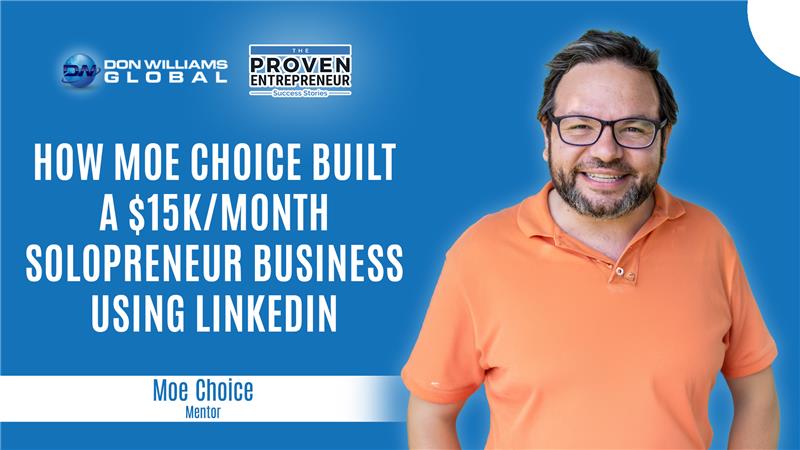
How Moe Choice Built a $15K/Month Solopreneur Business Using LinkedIn
Hey, Don Williams here with today’s episode of The Proven Entrepreneur Show. I have a great guest today, Mo Choice. Mo is a solo entrepreneur and he’s dialing in today from London, though he lives here in the States. So welcome to the show, Mo.
Yeah.
Thank you so much. Thank you for having me. I appreciate it.
I’m gonna have a lot of fun with the Mo. Like, welcome to the show Mo. So there we go. right. Family home. Did you have an entrepreneur in your household as you were growing up?
No, my father became a business owner when he left his job, but I was 11 years old when that happened. So I learned a lot of ideas around business from my father because I started to pay attention to the detail, let’s say. But I was around three years old when I realized I didn’t trust adults.
I looked, you those big people, don’t seem to know what they’re doing. So I’m going to have to figure it out on my own. And by the age of five, I realized I didn’t like people telling me what to do. I mean, I don’t even like telling myself what to do, to be honest, but I definitely didn’t like other people telling me what to do. So I started to pay attention to how am I going to live my life where I get to choose. And so was very difficult to handle for my mom and dad, and I was very difficult to handle at school. But I wasn’t a troubled child or anything like that.
It was more, know what I want and I’m gonna do it my way and if you’re gonna get in my way, I’m gonna snap at you. So I built habits pretty quickly in terms of being a solo operator, I would say.
love that and you know many entrepreneurs I think non-entrepreneurs think that entrepreneurs enter business ownership out of a profit motive and certainly some do but a significant percentage are actually just allergic to authority they can’t stand people telling them what to do and so they will go work when they’re in their startup phase and they’re grinding away
you know, they’ll work 168 hours in a week, which is every hour in a week for nothing as opposed to 40 hours a week for the man and which may be a woman, but the man. And, and it’s just how entrepreneurs are wired. So, so let me ask you this. At what point did you realize I’m an entrepreneur?
100%. 100%.
So it’s an interest, it’s a philosophical discussion this for me, and I don’t know if we wanna go down this route. Entrepreneur versus solopreneur versus business owner for me are three distinctions. ⁓ maybe people look at it as just semantics, but it’s important, I think, to consider this. So for me, an entrepreneur is somebody who’s trying to create something that hasn’t been created before.
You’re not an entrepreneur just because you own a business. You’re an entrepreneur if you’re creating something that’s never existed before. Share on XOkay.
trying to create a way of thinking, of operating, of behaving that hasn’t been done before and make it viable commercially, obviously. Because lots of people have great ideas and lots of inventors invent things and you just can’t make money from them. it’s the enterprise. So if we break down the word entrepreneur, the risk part, thepreneur part is with the enterprise. The enterprise is the risk, right? And all the parts that are involved. So solopreneur, where’s the risk? It’s solo.
So I think of solopreneurship more. Solo entrepreneur, think is fair, but solopreneur for me is the risk is with me and only me, which means I make the decisions, I get all the rewards, and if I fail, it’s on me.
Okay, good point.
That’s the idea.
And then a business owner for me is there’s something that works, I’m going to try and do it. I might try and do it better. So if I own a coffee shop on a high street, I’m not an entrepreneur, right? I’m a business owner. I’ve taken a concept that we know works, that there’s a market for it, and I’ve kind of copied what other people are doing, and I’m trying to create some income from it. Whereas an entrepreneur is like, hold on, no one’s ever done this before. Let’s try this.
And that’s how I, I’m not saying that’s the definition. I’m just saying that’s how I look at it. So I never saw myself as an entrepreneur. I never saw myself as someone who can change the world. I never had that idea. I always looked at it as kind of like what you said. I just want to create my own life. And here’s the thing. I made money at the age of 16 selling bootleg cassette tapes. So I love music.
and I had a good taste for music. So used to put together my favorite songs onto a cassette. And then in college, people would say to me, I want a copy of that cassette. And I was like, I can make money from this. And so I’d copy the cassettes and sell them at five bucks, four bucks, whatever it was. So that’s when I realized, if you do something that doesn’t exist, but on a smaller scale, not like what we were talking about. If you put together something, curation, let’s say, it doesn’t have to be creation.
If I can curate something that hasn’t existed and that gives someone a better experience than they would have otherwise, I can make money. I figured that out at 60. And so I like, want to do more of that.
So you would say you realize you were a solo-preneur at 16.
I think I realized that at the purest definition of solopreneur at three, honestly, you know, I’m a pure solopreneur. I don’t have a wife. I don’t want a wife. I don’t have kids. You know, I have, used to coach people personal development wise, right? And, um, they would say like, freedom is my number one value. And I’m like, you’ve got four kids, two dogs, a mortgage, a brick and mortar business, and you’re saying freedom is your number one value. Like, where’s the freedom?
I went three. Okay.
And so I had this idea of freedom from a very young age and I love this. I love placing that alongside solar pernurse, like true independence. Like I get to make the decisions and I don’t have to check in with anyone and I’ll suffer all the consequences. And so I realized that early. However, the, the, business side of things, the, can I make money in the market? Can I take something from the market, package it better and make money from it? I think I realized that at 16.
And then I realized that I can make money without anyone’s help, which means I don’t ever have to get a job. That I figured out at 16.
Okay, very good. okay, tell me about toughest day in business and how’d you get through it?
So when I became a business owner, I realized that I was no longer a sole opener because I had to deal with the land. I mean, for me, the landlord, I was in hospitality and retail. The landlord was my, was the boss. Like I had to pay him end of the month, matter what. And there’s no negotiating there. It’s like, so I’m, how come he gets to get the money every month and I don’t, you know? So.
And then investors, I decided to expand my most successful business and I brought investors in. It’s like, I have to now answer to them. And then you have HR regulation and you have legal and you have. And so I realized, so I sat back and this was in about 2012. I was like, I’m not, I’m not, I’m not, I’m not living my life independently here. I’m not doing what I want. I have to answer to all these people. And so I decided I’m going to give everything up that I worked for. And so the hardest thing I ever did was.
I’ve built up these businesses. I’m making good money. I’ve got a network. I’ve built my reputation. I’m known for something. I was quite popular. I was in Dubai at the time. So I built my businesses there. Very popular in Dubai. Good network. Stable income. Access to whatever I needed. How do I keep all that good stuff, but get rid of the investors and the staff and the landlords? And I couldn’t figure out how to do that.
And so it took me about three years to realize the only ways to leave everything behind.
Okay. All right.
And
that’s literally what I did. I put my passport in my pocket, I took a one-way flight from Dubai to London, and I left everything I built behind, and I said, I’m gonna start from scratch.
Start over. So what, tell me about a lesson in your past that you wish you had learned earlier.
Yeah.
Nobody cares about my feelings.
Hey, care to expand?
Yeah, here’s a way to put it in entrepreneurial circles or in business circles. The only feedback that matters is the market.
The only feedback that matters is the market—and the market doesn’t care about your feelings. Share on Xand the market doesn’t care about your feelings.
The market doesn’t say, because Mo likes this product, then we’re going to help him sell it or we’re going to make it a valuable product. Or because Mo thought this was a great concept, we’re going to make it popular. The market is the market. It’s like the way it’s like the weather. It’s like the weather does what the weather does. It doesn’t care that your wedding’s on Saturday. It’s not going to give you sunshine because your wedding’s on Saturday. It’s just going to do what weather things do. And I think the market, I didn’t understand that that was like, you can’t manipulate the market. You can only present the market with your idea.
and the market will either reject it, sometimes violently, or accept it and reward you for it. It’s like, thank you for providing us with this value. We’re going to reward you with money, usually. And it took me so long to come to terms with that idea. And if I did come to terms with that idea earlier, I would have made a lot less mistakes, lost a lot less money, made a lot more money, and not pissed as many people off as I did.
Yeah.
I think a lot of entrepreneurs, solopreneurs, and business owners get a little lost in doing things for people’s approval instead of doing things that make business sense. And it’s fortunate when they are parallel, but many times they are not. And so always best to do what makes the most business sense.
I agree.
So if someone wanted to follow in your footsteps, what would be the first step you’d recommend they take?
There’s a gentleman called Jim Rowan, R-O-H-N, a lot of people are familiar with him, a lot of people aren’t, which surprises me a little bit, who for me is the godfather of personal development. And he has this idea that the single determining factor in how successful your life is, is your personal phylo-, he said personal philosophy.
Right. And it’s how true you are to that full of how clear is that philosophy and how true do you live to that philosophy? How aligned are you with that in terms of your decisions and your thoughts and your actions? And anyone who wants to particularly for soul openers, but I think this is true for anybody. You have to have a clear personal philosophy and you have to live by those terms in order to succeed in any chosen path.
Mm-hmm.
And that would be the first step, figure out your personal philosophy and learn how to live by it.
Love that. What’s the dumbest thing you think solopreneurs do?
Build it and they will come.
yeah.
I don’t want to go fishing, the fish is going to come and find me. Yeah, the website’s going to attract people. The logo is going to attract people. The name is going to attract people. It’s like,
Yeah, I’m good.
Yeah, I’m shocked by the number of people that don’t understand that you will have to market. You will have to tell people what you do. Yeah, and the more people you tell, probably the better you’ll do. And then the better you do at converting the people you tell, the better you’ll do. It’s not rocket science.
You have to get their attention. They’re not just gonna give it to you.
It’s like it’s so logical. It’s so logical. Yeah. It’s so
and you know, partly it’s their fault because they haven’t been paying attention, but partly also they’ve been told this story about how they can do it in another way. It’s like, you know, I’ll sell you a shortcut and people like the shortcuts, you know, the Navy SEALs say everybody wants to go to heaven, but nobody wants to die. Right. It’s this idea.
Yeah
It’s like so, especially with the internet and social media. So it’s partly their fault, but also they’ve been manipulated, I think, by some charlatans.
Well, so many people are allergic to the whole selling process. They’re intimidated to ask somebody to buy. And the number one reason that most people aren’t selling what they should be selling is very simply, they don’t ask enough people to buy. It’s pretty simple. Ask more people.
you
And you hear the story, like when McDonald’s started saying, would you like fries with that, they started selling more fries and would you like to upsize the meal? started, it’s like we know the story, we know the data. It’s not like, it’s not a theory.
We do know the data. The other day I drove through a drive-through here in Texas. And I think it’s obvious, maybe not, but I think it was obvious that it was AI. I was talking to AI. I wasn’t talking to a human at the drive-through window. And I have a pretty good ear because I’ve owned call centers forever and ever. And so I do have pretty good ear.
But every order that AI asks if you’d like, would you also like egg rolls? Would you also like wonton? It asks that suggestive sales question. the data is in. I mean, we know that if you ask more, you get more, period. Ask more, get more. ⁓
And
if you don’t ask, the answer is always no. If you don’t go fishing, you’re never gonna catch a fish.
If you don’t ask, the answer is always no. If you don’t go fishing, you’re never going to catch a fish. Share on XRight? Right, right, right.
Yeah, absolutely. They won’t swim up to your door and on the door and ring the bell.
And
even if they do, that’s a one-off. Winning the lottery is my strategy for making money. Yeah, okay.
Yeah.
Okay. If you had to rebuild, because you’ve been a solopreneur like almost since birth. Okay. But if you, if you had to rebuild as a solopreneur, tell me a couple of things you do the first 48 hours.
starting from day one.
Well, aside from figuring out my personal philosophy, which we’ve already covered, let’s say I figured out my personal philosophy. The most important thing is how do I present, how do I, what’s the value I bring to the market, right? What is the value? It could be producing something, it could be making something, but it could also be more service-based, which is where I come from. Like, how do I present, how do I give value to the market and how do I now present this value?
Yes.
in a way where the market understands my truest value at the optimized level. That’s positioning, right? It’s easy to say, I’m really good at this, but if the market doesn’t see that, then it’s not gonna interact with that idea. So for me, it’s all about value, right? What’s the value that I’ve, even if you’re an employee, it’s like if someone’s paying you a hundred grand a year, they’re thinking he’s gotta be bringing me 300, 400, 500 grand value. Otherwise, why am I paying him hundred grand?
and in your CV and in your interview, you’re selling and you’re marketing yourself and you’re presenting your value in so many different ways that you might not see it that way, but that’s exactly what you’re doing. So the first thing I would always think about is what is the value, if I did my best work in the best environment, like no excuses, they’ve given me everything I need and I’ve done my best work, what ends up happening that wouldn’t have happened without me? What’s the outcome of my work, my best, greatest work?
What’s the outcome? Okay, that’s the value I bring. Now how do I present that idea to the market so that they can see that value and they can price it and they can pay me for it. And if you figure that and you don’t need long to figure that out. And if you figure that out, you now have something you can take to
Very good, okay. So as a solopreneur.
You’re doing everything.
Very definition of solopreneur.
Well, I’m not cutting my own hair.
How do
you balance personal and work life when you’re doing everything except?
So it’s an interesting question, Don, though, because it’s like I don’t do everything. don’t everything I do or even the things I don’t do are my decisions. So the impact on the so I don’t have to ask anybody for so for I’ll give you an example. So if I needed to build a website, I could pay someone to build my website. That doesn’t mean I’m not a solopreneur. Right. Or if I have someone if I have someone run my webinar funnel for me.
okay.
Now, if I hire them, I think you’re coming out of solo entrepreneurship because there’s going to be some ethical, moral, legal regulation around the hire. Right? So that’s where I think you start to cross the line from solo into. That’s why solo entrepreneurship for me is a different thing. Right? Yeah. I call them project managers, really. It’s like, this is my project, run it for me. This is my project. Even my VA, it’s like, she’s running my admin project. She’s keeping an order.
So contractor versus employee.
or my calendar organized in my, but she doesn’t work for me in the sense where she’s an employee and she has to appear at certain times. And this is an important thing also. If I say to someone, this is your job, get it done. I don’t care how you do it. I don’t care what time you work. I think we’re still in the solo printer game. I think if I start to say you have to turn up at nine, you have to finish at five and you have to report to me and all this, then it becomes employee. that’s the first thing to consider. You can bring help, like cutting, that’s why I made the cutting your hair comment.
Where, like, how do you, is the line of solopreneurship? Because without, okay, fixing my car, fixing my laptop, because if my laptop doesn’t work, I can’t work. So is the guy who fixes my laptop, does that mean I’m not a solopreneur? So it’s this idea that, again, if we think back to, I make the decisions without having to consult anyone, and I take all the consequences, positive and negative, it all comes on me. Now you can argue that if I lose my income or I lose my clients, then my VA loses her job, but she can just go and get a.
job where she can take on more clients. So for me, it’s in my pathway, I’m the only one who’s impacted. Really. Yeah.
Understood. Okay.
Very good. All right. So Mo, if someone in the audience wanted to reach out to you, ⁓ and for any reason, but to receive training or anything else, how would they do that?
Yes.
So there’s only one Moe Choice, M-O-E Choice, so you can find me on Google. I’ve got Moe Choice on all the social media platforms, but I’m mainly on LinkedIn. I kind of explored all the platforms and LinkedIn worked really well for me, so I doubled down on that. So you can just find me on LinkedIn, connect with me there. MoeChoice.com is my website, and you can send me a contact request through there as well.
But LinkedIn would be the place where I create content every day. interact in the comments and I interact in the DMs. That would be the best.
Okay, awesome.
And do you have an offer for the audience today?
I
have something, yeah, I’d like to present something just really for you guys. So I have a live masterclass that I run, very popular, and it’s called How to Make $15,000 a Month as a Solopreneur Using Just Your LinkedIn Profile. So the idea is you don’t have to any money, and you can hit those kinds of numbers. And so I’ll give you the proven framework that I used for myself and that my clients have used.
Yeah.
And so, and I deliver it live because I interact with the audience and I take their questions and it becomes more tailored to them rather than just a copy paste kind of thing. So they walk away knowing exactly what they need to do to hit $15,000 a month. That’s the promise. And just for your listeners, I’ve added two bonuses. So when they sign up to this, I give them a video on how to optimize their LinkedIn profile. It’s like a 25 minute video that shows them exactly what they need to consider. And I also give them a selection of my best content.
that will show them how to use LinkedIn to optimize their outreach and their sales process too. So it’s really, it’s like a kind of a mini course that will give them everything they need to get started on LinkedIn. And I’d like to offer that to your listeners.
Love that. And so do you want to share the link verbally? And then also we’ll put it in the show notes and all the clips, reels and all that. So what is the link to where somebody who’s just catching audio on Apple or Spotify, what could they go to?
So it’s moechoice.com, M-O-E-choice.com forward slash podcast.
Easy peasy. Yeah, easy peasy. Mo, thank you so much for being on the show today. It’s been my distinct pleasure to learn some things I did not know about solopreneurship.
Easy PC, always think, Ingon, always think.
Thank you.
I appreciate you, Don. I really enjoyed talking to you and thank you so much for the opportunity.
Thanks, Mo. That’s today’s episode of the Proven Entrepreneur Show. We’ll see you next time.