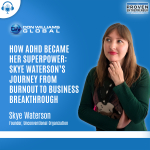
Get ready for an episode that’s as insightful as it is inspiring. In this edition of The Proven Entrepreneur Show, host Don Williams welcomes the dynamic and deeply relatable Skye Waterson, founder of Unconventional Organization. Broadcasting from opposite ends of the world—Texas and New Zealand—Don and Skye dive into a conversation that will resonate with every entrepreneur who’s ever struggled with focus, burnout, or the pressure to “do it all.”
Skye shares her powerful journey from academia to entrepreneurship, revealing how a late ADHD diagnosis during her PhD became the catalyst for a complete life and career transformation. She opens up about the emotional and financial toll of shutting down her first business—a healthy frozen food startup—during the COVID-19 pandemic, and how that painful pivot led to the creation of a more agile, purpose-driven venture.
Key Insights:
- How ADHD shows up in entrepreneurs—and why it’s more common than you think
- The dangers of “shiny object syndrome” and how to overcome it
- Skye’s neuroscience-based “2-Minute Focus Formula” for regaining control of your day
- The importance of identifying what’s already working in your business
- Why failure isn’t the end—it’s often the beginning of something better
If you’ve ever felt overwhelmed by your to-do list, distracted by new ideas, or unsure how to turn your passion into profit—this episode is for you. Skye’s story is a masterclass in resilience, self-awareness, and the power of building a business that works with your brain, not against it.
Visit our websites to learn more: https://provenentrepreneurshow.com/
Watch the episode here
Skye Waterson’s Journey from Burnout to Business Breakthrough
Hey, Don Williams here with today’s episode of the Proven Entrepreneur Show. I have an extra special guest whose expertise hits a little maybe too close to home. For me, I have a Skye Watterson with the unconventional organization with us today. Welcome to the show, Skye.
you ⁓
you
you
Hi, it’s great to be here.
It’s, I am thrilled to have you now, as everybody knows, I’m in central Texas and sky is from like deep, deep, deep south Texas, otherwise known as New Zealand. And, ⁓ so, ⁓ thank you so much for, starting your day very early and joining us on this afternoon episode.
Hehehehe. Hehehehe.
Yeah, you’re welcome. I work mostly with people from the US, so I love it.
Yeah, there you go. The world has become very small, hasn’t it? Yes, it has. So, okay, Sky, tell us about the unconventional organization, what you do, who you do it with, and why you do it.
Mm-hmm, yeah.
Yeah, so what I do, what I am passionate about is building systems and teaching systems and strategies to help executives and entrepreneurs, you know, get focused, get their time back and build out consistent revenue.
I love that. And I think you help a group that maybe focus is somewhat of a challenge.
Mm-hmm. Yeah, 100%. I helped the people diagnosed or not who come to me and I just jumped off a call with someone and say things like, I used to be making $30,000 a month. I’m making $5,000 a month. I know the problem is me. I know the problem is that I’m not doing the thing and I just can’t do it. And that is so frustrating. I’ve seen people get the best strategies in the world and just be unable to use them. So I bridged that gap.
Yeah, I love that. How long have you been doing it and what motivated you to start?
Yeah, so I’ve been doing this for about five years now. And what motivated me to start was it’s a bit of a journey, I’m former academic and I was diagnosed myself with ADHD at the beginning of my PhD. So I had been, you know, going on the academic ladder, but there were ups and downs, there’s a lot of burnout. So I figured I needed to find out what was going on, went to my learning center, they got a bunch of tests and they said, we think you should get tested for ADHD and…
Hmm.
For me, that was a huge moment of understanding what was happening in my life. And it prompted me to, of course, because academic, do the research into ADHD. And when I did that and I started writing about it, I was able to build strategies that I now teach today.
I love that. And so, you know, I’m a 38-year entrepreneur and ⁓ have worked with thousands of entrepreneurs. And I don’t know what the percentage is, but it is not uncommon for a person who’s an entrepreneur to have attention deficit issues. ⁓ you know, I can remember as a kid, I didn’t think anything weird about it, but I would be reading like five or six books at a time.
Mm-hmm.
It’s high. Yeah.
Mm-hmm. Yep.
Mm-hmm.
And, and not like Jefferson, where he read a page and then went to the next book and read a page and not like that, but literally books all around the house. And people were like, how do you do that? And I’m like, I don’t know. just like to read and I’m interested in all these things. And, and was one of those kids who, you know, I was like the plate spinner at the circus. Just keep giving me plates. I love to spin plates.
Yep.
Mm-hmm.
Yep. Yep.
Mm-hmm. Mm-hmm. Yes,
And of course, a certain
we love space. ⁓
point, becomes a little challenge to do that.
Well, sometimes we decide to grab a plate and start spinning it when everything’s going good and we just needed to consistently focus on the thing that was working. And so that’s one of the things I teach as part of what I do.
Yeah, so that’s like ⁓ preventing O’Shiny syndrome. Here’s something cool. Let me chase that for a while.
Yes, yes.
Yes, it’s a big part of what I do, you know, and we can get focused, we can get our time back, but then we have that consistent revenue and the shiny object syndrome is a big factor in avoiding, you know, I’ve seen people, yeah, people have businesses go down just because of that.
Yeah, I buy that. Okay, I’m going to take you back to your childhood home. You’re back to five-year-old Skye. Remember her? Okay. And so in your home, was there an adult influence who was an entrepreneur?
Mm-hmm.
Yep. Yeah.
No, which is really surprising. I didn’t. I was in a world of bankers and, you know, teachers and all that kind of stuff. So there wasn’t a lot of entrepreneurial influences, but everything was about, when I was growing up, everything was about grades. have immigrant parents, everything was about grades and it was kind of a similar thing. It was like, how are you going to figure it out? How are you going to get this? How are you going to make this happen? And so a lot of
No.
That I think is what helped me with what I do today.
Problem solving is just like a foundational ability for entrepreneurs. Share on XWell, I love that. I think, you know, problem solving is just like a foundational ability for entrepreneurs. Yeah. Give me a problem. I can solve it. And if we don’t have any problems, I’ll invent one so that I, so that I feel like I have something to do. Yeah. Okay. So, ⁓ tell me about your first job as a young girl or young woman, but the first, first thing that you did where you actually traded time or effort.
Mm Yeah, the problem solving was there.
Mm-hmm. yeah.
Yep.
Mm-hmm.
for compensation.
I did a paper run. That was my, that was my first job. And, ⁓ it was the first time I also realized I was like, damn, I’m not getting paid very much for this amount of effort. Like, so I ended up, it actually is funny. I was talking about this recently, but I, it started, it was raining, it got into winter. And so I ended up, hiring my sister to do the paper run for me in the rain, cause I didn’t want to, but in order to get her to do it, I had to pay her more than I was getting paid.
And so at the end, I learned a few valuable lessons about, you know, hiring and compensation and all those kinds of things.
Yeah, yeah. I don’t like it well enough. I’m going to actually lose money to do to not do it. Yes, I understand.
Yeah, yeah, so so I feel like that
was a that was an interesting first lesson
Interesting. Yes, yes, yes. And I just have to ask because ⁓ when I was growing up, it was very common to have ⁓ people who had newspaper jobs ⁓ delivering the paper. And I’m assuming that’s what you mean by paper run. Do they still have those in New Zealand?
my gosh, who knows? I think I’ve seen people, but I don’t see kids doing it anymore. I don’t see kids handing out flyers like we used to.
wow.
Yeah. Yeah. Well, I am here. The kids stopped a long time ago, but newspapers are just about gone the way of the dinosaur.
We still
do the newspaper, yeah, not the old paper round.
Yeah. Okay. All right. So, so you’re through childhood, you learn some good lessons about work ethic and, ⁓ hiring and let’s, let’s, you know, buy low and sell high and still be upset. and so, ⁓ when you left your family home, ⁓ I’m, I’m assuming you went to university.
Mm-hmm.
Mm-hmm. Mm-hmm.
Mm-hmm.
Mm-hmm, yep.
Yes. So this was really, I think for me when I got my first taste of entrepreneurship because I left university and I was in a position where it was like, it was sink or swim, you know, like I was, I was having to figure out my housing in New Zealand. That can be really like up and down. You can lose flats a lot like homes. So it’s just the way the market works here. And I was working as a contractor for the university, which means they give you a job teaching for a semester.
And it’s a great job, they pay you well, but they’ll only pay you per semester. There is a lot of, obviously you’ve got to deal with the holiday break and they might not pay you next semester, it depends on the numbers. So it became almost a job. I got thrown into that idea of independent contracting work and finding multiple contracts and keeping all of those contracts going at the same time, figuring out how to sell yourself, figuring out how to build connections.
without even really knowing about it because it was just the nature of the job that I was in.
Yeah, so the early gig economy in New Zealand.
Yeah, I was in the OG
gig economy before it was really a thing. ⁓
Yeah.
Yeah. You were a front runner, a groundbreaker. Okay. ⁓ and so then you, you’ve got your degree, your, your undergrad in entrepreneurship.
Yeah. ⁓
Mm-hmm. Yeah.
Yeah, no, I got my undergrad in. So I did a ton of stuff. I did my undergrad in psychology, my honors, and then I did a post-grad in public health, master’s in sociology, and then I started a PhD in population health.
my gosh, you were an academic. You were going to school forever. And so is unconventional organization your first entrepreneurial venture?
I know, I was really going for it.
You
No, no, that is, that’s a good point. So, the site, won’t include the various pieces of art I sold because that was, I, I was very focused on that. sold jewelry, all that kind of stuff. I actually went to university and learned entrepreneurship in that capacity first, if I was to a formal knowledge of it, but really, you know, my, ⁓ boyfriend now husband, when I met him, he was starting a frozen food company and you know, he was selling frozen food too.
Couple of people basically. And I was very passionate about this idea of turning it into a business. And we ended up running it up until COVID. So I can tell you what happened there. And we had a work and live space. We were connected and collaborating with gyms. And we were really going for it selling this kind of healthy frozen food. And that was my, we got connected with people who gave us access to
⁓ you know, business courses that you could do. And it was real like practical business stuff. You know, I learned, you know, the stuff from the university, obviously, but that was really, I think where the idea of business and running a business took hold and I was really passionate about it.
Okay, love that. so I have a really good friend who lives in Shanghai and he was in the frozen fish business, but the great stay home or COVID or whatever you want to call it, you know, was brutal to a lot of those kinds of businesses.
Mm-hmm. Mm-hmm.
Mm-hmm. Yeah.
Yeah, yeah.
Yeah. The government basically told us we weren’t allowed to sell anymore. Like we, we didn’t really have an option. So, so for that reason, we, ended up shutting it down and, and moving, you know, to the countryside. was still doing my PhD at this point. And that was really when I started to think about this as a business because I had been, you know, while I had been learning about ADHD, I’d been writing about it.
I’d been, you know, creating communities, which is kind of always what I’ve been doing in my university. I’d actually done a little bit of work in schools, helping them, you know, learn about it and understand it better. But it was really with COVID when I went into the space of like, okay, everything shut down. I love teaching. I’ve been learning about business and building this skill as well. How do we bring this all together? And that was when I found out about ADHD coaching and built unconventional organizations.
Yeah, I love that. Many entrepreneurs kind of overthink it, but it’s as simple as finding a problem and presenting a viable solution. And that’s a good way to start a business. And certainly ADHD is pretty common in the entrepreneurial community. And all of us would do better with a little more focus and a little less haze, I guess I would say.
Mm-hmm.
We’d all be
happier. Our family would be happier. Our bank account would be happier.
Yeah, absolutely.
Okay. So thinking back over your entrepreneurial career, I’m going to ask you about a hard moment. So typically when I ask this question, people are like, man, I got like a whole library of hard moments because entrepreneurship is not easy necessarily. But I’m looking for a moment when whatever happened happened. was like, ouch, that hurts.
Entrepreneurship is not easy necessarily, but sometimes the best doorways are after another one closed. Share on XMm-hmm.
Mmm.
Hehehe
Yeah. Mm-hmm. No, it is not.
Mm-hmm.
But maybe
in retrospect, maybe looking backward, it turns out that actually it was a positive. Do you have a moment like that you could share?
Yeah.
Yeah, I do. I do actually. mean, I think it’s already been touched on, but it was when the first business shut down. Like we had poured our heart and soul into it. We had spent so much time, so much money, we’d painted the roof, like just crazy things that you have to do to get, the, your, like, you’re allowed to function as a, as a business and, you know, sell more wholesale. And, you know, we’d gotten into that place and then, ⁓
And then we just got shut down. just felt like it didn’t make any sense. And so that was really hard. It was almost so hard that I didn’t really process it at the time. It was just like, how are we going to land on our feet? You know, what are we going to do next? We had a giant amount of frozen food and fridges that we could no longer use because our, you know, tendency came to an end and we had to find a place that we could stay that would take all that stuff and sell it and no one wanted to buy it. So, you know, all those kinds of things. And, ⁓
And we, but looking back, it was a real good thing. It’s hard to say actually, but the business we have now is it’s much more mobile. It’s, it’s a higher profit margin, like getting into frozen food, healthy frozen food. It’s not the easiest first business. definitely picked like a really tough one. And so we were able to kind of take what we learned.
get a coach, I got my own business coach and actually build something that took all of the learning and was just a lot more usable and helpful for us and our family. It wasn’t like tying us to one place and one product and all that kind of thing.
Yeah, I love that. you know, here in the, in the States, there’s a show about, you know, shark tank, you know, I’m sure everybody knows about that worldwide, but yeah, the interesting thing to me there is all of the sharks hate frozen food.
Mm-hmm. yeah, I’ve actually worked with clients from Shark Tank. Yeah.
Yeah, I get it.
When somebody walks in and says, yeah,
I have this frozen cookie dough. They are like, ⁓ get out. You know, we hate, we hate frozen. We hate frozen. What? Yeah, you don’t know. And, ⁓ with my own clients, I’m like, Hey, start somewhere. ⁓ just start. can over, you can overanalyze to death, you know, at some point you just have to start. So,
Yep, yep, yep, exactly, but you you got to start your business somewhere. You got to start doing something. So, yeah.
Mm-hmm. Yes. Yeah. Yeah. Yeah.
If there’s one thing I’d say is like, you can pivot. It’s fine.
Yeah, you can. And sometimes the best doorways are after another one closed. And ⁓ that’s just the way it is. okay, next. ⁓ If I had access to the library of your brain, which I think is pretty sizable, okay, and I was looking for a piece of valuable…
Mm-hmm. Yep. Yep. Yep.
Mm-hmm.
hehe
advice, something you hold near and dear to your heart, a golden nugget from your entrepreneurial path, your entrepreneurial journey, what would that be?
I think the biggest thing I would say is if you want to figure out what to focus on, look at what’s already working. Don’t look at what is, what someone’s just talked about or what someone’s just posted about, you know, look at what you’re doing and say, what have I already sold and how did I do that? And they do that more.
If you want to figure out what to focus on, look at what's already working. Share on XI that. And so I advise clients very similarly on their mission. If they don’t know their mission, and many people don’t, it’s not so much discovering. It’s not an outward discovery. It’s something you’ve already been carrying with you. You’ve just camouflaged it. And so it’s more of appealing back to find, this is where I’m energized. This is what I do well.
Mm-hmm.
Mm-hmm.
Mm-mm-mm.
Exactly.
Mm-hmm.
Time
means nothing. This is what I love. And it’s just recognizing that. So very similar. OK. ⁓ Maybe the toughest question I ask everybody. Put you in a time machine. Send you back. I’m going to introduce you to 20-year-old Sky. And you have about 60 seconds to share something you know now you wish you knew then. OK.
Yes.
Yeah, 100%.
Mm-hmm.
So into the time machine you go. Skye, I’d like to introduce you to this 20 year old Skye. What do you say?
Mm.
Honestly, I would just say you have ADHD, should look it up. Because, I didn’t know that and I, it caused so much freaking havoc. You know, it was just, you know, the distraction, the, the, the scenes like, well, you know, you were like, you did a lot of different things. It’s like, yeah, cause I thought that I just hadn’t found my passion yet. And if I could just say,
you
you have ADHD and you should be an entrepreneur and then vanish, like, look that stuff up, that would have given me so much more knowledge to go through without all of the anxiety and all of the angst of just being like, I guess this is just what life is and not know that there’s so many simple strategies that could have changed things so much at the time.
of that, thank you for sharing that. I have a son who was diagnosed with ADHD and I was reluctant to accept the diagnosis. But after I did and we did treat with medication, was life changing. And I’m typically not a proponent of meds, but in some cases, there’s a chemical thing. There’s a thing. ⁓
Mm-hmm.
Mm-hmm.
And it was so interesting because maybe six months into it, he said, Dad, you know why you didn’t think I have ADHD? And I was like, no, why? He’s like, you have ADHD. I was like, ah, ah, yeah. So I think it’s very common in our community. Yeah. So share one tip for.
Yeah, yeah.
It’s very common.
Mm-hmm.
an entrepreneur who has focus challenges. If you don’t mind, share one tip.
Yeah. Yeah.
I’m happy to share. Yeah. So for me, I would say number one thing is, okay, I actually give this away. You can message me on unconventional organization at Instagram. Just message me, Don D O N. I’ll give it to you. but in terms of, know, what we’re doing, it’s like, one of the first things people say to me is I will, come into the office and everything is urgent. Like I have a million things to do. have like.
200 thing tasks that they’re all on fire. What do I do? And so the first thing I teach and I give away is I want to say, okay, well, let’s look at what is truly, truly urgent and what is truly, truly important. And let’s get rid of all of that not urgent, not important stuff that is just cluttering up your life. So the first thing we do is we go, okay, let’s brain dump everything in your head because there’s a ton of stuff in your head that you haven’t written down. We should probably get that down.
Let’s get rid of all of that not urgent, not important stuff that is just cluttering up your life. Share on XLet’s not look at your email. Let’s not look at your task list that you’ve written that you’ve forgotten about that somewhere else. Just what’s in your head from there. What are those things that are urgent? Because if you don’t do them, there will be a significant external negative consequence tomorrow. The bill that doesn’t get paid, the event that you’re not prepared for, that stuff. That’s what we’re focusing on. And that’s the stuff where, you know, if there was an emergency and you had to leave, you’d still be doing it on your phone.
Usually for people, once they do that, there’s only like less than five things. Some people have zero of those things. There’s an instant relief. And then we can go, okay, now what is the 80 20 momentum building stuff that is important, but hasn’t been on your urgent to do list. And then I will teach you some neuroscience based tips to actually do those without resistance. That little cycle there.
That focus cycle is the first thing that I teach and it usually takes about two weeks for people to fully transform how they experience their day.
Amazing. Thank you so much for sharing and for your generous offer.
You’re welcome.
giveaway. So how would an entrepreneur who wanted to reach out to unconventional organization, what’s the best way to reach out to the organization and also to you?
Mm-hmm.
Yeah, so you can find me at Instagram. Yes, it’s me. I talk to people. I like people. And so I am at unconventional organization with an S. Like I said, message me Don, D-O-N, and I will send you that format of how to get focused. You two minute focus formula will get you focused and back on track. Then if you want to know more, you can find me at unconventionalorganization.com. I have a podcast, the ADHD skills lab.
And we also have a coaching community where you can go and you can connect with other like-minded entrepreneurs and build these strategies for focus, balance growth.
love that. Sky, it has been my distinct pleasure to have you on the show today. Thank you so much.
Thanks, Dawn, it’s great to be here.
My pleasure. That’s today’s episode of The Proven Entrepreneur Show. We’ll see you next time. Bye now.