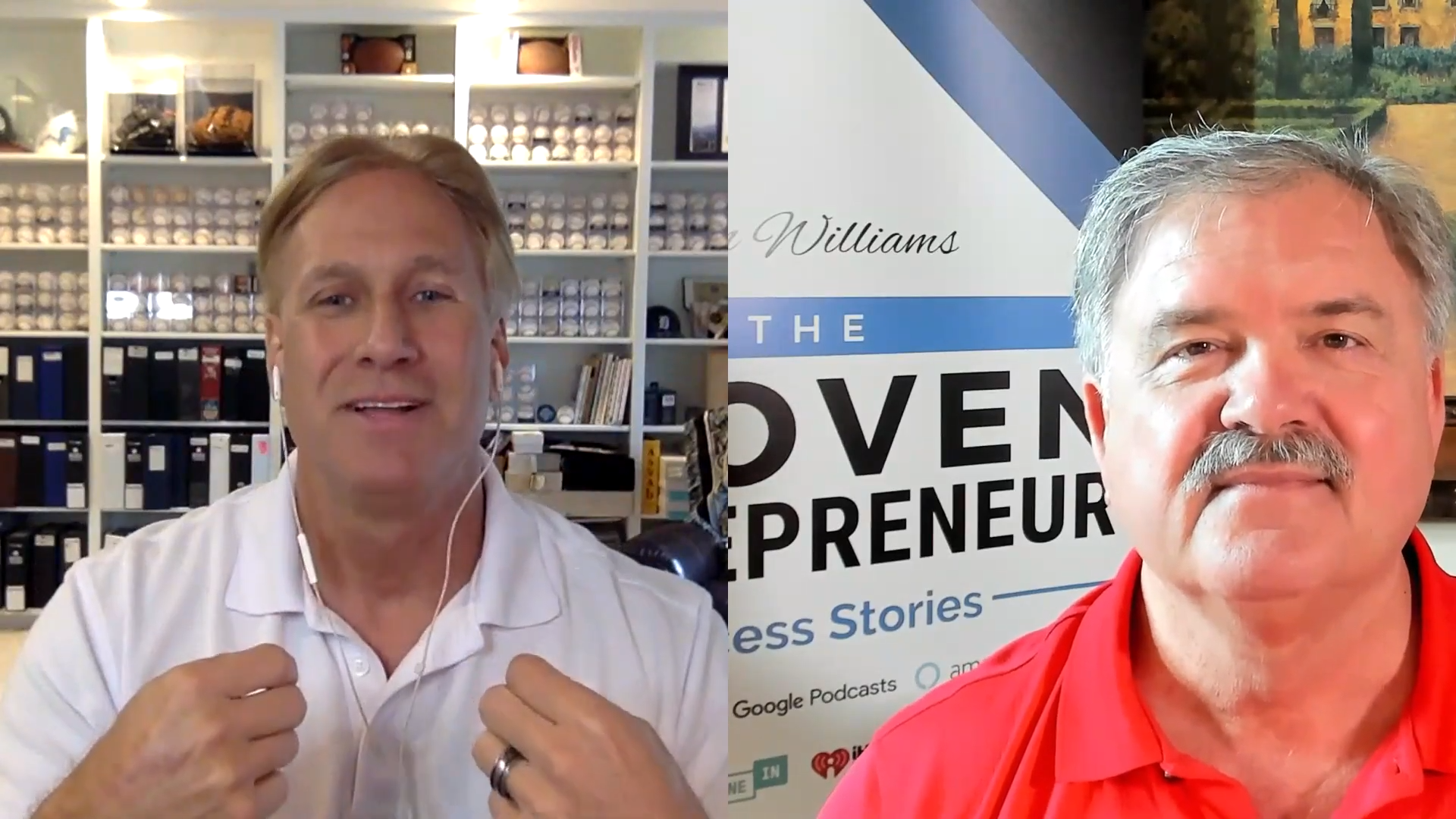
Welcome to an exhilarating episode of The Proven Entrepreneur Show, where we dive deep into the journeys, lessons, and wisdom of remarkable entrepreneurs. Join host Don Williams as he welcomes the dynamic Todd Palmer, affectionately known as the “Todd Father,” all the way from the chilly city of Detroit, Michigan.
In this episode, Todd shares his rich entrepreneurial narrative that spans from humble beginnings—growing up in a household without entrepreneurial role models—to launching and running successful businesses. Discover how a personal tragedy at a young age shaped his entrepreneurial spirit and led to a steadfast belief in self-reliance which initially became a double-edged sword.
As the founder of Extraordinary Advisors, Todd coaches CEOs on a journey of self-discovery and growth, revealing the unique coaching approach he’s developed through his concept of “reflective inquiry.” Listen as Todd breaks down pivotal moments in his career—from his first enterprise in staffing that nearly brought him to bankruptcy, to key transformations that propelled him to become one of Detroit’s fastest-growing companies.
This episode isn’t just about Todd’s successes—get ready to dive into his challenges, particularly the hard lessons learned about trust, relationships, and the delicate balance of leadership. With insights on the importance of vulnerability in leadership, Todd emphasizes that true growth begins within.
Expect to gain invaluable insights about:
- The pivotal role of self-awareness in leadership.
- How vulnerability can foster deeper connections and stronger teams.
- The power of reframing failure as a stepping stone to success.
Don’t miss this inspiring episode filled with valuable insights and practical advice from an experienced entrepreneur. Tune in now!
For information on how to work with Don visit Work With Don Williams
You can also reach out to Don Williams at https://donwilliamsglobal.com.
Watch the episode here
Embracing Failure as a Learning Opportunity: Todd Palmer
Hey, Don Williams here with today’s episode of the Proven Entrepreneur Show. I have a real treat, a great guest, great friend, all the way from Detroit, Michigan, where it’s much cooler than it is here in Fort Worth, Texas. Okay. Todd Palmer. Welcome to the show.
Oh Don, thank you so much for having me. It was a comfortable 92 degrees yesterday.
Oh, we saw 92 twice yesterday. Once as we went past at about 12 degrees. And once when we came below it, maybe four degrees or something like that. So anyhow, this show is like Texas, is gonna be hot, because got my good friend Todd Palmer, affectionately known as the Todd father. And so Todd, tell me a little bit about your
There you go.
current business and what you’re doing now, what’s getting your time, what’s getting your attention, and then we’ll get into your story.
Well, thank you for asking. My current business is ExtraordinaryAdvisors.com in where I coach CEOs on a journey on how to explore themselves in order to grow their businesses and even bigger grow their lives. My model is based on a thing called reflective inquiry, where we are the cause of, and the great part is, the solution to all of our problems.
It’s really coaching a person, not necessarily coaching a great process like an EOS, where it’s scaling up both needed processes, where I really get into the ick of who you are, what’s holding you back, preventing you from what you do, what you want to do. And the second part of my business is I run anywhere from 30 to 40 forum retreats per year, where I work with a group of forum members, a mastermind group, teach them techniques to get deeper coaching, create those deeper connections within that group.
allowing them to support each other to get to higher levels.
And let me just tell you, Todd is an expert in his field. And so if you have any need for that, please reach out to Todd directly. Okay. Now I’m going to take you all the way back to five year old Todd. Yeah. So that is way back. Okay. Well, not way back for you, but it’s back a ways. Okay. And so five to 18 in the household where you were raised, and that’s different for different people. But.
Yeah.
Was there an entrepreneur, was there an adult who was an entrepreneur that set an entrepreneurial example for you as a young cod?
Great question. No one’s ever asked me that question. Love that. There was not. Both of my parents were auto workers living in Detroit. Not a surprise. My older brother, 12 years older, was an executive, both East Coast, West Coast, New York, Los Angeles. So no, there really wasn’t that. But what I will share with you, kind of a vulnerable share, hopefully that’s something you’re open to, is at five years old, I lost my dad.
He passed away. And what the story I told myself was, that the only person I can rely on is me. Which is, if you think about it from an entrepreneurial thought process, is wonderful when we’re startups. You know, I’m HR, I’m sales, I’m ops, I’m accounting, I can do it all. There’s a limit to that I found. And I put the glass ceiling in there because I wouldn’t trust others, because I didn’t trust myself. And it was a very interesting
I heard that.
evolution for me as an entrepreneur that I realized that again was both the cause of and the solution to my problems because my struggle to scale was I didn’t know how to trust but verify. I didn’t know how to put proper rules of engagement in because at five years old I told myself I’m the only one who can rely upon. So it took a lot of coaching. I was blessed to work with two great coaches. Last one was Dr. Danny Friedland, a neuroscientist who helped me understand that at five years old I made a decision.
that I carried forward into my 40s.
Love that. Now, so I want to ask you a question because trust, as we know, is foundational to all selling relationships, all leadership relationships, basically all relationships. Okay. No trust, no relationship. So when you said, I didn’t trust myself, was that you didn’t trust yourself to trust others?
Mm-hmm.
100% great catch that I didn’t trust others because the story I told myself, which was just the story in my head, my itty bitty shitty committee having a meeting, you can’t trust others because you don’t trust you because you picked those people to be in your life. You chose that employee. You went after that client engagement. When the true reality was none of that was really true. It was getting out of my way to learn how to put proper boundaries in place so that trust could be earned.
Trust shouldn't be given out freely like Halloween candy; it has to be earned. Share on XTrust shouldn’t be given out freely like Halloween candy. Trust should be earned over time. And there are certain groups of people in the EO community, you and I spent a lot of our years in, where there’s a group of people that are so trustworthy that they are the people you will go to war with. You take that outside of the bigger part of EO, maybe those people aren’t as trustworthy. They’re trustworthy to a point, but the relationships aren’t as deep because the connection isn’t as deep, because the trust isn’t as deep as the group you’ve earned it with. So,
I definitely played a huge part in not trusting others and realizing what my part was, allowed me to create a bigger network to connect with people like you and others so that I could deepen those relationships, create those deeper connections, which makes a more fulfilling life.
I love that. And you know, here’s just an aside on trust. I believe trust is a bridge built gradually. Okay. And destroyed it within an instant. And so it takes a long time or it takes time, maybe not a long time, but it takes time to build that bridge and only takes an instant to destroy it. So thank you for taking me all the way back to five-year-old Todd.
Mm-hmm.
So true, so true.
Probably been a day since you thought about five-year-old Todd. And so appreciate that. Okay. So now tell me about, so you’re still in your schoolboy years, your first job, and that might’ve been a lemonade stand. You might’ve been an entrepreneur as your first job. That was not my case, but what’s the first activity that you did for you traded time, effort, and energy for commerce for money?
Great question. So I grew up in a very small town. I grew up on a farm in mid Michigan. I had 42 kids in my high school graduating class. We’re talking like John Cougar Mellencamp writes songs about the time I grew up in. And in our town, we had literally one grocery store and that grocery store sold candy and I had an allowance. So I would take my five bucks and I’d spend it all on candy which then I would go to my school and upsell for 15 bucks over the course of the day, fireballs and.
different candy bars and what have you. And I remember very distinctly, this had been about seventh, eighth grade, and I got called into the principal’s office because I was taking advantage of others where you and I would argue, hey, there’s marketplace conditions, there’s opportunity, why wouldn’t we seize those? And I remember my mom came in and she’s like so supportive of me. She, I didn’t get the, like, I can’t believe you embarrassed me, your family name, no, she’s like, well, but what’s he doing that’s wrong?
If the kid, if he buys a printicle and he sells it for a quarter, what do you really care? Well, he’s taking advantage of others, taking advantage of others. So that was a really important lesson for me to learn as an entrepreneur that family support is super key. And also just because others don’t see opportunities in the marketplace doesn’t mean I can’t see them. So literally my first job was selling candy at school.
And you’re literally just capitalizing on a location, no different than why the hamburger’s $30 at the top of the ski mountain and $7 at the bottom.
Oh yeah, if I go to the ballpark at Arlington, a beer is what? $10 with the same beer across the street at the bar is $2. Location, location, location.
Exactly. So love that. Okay. After your schoolboy years, okay, you went to university, you backpacked across Europe, you joined the merchant Marine, you joined the Marines. What’s your story? Where’d you go?
So I graduated from college. It was just my mom and I, single parent household, not a lot of money. And I had two routes that could have gone. I had a basketball opportunity to go play division three. And I had the local community college was giving out, what are they called? Talent scholarships. So my talent in quotes was writing. And I know you and I both written books, but my goal was really to be a journalist. I wanted to be a writer and I realized I’m six feet tall. I don’t jump very high and.
My basketball skills had a glass ceiling at 17 that I was very clear on. Um, and so I took the route to go and get a talent scholarship, which was eight, the perfect choice for me. I spent two years at junior college, getting my basics out of the way. And because I had a talent scholarship, it was free. And I met a great, uh, department head of my department for the English department by the name of Mark Harris. And Mark Harris saw things in me that no one had seen before. He goes, try this, do this. So I got to make a movie. I got to.
it spread my wings on a creative side. And I really got a chance to enjoy not just the academic experience, which was fine, but I got to explore the learning. And I always tell kids this learning is way beyond the classroom and doing different things. And I was the newspaper editor for a year to lead others at 19 years old. I’m not really sure I was leading them. I think it was just a…
the blind leading the blind at that stage, but it was a huge opportunity. Then I went to Eastern Michigan University, completed my degree there, and I had a second branch point decision where I could go into, you know, I got married very young. Boy, as my son, when he listens to this, will know the marriage did not work, but it produced my favorite human being my son, Tyler. But I had a branch point choice where I had gotten an opportunity to go teach at university or I could go into the business world. Well,
At the time I was married and my then wife was making an income we can survive on, I actually taught college for two years as a part-time basis as I was working towards my masters and my PhD. Then I got custody of my son and made the choice, the first really big real life decision, like I’m going to not pursue this because I need to make enough money to provide for a household of two. And I don’t regret that decision. That would have been age 22, 23.
And so I put my academics piece on hold, but I think I’m still a writer at heart. I think I’m still a teacher at heart in the work I get to do today.
I love that and I didn’t know that. Thank you. Thank you for sharing. So I know you founded a couple companies. Tell us about the first company that you founded and how that ended up.
My pleasure, thank you.
how that ended up. First company I started at 27 years old for $15,000 in credit card debt was a company called Diversified Staffing Services. Generic staffing, temp help, Metro Detroit, unemployment rate was about 3% to 4%. So if you could find a person to put to work, there was always opportunities. Got off to a rock, rapid start, turned profit set day 72 and thought I really had it all figured out because again, what we don’t know is what we don’t know.
Fast forward, change the name of the company from diversified staffing services to diversified industrial staffing, get more brand focus, more niche specific. And with it by, so I started in 97 by 2006. On paper, I was bankrupt. The bank called my note. And as I wrote about in my book, From Suck to Success, they literally said, you have 60 days of cash left and we are gonna begin.
collection processes against you, we are prepared to take your home. So that business grew rapidly. I got into EEO in 03, but by 06 I was bankrupt and I didn’t know how to read my finances. Cause again, I have to know everything going back to my childhood story. So I wasn’t telling anybody. I wasn’t telling my forum. I wasn’t telling my staff. And when I hired my first coach, he’s like, yeah, you’re in really bad shape. You should strongly consider bankruptcy.
And I remember saying to him very clearly, I can’t file bankruptcy because I know within me, I have not done my best and I’m accountable to this. Just like I told my son when he wanted to quit football, he hadn’t done his best. We can only quit something when we do our best in our household. And by 2013, I paid off all the debt and the business grew even better, got all the bad players out of the way. I became a better leader and we made the Inc. 5000 six times in seven years as Detroit’s fastest growing company.
So that’s the beginning, middle and end of the diversified industrial staffing saga.
I love that. Okay, so still in that business?
Now I exited that company six years ago. Now I just do the speaking, the coaching, and the retreat facilitation. And write books.
Awesome. And write books. Yeah, love that. Okay, thinking back across your career, I’m looking for a hard lesson and I know that there’s been more than a couple probably. In my case, you know, I saw, I got a note from a friend the other day that said, you know, if you can’t look at your past and see what an idiot you are,
Just a few.
you’re probably still an idiot. And to which my comment was, I can look at yesterday sometimes and see what an idiot I was. And so, um, so anyhow, hard lesson, something that happened that when it happened, it was a gut punch that hurt. But maybe in retrospect, now that some time has elapsed, you’re able to have some distance and look back on that and say, you know, man, that was really painful.
But in the long run, maybe that was the best thing that could have happened. Do you have a lesson like that you can share, Todd?
Yeah, absolutely. I was running a retreat and a gentleman asked me a very similar question. Do you regret that you almost went out of business? Do you regret the decisions you made in your mid 30s? And I said, no, I don’t regret them because they were all the lessons I learned. And I said, I wouldn’t be here today working with your forum if I hadn’t learned those lessons. And the biggest thing I got out of it was I was chasing a number. Man, I had to be 20 million. That was the number.
I didn’t care how I got there. I was cutting bad deals. I was giving bad terms. I was given 120-day payment terms. That bit me square in the butt. I had a client go bankrupt for $242,000 because I gave them huge payment terms. I didn’t know how to watch it. We’ll pay you, we’ll pay you, we’ll pay you. I didn’t realize that there was a financing strategy to offload all your employees to a third-party vendor and then close shop and you can discharge them in bankruptcy. I didn’t know that. But you know,
heard this said many times, you know, revenue is vanity, profits are sanity. And I was running, you know, $10 million company and not making any money. But I was chasing that 20. And it’s like, no, it’s, you’ve got to focus on the margin. If I one lesson, it was painful me to learn is margin business. I mean, I was a staffing company. But in the reality, I was a finance company, because I was letting everybody give me their bad debt. I was the Statue of Liberty of staffing, you mean, your huddled masses and your terrible credit ratings, and I will work with you.
Revenue is vanity; profit is sanity. It’s the margin that matters. Share on XAnd it was the most painful thing that I ever learned. When I did my turnaround, we took our payment terms from 120 days to seven, and we boosted our margin by almost 18%. That’s how I got out of debt. I mean, I got paid faster and got paid more. Had to change the model, had to change our market, didn’t go after the whale accounts anymore, but man, that was an incredibly painful lesson.
But it wasn’t like learning to speak Russian. It wasn’t, you know, you made two fundamental changes to your accounts receivable system, okay? And I don’t belittle that, but actually pretty simple things, maybe hard to do, but simple to identify and know that this is what we should do and, you know, made all the difference. And so many times…
Oh yeah.
I think with entrepreneurs and maybe just people in general, everybody does the big things pretty well, but it’s the little things that make the big difference.
And it was the mindset I had to go through because I wanted to be liked. I wanted to get, I liked getting the bigger accounts. I liked the big yeses and the celebrations. I had to be okay with telling people no. There’s a great book out there called The Power of the Positive No, which sits with my deepest yes. My deepest yes is I got to get out of debt and I got to make money. So no, I can’t give you those payment terms and no, I can’t give you their price. What I will do…
I give you these payment terms and this pricing. And what we’ll do is we’ll change the way we work with you in a way to measure the relationship differently. So if you’re just looking at us as a commodity provider, price only, what if instead we take a look at, not look at price, but take a look at your turnover ratio and create a model. We took a client on that did 120% turnover. So every time we sent them 10 people, 12 walked out the back door. We got that down to 40%.
and they made a lot more money based upon consistency, reliability and dependability of their employees, changed everything for them. But we weren’t gonna budge on our price. We just couldn’t, but we showed them a different value prop, sales 101, we showed them a different value prop and that made a huge difference, but we had to be okay. I, as a leader had to be okay with telling them no, sticking to my guns, knowing why I was doing it and then messaging that not only to the customer, but also to my internal staff that this is why we’re doing this.
And it went to the core value exercise of we improve lives. Well, one of the lives we have to improve is ours. So we got the customer, we got the candidates as a recruiting company, we also have the internal staff. We have to improve our lives and you all want raises and you all want vacations, you all want bonus programs and you all want trips, all that great stuff, that’s gotta be paid for. And it’s gotta be paid for out of profits. This is the decision, this is why we’re doing it. Once that was explained, and we even shared that with the client, like this is how we have to operate. It created it not just a transactional relationship,
but a real relationship.
always believe that the more a client understands the supplier and the more the supplier understands the client, the better everything works. Total transparency works. And there’s a common thread in our talk today about leadership. And so earlier you mentioned, hey, we’re part of a group where there are certain people in that group that you would do anything for and others that, and maybe we just don’t know them well enough,
100%
but that we probably wouldn’t go to that extreme. And so, you know, one of my beliefs is that there are great leaders and there are separately people in positions of leadership and they’re not necessarily the same thing. And so, encourage our listeners to work to be the best leader you can be, not just to…
own a position of leadership and think that you’re doing a great job. Okay.
Oh, absolutely. We call them, you got the person who’s got the title. I’m a big sports guy. You can see by my background. Bill Belichick is the coach of the New England Patriots. Tom Brady was the leader of the clubhouse. The two of them had to find a way to work together. One was, it’s who’s the leader in your clubhouse. And then who would be Tom Brady’s offensive leader, his defensive, his special. Who are his go-to guys to control the chaos of an NFL locker room?
It’s no different than an entrepreneurial environment. Pride, ego, narcissism all permeates through that community, just like with entrepreneurs. You got your stated leader, Bill Belichick, but you got Tom, you got the guys on offense, the guys on defense to make sure the system runs appropriately and picking those people is somewhere between an art and a science for Belichick to do. And going back to what you said, trust is earned over time. He and Brady played together, worked together for what? 12, 15 years, that’s a long relationship.
long relationship in an eternal relationship in the NFL. I mean, that just doesn’t, that just doesn’t happen. The players remain the same, but typically they change, they change brands. Yeah. So, okay. So, um, all right. Thank you for that. Now, now I’m looking for a warp speed moment. So things are going pretty good in your business, either this business or your previous business. Things are going pretty good. And then all of a sudden a couple key.
Yes.
It’s a revolving door.
Yeah.
decisions, a key hire, and all of a sudden you are on that hockey stick of growth. It’s just like, wow, I didn’t know it could go this good, this fast. Do you have a work speed moment you could share?
I do. With the recruiting company, I realized that I was only good at a few things, which was very pride-swallowing at one point. And one of the things that I realized I wasn’t really good at was training my recruiters. I just watched by osmosis and then I would show off and it didn’t work well. So I actually found the best trainer in the recruiting space is named, I think.
guy named Danny Cahill out in Connecticut, and I would send every single one of my new hires there with their manager to his bootcamp three times a year. Very expensive, but I wanna invest in the people that get the best for them, and we needed one training methodology, one messaging across the company. So anytime you, if you were to call in, whoever picked up the phone answered it the same way with the same message across lines. I was not the, I’m an entrepreneur, I like to break the rules. I understood the value of the rules, and I would follow them.
with the team, but I needed to outsource that and bring in somebody better. The second piece when we hockey sticked and made Inc. six or seven years, was to me to get out of the way and bring in an integrator to do the stuff I was bad at. By the, by when we were at Flying High, I had two responsibilities, big relation, big relationships, vision and accounting reported to me. That was it. And my integrator reported to me. That’s like, now I, wait.
we’re friends, I’ll tell you the truth. Sometimes I would go in and create chaos and talk to the team and confuse them. And then my integrator would call my coach. He would call me up and say, get back in your sandbox and quit screwing everybody up with your visionary nonsense. Stay your course, your company’s diversified industrial staffing, not diversified medical staffing. Yes, you could go staff nurses. Yes, you could go staff accounts. Stay in your lane. Own your very tight vertical image. Okay, you’re right. But once I empowered her to be in charge, empowered her to run her teams as she saw fit,
which was not how I would have run them. It’s amazing once I got out of the way how the business grew beyond my skillset.
You know, very similar experience. My, um, vice president of operations for years has since retired, but, um, on any given day, I think I could outperform whatever we were doing on any given day. But day in, day out, week in, week out, month in, month out, quarter in, quarter out, you know, he just ran circles around me because, because in the short term.
I can bring some magic, I can bring some brilliance, I can bring a spark. But it’s hard on people to have that every day. And it’s really hard to deliver that every day. That’s hard. Okay, so, alright, so this is kind of personal. Okay, sorry, but not really. If I was able to look into your mind, and in the chapter…
Yeah.
titled, These Gold Nuggets I Know. Okay, so things that are so huge to your makeup, to your belief system, would you share one nugget with us that we’d want to know if we knew what you knew?
Yeah, appreciate the directness of the question.
A lot of leaders want the greatest performances from their teams. They want people to step up and be amazing. What the leaders often struggle with is being vulnerable first. In order to change your organization, in order for me to change my company, the first place I needed to make the change was within me. And that was really hard. I was really good at pointing the finger.
and blame the economy, blaming the marketplace. I mean, it’s really easy to blame Detroit during a recession when it’s on 60 minutes filing for bankruptcy. That’s, oh, I’ve got a bunch of external excuses. It’s not me, it’s them. It was me. And so for a leader, if you want vulnerability from your team, you wanna have a psychologically safe work environment, you have to demo that and you have to live it and you have to breathe it, and you have to be the person to lead and be vulnerable first. And that I’ve seen across
almost every leader I’ve ever worked with, is the hardest thing for them to do. And part of that being vulnerable is to ask for what you want, why you want it, how others can contribute versus just do as I say, which still, unfortunately, still comes out quite a bit. So for me, Brene Brown 101 is to lead with vulnerability.
Love that. Thank you so much. OK, so I’m going to ask you the tough question. Before we do, OK, we can see 792 baseballs behind you. What’s the story with 792 baseballs?
I am a baseball nerd. I still play baseball as you know. And baseball for me is a sport, the only sport I know of that where if you fail seven out of 10 times, you’re a success. To me, right. Well, imagine if we ran our businesses and we failed 70% of the time. That’d be tough. Now, unless we’re in an iterative loop where we fail every day to fail forward, that makes total sense to me. Love that model. So for me,
Oh, you’re in the Hall of Fame!
Yeah.
You know, as a kid, baseball was my favorite sport. It’s something that you can take, you know, I know you go to a lot of Rangers games and you can sit there with your lovely wife and be visiting, have friends around, watch the action. It’s not an action where you have to be paying attention 100% of the time from a social aspect. And it’s just one of those things where, I’ve met a lot of professional athletes, a lot of professional baseball players and they never master the sport. They never master it.
and you can be hot, you can go cold things. And it’s one of those sports where I think just the parallels to business and baseball and life in regarding that you have to be a lifelong learner. It’s never getting it mastered. It’s a team sport controlled by the pitcher and the hitter, and nothing happens until the pitcher releases the ball and then the hitter takes an action. I mean, it’s not football where you got 12, 24 guys going back and forth and different things like that. So to me, it’s just always been something
really enjoyed and but through the blessings of a lot of cool opportunities I met a lot of guys together to sign my baseballs.
Awesome. Love that. And so I was just at a game last week with some good friends, the tips and in their suite. And we enjoyed the game with Pedro Rodriguez. He joined us super guy, hall of fame catcher, you know, but, but he didn’t hit a thousand either, you know, he, he hit three 10 or whatever, but, but that’s hall of fame stuff, you know, and.
Very cool.
No.
Right.
Yeah, well, you got to learn how to deal with failing. You could strike a, I had this happen last week, I struck a ball as good as I’m gonna hit it. Shortstop happened to be standing right there. I’m not gonna hit the ball any better. Next at bat, I hit it off the end of the bat, curls over the first baseman, hits the chalk, it’s a double. The first one was a much better hit. Baseball, but the result was just different. So how do we manage through all those things? And I remember when Pudge came to Detroit.
Yeah.
And we were a terrible team. By 2006, we’re in the World Series because of him and Maglio and Verlander and those guys. And it’s an amazing thing to spend times with somebody. So Mickey Manley had this quote. He goes, I played 19 years. I went hit list however many times. He goes, basically five of my 19 years, I didn’t get a hit.
Yeah. I think the thing that to me is parallel to the entrepreneurial journey of baseball is this. Baseball is a game of ones. One hit, one error, one strike, one passed ball, one dropped ball, one catch over the wall. You know, so many games are decided by one something. And, and entrepreneurship.
Mm-hmm.
is also a game many times ultimately decided by one something. It’s that one phone call from that client that is a $5 million client. It’s that, that engages or conversely, that $5 million client that calls and fires you, you know, it’s, it’s the, it’s the one key hire. It’s the one. Um.
Yeah.
Yep.
I know I’m not good at training. I’m going to get the best trainer I can find on the planet. It’s going to cost me a ton, but I’m going to ship people to see him every year. Okay. And we’re going to actually have a brand. Okay. If we can keep me from talking to people because I’m not, I’m not going to be on brand, I’m on the Todd Palmer brand. I’m not really on the company brand. And you know, that’s just how we are. So, um, love that. Okay. So toughest question I ask the average.
Yeah.
Some days.
proven entrepreneur and you know, the name of the show is Proven Entrepreneur Success Stories. You’ve shared some failings. We know that failings are in fact part of the success journey. They are not the opposite of the success journey, but toughest question I ask. I’m gonna put you in a time machine. Okay, gonna take you all the way back to 20 year old Todd. Okay, can you picture him? I had more hair and it was brown. Okay, and I weighed less.
Mm-hmm.
Mm-hmm.
And so I’m going to take you all the way back to 20-year-old Todd. You’re going to get 60 to 90 seconds to share one or two thoughts with Todd that would have sped you, helped you along your path. Okay. So into the time machine you go all the way back. Here’s 20-year-old Todd. Todd, what do you say to Todd?
I love the question. I would say to 20 year old Todd that don’t let your imposter syndrome drive your business. Don’t let your itty bitty shitty committee and your self talk be an anchor to your success. You have more capabilities, you have more knowledge than you realize. And at the end of the day, it’s failure to your point is actually just a word in the dictionary.
So I used to think, God, I’m a failure, I’m a failure, I’m a failure, I’m a failure. Failure is nothing more than a word in the dictionary. If you take the word failure and replace it with the word learning, you will be using the highest functioning part of your brain. Dr. Danufre, then 101, use the highest functioning part of your brain as often as you possibly can. So that would be the gift I’d give me, is like, don’t be your biggest critic, doesn’t serve you well, recognize that imposter syndrome is part of, what you’re gonna have fears and internal concerns. Realize that failure isn’t permanent.
“Imposter Share on XFailure is actually not really real. It’s just a word in the dictionary. And if you take failure, replace it with learning, that you’ll be unstoppable because learning is a never ending iterative process.
I love that. And so one thing I share with my clients and you and I kind of live in parallel universes. Okay. But one thing I share with my clients is, Hey, either you win or you learn and learning is just slower winning. And
I’ve never heard it called that. I love that learning is just slower winning. I love that.
Learning is just slower winning. And so, okay, so tell us again, how do we reach out to you? And let me just tell the audience, Todd Palmer, phenomenal speaker, phenomenal facilitator. Okay, you would do yourself well to bring Todd to your organization. So how do we reach out to you, Todd?
Yeah, simplest way is to reach me out via my website or just email me at Todd at extraordinaryadvisors.com. If anybody’s interested in my book, From Suck to Success, if you send me an email, I’m happy to send you a free chapter. Or if I even have some free copies of my audio book and I can send you the whole book for free. The book for me was an opportunity to pay back all those that helped me along my journey. Being an entrepreneur, as you know, Don, is not a journey we take.
often by ourselves very successfully, and we get the people around us. And so I’m always a giver’s game. And so if anybody emails me, reaches out to me, I’m happy to support you in any way I possibly can.
Awesome. Thank you, Todd. Okay, folks, that’s today’s episode of The Proven Entrepreneur Show with Todd Palmer. See you next time. Bye now.