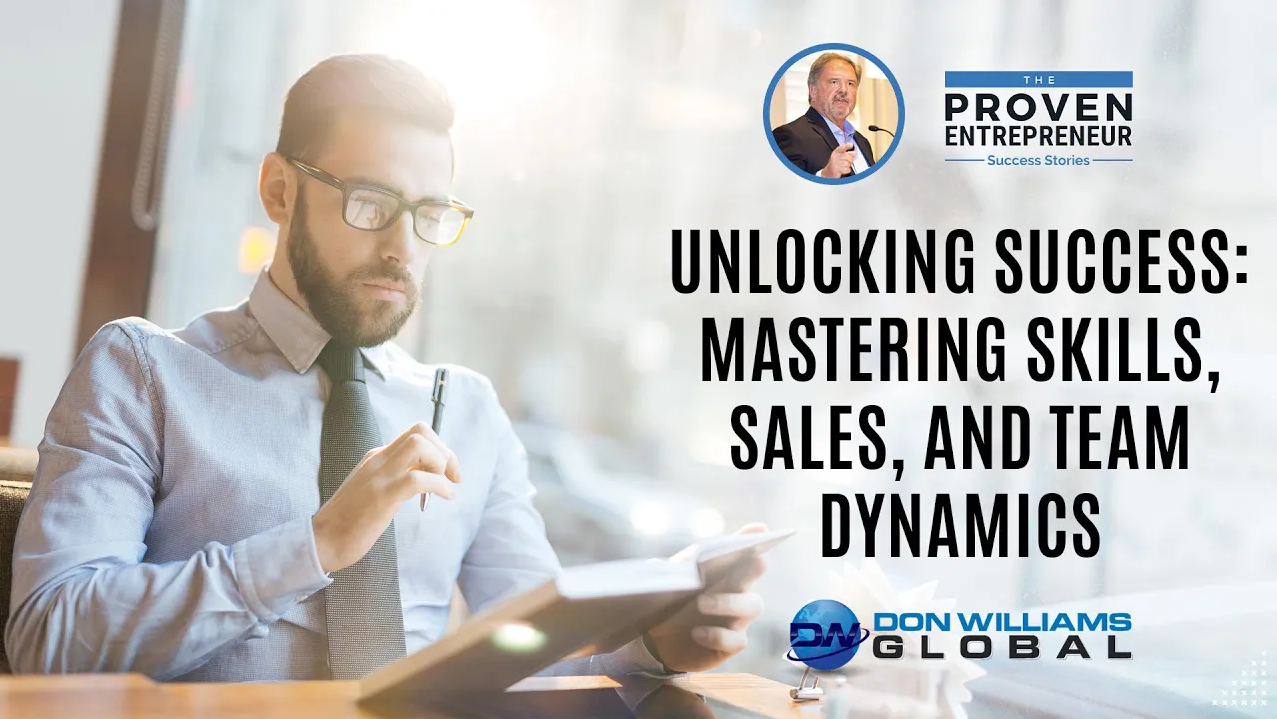
Welcome to the Proven Entrepreneur Show. In this episode, Don Williams interviews Matthew Pollard, an entrepreneur and sales expert. They discuss Matthew’s early entrepreneurial influences, his professional focus, and the importance of talent, skills, and belief. Matthew shares his journey and success in sales, highlighting the pitfalls of promoting great salespeople to managers. They also discuss the power of enthusiasm and being sold yourself, influenced by the teachings of Zig Ziglar.
The conversation delves into understanding introversion and extroversion, building teams with diverse personalities, and the importance of bias and prejudice in team building. Matthew shares hard lessons and warp speed moments in his career, emphasizing the power of collaboration and the EO community. The episode concludes with closing thoughts and how to connect with Matthew.
Don’t miss this inspiring episode filled with valuable insights and practical advice from an experienced entrepreneur. Tune in now!
For information on how to work with Don visit Work With Don Williams
You can also reach out to Don Williams at https://donwilliamsglobal.com.
Watch the episode here
The Proven Entrepreneur Show: Unlocking Success: Mastering Skills, Sales, and Team Dynamics
Hey, it’s Don Williams with the Proven Entrepreneur Show. And do I have a treat for you? I have a gentleman from further away than East Texas, and I’ll let him say where he’s from, but though we’re significantly different in our where we’re from and in our ages, the first time I spoke with him, I think I made the comment.
You are my brother from another mother. And so welcome Matthew Pollard. I am thrilled to have you on the show today.
Mate, I am ecstatic to be here. And I have to say, after having you on my show yesterday, just a little concerned about the curve ball questions that you promised to give me.
Well, so I was a guest on Matthew’s great podcast, The Introvert Edge yesterday, and we had a great time, and he threw me a really hard question at the end, and so I stayed up all night noodling the, how could I ambush him? No, I’m kidding, on the podcast. So let’s hop right in. Matthew in the home. I’m gonna take you all the way back to little Matthew.
say ages five up to 18. In the home that you were raised, however that looks, and it looks different for different people, okay, was there an adult who was an entrepreneur and set an entrepreneurial example for you?
You know, at the age of five, I’m going to be able to safely say no, but in my later years going up to high school, absolutely. And what’s really interesting, you’ll enjoy this. My father was the first one to get a degree in his family and he became industrial chemist or degree qualified and then got one of those safe jobs. However, my mother, she was, I mean…
she’s brilliant, my mother, she won top marks at all of her primary schools and high schools. And because of that, she got scholarship to any school she wanted to go to. And her principal said, look, she needs to do one of these high level qualifications. And he was suggesting Dr. Loya, really anything. And her father, who was a sheep shearer, said that
later in later years went to work in a factory said no daughter of mine will ever have one of those degrees she’s going to go to secretarial school where she can get a safe job. Now my
Her mother actually got what’s called RSI, which is a horrible issue with her neck. And so when that happened, she couldn’t do secretarial services anymore. She put my, my father worked really hard while my mother went back to school, got her business degree and actually became a business coach. So I was lucky enough in the later years to hear about rich dad, poor dad, and emith around the dinner table. And that was around those years that I actually started to pay attention around the dinner table, as opposed to wishing I was in front of the TV. So it was great timing for me.
Okay, I love that. And maybe my audience can figure it out, but I should ask you, Matthew, where are you from?
Well, so I’m from Austin, techno. I’m from, from Melbourne, Australia, and I’ve lived in the States for about 10 years. And my father says that I sound much more American, but every American that I know says, you don’t sound American at all.
It’s so funny. So I’m from Kansas, but I live in Texas. When I go back to Kansas, they’re all like, oh, you have this Southern accent. And I’m like, hmm, this is just how normal people talk? I don’t know what you’re talking about, but anyhow, there you go. Okay. So tell me, I know you’ve done several things. You’ve had a very illustrious career, even at such a young age, but tell me what.
Yeah.
What’s getting most of your time professionally? What do you do? What value do you bring to the world that you are able to charge people for and trade your time, effort and energy?
Yeah, absolutely. I think I was.
I had a really lucky, which at the time seemed really unlucky thing happened to me when I was younger. I know Don, you fell into sales, chose sales and just happened to be brilliant from day one. That was not me. I had a reading speed of a sixth grader in late high school. I was super introverted and luckily enough, I got diagnosed with this thing called Erland syndrome, which basically means I put on a funny pair of colored lenses and miraculously I can learn to read. Now not like everyone else, I could start the process of learning to read.
What actually happened was the last two years of high school, I worked really hard, but my family could see I was just exhausted. And because I had no idea what I wanted to do with my life, we all agreed I was just going to get a safe job for a year to find myself. And that job was doing data entry at a real estate agency until it shut down three weeks later and I was out of work, which I literally fell into commission on these sales in Australia at Christmas time. The only jobs you can get.
I mean, there was like three jobs in the paper and they were all commissionary sales roles. And we can talk about how horrific that was for me, but I went to becoming the number one salesperson in the largest sales and marketing company in the Southern hemisphere. And about a year later, I started my own business and I fast forward to shy of a decade, I’ve been responsible for five multi-million dollar success stories. So now I love teaching people.

how to get beyond their functional skill. Because a great accountant thinks that the key to being successful is being a better accountant. And the problem is they all define themselves by their functional skill, which makes price the only factor. And I just think there’s something heroic about a person with enough talent, skill, and belief in themselves to start a business of their own. And I just find that they just get stuck in this endless hamster wheel of struggling to find people that will listen, trying to set themselves apart and trying to make the sale. And especially those introverts that wear their heart on their sleeve that find self-promotion so uncomfortable.
It just, my heart goes out to those people. And that’s what I spend my life doing now. I help them through my books, through my coaching, through my speaking. And I just love doing that.
I love that. And you know, my own mission is to help others help others. And, um, and so we are very closely aligned there. And, and I love the point and I want to, and I want to point this out in case anybody missed it, but talent, skills, and belief. And, um, you know, all of those can be improved and it takes all three. And so, um, thank you so much.
Absolutely.
So, okay, we’re back to young Matthew, younger Matthew. Okay, you’re raised in Melbourne, you hit 18, you go to university, you backpack across India, you join the Merchant Marine. What do you do?
Well, as I said, I mean, I…
I always found life tough because of my reading issue. I got very used to feeling like the slow kid. And I have to say that was actually a great learning experience for me, because I learned that, for instance, I couldn’t read the textbooks that they had in English class. So I would start very heated conversations in the classroom so I could find out what the book was about. So I learned different ways to find shortcuts or find paths that would actually work for me, because the world didn’t work for me like it did for most people.
And I think that really applied to what happened after, like I fell into a job doing data entry, as I said, and then lost it within three weeks and picked up the paper and said, you know what, I’ve got to apply. My dad broke his back 80 hours a week supporting the family. I’m not going home with nothing lined up. So I reached out to three commission only sales roles. And if you think about a guy that, look, I had chronic acne back then and I had braces. I felt like the slow kid.
These are not the three calls I wanted to make. I made them anyway, because my father was scarier. And I applied for three jobs and I got three job interviews. And then I went through the three interviews and I got three job offers and I went, maybe they see something in me, I don’t see in myself. So I take this job doing business to business telecommunication sales door to door. And I actually went in a little bit confident to my first day of product training, because that’s what you get five days product training, no sales training. And my manager said like,
Matt, we just hire everyone. We’ve got this saying, we throw mud up against the wall. We see what sticks. Every commission rolls like that. So I got three job offers, because they all hire everyone. Well, after five days product training and not a single second of sales training, I get thrown on this road. I still remember it’s called Sydney Road in Melbourne, Australia. It’s like a thousand doors on each side, which I guess if you’re gonna get turned down, you don’t have far to walk. Great. Well, I had this realization before I walked in the first door. I don’t even know what to say. No one taught me that piece. So…
I walked in, took a deep breath, walked in and I was politely told to leave, which I thought was terrible right up until my next door where I was sworn at. But my personal favorite was always getting told to get a real job. I mean, this was the only job that I could get, right? So door after door, I did this. And I remember I got to my 93rd door and I made my first sale. And I mean, it was $70 I made. That was a lot of money for me back then.
But then I had this sobering realization, I gotta do this again tomorrow, and the next day, and the next day, and that whole concept was just not okay. And I think for a lot of the introverts listening, I’m sure this sounds terrifying. But for me, I feel like most introverts especially, but I mean, most business owners in general, they say, I’ve either got it or I don’t. So I’m either gonna hustle and grind it out and rely on lady luck, or I’m just gonna give up. And a lot of people sadly give up. And I just went, no, I’m not willing to accept that. I had to choose that sales was a system or my year was gonna be horrible.
And I just went to work learning that system. I literally, I mean, I wasn’t going to pick up a Brian Tracy or a Zig Ziglar book because I knew it would take me a year to read it, let alone apply it. But I typed sales system into YouTube and all these videos came up and surprise, I wasn’t the first person to have this idea. So I would spend eight hours applying what I learned every day. And then I would.
rush home to learn the next step of the process or to perfect the part that I was working on. And Dora, like every day I’d get better, but I mean, soon it was 71 doors, then it was 46, then it was 28, then it was nine. I got it down to making a sale every three doors. And I still remember it was about six weeks in, my manager pulls me aside and he pulls me to his office. And I thought I was about to get fired. Like he had this puzzled look on his face. I mean, I was the quiet guy. I handed my paperwork in downstairs. I didn’t even really speak to anybody. And he’s like, Matt, we just got our national sales figures.
And it just, it turns out you’re the number one salesperson in the company. And it was like, it started out of his mouth. But the one thing he definitely knew was because I was at the top, because I can sell, obviously I can manage. He’s like, you need to manage a team. I don’t know why people think that because you can sell, you can manage. They were like, no worries, we’ll give you 20 people. Mud up against the wall. 24 hours, everyone quit. Back to YouTube, learned to manage, got pretty good at it, promoted seven times. And then, you know, the rest is history. But I definitely had no plan leaving high school. And
I have, you know, really just the gods to thank for letting me lose that job. Not that I feel that anyone doing data entry should feel bad about that. If you love it, if you’re, if you love coding, if you love writing, I just, I love doing what I do now. And I feel I would have missed out on that if that horrible happenstance didn’t turn out to be a blessing.
And even though you’ve told me a couple of times they went out of business, I keep hearing that in three weeks you put them out of business. Um, yeah.
Oh yeah, absolutely. Yeah. So I, I sent out a series of letters to everybody saying we had to double their prices and they all got fired. No, what happens was it was getting like, you got to understand in Australia is very different. Like, yes, the toilet bowl spin the other way, but we also have our summer season at a different time. So what happens is about the 20th of December, everyone goes on holidays until the 15th or 20th of January.
So if you’re thinking, if you’ve got an unprofitable office, you’re gonna shut it down at about that time so you don’t have to carry everyone for an entire month, as horrible as that sounds. Like I know people here talk about shutting, getting fired just before Christmas, and that’s horrible because it’s harder to get a job for a few days. It’s a month in Australia, right? So the reason, I mean, what happened is, my boss at the time got a phone call from head office.
And he got told that the office wasn’t performing. And because of that, they were shutting down the entire office. And I, because of that, everyone in the office was out of work. And I knew why. I mean, it’s funny. I wrote a chapter about this in my first book, the introvert’s edge to sales. And it’s this story about this real estate agent. When I was learning, like he would take me out sometimes just to show me, I think he had in his heart that I was one day, I mean, he was horribly wrong the way I was behaving, that I was one day going to enjoy selling.
And I would watch him drop a few pamphlets off and then go, okay, it’s time for lunch. And he would be out prospecting for like 10 minutes. And then the rest of the day would be, you know, finding time to waste. And so it made sense why it closed, but at that point I was like, well, that’s just how businesses run. It only took the next job for me to realize, no, it’s not.
Yeah, yeah. The other thing that I want to draw a little emphasis to is this. You were a great salesperson and so they made this presumption, he’s going to be a great sales manager. And I see that so common in my past where companies took a great salesperson, promoted and manager, and they lost twice. They got a horrible manager and they lost their best salesperson.
And so the other thing that I think that you did so well and were wise beyond your years is Zig used to say, people are born boys and born girls. There’s no born salespeople. And so the great salespeople somehow between birth and death, learn how to do it. And so you on your own.
Okay. And maybe because of your learning challenge said, Hey, I’m not as good at this as I want to be 93 doors to get a sale. Maybe I should learn something about it and, and figure it out. And the other thing that I think was really wise beyond your years is this. Many times clients come to me and they’re like, I just, just teach me the tricks of the trade.
Sales isn’t about shiny tricks; it’s about knowing the trade. Share on XSales isn’t about shiny tricks; it’s about knowing the trade.
And my answer is always this, it’s so much easier just to learn the trade. The tricks won’t make any sense until you learn the trade and selling is in fact an honorable profession and literally nothing happens in the economy until somebody makes a sale somewhere and I don’t care what the product, service or experience is.
Yep.
Mm-hmm.
You know, I’m glad you said that because you said something when I interviewed you about sincerity and when you’re sincere, sales becomes easy. And, you know, I’m glad you brought up Zig Ziglar actually, because for those people that think they can’t sell and they’re not going to believe you, who by the way, we haven’t outed you as an introvert. And I promised I would as an introvert yourself can sell. I as an introvert can sell. But if you think that we perhaps, you know, maybe we’re not perhaps as high class as the best in the world.
the whoever existed is also an introvert. But I also think that he would struggle with this. And I’ve interviewed his son, Tom Ziegler on the podcast and his father definitely believed in being sincere. But to being, if you want to be sincere, you have to truly believe that you’re leaving the customer better off by having them buy your product. And I know you and I both agree, if you’ve got a product or service that doesn’t better the client, then.
go find something else to sell, go start a different business and actually stop listening to this podcast episode because I don’t want to help you. But if you do have a product, the best way to serve your clients is to get them out of their own way. And the best way to get them over out of their own way is not to educate them because they don’t want all of that jargon. You want to tell stories and you want to motivate and inspire action. And just so everyone’s aware, the true definition before the used car salesman perhaps destroyed it or the door to door salespeople destroyed it.
The definition of sales comes from the Scandinavian word 'to serve.' True sales is service Share on Xis the true definition of the word sales is derived from the Scandinavian term to serve. So originally, people believed that sales was service, it got lost along the way, maybe because those extroverts got hold of it and said, I’m just going to wing it. But if you plan and prepare, you should be trying to get your client to a better place. And if you are, then how is it that if you get the sale, that’s too slimy or manipulated?
manipulative, you’re just trying to help. And if you really help them, then why would you not want to make them buy your product or service?
Absolutely. And so I’ll just echo that. If the product, service or experience that you represent is not worth a multiple of the dollars that you ask for, if the value doesn’t far exceed, quit, go find something where it does that you can be that passionate about. So I don’t know if it was Zig and I’ll tell you a short Zig String in a second, but, um, you know, the word enthusiasm.
Okay. And I find you to be very enthusiastic and enthusiasm is not necessarily volume related and shiny suits. You can be enthusiastic and actually be pretty quiet, but enthusiasm comes from two Greek words, en and theos, which literally translates to God within. And depending on your own belief system, I would say just translate that to faith. Okay. I have faith.
And then of course the last four letters, I-A-S-M, and I think that is ZIG. I am sold myself. And so it’s really hard to sell people on something you’re not sold on. And so that’s why Matthew and I both say, hey, if you don’t have something that is of superior value, go find something that does and do that. So let me tell you about my ZIG story. So one…
Yeah.
I have a friend here, I live in Fort Worth, Texas, or outside of Fort Worth, Texas, I have a friend here who is a sales trainer and Zig Ziegler was his Sunday school teacher and was kind of an uncle figure to Jason. His, Zig had a brother whose name was Judge and Judge was a couple years older. And Judge.
not Zig, and they looked almost identical. You would have thought they were twins. They were not twins. They were a couple years apart, but they looked and sounded almost identical. Judge held the world record in pot and pan sales, I think in 1958, and he had sold $100,000 worth of pots and pans. That’s a door-to-door sale in Nowhere, Mississippi.
They were from Yazoo City, Mississippi. And Judge tells a story about selling, of lining pots up in the hospital hallway while his wife was preparing to give birth and he was selling pots at his child’s birth, which maybe is a little extreme, but I had the opportunity to work with Judge. He was a personal friend of the gentleman that I worked with. And so.
He and that gentleman were partners in an office that I was the manager of. And so I got to work with Judge Ziegler for about 60 days. I taught him nothing about sales, but I was able to teach him about the nuance and idiosyncrasies of that business. And then of course I learned a ton because I had the terrific opportunity. And he wrote a book. And see to me, the number one reason why people don’t sell as much as they want to.
Yeah.
Well.
that aren’t asking enough people to buy. That’s number one. Matthew had to knock on 93 doors to get his first sale. Okay, well, that’s a lot of asking. That’s a lot of asking, but you can do it on volume. Okay. But his book was titled, Timid Salesman Have Skinny Kids. And I love that book.
Thank you.
And his big thesis in the book was this, I know exactly how many appointments you need to have to hit your goal. I don’t care what your industry is or who you are. And his answer was, you need too many appointments. You need too many. That’s the number.
Yeah, yes.
You need to close more. You need to learn to close more. Do you know, you know what’s interesting and it’s funny. Like, so Zig, I never got a chance to meet. I was delighted to meet his son, Tom, but I didn’t get to this country in time, unfortunately. But I, you know, I remember hearing about Zig Ziglar, you know, around the dinner table, I remember hearing about Ivan Meisner, the founder of BNI, who I’m delighted to say is just a wonderful friend of mine now, and Michael Gerber, who’s a delight, you know, he endorsed my last book. He’s just a great guy. And I never got to meet Zig and forever I am sadded.
Yeah.
that I didn’t make it here in time to get to experience him. Cause I’ve heard that he’s a phenomenal person to just experience and just watching some of his videos, you can tell. And a lot of people will say, well, there’s no way, maybe he was introverted in the past, but he definitely wasn’t, you know, when he was on stage. And just so everyone’s aware, introversion is just where you draw your energy from, right? So if you draw your energy from being by yourself, you’re an introvert, you can’t change that. And there’s nothing wrong with being introverted. It just means, and…
I warned Don after this because I’ve had to experience Don twice in two days that I would have, you know, I’m glad that we strategically booked this after at the end of my day because I’ll need the weekend to recover. But the truth is I do podcast interviews all the time. I do plan them for the second half of my day because they do take energy from me and I can’t do creative work afterwards. I know that about myself, but it doesn’t mean I can’t do creative work and it doesn’t mean I can’t do podcast interviews.
I do get less tired now doing podcast interviews, like I get less tired networking and speaking from stage and all of those so-called extroverted arenas that I believe introverts have the edge in. That being said, a lot of people, and I struggle with this because a lot of people when they find that it takes less energy, perhaps because they’ve discovered a system, they then say, I’m now more extroverted or I am now an extrovert.
That is not what happens. And this is the struggle that I see because we don’t a lot of times see, like Don is an introvert, you would naturally project extroversion upon him because he’s successful. You might project extroversion upon me. And then there are other people that aren’t willing to say they’re an introvert because they truly believe they’re extroverted, though they still get tired in all those so-called extroverted arenas that they dominate. So just know that if you’re an introvert and your energy depletes,
You’re not more introverted or less introverted perhaps than Don and I, you just don’t have the strategies in the systems. And I will say one last thing, which is that if you are looking for the shiny objects in sales, no, as an introvert, you can do a lot of planning and preparation to make sure you differentiate niche down before you even get to sales to take a lot of that heavy lifting off. But of course there’s a ton you can do in the sales process to mean that you need less appointments too. I like, I like, I like more quality appointments as well.
No doubt. No doubt. So, do you think the confusion on introversion and extroversion is merely because most people don’t actually understand the definition?
think the psychologists have made it so confusing. I think maybe there’s been too many research dollars in play. And the truth is, there are some more complexities. Like for instance, yes, introversion and extroversion is a spectrum. If you want to sit down and read a few books on the topic, and we can all really have a big broad conversation about it. But no one’s going to do that. Like if you think about career professionals, they want to do a very quick thing to find out.
Oh, maybe?
whether they’re team members or introverted or extroverted. And by the way, if you don’t know, if you have an organization, small or large, if you don’t know who your team members are and whether they’re introverted or extroverted, you need to know. And truthfully, if you don’t create an emotionally, an emotional safety before that there’s nothing wrong with being either. And by the way, for those people, because I made a joke about extroverts before, it’s not about extrovert bashing. The truth is that extroverts struggle with things like empathy and active listening.
those are things that introverts have in space. We all have our burdens to bear. The difference is, extroverts believe that they’ll be disenfranchised by finding out that they’re introverts or they’re boss finding out because then poor Sally is never gonna be a great leader. Poor Sally is never going to be a great networker. While John, we can totally teach him how to empathize more because everyone knows that that’s a coachable skill where gift of gab is not. That’s where things go wrong. I think that if people realize that…
Yes, it is more complex than that. And yes, shyness is something totally separate. And there’s a whole bunch of extra complexity here. But if you just say, I wanna make it simple because I need to know about myself and my team, then just say it’s where I get my energy from. If I get my energy from being with people, I’m an extrovert. If I’m by myself or maybe just with a few family members and I find my energy comes from that, I’m most likely.
and introvert and therefore I’m most likely going to benefit from a much more, well, truthfully, extroverts would benefit from a sales system and process. They’re just less likely to follow one. But as an introvert, you need to hold on to one of those for dear life and you need to find someone like Don or someone like myself. And don’t get me wrong, half the people on the global gurus list of top 30 sales professionals are introverted. I’m not saying it’s just us, but you need to find an introvert because 90% of the job is belief and the other 10% is the sales system.
“Half Share on Xlove that. And so I think the average American anyway, thinks of extraversion as somebody who is loud and chatty and gregarious and charming. And the average introvert is very quiet and retiring and shy and demure. And actually, that might be true at times. But as Matthew says, the definition is really where do you
recharge your batteries. Do you gain, if you’re in a room and you have to talk to everybody and you gain energy the longer you’re in that room, you’re an extrovert. If you can do that, but then after a while you say, I have to go to my room, I have to recoup, then you’re an introvert and Matthew’s 100% right, it is a spectrum. There’s some people that are on the edge, some people in the middle, ambivert, you know, as somebody who kinda can go both ways.
And I remember when I first found out that I was an introvert, I was going into business with a gentleman and he wanted me to do Myers-Briggs. And so I was like, sure, I’ll do it. And, um, and, and of course the results go to him, it’s his account. And he’s like, well, you have to take it again because it’s wrong. And I was like, you had me take something where it could be wrong? It, no.
Yeah, that’s what, not a great principle for a test.
No. And he said, well, it says you’re an introvert. And I’m like, oh, I’m such an introvert.
Actually, I want to just pause on that for a second on, because you put that on your website. I know that you’re very much about honesty and integrity, but a lot of people would say, you earn a living as a sales trainer, as a speaker, a lot of other ways as well, but you put yourself forward as those two things as well. So do I.
but yet you put it on your website and you went, you know what, I’m proud of this. And I feel that it’s important for people to recognize that because you shouldn’t feel.
Like it’s scary to out yourself as an introvert and you should feel proud of who you are. And don’t get me wrong, if you don’t wanna be in sales, that’s fine. Like you should be proud if you wanna be a writer, a coder, a graphic designer, a more quiet role, but you shouldn’t exclude yourself from being a public speaker, a salesperson, a business owner because you’re introverted, because you can. And there are lots of types of introverts, just contrasting you and I, Don. I mean, you are…
you, your speech pattern and my speech pattern are very different. We talked about this on my show that you, you think through questions if somebody throws you a curve ball and you’re not afraid to have pregnant pauses. For me, it took me a lot longer to be very comfortable with pregnant pauses. And for me, I’m so passionate about what I do. I speak, well, Australians speak quickly anyway, but I speak faster and I’m very like
I feel like anytime I talk about this topic, it’s like a supercharger of adrenaline. And most introverts are like that when they’re talking about something they love to talk about. But it would be easy to say, well, if you were watching us have a dialogue, well, Don is an introvert, Matthew isn’t. And the truth is that the most chatty person you have ever met could actually be an introvert, the loudest, most chatty person, because you’re talking about their favorite topic.
Yeah, yeah, totally agree. And so when people have been confused on what the two terms actually mean, I’m like, look, I can do the Charming Gregorius Loud work the room thing better than most people. It just tires me out. I can do it. I just can’t do it all day and I don’t wanna do it all day. So.
So I’m going to take you and I will tell you this, you know, we’re both, we have commonality through entrepreneurs organization. I’ve been a member there for 10 years and, um, I’ve been through multiple exercises where we put a couple hundred entrepreneurs in a room and then a couple of questions. Okay. You can separate the introverts from the extra, you know, you can ask a couple of questions and
If you answered this way, you go to this side of the room. And if you answered that way, you go to that side of the room. And then the entrepreneur community, okay. It’s about 50 50. Okay. And, and the other thing in the entrepreneur community, when you talk about building teams and, and I don’t take anything away from the solopreneur. Okay. But if you have the ability to lead the world needs you to lead.
Mm-hmm.
The world needs you to possibly affect as many people as possible. Okay. And when you’re building that team, if you had a team of two, it’s probably a good idea to have an introvert and an extrovert because they see things differently. Now, when you get further, so like if you go into Myers-Briggs, they…
Yep.
score you, they give you a four characteristics out of 16 and most of those psychological assessments stop at the 16. But you want to color your team. You want to build this beautiful painting of different colors with people who have different skill sets and different bias and bias and prejudice. Sometimes people get confused on those. Prejudice…
is mostly negative. Bias is a very neutral term. It just is your perspective, how you see things, but you want people with different bias, and then you want to treat everybody with trust and respect to where you take the input from everybody on the team before you make decisions. Because in reality, for most of my life, if you and I disagreed, my default was, Matthew, you were wrong and I, Don, am right.
Thanks.
And that’s just human, okay? But the reality is, as any one human, I know like one zillionth of 1% of all knowledge, and so why would I think knowing that little bit that I know, ultimately right or wrong? I don’t. And so you want to build your team. Okay. So I want to ask you, next question. I want you to think back across your career.
Yeah.
Yeah.
And I’d like to ask you to share a hard lesson. So something that happened that at the time, oof, man, that hurts. But maybe today, in retrospect, looking back on that event, it still hurt, but maybe today, you actually can see how positive it was.
Yeah.
for your development and for your success. Do you have a hard lesson you can share with us?
Gosh, just one. Okay, so here’s the thing that I would say. I think the most valuable one for people to hear is actually what happened when I came to the United States. Because don’t get me wrong, I’ve had a lot of stuff happen in my life. I mean, falling into door-to-door sales was tough. I actually don’t, I have 26 stitches I had across the side of my face through a horrific accident that took five years in plastic surgery. And when you look like you’ve just got out of a fight and you happen to be in sales, fostering trust requires,
and a lot more work. But when I came to America, it was the first time I sold myself rather than selling a product. And I feel that a lot of people that are listening, they sell themselves as an accountant or they sell and it’s funny that you mentioned bias because when you say you’re an accountant, somebody says, oh, I know what that is. And they then put you in a bucket, you have to climb out. And I remember this when I came to the United States.
And I got talking to this guy, just I was staying in an apartment while we were looking for a place to live. And I mean, I was looking for friends before clients, right? I just moved to a whole new country. And I mean, my wife who I’m now, well, my girlfriend at the time, who I’m now married to at that time, she was, I mean, she’s more introverted than I am. So she had a handful of friends and she’d just moved to Austin, which is where we now live and I got asked by somebody.
who owned a gym franchise, who I had listened to for probably 15 minutes about what it is they do and how much they like their gym and things like that. And then they asked me what it is that I did. And I said, oh, I teach people about sales and his entire facial expression changed. He looked at me like I was one step above a scam artist. And he told me how horrific.
sales trainers were. And I’m, oh my gosh, I remember walking out and I did what introverts do well. I ruminated over that over the night. And perhaps my rumination was what led me to this outcome. But what I realized is that you cannot introduce yourself by your functional skill. You can not do that. And so I tried, don’t get me wrong, I didn’t learn it straight away. I remember going to a networking event shortly after where I was actually trying to get clients. And I went, you know what, I’m not going to say I’m in sales because people don’t like that.
I’m gonna say I’m in marketing. And the first thing I got is, oh, I need a marketer, how much do you cost? And I’m like, well, now I’m talking about price, I just met them. And then the next person is like, oh, I’ve got a marketer. And now what am I gonna do a dance? Oh, I’m different, I’ve got magic ruby slippers. Like it was awkward. And what I realized is that nothing existed. And it’s funny when I see people networking, you got transactional based networking, which extroverts tend to be more focused on, which is, do you wanna buy from me? No, what about you? What about you?
which is why most people do what I call aimless networking, where somebody asks you what you do and you say, oh, my day job is, I mean, who wants to buy off somebody that says my day job is like you don’t even like it. And that’s why everyone runs home with all those business cards. The lesson I learned is that I needed to stop introducing myself by my functional skill. And this is where I invented the concept of what I call a unified message. And what I realized is, for instance, everybody listening, like if you are a sales trainer, you’re not just a sales trainer, you have a wealth of experience.
past experience, past customers, you’ve read tons of books, you’ve got different qualifications. I am not just a sales trainer, I’m not just a marketer. I’m a master in neuro-linguistic programming, I’m a business coach, I’m too many things. And truthfully, if I tried to explain it, nobody cares. They don’t care how hard it was for me to learn these things or how long it took me to learn them. But what I realized, I needed a way to summarize what I did in a really clear way. And I realized that it didn’t exist, it needed to not exist to get people to lean forward and ask this question.
What exactly is that or how exactly do you do that? So what I did is I decided that I would start to introduce myself as the rapid growth guy. And what I found is that then led to people going, what exactly is that? And then I could respond with, and please don’t take it to, oh, and you know, thanks for asking, you know, I help small business owners with sales, right? That’s again, transactional. So I, I realized that to your point of sincerity,
that I could respond with my passion and my mission. So when somebody asks me what I do, I say, oh, thanks for asking. I’m the rapid growth guy. They then say, what exactly is that? Because their brain needs to put me in a box so they can exclude me. And because of that, and because I was interested before I was interested, ding, what happened was they felt obligated to ask. And then I would say, well, one of the things I love to see more than anything in the world is an amazing introverted service provider, XYZ.
But what I just hate seeing is they end up getting stuck in this endless hamster wheel, struggling to find interest to people, trying to set themselves apart, trying to make a sale, feeling like people only care about one thing, price. Do you know anyone like that? I knew that they did because I’d researched them beforehand so that the networking meeting felt like an appointment. And then I would talk about my mission for helping introverted service providers overcome that by focusing on three things outside the scope of their functional skill and telling them a story. That was a hard-learned.
lesson because there is nothing worse than having someone look at you like you’re a scam artist. And you know, I could say, but I’ve built all these really successful businesses. I just wanted to help. But he looked at me like I was trying to rip him off. And all I was looking for was a friend at that point. And I think that was the most valuable lesson for me because now when I teach people how to, how to, how to market themselves, how to build their business, what I’ve realized is if you can’t successfully articulate the value of what you provide when somebody’s politely listening to you in a networking room.
You have no chance online and it always becomes, let me say it this way, there’s just more heavy lifting required in the sales process. But if you can separate yourself from everybody else and make sure that people understand that you genuinely care, that you hear the words, I love seeing this, I hate seeing this, I’m on a mission to do this as opposed to I do this and I’m just really trying to sell you that because I’m trying to buy a new car and I really want a new car. The difference is profound. Yet what I found is no one did that.
So I really created a different way of networking. My sales book, I really put together a concept. It was the best practices that I found that worked for introverts in selling. But what I found is nothing existed to be more authentic in the networking process that was strategic, which is why everybody lived in this aimless networking world.
Love that. Thank you so much. Okay. Next question. What about a warp speed moment? So things are going pretty good in your business, but then you make a decision, you do a new hire, you do some new marketing, and you just get that hockey stick. Do you have a warp speed moment you can share with us?
Yeah, absolutely. So I’m actually embarrassed to say this and I’ve, this is the first time I’ve actually done this on podcast on. So you got one from me. So I learned how to sell as an introvert and I took a lot of inner pride for that. And I would say that a lot of ways, my personality and my ego, everything about me over that next 10 years.
echoed because I’d managed to overcome that. And what was interesting is in the world of SEO, the world of pay-per-click advertising, the world of social media, I always thought that all that stuff was kind of a scam, right? And I was like, if you really, like, you only need that stuff, if you can’t just pick up the phone or walk in the door, right? And because of that, I never really focused on online. We wouldn’t even get email addresses for a lot of our clients when they started putting it on the forms, you know, for things that we used to sell.
And I just thought online was a joke. And I felt like if you wanted to sell, you’d pick up the phone and you’d call. And that meant that every organization I had grew to 50 staff pretty quickly. And, you know, and then you would grow from there. And I always knew that world and I was so closed off. Like I, I pride myself on being a, in a growth mindset kind of guy.
And yet I had this fixed mindset when it came to digital, just because my identity was linked to offline sales. And when I moved to the U S I remember thinking about building a business like I’d known them in Australia. And then I realized as a matter of fact, I probably wouldn’t have moved to the States if I had learned this before I left. I realized that if I built that, that was requiring my time a lot. And if my family got sick and I needed to get home, I couldn’t do that. So I made a decision.
that I was going to try online. And what I realized is by being the clearest, not the loudest in a networking room, you don’t have to go to as many networking rooms and you don’t have to be the loudest person in the room. And then I found that if you can be the clearest online, you can use technology, psychology and strategy to get your ideal clients to chase you. I mean, think about what we’re doing on this podcast right now. I’m sharing my passion, my mission, and I don’t need 50, 100 salespeople to call and show up at your business.
I’m using this one podcast to speak to just as many ears. And I’m hoping that my passion touches certain people. And they say, you know what? I want to consume more of Matt’s content. I want to check out more of Matt’s books. And that’s what I realized. And that was the hockey stick moment for me. We do, I mean, my business, I mean, it makes good money, but it does it with a 10th of the labor requirement, probably a hundredth because I use automation.
to drive people from social media, from podcasts to website, to email, to phone call. And that doesn’t mean that when we have those phone calls, we don’t know how to close, we do. But it means that we’re not trying to hustle to get those leads. And that was transformational for me. I can’t believe I waited until I was 30 to start.
So I too kind of turned my nose up at digital until I had the realization that just like you buy, if you were buying a billboard to market your business, you would put it on the busiest highway in town and that the internet is the busiest highway anywhere. And so once I had that realization, we stepped up our game.
Okay, toughest question, last question. Gonna put you into a time capsule. Gonna send you all the way back to 20-year-old Matthew. Get about 60 seconds, maybe 90.
What would you tell your 20-year-old self?
that would have stopped pain or increased pleasure would have sped you along your entrepreneurial journey.
So into the time capsule you go, back to 20 year old Matthew, what would you tell him?

You know, I think that’s an interesting question because I discovered sales systems at that point. And I think I discovered every single process. I think at that point, I think what I really needed to hear is that I didn’t have to do it alone. And what I mean by that is because I’d had disabilities and I always felt like the slow kid, I had this force field around myself that I had to figure it out. I had to find the solution. And I felt like I was smart enough to find it. And I just put great work and I always tell, I mean, I know you say the same thing, Don, like knowing the answer.
isn’t as important as doing the work, right? So if you don’t know the answer, you’ve got a problem. But I always lived with this. I took responsibility. I lived in what-if thinking to find the solution. And then I did the work. But I didn’t have to do it alone. And I think that…
And you and I both speak at EO and we’re both big fans of it because it creates that comradery. And I’m not saying that people that are listening need to join EO for that, but I did it totally alone. And because of that, I probably wasted a lot more money than I needed to making mistakes. And more importantly, I felt totally isolated. I grew up in a blue collar neighborhood where most of my friends were working in factories. And I mean, I went from working at McDonald’s for $200 a week, where as my part time job to being in a real estate agency for three weeks.
to making six figures and then a year later, having a multimillion dollar business. I didn’t even like, the numbers were terrifying and I didn’t wanna admit it to anyone. So if you’re just starting a business and it’s working, you need a support group. If you haven’t figured out how to make it work, you need a support group. And I’m not talking about the group that you go networking with, where you tell everybody it’s wonderful and you know everything because you’re trying to get them to buy. I’m talking that group of people that you can say, you know what?
it’s tough at the moment or I’ve got this challenge. And while everything looks like all my friends and family are saying, you’re a Marvel, you’re doing so many things. I don’t feel that way because I feel like it’s hurting here. What suggestions do you have? I wish I learned that soon.
You know, we’re talking about EO. So I’ve been a member 10 years. I’m 63. I’ve been an entrepreneur 37 years. I’ve started a dozen companies. Almost everything I’ve done has worked out. There were a couple stinkers that did not work out at all. They were horrible. Okay. But the beauty in collaboration with peers, people that are
equal. Okay. You know, I ignored that for the first 27 years as an entrepreneur. When I joined EO, I thought, I haven’t asked anybody a legit question or shared anything with anybody in forever. Okay. And I’ve done pretty well, but what I’ve learned and what I want to emphasize to entrepreneurs is this, there is power in the tribe.
And you don’t know everything and there’s somebody out there who knows something at a much deeper level that will just tell you, that will just share it with you and you won’t have to learn the hard way. And so I love that. Matthew, before we sign off, any closing thoughts? How would, how would an audience member reach out to you?
Yeah, absolutely. And I appreciate asking. I mean, firstly, my publisher is going to hate this. You don’t need to buy my books. I mean, you can go to the introvertsedge.com or the intr to download the first chapter. And I’ll explain the first chapter is really designed to get you over that belief that you can’t sell and help you realize why you make an amazing salesperson or networker. But the other thing that I love about the first chapter, especially the salesbook is I literally outline the exact steps that you should follow in a sales system. Because I’m passionate about helping people overcome that problem. And I’m like, if you don’t buy
the book, just download the first chapter, do that, grab what you currently say and fit it into that. And if it doesn’t fit, by the way, throw it out. You shouldn’t be saying it to customers. If it does fit, you’ll probably find it’s out of order and there’s some gaps. Fill in those gaps, put things in order, you double your sales in the next 60 days.
For those people that love the concept of, you know, if you’re an accountant, a managed service provider, and you’re tired of saying that and seeing people’s eyes glaze over or get the sense that they, they know what that is and therefore they don’t need you or you start to talk about price, then I’ve got a great template you can access at matthiupolla.com forward slash growth where
it’ll actually take you through an exercise where you can create your version of the rapid growth guy and discover your niche of willing to buy clients. And I do this all the time as an exercise all over the world. And usually at the end, I’ll say, actually I just did it recently at the National Freelance Association. And I said, look, do me a favor, just put your hand up. If you now believe you’ve got your version of the rapid growth guy and you’ve got your niche of willing to buy clients, like 97 odd percent of the room put their hands up. So just do me a favor, keep your hands up if this is the longest time you spent actively working on your marketing, right?
it was about 85% of the room, they kept their hands up. And I said, I did qualify, not reading books on marketing, but actively working on your marketing. So that template at matthiopolla.com forward slash growth, I would suggest don’t do it straight away. Get them to listen to this podcast with Don and I first, so they understand what it is and why it matters. And then spend about an hour and a half to two hours with someone else doing it for them and then get them to do it for you. And your business will transform because I think that a lot of times we go to a coach and we hire them because
We feel like we need to get that resolved, but a lot of times we don’t leverage the people that we know well to get them to help us get to that successful outcome. Now with this exercise, if you’re a coach, don’t work with another coach, work with a florist or a dentist and vice versa. Don’t get stuck in your functional skills together. This is about getting you out of your functional skill. But for those people that are listening, the thing I want you to know is sales and marketing isn’t as hard as you think. You just don’t do it. And because you don’t do it, it feels harder. And if you.
actually spend just a few hours, you will be blown away at how far you come. And then if you just reinvest the time saved back into getting better at it, it won’t be long until you don’t have time because you’ve got too many customers.
Love that. Thank you so much. So, matthewpoller.com slash growth. Okay. And go there, download it, do the work. Matthew, I’m so grateful to have you on the show today. Thank you very much. You honor me to come on.
Mate, it was my absolute pleasure. Thank you for having me.
Okay, we’ll see you next time on the proven entrepreneur show. Thank you.
There we go, mate. The time capsule question, I think, was as close to a curve ball as you gave me. I appreciate the soft balls.
Well, this show is all about inspiring and people.
If I see you do it, I think I can do it. And so this show is all about having people share their stories, their success stories, where other people are inspired. And we talked about this yesterday. I love to help people learn, but I really only wanna help people who learn, who wanna do something. And so you dropped the nuggets. Thank you very much.
And I’ll need the weekend to recover after both days.
Well, good. I’m glad it was you as not just me, but I look, I will say that’s the reason why I tell people to team up with somebody else. Because what I find is if they don’t do that, they’ll say, no, I want the action anyway. But I find that a lot of people say, I can’t afford Don, I can’t afford Matt. And then they don’t take action. So I’m the same as you. If you can push them to do something themselves, they’ll either take action towards it with someone or with you. Either way, I get my outcome, which is awesome.
Yep. All right, brother, I gotta run.
Yeah, I know Fridays is you and your wife’s time. I know that, mate, like from last time. But mate, it was a pleasure hanging out with you for the last two days, dude. So I appreciate it.
The pleasure was all mine. We’ll do it again. Thank you so much. And I’ll let you know when we get this one ready.
Sounds great, man. I look forward to sharing it out with my audience. See you, bye.
Thanks, Matthew. Bye-bye.