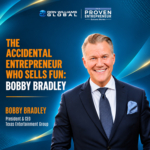

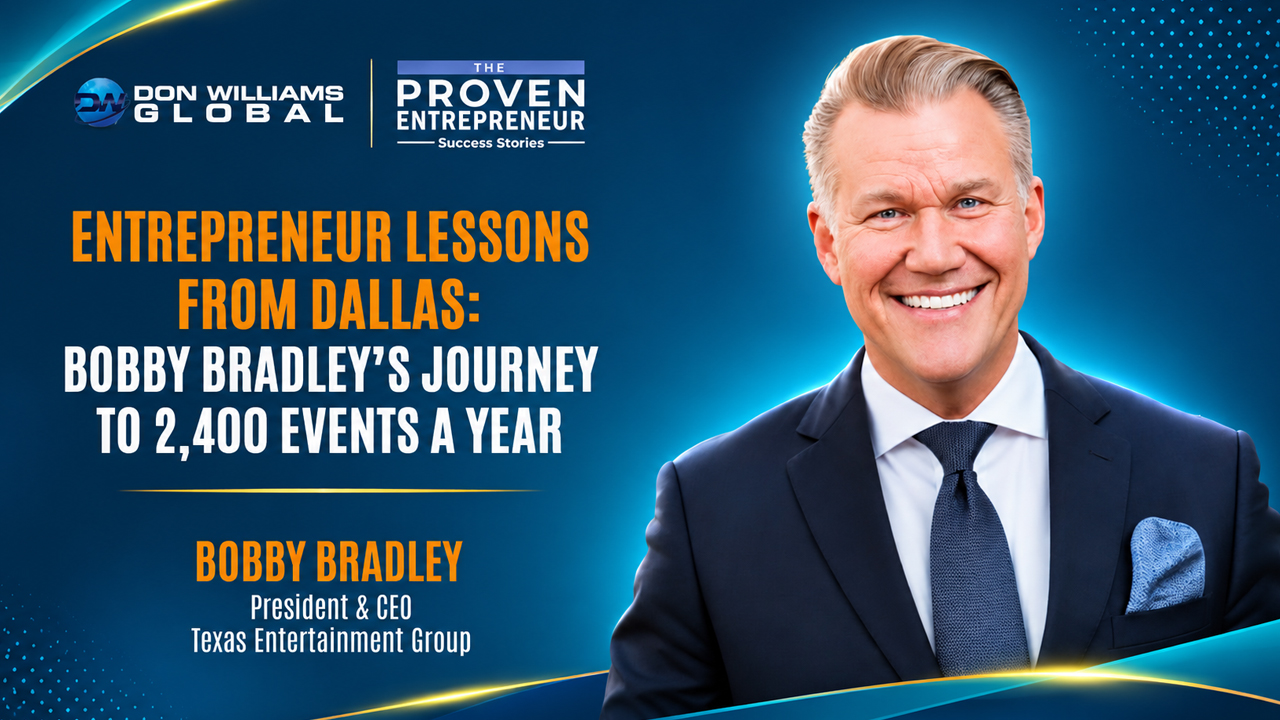
Some entrepreneurs plan their business for years, but Bobby Bradley landed in his while simply trying to support his family. That accidental start in the Dallas Fort Worth area grew into Texas Entertainment Group and Texas Tent, two companies that supply carnival rides, zip lines, arcade games, live game shows, and large event tents across Texas. Today the team works about 2,400 events a year, and last year their events reached over eight million people. Not bad for a founder who began with dial up internet and a Nextel phone.
In a candid conversation with host Don Williams, Bobby shares what he wishes he had known as a young entrepreneur, from finding a mentor to knowing your numbers. He talks about the founder habit of trying to fix everything yourself, the cost of hiring mistakes, and the lessons he took from selling a business. He also explains coopetition, a business growth idea that turns competitors into partners. Each story is told with the humor and honesty that make this entrepreneur podcast easy to finish.
Don adds his own stories about customer experience, from a big event in Fort Worth to surprises that cost almost nothing. Together, the two leaders show why the entrepreneur mindset works best when it includes service, creativity, and a little fun. If you run a small business, lead a team, or dream of starting one, this episode offers practical ideas you can use this week. Listen to The Proven Entrepreneur Show, then visit texasentertainmentgroup.com or TexasTent.net to connect with Bobby.
For information on how to work with Don visit us at https://donwilliamsglobal.com
You can also reach out to Don Williams at https://provenentrepreneurshow.com
Watch the episode here
Entrepreneur Lessons From Dallas: Bobby Bradley’s Journey to 2,400 Events a Year
Hey, Don Williams here with another episode of the Proven Entrepreneur Show. Man, got a real treat for you today. The man, the myth, the legend. I got Bobby Bradley from Dallas, America. Bobby, welcome to the show.
Hey, thanks, Don. I’m so excited to be here with you today and to spend this time kind of talking about life and opportunities for success. And hopefully through this conversation we have an opportunity to serve some people and help some people out in their entrepreneurial journey.
I love that. You know, this is the show where entrepreneurs learn from other entrepreneurs and from our life experiences. And so I love that. So, Bobby, your primary business is Texas Entertainment Group. And if and this is a fun company, and if anybody knows Bobby, Bobby’s incapable of not having fun. Okay. His his picture might be in the dictionary under fun. Okay. And so
Bobby, tell us what does Texas Entertainment Group do?
So we we actually operate two entities here on premise in the party and special event space. We have Texas Entertainment Group, and Texas Entertainment Group is an event rental company that provides games and attractions that people play on or play in or play with. And so you can think about walking into any kind of a special event. And then you look up and you see something that just makes you go, wow.
That’s what we do. And it could be anything from carnival rides and zip lines to mechanical reindeers and mechanical unicorns, photo video products, inflatable games, arcade games. We do live game shows. We do team building. We provide the fun and functions. We also
the
have a secondary company that that operates kind of as a combined single unit called Texas Tent. And so we have a tent rental company. And so you can think tents and
Anything that goes under a tent to also support fun events for people.
Okay. And so tents like like circus sized tents and smaller yeah, large, large tents. Yeah.
Large stents. Large stents. Large stents for large events.
Yeah, there you go. So I I don’t think I’ve ever shared this with you, but one of my favorite neighbors, when his daughter his daughter didn’t marry until she was about forty two, and they w she wanted the wedding in her parents’ backyard, which is across the street. Now we live on very large everybody
has an acre or more. And so it it’s big properties. And so they put this huge I mean, we we sat 300 people underneath it for dinner in their backyard. And most fun wedding I’ve ever been to in my and and I had fr and I had the best parking spot because I just walked down the hill
Walk across the street.
and walked across the street. It was it rocked. It rocked. Okay. So
All right, I’m gonna ask you five or six tough questions here. You’ll feel like you’ve been arrested and they’re interrog no no you won’t. Okay. So Bobby, I I know that you have a couple decades as an entrepreneur. Tell me this. What something you believed about business, I don’t know, twenty years ago, that you now think was just wrong.
That’s it’s a really interesting question because twenty years ago, I mean I was an accidental entrepreneur. And I was especially early on and and you know, and and this all started more than thirty years ago, I I was just scrapping and fighting for anything and everything I could to support my family. And it just happened to
To land into a business and an industry that was a blast that I love absolutely loved doing. I think probably probably and and you may get to this question that like thinking thinking back and and thinking about duration, I think maybe a a better question to answer would be like, what would I what would I wish I would have known back then? Are you gonna get to that?
hey, we’re following your lead. Answer that question.
Sorry.
I I have a tendency to kind of take things over. I apologize. Yeah.
Th tha that’s right. I I’m gonna wrestle it back from you, but you go ahead on that one.
You know,
You know, there there was
When when I was younger and getting started in business, I we well, we had AOL. So so we had dial up. And so we didn’t have access to the resources and the tools that that current entrepreneurs have for learning and for education. And this is the back in the days when, you know, you were lucky to have a cell phone. You know, we had Nextels, beep beep. And I didn’t have I didn’t have mentors or peers that I could I could reach out and talk to.
And so, you know, legitimately we we we we were just anything and everything I did well I was just flying by the seat of my pants. things that I wish that I would have number one, I wish I wish that I would have had a mentor or a group of mentors. You know, and and you can talk about organizations like EO or organizations like Vistage or GoBundance. I mean, there’s several that are available and and you have access to, or paid private coaching.
We didn’t have access to those things. I wish that I had YouTube videos. I wish I had someone that would would have told me years ago, like, hey, you really need to know your numbers.
Early on, I wish someone had told me to know my numbers and had pointed me to mentors and peers to learn from. Share on XYeah, that’s a good one. I I remember
when I first started out, and this was a big fail on my it was a swing and a miss, but I never asked anybody for any help.
Well, I mean, it’s because as entrepreneurs, so often we wear the Superman cape, right? I mean, because, you know, inherently and you know, we start out because we’re good at something and we’re like, hey, let’s turn it into a business, right? And because you’re good at it, if something comes up, a problem, a challenge, you’re like, well, I’ll just fix it because I know more about it, I can do it better and I can do it faster than anyone else. And that’s a curse of trying to scale or grow a business.
yeah, but we all and we all have the tendency to to put on that Superman cape and just do it and try to handle it. And and ultimately that’s that’s one of the biggest, biggest failures that an entrepreneur can do is to continue in that that mindset and belief.
Entrepreneurs start businesses because they are good at something, so they fix every problem themselves. That habit becomes a curse when you try to scale. Share on XYeah, my my cape is in the closet. Okay.
you still have it?
Yeah. I still have sure. Have to wear it some nights. I mean, just have to.
Yeah.
okay. So your businesses, the product, I mean you have products, but really the product is the experience of fun, the experience of wow. What have you learned about people? You’ve watched thousands of people.
That you think most CEOs don’t understand.
You know, you know, our business is unique. We we do rent products. The service we provide is the wow. But inherently we are we are a logistics company. We’re moving
Yeah.
we’re moving people and trucks and equipment to places to serve people to fulfill commitments that we guarantee to our customers.
You know, it’s interesting you asked the question about I don’t I don’t know that I I don’t know that I know a a lot more than than a lot of CEOs, but I I was listening to a to a another podcast this past week when I was in the gym and and they were talking about something that was going on in New York with Amazon, with contractors turning into employees. And it came to the real reality or the realization in my mind we we have
We employ employ an uneducated workforce. And I think a lot of times the misconception that probably founders could have or CEOs could have that don’t work with or employ an educated workforce that
It’s the same. Now there’s a lot there’s a lot of parts of it that are the same, right? Obviously having having really solid and sound hiring tools and systems, not settling and not wanting to rescue people, but
It’s it’s d different. you know, it’s different hiring, you know, a computer science grad from U T that’s, you know, doing, you know, programming versus someone that
I you’re giving a lifeblood because they can’t keep a job at Walmart.
Yeah. Yeah.
and so probably the one I don’t know. I’m not smarter than anyone. I work har harder than a lot of people and I’ve taken a lot more risk than a lot of people, but I don’t I would think that when it comes when it comes to people, it’s
Knowing the people and and trying to put yourself in their shoes without caving to their demands.
When it comes to people, put yourself in their shoes without caving to their demands. Share on XYeah, I I love that, the in their shoes. You know, what I learned 150 years ago when I was a kid was that if I if I see everything from the other person’s point of view and I position my messaging that what I want to get done is in their best interest, that people will always do what’s in their best interest, they they almost don’t care what’s in my best interest.
But they do care what’s in their best interest. And so if I can position what I want parallel to what they want, they’ll drive me to my goals as they are getting their goals. And it just takes a lot of the unfun out of human relations, okay, whether it’s employees or vendors or prospects or competitors, you know, just to see things from the other person’s point of view.
and position your messaging and your outcome to what’s going to benefit them the most because they’re always going to act in their best interest. And they should. They should. Okay. And I should
People will always act in their own best interest. Position what you want alongside what they want, and they will help you reach your goals while reaching theirs. Share on XYeah, yes.
I should be smart enough to figure out how to position my message where I’m I’m in alignment with that. Okay.
Yeah, then
it’s just about taking the time and and caring enough to understand what they perceive their best interest is.
Yeah, yeah, exactly. Okay. I think I don’t know if you coined the fr maybe you coined the fr did you coin the phrase coopeti coopetition?
So I was I was on a I was on a panel at a at a trade show in Austin a couple of years ago and it it was a friend of mine, Gary. It wasn’t my coin but I didn’t coin it but I got to speak to it.
Okay. Okay. So tell us tell us one what it means and tell us two, give us an example of when you put it into play.
Yeah, we we actually so coopetition in my in my opinion is a premise where you develop a strong enough relationship with your competitors that you can both serve each other in a in a great way without negatively impacting either of your businesses. So utilizing your competitors
Coopetition means building a strong enough relationship with your competitors that you can serve each other well without hurting either business. Share on XTo help you grow your business. And and we we use this we we use this all the time. I I’m a firm believer that that I choose to be friends with my competitors. Unfortunately, my competitors don’t choose always to be friends with me. and I can’t own their feelings. I get that. I accept it. But, you know, we if if we have a competitor that comes to market with
with a a a a new attraction that’s that involves a lot of capex and I just don’t want to commit to it. we will work out an agreement with that competitor to subrent that equipment from that competitor. They’re getting revenue. Probably we’re probably giving them more revenue because of the scale and scope of our business than they’re probably generating on their own. and it keeps me from having to take that capex investment while still a proving a product
before I want to spend the money on it to bringing it to market. and allowing us to continue to serve our customers and providing new and innovative attractions on a con constant basis for them.
When a competitor launches a costly new attraction, I can rent it from them. They earn revenue, and I prove the product before spending the capital. Share on XI love I love that. So a couple of years ago I’m chairing a big event, Fort Worth, 600 entrepreneurs from all over the world, budget of a mil a little over a million four, two and a half days. Big event. Okay. And and so it’s on my heart, like like wow. Sometime we’ll talk about that. I have a whole echo ecosystem. Wow. I wrote a book, The Wow Blueprint. I mean, I live in the world of wow. So I want to have this wow event.
And I want to close it off with fireworks. Okay, we’re outside. Okay. And
that’s easy.
it is it what it’s kind of easy. If you get a if you get a pro, it’s easy. Yeah.
It’s easy for me. Yeah.
So so we I I have a friend who’s kind of a pyromaniac and does his own fireworks out in the country where he can. But he introduces me to a professional here in town. And and that’s a great example of
coopetition, I I have a fifty thousand dollar budget for the show for the fireworks show. So that’s
She a twelve minute show.
That’s pretty good. Yeah. I mean, it it’s expensive, but you know, it’s pretty good. But but he tells me, he’s like, Look, if you were my brother, here’s what I’d tell you to do. Have me open for about 30 seconds and have me close for 60 seconds and do drones in the middle. And I’m like, hmm, never even thought about doing drones. I’m like, Do you do drones? He’s like, I don’t do drones. Okay.
I got a couple competitors. Okay. And I can I’ll introduce you to two and I’ll tell you who I would
And I know I know who both are.
probably go with. And and I was like, I like this guy. He’s so honest it hurts. Okay. And and that makes him perfect in my book. And so we do the, you know, we do like thirty seconds at the front. So all six hundred people, you they’re
They’re noisy and they’re showy at night. And so all 600 people are, you know, moving to where they have a better view. And then and then after the fireworks stop, we lift off 500 drones. Okay. Which, man, if you’re gonna do a drone show, man, try and get you 500 or a thousand in the air. It’s amazing what you can do. It’s expensive, but it’s amazing what you can do. And and we run a drone show and then
at the end, we run about 10 minutes of drones probably. and then at the end we run, I don’t know, 90 or 120 seconds of fireworks. But literally, I mean, the the an entire group is going, Wow, this is so cool. And and people are like, I’ve been to drone shows, but they were at a drone show where somebody lifted a hundred drones. And I’m not knocking that. If that’s your budget, hey, a hundred drones is better than no drones.
But I’m just telling you, man, if you can get 500 or a thousand drones in the air, you can do some wild and crazy stuff. And everybody was like, man, this was just amazing. And the thing about wow is this every moment doesn’t have to be a wow, but you have to have some magical moments that hit that pinnacle. And that’s what people will fixate on, and that’s what they’ll remember. And they won’t necessarily remember what you say.
They and or what you did, but they will remember how they felt. And so and so
Not every moment has to be a wow, but you need a few magical moments. Those are what people fixate on, and they remember how they felt. Share on XAlways. You know, and it’s
interesting also, you you took in and and you flipped through that experience, you flipped someone’s expectations. Because you know, your guests, as they were sitting there, you you start seeing the first set of fireworks going off, and they’re like, Okay, I’m gonna see a fireworks show. Now, for me personally, I can work watch fireworks for two or three minutes and I’m done.
Yeah.
But you completely flipped their expectations.
By stopping the fireworks, doing a really great drone show, then you did it over again by finishing with fireworks. So they had the best of everything. And so through that, you generally created an experience that they had, I promise you had never seen before. Because even personally in the business, I’ve not seen seen someone do fireworks, drone, fireworks. It’s one or the other, or maybe it’s it’s it’s not the three stages.
And so kudos to you for doing that. But you know, also what that does is it goes to speak to how can we do that?
On a day-to-day basis or a week-to-week basis in our businesses. What whatever the business is. Now, not everyone is gonna be in a business where they can create that kind of wow experience, right? But then the question becomes, but
What kind of wow experience can we as entrepreneurs generate regardless of the business vertical we’re in, to make our customers leave and say, Wow.
Yeah. So I think, and I and when I preach on the concept of wow, I would tell you this, Mr. and Mrs. Listener. The number one indicator of on delivering wow is deciding I’m going to deliver a wow experience. That that one thing sets you up for success. And think about it like this. You know, I wrote a book, Romancing Your Customer, and I see the
The customer journey is very parallel to the romantic journey. So if you go home tonight, Mr. Listener, and you stop, it’s Tuesday. If you’re in Dallas, Fort Worth, you stop at Central Market. They have roses as big as your fist. They’re normally $2 a stem, but on Tuesdays, they’re one dollar a stem. Okay. You want to do a real wow? On your way home tonight, you stop at Central Market. Yes, Central Market, you’re welcome. You go in and you spend a
A dollar seven, you’ll have to pay or eight, you’ll have to pay tax. You have them wrap it in paper and tie the tie it with Raffeta. Okay, and when you walk in the door, you give it to your wife. And I’ll bet you you hear the word, wow, what’s this for? Okay, because romance always has an element of surprise. A single rose on August 18th is worth.
five dozen roses on Valentine’s Day when she expects it. Okay. And so wanting to deliver the wow is job one. Two, just be creative. It doesn’t take a $50,000 budget. That doesn’t hurt. Okay. But it doesn’t require that. Okay. It could cost a dollar eight. And and so it’s just deciding that you’re going to do that, you know.
The first step to delivering a wow experience is deciding to do it. It takes creativity, not a big budget. A single rose can cost about a dollar. Share on XSticking a twenty dollar gift card in and an envelope for your employee, unexpected to Starbucks, chick wherever, it doesn’t matter. And don’t say anything about it. Just hand them the gift card and say thanks and turn around, walk off. That that will be like dropping a stone on a on a smooth pond. It’ll splash and it’ll ripple for eternity. So
I like the wow, okay. And
Well the book so
the book I’m ri I’m writing right now, it’s called Decide and Do. And you’ve you’ve
you’ve almost said that four times now. But that’s all you have to do. Just make a decision, decide and do, and just go do it.
Yeah, yeah. It’s well, like the biggest part’s just deciding. The the doing is a lot easier than the deciding. Yeah,
It’s probably it’s actually probably the ninety six percentile, yeah.
yeah. Okay. All right. I’m I fell down a rabbit hole there. Thanks for bringing me back out. tell us about an expensive mistake you made in business.
Would you?
There may be a few.
Yeah, for sure.
Just pick one, it’s okay.
So in the first business that I ever sold, I I I made a really bad deal. The mistake I made is that I did not secure the proper representation so that I had the right advice.
And unfortunately I made the mistake again when I sold another business.
Hmm. Yeah.
In in the exits that we’ve had, we’ve been blessed to have since then, we’ve we’ve been represented well and we haven’t made the same mistake. But but inherently, like if you talk about continual mistakes, the continual big mistakes that that hurt us so much financially are have been in hiring, just hiring the wrong person. You know, hiring quick, not hiring slow, not using the tools and systems that we actually
Desperation hiring is probably my well my opinion over the years the most costly mistake, repetitive mistake that that we have made.
Desperation hiring has been my most costly repeat mistake. Hiring fast instead of hiring slow, without using the tools and systems we had, hurt us most financially. Share on XYeah, it’s the who, not what. Almost every time. Thank you for sharing. So, you know, I think the public thinks that entrepreneurs, we just sit around talking about money, thinking about money, stacking money up, counting money, rolling in money. Okay. I mean, it’s not really like that, folks. Some days there’s no money, okay, but some days there is. So I know this about you and your heart. You’ve also spent years giving back. Okay.
And so when did you realize that success isn’t just what you can build, but how much impact you can have for others?
There there was likely a progression of the understanding on that. I I started serving when I was when I was thirteen.
in an unusual different way and
I think God I think God just made made me with a heart of service. And and it I mean I can I I can look back and I I’ve just got memories that are flooding through of so many times when
lot of times I gave more than I should have should have. then we had times that I learned to tell people that I’m all out of free.
Yeah.
but but but I’ve I’ve honed in more of who I serve, when I serve, why why I choose to serve. I mean when I when I think of service now, yes. I I want to overserve.
But I ha I have to do it in a constrained manner so that I don’t cause harm to my myself, my time, the business.
But I literally it’s it’s started from from a young age and and I I will not discontinue
Doing anything and everything I can for others. you know, and and I I look at that, you know, in in our business and our in our core business and what we get to do on a day to day basis is we get to serve people. I mean, we ran some numbers last year and we had we had exposure and impact over eight million people last year.
We got to create unbelievable memories for over eight million people last year. That’s a huge responsibility.
It it is a huge impact. I mean, to put to kind of quantify that, that’s like touching everybody in the Dallas Fort Worth Metroplex, plus
Twice?
about plus about another five hundred thousand, you know. I mean the entire eight counties, okay,
Yeah. Yeah. Yeah.
plus about another half million, you know, plus Oklahoma City just for kicks. Okay. That’s that’s huge. Okay. We’re in the fourth turn. I can see the checkered flag.
coming in, you know, from my viewpoint, you’ve basically built a career
Sure, there’s products involved, but basically you’re selling fun. Okay. And I did an exit interview with a client. We her sales were up 50%, very successful. And in the you in the exit interview, I’m like, so what worked? She told me. What didn’t work? She told me. I was like, thank you. That’s important to do that, people, you know, so that you know what other people really think, not just what you think they think, which is rarely a hundred percent accurate. But
But she was a really smart lady. And so she said, but Dawn, before we’re done, what could I do better?
And I was like, I I have an answer for you. It I don’t think you’re gonna like it, and I think you’re gonna be really surprised. Because because this lady has mad crazy business skills, mad crazy leadership skills, mad crazy, you know, she’s just talented.
So but the thing is this.
Are having any fun?
And it was an emotional moment because she’s like, you know, I’m not.
Okay, I’m gonna I’m gonna send you. I said, remember when you were a little girl and you first heard coloring and they gave you the crayons, but there was only eight in the box because they’re about as fat as my thumb. They’re for little, they’re really fat for little hands. Like that makes sense. Why is how does that make sense? Let’s make the fattest crayon possible and stick it in somebody’s hand that’s this big. But that’s how it goes. And she’s Yeah, I remember that. I’m like, I’m gonna ship you a box of crayons. I just want you to put them on your desk.
And I just want every time you see him to remember, hey, this can be fun too. Okay. There was a Matthew McConaughey movie. failure to launch. When she asks him, Well, do you want to spend the rest of your life with me? And he’s like, We well, we can have a little fun too, right? And it’s like, as an entrepreneur, you can have a little fun. It’s okay. So
And we should.
And and we absolutely should because there’s there’s plenty of highs and lows. So tell me this, Bobby. Why do you think so many entrepreneurs kind of struggle with the have fun piece?
think I think it goes it goes back to the entrepreneur journey.
And you know, it’s clearly described in the book The E Myth. And where, you know, someone acquires a skill, they do the skill, they start making money, they decide to start a business, maybe they talk take on roles and responsibilities in the organization that they just don’t know how to do, that they don’t enjoy to enjoy doing, and so they end up in a seat in the business that maybe they aren’t qualified for, maybe they just don’t enjoy, and and then they have a tendency to forget why they started in the beginning.
And that’s and that’s hard. And it’s tough, especially as you’re as you’re starting as a solopreneur and you’re growing, you’re bringing on people, you’re bringing on teams, and I mean it’s hard. It’s hard. And I think people just forget. And I’ll tell you right now, we’re in the business of fun. And and I can look back and at at periods of time when when I forgot to have fun.
Entrepreneurs often end up in seats they do not enjoy and forget why they started. I can look back at periods when I forgot to have fun. Share on XI don’t I don’t
Yeah.
get to to go out and and we do we do about twenty four hundred events a year and so I don’t I don’t get to see I don’t get to see a lot of events anymore. but but the the the few times a year that I do it just reminds me ’cause I get to see I get to see joy and and it reminds me of why I started all this in the first place.
Yeah. Yeah, I think that’s a great answer. Okay, Mr. Bradley, somebody listening to this episode’s gonna want to talk to Texas Tent or Texas Entertainment. What’s the easiest way for them to get in touch with your companies?
So the easiest way, obviously on the web, Texasentertainmentgroup.com, TexasTent.net. Info at either of those domains or Bobby at either of either of those domains, if they want to talk to me, and I’ll I’ll open myself. I love talking to entrepreneurs, I love mentoring, I love coaching, I just love serving people. so Bobby at Texas Entertainment Group.com, Bobby at Texas Tent.net. I’d I’d I’d love I’d love
To hear from people.
that. Bobby, pleasure to have you on the show today. Thank you so much.
Thank you so much for the opportunity.
Yeah. Folks, that’s today’s episode of The Proven Entrepreneur Show. Go out there and have some fun. See you next time. Bye now.