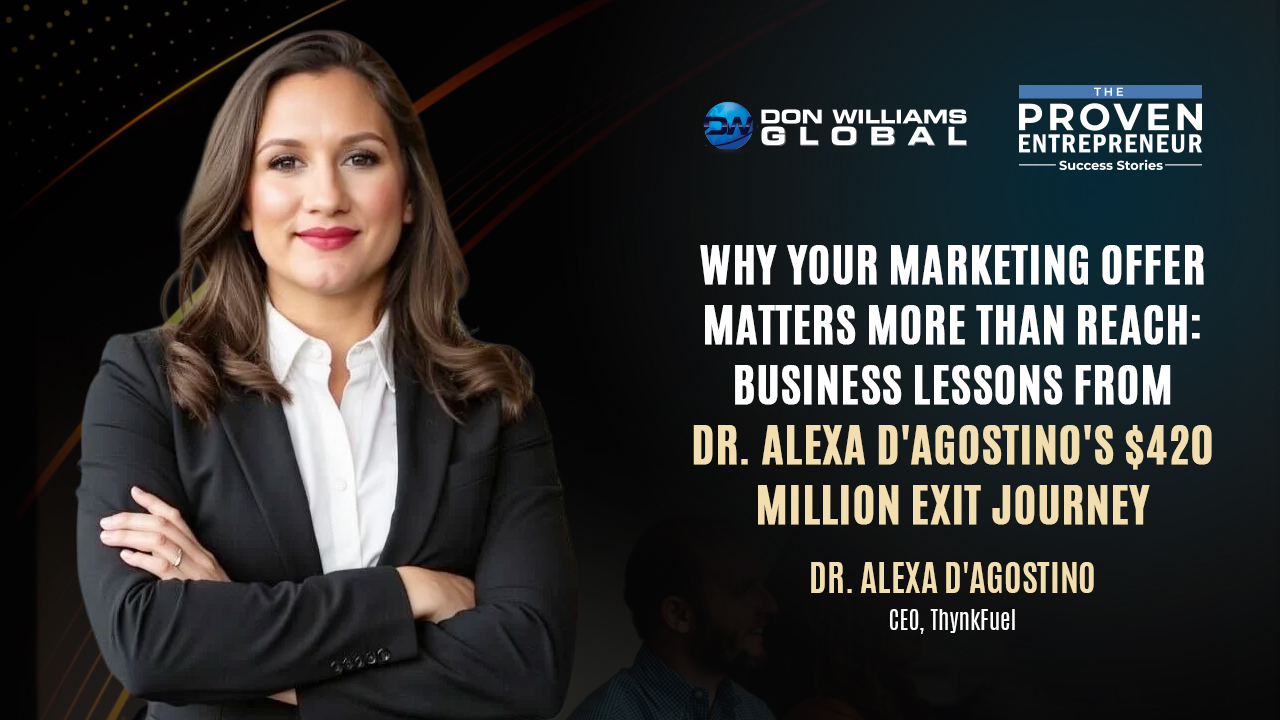
Overview: Dr. Alexa D’Agostino, founder of Think Fuel Media and a serial entrepreneur with over 20 completed business exits, sat down with Don Williams on The Proven Entrepreneur Show to break down what actually drives business growth. This blog pulls the sharpest lessons from that conversation on entrepreneurship, offer optimization, personal branding, and sales conversion, and turns them into practical takeaways for founders, marketers, and business owners trying to grow revenue instead of just followers.
You can have a million followers and still make zero dollars. That single idea, shared by Dr. Alexa D’Agostino during her interview on The Proven Entrepreneur Show, cuts through most of the noise in modern digital marketing. As a fractional CEO and CMO who has helped scale more than 20 companies to exit, she has seen founders pour money into content, paid ads, and personal branding while ignoring the one thing that actually determines revenue: the offer itself. Her track record, including a personal exit history north of $420 million, gives this perspective real weight for anyone building a growth strategy in a crowded market.
Alexa’s biggest lesson for entrepreneurs centers on offer optimization over audience size. She shared a real case where a client spending $80,000 a month on ads with a 17 percent click through rate was still struggling with a high cost per acquisition. Instead of touching the creative or the targeting, her team rewrote the offer, and the acquisition cost dropped 60 percent in three weeks with the same traffic. For anyone studying sales conversion, digital marketing strategy, or startup growth, this is a case study worth remembering.
The conversation also digs into personal branding and thought leadership, arguing that visibility without a clear point of view is just noise. Alexa’s approach to building influence, resilience through failure, and scaling a business without losing yourself in the process makes this episode a strong resource for founders searching for entrepreneur success stories, business mindset lessons, and real world exit strategy advice. Watch or listen to the full episode for the complete breakdown of her framework.
For information on how to work with Don visit us at https://donwilliamsglobal.com
You can also reach out to Don Williams at https://provenentrepreneurshow.com
Watch the episode here
Why Your Marketing Offer Matters More Than Reach: Business Lessons from Dr. Alexa D’Agostino’s $420 Million Exit Journey
Don Williams here with today’s episode of The Proven Entrepreneur Show. Got a real treat for you today and got to meet her young son right before we went online. And I can tell you, look out world, he’s going to be a go getter. So Dr. Alexa D’Agostino with Think Fuel Media, welcome to the show.
Thank you for having me. I’m really excited to be here.
Well, we’re thrilled that you’re here. And before we start questions, tell us what you do in your company, who you serve, why you do it. Give us the business stuff.
Yeah, so I’ve been an entrepreneur for 20 years and basically my job has been problem solving, how to figure out how to make companies grow. So Think Fuel Media is a technology and marketing company, but we like to say it’s a non-traditional marketing AI and tech company. And I use the word non-traditional on purpose because we’re not an agency, we’re not a content shop, we’re a growth engine. And me and my two business partners, I mean, we have grown and scaled at this point.
20 plus businesses scaled to exit. You’re talking about billions. My business partner invented Amazon Alexa. My other business partner sold their company to Clorox and some very big PEs. So we’ve done some really non-traditional things. I’m probably the loser of the group with only $420 million worth of exits. So
poor you.
yeah, it’s not great. So what we do is we come in as fractional CEOs, CMOs and CTOs we help companies scale and grow and exit.
And we’re at the point now where we invest in some projects. would say half of the projects we work on were invested in. Half of them are clients. We do have a couple of Fortune 10 clients. But yeah, I mean, we focus on building incredible technology and building awesome marketing to back that up because we believe product and marketing have to play together. So yeah, so I mean, it’s simple. We build companies and we sell companies. That’s what we do.
I
love that we build companies, we sell companies and that’s what we do. And that’s a pretty good tagline right there. So, um, uh, a little long, but yeah,
I think I gotta take that. I gotta go wrong with that now.
I’m just saying. okay. So first question, when’s a moment when you realized you, you’re not just building businesses, you’re, you’re building influence and.
When did you know that playing small was not going to be an option for you?
This is such a good question. So I would say it actually hit me after I sold my fourth company at 23. It was to date, not my largest exit on the number of the gross, but the largest number I received myself in an exit. And I thought the moment that I signed those papers that I’d feel like this huge rush, and I did for like a day.
I signed it, I felt like, I did it. I remember walking out and holding that check. And I was like, this is the biggest check I’ve ever, and it was only one third of the payment. It still was the largest check I’ve ever received in my life. And I just remember like, don’t lose this check, you know? And then, you know, I woke up and had a realization probably weeks later that the business was gone. Like, I’m like, my God, you know, it’s everything I had built my life, my relationship, my reputation, the way people saw me.
Like I had kind of exited that. And so that was probably the moment that it clicked. I’m like, okay, now what? Like what’s the next piece? And that’s when I started to really go down this rabbit hole of trying to understand who I am as a person and understand why am I successful? Why do I think the way that I do?
And so I started to go down this rabbit hole of my childhood and try and understand who I was. And part of it was while I was coaching, the next step naturally you start to coach people. People kept asking me, coach me, Alexa. And while I’m doing this, people would ask me questions like, well, why do you think, how did you get to that conclusion? Why do you think the way that you do?
And it boils down to Dawn that there’s a lot of moments in your life, what I call defining moments. And I’m actually writing a book about this right now that leads you to behave the way that you do, and lead you to be motivated the way that you are. And so it in these moments of writing these stories that I realized I am where I am, know, good, bad, or indifferent.
because of these moments. And I had opportunities in my life to go left or go right. And sometimes there was no path that I wanted to take and I forged my own path that I didn’t want to go left or right. I wanted to go straight, right? And I didn’t really care what people thought of me. I did what I thought was right. And so, while writing this book,
and trying to find myself because you think it’s great you sell your business, but you don’t realize that you’re kind of selling a piece of you in a way, right? So what that shift has done for me is realizing that everything I did to build that company, every deal I closed, every hard lesson, it compounded into who I am. And it wasn’t until December 24th, 2019, when I was sitting in my sister’s living room and my dad looked at me and said, you look miserable.
Every deal I closed and every hard lesson I learned compounded into who I am today. Share on XAnd I go, why? And he goes, you just look miserable. And, and I just started crying and I was like, I just, I miss having a company and I had a five year non-compete so I couldn’t go start something else. And I was working in private equity and getting a PhD. that’s a whole other story. you know, trying to find myself and he, and I said, but I was miserable running my company five years ago. It’s why I sold it to be honest. And that’s the realization I had. And he said, you weren’t miserable running your company. You were miserable.
how you were running your company. You love marketing. You love running an agency. didn’t like how you felt like you were selling your soul to build the company. And that’s why you hate it. And it dawned on me and it hit me. And that’s literally the next day I started Think Fuel. On Christmas day, I started Think Fuel and it was a million dollar company by March. And I just, forged ahead and that was the moment where I realized I wanted to do something bigger and better than what I had done previously.
I love that. you know, I think many entrepreneurs view their business almost like a child. Not really, but they were there when the business stumbled and hit its head on the coffee table and they were there in the business, got them up in the middle of the night. there are some parallels.
It was a defining moment. was an acceleration moment when, you know, your dad made the comment. And, and I think most of us grow through pain. rarely grow through pleasure. We rarely, it typically has to be something tough for us to grow. It’s just kind of how we’re wired. so, so you help brands, you know, get
attention, a massive attention in what has become a really, really noisy world. Okay. There’s a lot of stuff out there. What do you think is the biggest falsehood entrepreneurs believe about media and that belief keeps them darn near invisible?
Yeah. I mean, the problem that you have, and it’s actually my Ted talks a little bit about this actually, um, about how in, um, 19, um, in, um, 1888, when Rockefeller created, um, entrepreneurship, he created it to create worker beasts. That’s why he created higher education. And my whole Ted talk is about how, you know, part of why I’ve been successful is because I’ve gone against the status quo.
Every time society said go left, I went right. I did the complete opposite. And I think that a lot of people think, okay, if I just post more, if I just show up on more podcasts, if I just get on more stages, the business will grow because you have all these gurus out there that tell you what to chase. And so that’s what they do. They chase, they chase followers, they chase impressions, and they wonder why none of it converts. And the reality is that visibility
equals influence, right? So, but here’s what they’re missing. Visibility without a point of view is just noise. And a lot of people don’t stand for something. They have a, they get visibility, but they do the dance to get everybody to look at them, but they don’t have something to hold a stake on. And you could be seen by millions of people and they like what you’re doing because it’s funny, but you could still be invisible. And nobody knows what you actually stand for if you don’t
Visibility without a point of view is just noise. If you don't tell people what you stand for, nobody knows why they should trust you over anyone else. Share on Xtell them what you stand for. And so nobody knows what you’re fighting for. Nobody knows why they should trust you over the 50 other people that are saying the exact same thing in their feed. The operators who actually build influence are the ones who move the markets. They do the opposite. They say things that make people uncomfortable. Look at Gary Vee. He pisses everyone off, but look how people follow him. They take a position. They pick the fights with bad ideas. They’re willing to be wrong in public.
That’s what creates the gravity. When people say, don’t want to get involved in politics or I don’t want to get involved in this, what you’re saying is, is I don’t want to stand up for what I think is right. And I’ll tell you where this shows up in business is when a CEO calls and they’re not calling because they saw my follow account, they’re calling because they read something I wrote that is exactly what their gut already knew and nobody else had the guts to say it.
So the lie is more media equals more authority. The truth is sharper media equals more authority. One strong opinion will do more for your business than a hundred safe posts. And you know what? If you lose two people because of your opinion, they’re probably not the right people anyway. And those are the people that make your business miserable. And so stop trying to be seen and start being unmistakable. And that’s the biggest thing that I think.
One strong opinion will do more for your business than a hundred safe posts. Share on X
Stop trying to be seen. Start being unmistakable. Share on X
I love that. so shine your light. Know what makes you shine and then tell other people. I mean, it was worth the price of admission what Alexa just shared about, nobody knows what you stand for unless you tell them. And so tell them and tell them a lot. Tell them what you’re to tell them. Tell them, and then tell them what you told them. Okay. Cause they’ll forget. Okay. Another thing you touched on, like a lot of people are chasing, you know, these vanity.
metrics. So look how many views I got. And very few are actually turning that into revenue.
For someone who’s in that boat, what’s a shift they could make to go from content factory to business owner where they’re ringing the cash register?
Yeah, so this is where a lot of people get it completely wrong. They get the visibility, they get the followers, sometimes they get the wrong followers. So there’s two things here. So one, they’re attracting the wrong people. And the problem is a lot of people think they understand the problems are, but what they do is they create an offer that solves the problem. That’s not a problem that people have. And so everybody’s obsessed with the type of funnel, the views, the likes, the impressions, the followers, and none of them pay the bills. And I’ve seen companies with millions of followers do zero revenue. And I’ve seen companies
with 3000 followers do seven figures a month. And the difference comes down to the actual offer. And here’s what I tell all my clients, your content’s not the problem, your reach is not the problem, your offer is the problem. If the offer is weak or the offer doesn’t solve the problem that the audience has, or the offer is something that they’re not willing to pay for, more eyeballs just means more people ignoring you faster. And the easiest way to do that is put some ads out and see if people are actually clicking and buying.
I've seen companies with millions of followers make zero revenue, and companies with three thousand followers make seven figures a month. Share on X
Your content is not the problem. Your reach is not the problem. Your offer is the problem. Share on X
people don’t understand that your offer has to solve the problems that people have. And if you put an offer out for, you know, it’s a thousand dollars and you just go out, put an ad out for one day for 9.99 and see if people will buy it. And if they won’t, that tells you something, right? A strong offer does three things. It solves a specific problem, a pain point.
It’s clear enough that a 12 year old could repeat it. That’s the biggest thing. Sometimes we try to make these offers so complicated and people don’t understand it. And it makes the buyer feel stupid for saying no. They’re like, God, I need this. Like this is a no brainer. And most entrepreneurs build offers the opposite way. They make them so broad that they can serve everyone. And I always say, you’re trying to, if you’re trying to appease everyone, you’re gonna appease to nobody.
A strong offer should be so clear a twelve year old could repeat it back to you. Share on XIf you’re trying to sell to everyone, you’re gonna sell to nobody. You can’t do that. You have to have a very specific problem, which means it’s a very specific person. And they make it so complicated to try to make themselves sound sophisticated. But what you do is you make people not understand what the heck your offer is. And they price them based on what competitors charge instead of the actual outcome. And then the blame marketing when it doesn’t convert. It’s marketing, it’s the content, it’s the landing page. And I’m telling you,
If you try to sell to everyone, you sell to nobody. Pick one specific problem for one specific person. Share on XUm, a real example, I had a client that was spending 80 grand a month on ads, very beautiful, creative, great targeting. The CPA was, was destroying them, the cost per acquisition. Um, and so we, didn’t touch the ads. I didn’t even touch the ads because I’m like, the ads aren’t the problem. The click through rates are through the roof. I mean, we were at like a 17 % click through rate, which is insane. Um, what we did is we rewrote the offer.
And the cost per acquisition dropped 60 % in three weeks, same traffic, same audience, and just a different offer. So here’s the rule. If you don’t need more leads, you need a better offer. Like that’s what it is. So fix that and the content starts to work overnight.
We rewrote one offer and cut the cost per acquisition by sixty percent in three weeks, with the exact same traffic and audience. Share on XYeah, love that. know, I don’t know, 10 years ago, I wrote a book titled Romance and Your Customer and that book got me on stages and it’s been really a defining moment for me. you know, we talk, yeah, yeah.
You’re using the final moment, right? You’re not going be able to put it down now.
No, I’m not. And I’ll give you credit when I can. Okay. And I’m waiting for your, is the book going to be, is that going to be the title?
we don’t know yet actually. Well, I’ll let you know. We don’t know yet. We’ll see. We’ll see what it is. Thank you.
Okay. Okay. Well, I’ll buy the first copy. Okay.
If you tell me where I’m first in line. So, but in romancing your customer, which is all about delivering exceptional experiences and winning people through their heart, not just their head. Okay. Which is really how you win. But it’s about, know, do you have enough dates? Do you have enough leads? Do you have a consistent?
Stream of qualified leads, and then two, are you a good dater? And that’s the offer. Can you convert an acceptable percentage of your leads to where you actually have a business? The other thing, audience, I want to be sure you pick up on is, Alexa has used the word problem a lot. Okay. And, and, and rightly so many entrepreneurs position their offer.
as we make things better. It’s so much easier to sell if you solve a problem, if you make pain go away, okay? Because people who have pain, people who have a problem, they want it to stop, okay? Much easier to go that direction than the other. okay, tough question.
been very successful, okay, even if you’re the loser in your business partnership. Been very successful, but share a time in your journey when things weren’t working.
I mean, I’ll be honest, I could probably share plenty of stories. You know, I think that…
One of the biggest stories that haunt me to this day is, you know, I was working for Fortune 100. They’re technically a Fortune 10 company. I was young, I was 19. I was software engineer. That’s what my first company started as, which then ended up turning into a marketing tech firm. And he said, I have a great idea. I want to run with this idea. Do you want to work on it with me? We’ll go 50-50. I’ll fund it. You run with it.
This happened actually three times in one year. I, what I didn’t realize is I was kind of starting my own venture capital. And, so he kind of, he trusted me to run with it, you know? And so I run with it and, we build this awesome app out and we, get a call from a fortune 10 number one financial institution in the world. you could probably figure out who they, who they are.
you
and they said, we want to buy your IP. And I said,
Well, that’s awesome. I’m 19. I’m already going to have an exit. This was before I had any exits. So they fly us out to Vegas and we pitch it and they said, we love it. We’re we want to buy it. You know, we started talking numbers. It was a significant amount of money in the eight figure range. And we go home. I’m on we’re on Virgin Airlines, cheersing and first class. You know, we did it. We sold it. And.
A week later, I get a call and they’re like, well, there’s good news and bad news. And I said, bad news always first. said, the bad news is we just dropped your offer significantly. And I said, okay, why? Well, because there’s a flaw in your logic and it’s going to take us a substantial amount of money to fix it. And I said, okay. The good news is we still want it. And I said, okay. And you know, I think they took a little bit of an advantage. was 19. They said it’s a significant amount of money.
and you should take it. This is life changing money. And of course I did. but you know, the lesson that I learned, there’s two things. So the first lesson I learned there was, you always want to get legal involved. and you want to get experts involved that know this stuff. what I, we spent about 450,000 building out the IP and we did not include a lawyer to let us know that, and it was an online raffling software, IP and what you don’t know about.
Always get legal and industry experts involved before you sign a deal. One missed detail can cost you tens of millions of dollars. Share on Xraffling at the time is that every single zip code has a different law. So what we did is we built it by city. We didn’t realize it was by zip code. And so that was where the significant time stuck for them to fix that. But the idea was there, the IP was there, but it had to be by zip code, not by city. And that one mistake for not bringing in the legal. The second mistake is I sold 100 % of it. If you go into any casino,
Hard Rock, any of them. They have little iPads and have raffling on them. That’s my IP. It’s worth billions, billions of dollars
Yeah.
now. I should have kept at least one or two percent. you you live, learn. That’s just one of probably hundreds of stories. But when the due diligence hit, it was something I missed. And I mean, you’re talking tens of millions of dollars, you know.
that I missed. So you live and you learn and this lesson I would never make that mistake again. but.
Thanks for sharing.
I work with lot of entrepreneurs in my coaching practice and we do a significant number of exits. And what I’ve found is the average, you’ve done multiple exits, okay? But the average entrepreneur who does an exit does one. And typically they’re being acquired by somebody.
some entity that’s maybe done 50 deals or a hundred deals. And so just the experience is they’re kind of outmatched. If you don’t get expert help, I mean, it’s, it’s almost cliche that whatever the original agreed price is, it’s not going to end there. Okay. They’re going to push the down button on the offer elevator. Okay. And, and maybe it’s right, you know, maybe it’s
should and maybe not, but you’re just so much better to get experts on your side early. And then Alexa has such a great attitude about it. Yeah, it was expensive and I should have kept a point or two, but notice she was laughing and smiling. It was just one step in your journey and you didn’t let it crush you. And so…
Thank you for sharing that. Okay, Alexa, how would a listener reach out to you or think Fuel Media? How would they find you?
Yeah, I mean, I’m all over social Dr. Alexa D’Agostino or you can go to alexadagostino.com and learn more about me. I don’t, I don’t coach anymore. We’re so busy in our projects. I do run something called the wealth mastery. It’s an invite only. You do have to know somebody in the room to get into it. A high net worth. mean, the, you can go to wealthmasteryevents.com to look at some of the people that are in the room. I mean, it’s, it’s an incredible group of people.
But other than that, I, you know, on social is the best way. Awesome.
Awesome. It has been a real
pleasure having you on the show today. Thank you so very much.
Thank you, Don.
That’s today’s episode of The Proven Entrepreneur Show. We’ll see you next time. Bye now.