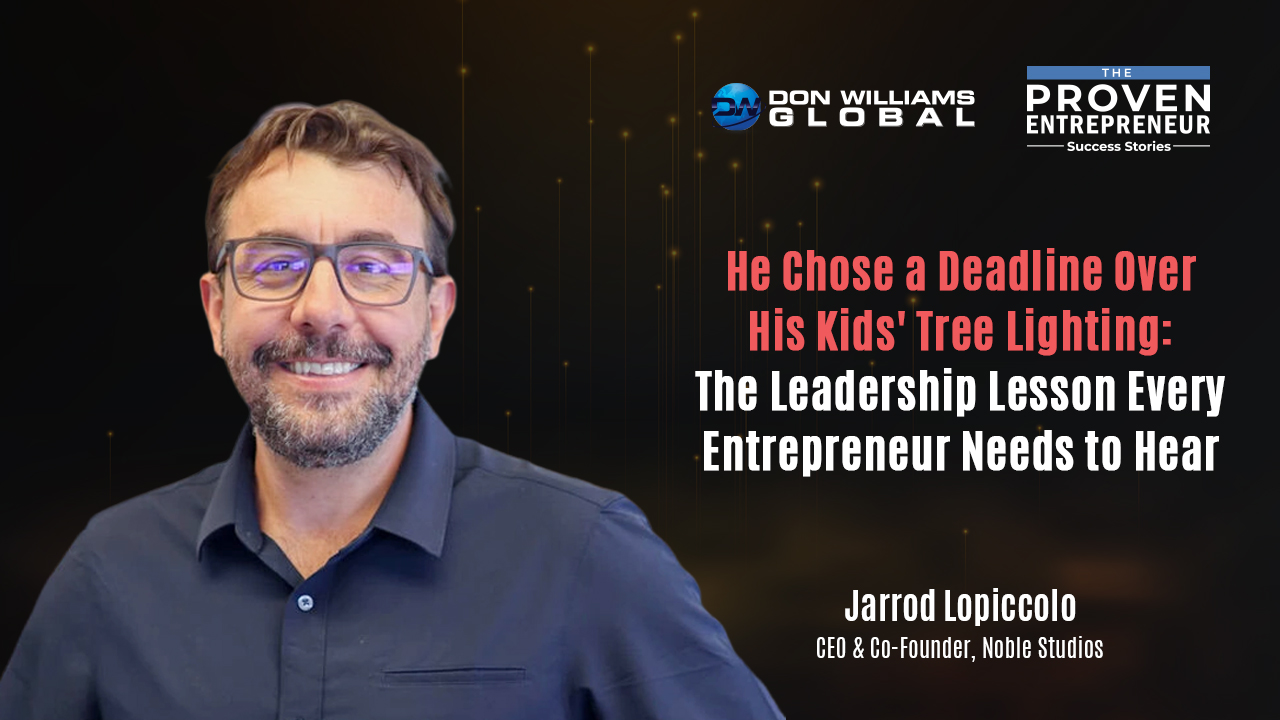
Overview: This blog breaks down a powerful conversation between Don Williams, host of The Proven Entrepreneur Show, and Jarrod Lopiccolo, co founder of Noble Studios, a creative digital marketing agency built over the past 22 years. The piece explores business growth, entrepreneurship, leadership and executive coaching through one real moment that changed how Jarrod runs his company, his team and his life. It touches on topics like marketing and lead generation, sales strategy, LinkedIn and personal branding, business consulting, customer experience and even the growing role of AI for business, all through a story rather than a checklist. Readers looking for practical leadership insight wrapped in a real, human story will want the full episode.
It was December 5th, 2008, five o’clock sharp, and Jarrod Lopiccolo had a Fortune 500 deadline staring him down while his kids waited across town for the town’s tree lighting ceremony. He chose the deadline. His wife’s eyes welled up, she left with the kids, and Jarrod sat there holding his heart in his hands, wondering what kind of leader chooses business over family. That single moment became the turning point behind everything he now teaches other founders about leadership, business growth and entrepreneurship.
What happened next is where the real lesson in executive coaching and leadership begins. Jarrod’s team turned their chairs, looked at him and said they had it handled, that they had delivered before and would deliver again. It was the first time he truly let go, and it forced him to rebuild him self as a leader rather than the architect and designer he once was. That shift, from doing the work to building the systems and people around him, is the foundation of how Noble Studios grew into a respected name across B2B marketing and lead generation, sales strategy and customer experience for both travel brands and technology companies.
Years later, that same lesson carried Jarrod and his team through the pandemic, a season he calls duck on water, calm on the surface while everything moved fast underneath. It tested his culture, his client relationships and his ability to lead through uncertainty, proving that real business consulting starts with trust, not control. From LinkedIn and personal branding to how AI for business is reshaping client relationships today, this episode connects timeless leadership principles to the challenges modern entrepreneurs face right now. Listen to the full conversation to hear how one missed tree lighting changed the way Jarrod leads for good.
For information on how to work with Don visit us at https://donwilliamsglobal.com
You can also reach out to Don Williams at https://provenentrepreneurshow.com
Watch the episode here
He Chose a Deadline Over His Kids’ Tree Lighting: The Leadership Lesson Every Entrepreneur Needs to Hear
Hey, today we’re joined by Jared Lopickalo. He’s an entrepreneur, digital growth strategist, and the visionary behind Noble Studios, a company that helps brands navigate the fast changing intersection, I love this, of creativity, technology, and human connection. Jared, welcome to the show.
Dawn, thanks for having me. I was looking forward to sharing some of my journey and hopefully, yeah, hopefully adding some value to your listeners.
man, I’m sure that’s going to happen. And thank you so much. before we get too far into it, tell us, give us a little more detail on Noble Studios, who you serve, how you serve, how that works.
Yeah, so 22 years ago, my wife and I, created Noble Studios. It’s a creative digital performance marketing agency. And after 22 years, we still love each other and we’re still connected. We have other partners. We like to bring all the family values in, but none of the nepotism in running a business. But ultimately, we serve about two different categories. One is the travel and tourism category. That includes anything from
destination marketing organizations to cities, counties, countries, national parks, fill in the blank attractions, you all those things. And then the other side of our business, we serve more of like the B2B side, which I recognize as a pretty wide category. So within that, we like oftentimes work with some of the FinTech or HealthTech or, or manufacturing tech. So some of the more emerging sort of B2B type businesses. And yeah, and we do that with a really healthy.
culture, at the end of the day of every agency, you have to have really good people bringing their full self to work in order to get the best work out of them and into our clients.
totally believe that we’re all in the people business and that’s
yeah.
not just who we serve, it’s who we serve with. And
Yes.
so if we don’t have the best team, we won’t do the best work for the best people. And so
That’s right.
it starts at home. Okay, I’m going to ask you five or six questions.
Peace.
And I think the audience knows this, but you know, I never prep a guest because I ask them questions about their life and they live their life.
Yes.
So they’re neat questions.
Okay,
so here we go. So you build noble studios to successful business. And then there’s the person that you had to build in yourself to be able to do that.
Yeah.
Who did you have to become that the younger version of you?
didn’t foresee might not recognize.
Yeah, no, that’s great. I often talk about this transformation that entrepreneurs have to go through. we always kind of every time I talk to any entrepreneur, they start with what they were good at themselves. They were this trades person. I was an engineer. I knew how to build a computer. Or I was a chef and I knew how to make these and mix these ingredients together to become this incredible dish. And people sought that from me. And for me,
I was really a designer, an architect, right? I focused on building physical space for people, right, to experience. And what I found is that those skill sets and even mindset was not going to be what I carried into the future, right? It was a foundation to sort of build upon. But now I’m a business leader, right? And my clients and my talents are really working with my culture, right? The team that…
that ultimately brings their best version of themselves to work and produces the great work for our clients. So yeah, I had to really focus on delegation, letting go, right? Sort of letting go of what made you successful in the first place, of what you started becoming as an entrepreneur for, and all these new skill sets developed. In fact, behind me, this top row of books up there, those are all self-help books, right? They’re all…
They’re all frameworks, they’re all how do you unlock yourself? How do you let the ego go? Or if you’re gonna have an ego, do you have the biggest ego where it’s shared for everyone, right? So yeah, nowadays the younger version of me would probably look back and say, well, don’t get, in the future, I don’t get to design stuff. I don’t get to play with color palettes. I don’t get to.
you know, think about the new user experience, you know, and guiding people through this digital space. And it’s, and, maybe that younger version might not have liked this newer version that who I am now, but I know I love this version of me. I love the fact that I’ve been able to elevate and really just work with, with people. mean, that’s, that’s the product now for me is, is whether it’s clients, it’s partners or team members. It’s all about building those deep sort of meaningful connections and, driving the most out of.
in creating win-wins and driving the most out of all of us, you know?
Great
answer. I wrote a book, eight or nine years. I’ve written several. thank you very much. Thank
I saw that and congrats by the way. Yes. Best selling author. saw that. Yes.
you. So my second book, Romance and Your Customer, it talks all about delivering exceptional experiences to customers. But of course,
Yes.
the way you do that is by delivering exceptional experiences to your team. And
Yes.
it also works at home. it’s just like romancing whoever you’re involved with. It just works
That’s it.
better if you take care of it like that.
Yeah,
well, and to your point, feel like, and I think it’s really important for people to hear this is that, you know, if you ask someone how their day is, you need to be prepared to listen, you know, for their response, right? Because that that’s showing you actually care about who they are as an individual. And the more that you learn about them as an individual, the more you share in how you’re an individual. And that’s what the bond happens. And you can always find some authentic connection with some other person. And so
to your point, you’ve got to lean into these people, right? And they’ll lean in back, but you’ve got to walk through the door if it’s open, right? Yeah, you got to go first. If you’re going to lead, yeah. Yeah, that’s right. Yeah.
And you got to go first. I mean, if you’re going to lead, you got to lead. Yeah. Yeah. That’s
the way it goes. Okay. So what responsibility do you, or maybe in a more general manner, just seasoned entrepreneurs carry today that’s maybe heavier than what non-entrepreneurs would understand?
Mm hmm. Yeah, I think.
payroll pressures,
leadership loneliness.
Yeah, I definitely feel, you know, oftentimes I always say like, you know, you give all the credit away and you take all the blame. Right. And I think that that’s if you think of that and you wake up with that mindset every day that I’m here to serve so many other people, you know, and that when things go wrong, right, there has to be there has to be someone right, some system or something to to sort of catch a bit of that blame. And and it doesn’t mean that you
You give all the credit away and you take all the blame. That is the mindset of someone who is here to serve so many other people. Share on Xdon’t get to celebrate in the successes or anything like that, but you just have a greater responsibility beyond just your individual contribution at work, right? You’ve got to sort of have an umbrella across all of your team members, across your clients, across your clients’ customers. And when you have that really sort of like massive amount of ownership, you you think about things differently. You wake up thinking about…
you know, all the interconnected dependencies of relationships that exist. And you make it your, I think you make it your goal to sort of conquer that, to understand that. And that’s the sort of master game of entrepreneurship is when you realize all of these interdependencies, all these systems, when you can get them all to align, right? And can connect and work as one sort of system. I think that’s where the success in an entrepreneur really lies. And it doesn’t matter what
business you’re in. think you always have to lead, of course, with like good customer service and people first mindset and everything else. But you could be in the Tupperware business, right? Or you could be anything else. And I think though, when you finally hit that maturity of an entrepreneur is when everything is working in concert, you know, and for that you have to think about all these, all these interdependent systems. And I enjoy
The master game of entrepreneurship is realizing all the interdependencies and systems in your business, then getting them to align and work together as one. Share on XBye.
that. That’s, and then maybe that’s where for me, you know, why I think we’re doing a bit well and believe me, it’s hard for me to always take
I take credit in general, but because I grew up as an architect, right, you see all of those systems, they all interconnect, you have timelines, you have materials, you have people, you have processes, and I feel like that’s a super gift. Now it could be also a distraction because you could get spread thin quite quickly and care too much and put weight on everything and all of it has a 100 % priority. But I think that that is the true magic of an entrepreneur is when you…
when you can actually see all the interdependent systems and they all interconnect and you’re really shepherding those fusion moments.
Yeah, love that. I think that’s why, I think this is right, that out of the world’s billionaire population, like 38 % have an engineering background because they
Yeah.
see all of those interdependencies.
Yeah.
we think we’re deep thinkers, but maybe they’re thinking three levels deeper than that. And so there’s something.
Yeah, it’s an interesting stat.
haven’t, I haven’t heard that, but it kind of makes sense, right? Because they, really do have to think of governance. They’ve got to think of people. mean, you’ve just got so many things. And then of course the industry that you’re in as well, right? That there’s so much complexity, whatever industry you’re in. And so, yeah, I just, think you have to have that sort of, that ability to not get so emotionally caught up in it, but also understand where is the win-win with all of these things connected together.
Yeah, good point. Okay, if we could go back to one moment in the growth of Noble Studios and make a different decision, not because it failed, but because of the personal cost, do you have something you’d have done differently? Not because it failed, but
because
Mm-hmm.
of the personal cost.
Yeah, I do. And I think probably what I would say is I wish I would have done this earlier is probably what, and oftentimes when I talked to entrepreneurs, stepping out of their lane, right? What they’re known for, what they’re good for that got them there, that element right there. And I’ll tell you, I know the date. It was December 5th, 2008, right? That’s how much I remember this. And we were working with a really large client Autodesk. They’re a 2D, 3D software.
company, Fortune 500. And we had a deadline at five o’clock and in Carson City where I live, a small little tiny sort of mountain town in Nevada, a capital, this was the tree lighting ceremony where Santa Claus comes down the street with this, the carriage and all the lights turn on. so because my wife and I work together, she ran out at like 3.30 to go get the kids from daycare, came back and she’s like, yeah, we gotta go down there. It’s five o’clock. The tree lighting happens. And I looked at her and I just sort of we…
I can’t make it.” And she’s like, what? And I said, yeah, we have this deadline. We’re missing it. We’re not going to be able to make this deadline. And she just kind of, saw her eyes well up and I just, she left with the kids and didn’t say anything. And I kind of had my heart in my hands just holding it like, wow, what am I doing? I’m choosing business over family. And in that moment, I love my team for this because they all kind of swiveled their chairs and they said, Jared, we’ve got this. know, we know we’ve delivered.
you know, for this company multiple times and we’ll deliver again for you, right? You know, and I just was like, just make me cry right now. Actually, I started crying, you know, and, and, that was the moment that was the moment that I realized I have to let go of these skill sets that once served me to get to where I am. And I’ve got to develop new ones, right? I’ve got to be able to delegate. I have to delegate to people that have the willingness and the individual, you know, readiness. And, and I have to scale that against the importance of the task. And,
That was the moment I realized I have to let go of the skill sets that once served me, and develop new ones. I have to delegate to people who have the willingness and the readiness, and scale that against the importance of the task. Share on XYeah, and I just remember going down there across the street and I saw my wife season and she’s got her two kids and she’s crying, right? Because the noise coming and I’m crying and it was just this big celebratory moment of like, wow, you can do both, right? As an entrepreneur, you can fill up all your cups individually and make sure they’re equal, whether it’s family or community or hobbies or fill in the blank. It just takes a lot of discipline. It takes a lot of intentionality and.
And sometimes you need a forcing function for that to happen. that was that one moment. I just wish I would have done it a year or two earlier because there were other things that I had missed with the family. And I always tell people, you’re never gonna remember the time that you worked long. You’re gonna remember the time that you missed a family moment. yeah.
You are never going to remember the time that you worked long. You are going to remember the time that you missed a family moment. Share on XI love that. Thank you so much for sharing.
Pretty intimate moment. so, you one of the things that resonated with me out of that was my own clients, as they’re building their teams, they’re like, well, how do I know when I can trust
Mm-hmm.
them so I can walk away? And my typical question is like, well, have you tried to trust them? Have you? Have you
Yeah, yeah, right.
got your
backside out of the leadership chair and walked away and said, Sally or Bob, you have the control right now. Have you done that? And they’re like, well, no, I can’t do that. And I’m like, well, then you will never develop a leader because
Yeah.
they’re not going to, quote unquote, sit in your lap to do
No.
it. You will have to get out of the way and let them try. And I think back to my own life, my wife and I took a extended trip to Thailand.
Mm-hmm.
And I was a little panicky about being gone. And I think we were gone three weeks. And when we came back, people asked me, how’d it go? And I’m like, it wasn’t perfect.
Right.
But you know what? When I’m here, it’s not perfect either. It’s a little different kind of imperfect,
Right, well said. Yeah, yeah, that’s right.
but whatever. And so the next year we went to China for five weeks.
And you just let people, if you want to develop trustworthy people, you gotta lead, you gotta
Yes.
try and trust them. Okay.
Well,
I’m glad you shared that Don, because that is something we did 16 years ago. did, and it was forced out of a forcing function. We’re going to break. And so we decided to take a three weeks, we call it sabbatical. And what we found was your point that came back, there was some things that didn’t work and some things that did work, but that allowed people to fill the shoes, right? Where you’re gone, they’re going to take, they’re going to make decisions on behalf of themselves and the company or what you might do when you’re as an absent leader in that moment of time, right? And that
That gives them the, so you have to almost create the forcing function for it to happen. And then you do it again and you do it again and you do it again. And all of a sudden these people, fill all the shoes, right? And they surprise you. And I always say, I always think about humans always outperform our expectations, right? When they’re given the right moment.
Humans always outperform our expectations when they are given the right moment. Share on XYeah, I agree. If you have good people, they’ll do good things.
Will it be perfect? Probably not. Will they make a mistake here and there? Probably so. But
That’s right. No. Sure. Just like we would.
I’m making mistakes myself. So like, what’s the big deal?
That’s right. Yeah.
Okay. Was there a moment when the company from the outside looked wildly successful, but on the inside?
you were questioning everything.
Yeah, yeah, there was and I would bet every entrepreneur listening today can recall
Sure.
where that was. I like to call it the duck on water, right? In that like the legs are going crazy underneath it’s spinning, but on the surface, it’s just calm and it’s going, you know, and it’s just it’s yeah, you just say, it’s a perfect duck. I would say there’s, you know, through every entrepreneurship journey, like there’s likely multiple chapters that you sort of excel and you grow and you, you sort of
I like to call it the duck on water. The legs are going crazy underneath and it is spinning, but on the surface it looks calm. Share on Xshed the skin, if you will, of those skills and you adapt new skills and you kind of new mindset and even new tool sets. The pandemic, and maybe this has come up with other entrepreneurs with you, the pandemic really did test everything, right? It tested the fact that we had to work remotely. It tested our culture and the strength of it. It tested whether we were clients or partners to our clients or just vendors, right? I always say, if you’re a partner, you’re gonna sit on the balance sheet as an investment.
if you’re a vendor, you’re going to sit there as a cost. And guess what goes first is the costs, right? And so it was just a really trying moment where on the outside, right, all of our clients were loving us. We were being strategic. were bringing great ideas forward. We were helping with their messaging and, you know, you know, what, what channels they should be marketing in over other ones, where they should, we were, we were spending their money. Like it was hours.
If you are a partner, you sit on the balance sheet as an investment. If you are a vendor, you sit there as a cost, and the costs go first. Share on XBut it required us to work some of the hardest hours, right? Not just long hours, 60, 80 hours, but really strategic and having to like try to always be a little bit ahead of the, our government, or even just like a sentiment of consumers. Are they interested in buying this right now? Are they ready to go on a trip right now? And it was just tough. It was really tough because when you think about our agency, at least ours, and like you said,
people are the variable, right? Your people are what makes the difference between a good company and a great company. And we just said, we had to stay steady for them, right? They looked to us as if we had the answers, you know, for all these things. And so we had to show up strong and consistent and strategic. And it was just, it was really difficult, you know, but also as we all have, there’s silver linings in all of those types of experiences. And we got closer with our team. We got closer with our clients, closer with my family.
closer into like our hobbies, right? We made sure that we invested in those just as much on the work side, but it was tough. It was tough, but I’m really happy the way we came out of it. I felt like we came out a bit in the pole position with clients. They just saw us really lean into the strategy side of the work. And for that, we still have so many of those relationships, not just team members, but also clients, partners and such. So yeah, I’m really proud of that moment, but yeah, it’s a tough one. mean, every entrepreneur goes through
A moment where you’re just like I said, duck on water, you know? so whatever gets crazy, I always use that analogy. Hey guys, duck on water. For next week, duck on water, you know? So, yeah.
That’s a good one. And in my own history, I’ve been the duck on water more than once.
Yes.
And that’s the joy of doing it for a long time.
Yes.
last question, years from now, the Noble Studios story is written and finished. The people who built it with you are talking about their experience of being on that journey.
What do you hope they say about the way Jared Lopickalow showed up as a leader and just as a human?
I think I want people to think of me as someone who really is authentic, who really brings their whole heart to everything, that tries to find that connection with other humans, right? Just always finding the right positive sort of connection with them. And then want people, having interacted with me and or Noble, I want them to leave better, right?
than when they showed up. And I as well want to leave better, right, for having met them or having had that sort of connection with them. But that would be, if you were to say like a legacy, you know, it’s not to keep the business running for hundreds of years or all this money or all these other things. It’s really just to be known as a really good human that made a positive impact and helped, you know, just helped create deeper connections across anyone and everyone that we came in contact with, truly.
I want people, having interacted with me or Noble, to leave better than when they showed up. And I want to leave better too, for having met them. Share on XI love that. You know, so many clients come to me and they’re like, you know, what can I do to, get better results? And the short answer is also the tough answer. It’s like, be better. And
Yep, that’s right. Yep.
that sounds easy. It’s, it’s not necessarily, but
All right. No.
if you can just improve,
That’s right.
I don’t know how to do perfection. just know how to.
take the next step. If you can just take the next step and improve, you’ll get to where you want to go. So Jared,
Yeah, I agree.
if somebody in the audience wanted to reach out to Noble Studios or you, what’s the best way to do that?
Yeah, thank you for asking and thanks again for the show. This was great conversation. I know it could go for a long time. So thank you, Don.
pleasure.
Obviously I like to talk that maybe that’s the Italian in me. I don’t know, but I would say, you you can find me on LinkedIn. If you just look at my name, Jared, J-A-R-R-O-D, last names, Lopiccolo, L-O-P-I-C-C-O-L-O. You can find me there. I do a lot of thought leadership on there, but send me a direct message. always, you know, that would be one. Also, you can go to Noble Studios.
Noblestudios.com. That’s our website. You can kind of read some of the content we’re putting out there, some of the clients we work with. But honestly, I just like to have great conversations. And I always just tell people, if you’re going to reach out, don’t sell me anything off the bat, right? We all have stuff to sell to each other. And we’ll wait till we have that authentic connection to then say, hey, by the way, have you considered this or whatnot? you never know where conversation is going to go. I believe wisdom sits under every one. everyone has their own unique
journey they’ve been on and I just love to hear other people’s stories as I’m sure you do at this point, know? So thank you, Don. Yeah.
Yeah, my pleasure. And I’ll echo what Jared said. Remember, people buy from people they know, like, and trust.
People buy from people they know, like, and trust. And knowing is more than connecting on LinkedIn. Share on XTrust.
And knowing is more than connecting on LinkedIn. And
Yes.
even Google will tell you the average sale doesn’t happen until the seventh interaction. And
Hmm. There you go. Yep.
sometimes that takes years. So if you’re not meeting new people today,
Go meet new people today and keep
The average sale does not happen until the seventh interaction, and sometimes that takes years, so if you are not meeting new people today, go meet new people today. Share on XThat’s right.
in contact with them because you never know when that might come back around.
I love it.
Jared, thank you so much. It’s been a pleasure to have you on The Proven Entrepreneur Show.
Yeah, thank you, Don. It was really great. So happy to share. Thank you.
Thank you. Folks, we’ll see you next time. Thanks. Bye.